JavaScript and Cookies are required to view this site. Please enable both in your browser settings.
Hubble Space Telescope Advent Calendar 2009 (25 Pix) - Section 3

Hubble Space Telescope Advent Calendar 2009 (25 Pix) 

Current Rating:

Unlimited Views No Ads No Algorithms Lifetime Account

Documenting Reality

Community Forum · Est. 2006

Join Now
Thread Tools
  #21  
04-29-2010, 08:52 PM
güttsfükk's Avatar
güttsfükk
Offline:
Super *********
Poster Rank:89
Join Date: Nov 2008
Posts: 17,426
 
Mentioned: 5 Post(s)
Quoted: 99 Post(s)
Activity Longevity
0/20 18/20
Today Posts
0/11 ssss17426
Re: Hubble Space Telescope Advent Calendar 2009 (25 Pix)

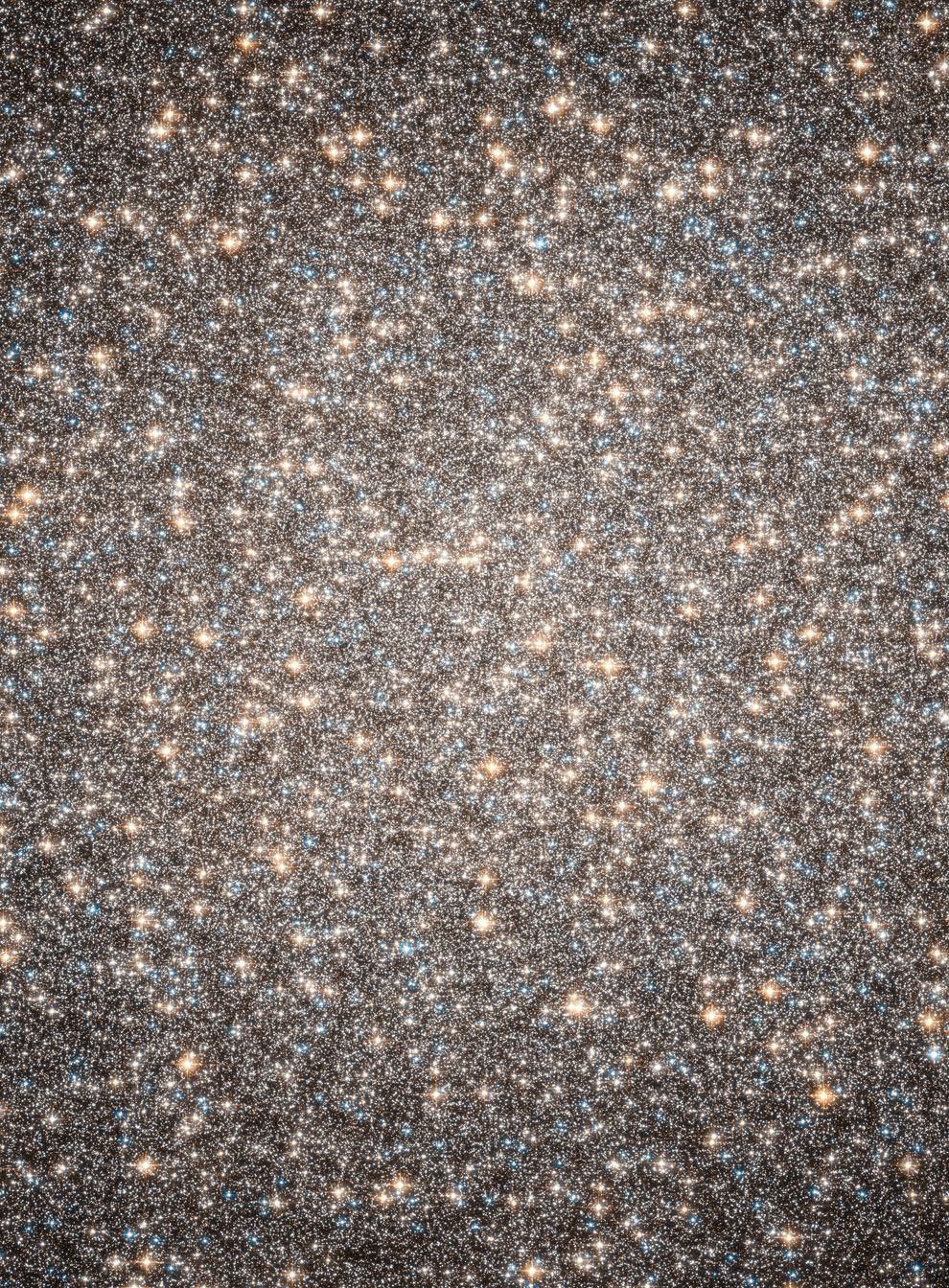
This portrait is the most detailed view of the largest stellar nursery in our local galactic neighborhood. The massive, young stellar grouping, called R136, is only a few million years old and resides in the 30 Doradus Nebula, a turbulent star-birth region in the Large Magellanic Cloud, a satellite galaxy of our Milky Way located some 170,000 light-years away. Many of the diamond-like icy blue stars are among the most massive stars known. Several of them are over 100 times more massive than our Sun. The image, taken by Hubble on October 20-27, 2009, spans about 100 light-years across.
a21_2009-32-a.jpg
469.4 KB ·62 views
▼ PROMO FROM DOCUMENTING REALITY
Not what you expected? Here You know.
Join Now
Hidden for upgraded members.
  #22  
04-29-2010, 08:52 PM
güttsfükk's Avatar
güttsfükk
Offline:
Super *********
Poster Rank:89
Join Date: Nov 2008
Posts: 17,426
 
Mentioned: 5 Post(s)
Quoted: 99 Post(s)
Activity Longevity
0/20 18/20
Today Posts
0/11 ssss17426
Re: Hubble Space Telescope Advent Calendar 2009 (25 Pix)

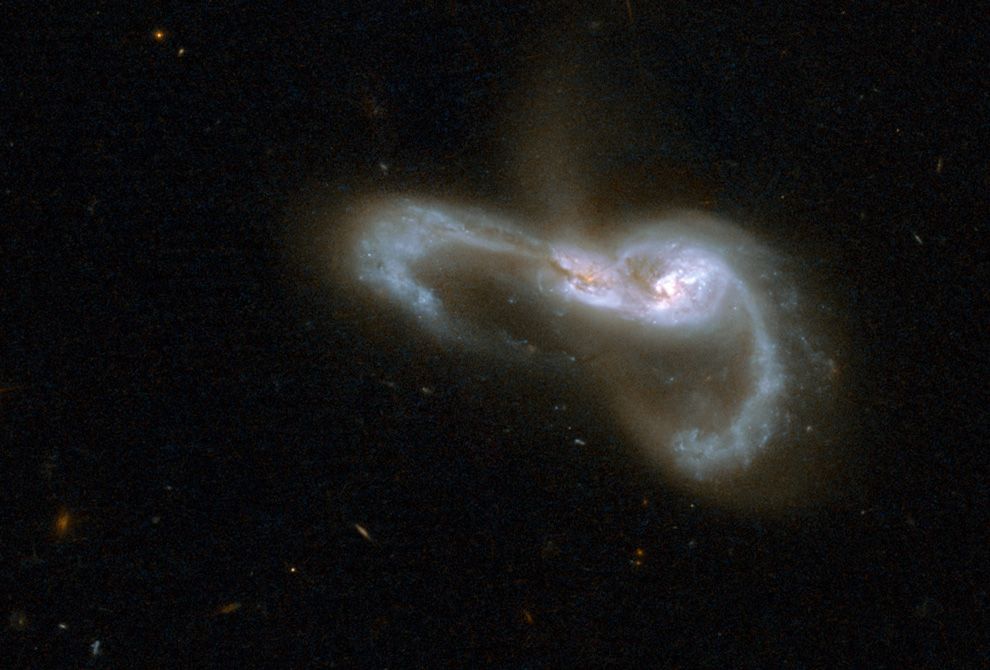
Hubble's Advance Camera for Surveys (ACS) recently took this image of galaxy NGC 4522 in the Virgo Cluster. Backdropped by many other more distant galaxies, the impression given by NGC 4522 is that it is flying apart. A phenomenon called ram pressure stripping is mangling the galaxy as it hurtles through a region of hot x-ray emitting gas at 10 million kilometers per hour- stripping away its own gas content. NGC 4522 is some 60 million light years away.
a22_heic0911b.jpg
426.2 KB ·104 views
  #23  
04-29-2010, 08:52 PM
güttsfükk's Avatar
güttsfükk
Offline:
Super *********
Poster Rank:89
Join Date: Nov 2008
Posts: 17,426
 
Mentioned: 5 Post(s)
Quoted: 99 Post(s)
Activity Longevity
0/20 18/20
Today Posts
0/11 ssss17426
Re: Hubble Space Telescope Advent Calendar 2009 (25 Pix)

The star cluster Pismis 24 lies in the core of the large emission nebula NGC 6357 that extends one degree on the sky in the direction of the Scorpius constellation. Part of the nebula is ionised by the youngest (bluest) heavy stars in Pismis 24. The intense ultraviolet radiation from the blazing stars heats the gas surrounding the cluster and creates a bubble in NGC 6357. The presence of these surrounding gas clouds makes probing into the region even harder. One of the top candidates for the title of "Milky Way stellar heavyweight champion" was, until now, Pismis 24-1, a bright young star that lies in the core of the small open star cluster Pismis 24 (the bright stars in the Hubble image) about 8,000 light-years away from Earth. Pismis 24-1 was thought to have an incredibly large mass of 200 to 300 solar masses. New NASA/ESA Hubble measurements of the star, have, however, resolved Pismis 24-1 into two separate stars, and, in doing so, have "halved" its mass to around 100 solar masses.
a23_heic0619a.jpg
385.2 KB ·69 views
  #24  
04-29-2010, 08:53 PM
güttsfükk's Avatar
güttsfükk
Offline:
Super *********
Poster Rank:89
Join Date: Nov 2008
Posts: 17,426
 
Mentioned: 5 Post(s)
Quoted: 99 Post(s)
Activity Longevity
0/20 18/20
Today Posts
0/11 ssss17426
Re: Hubble Space Telescope Advent Calendar 2009 (25 Pix)

The photographer itself - a crew member aboard the Space Shuttle Atlantis captured this still image of the Hubble Space Telescope above the Earth, as the two spacecraft continued their relative separation on May 19, 2009 after having been linked together for the better part of a week during the STS-125 mission. During the week five spacewalks were performed to complete the final servicing mission for the orbital observatory.
a24_s125e011835.jpg
128.0 KB ·139 views
  #25  
04-29-2010, 08:53 PM
güttsfükk's Avatar
güttsfükk
Offline:
Super *********
Poster Rank:89
Join Date: Nov 2008
Posts: 17,426
 
Mentioned: 5 Post(s)
Quoted: 99 Post(s)
Activity Longevity
0/20 18/20
Today Posts
0/11 ssss17426
Re: Hubble Space Telescope Advent Calendar 2009 (25 Pix)

In 2004, Hubble created the deepest visible-light image of the Universe and now, with its brand-new camera, it is seeing even farther in the same region. This image, taken by the HUDF09 team with the new WFC3/infrared camera on Hubble in late August 2009, during a total of four days of pointing for 173,000 seconds of total exposure time, is the deepest image of the universe ever taken in near-infrared light. Nearly every smudge and bit of light in this image is a separate galaxy made up of billions of stars. The faintest and reddest objects in the image are galaxies that formed 600 million years after the Big Bang. No galaxies have been seen before at such early times. The image was taken in the same region as the Hubble Ultra Deep Field (2004), and is roughly 2.4 arcminutes wide. Again, I invite you to step outside some dark night in the future and gaze up at the sky, knowing that every bit of apparent darkness above is really filled with the faint light of these billions of faraway galaxies. Best wishes to all, and a Happy New Year - Alan.
a25_heic0916a.jpg
606.6 KB ·374 views


Powered by vBulletin Copyright 2000-2010 Jelsoft Enterprises Limited.

Search Engine Friendly URLs by vBSEO