JavaScript and Cookies are required to view this site. Please enable both in your browser settings.
Hubble Space Telescope Advent Calendar 2009 (25 Pix) - Section 2

Hubble Space Telescope Advent Calendar 2009 (25 Pix) 

Current Rating:

Unlimited Views No Ads No Algorithms Lifetime Account

Documenting Reality

Community Forum · Est. 2006

Join Now
Thread Tools
  #11  
04-29-2010, 08:43 PM
güttsfükk's Avatar
güttsfükk
Offline:
Super *********
Poster Rank:89
Join Date: Nov 2008
Posts: 17,426
 
Mentioned: 5 Post(s)
Quoted: 99 Post(s)
Activity Longevity
0/20 18/20
Today Posts
0/11 ssss17426
Re: Hubble Space Telescope Advent Calendar 2009 (25 Pix)

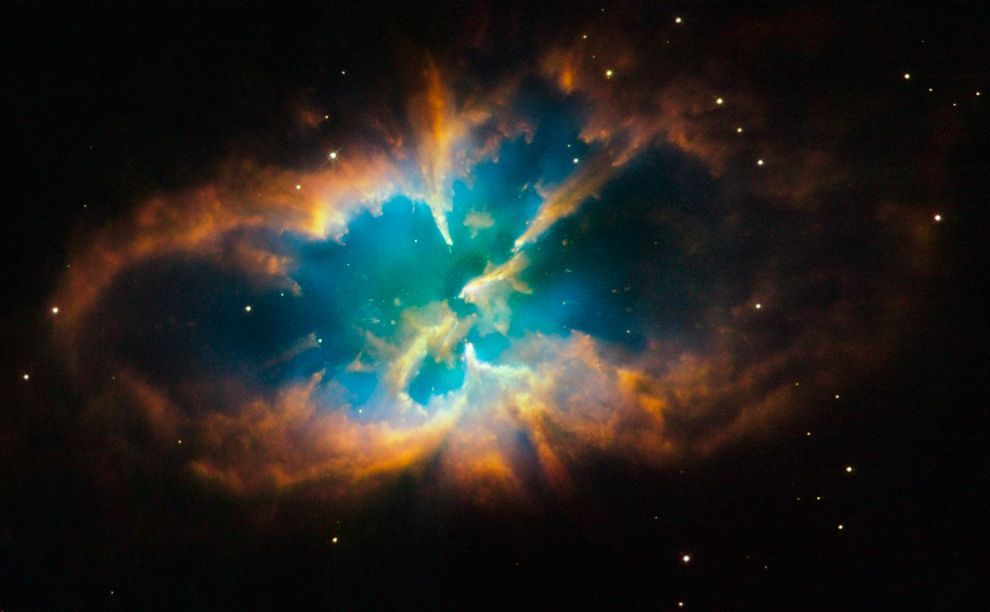
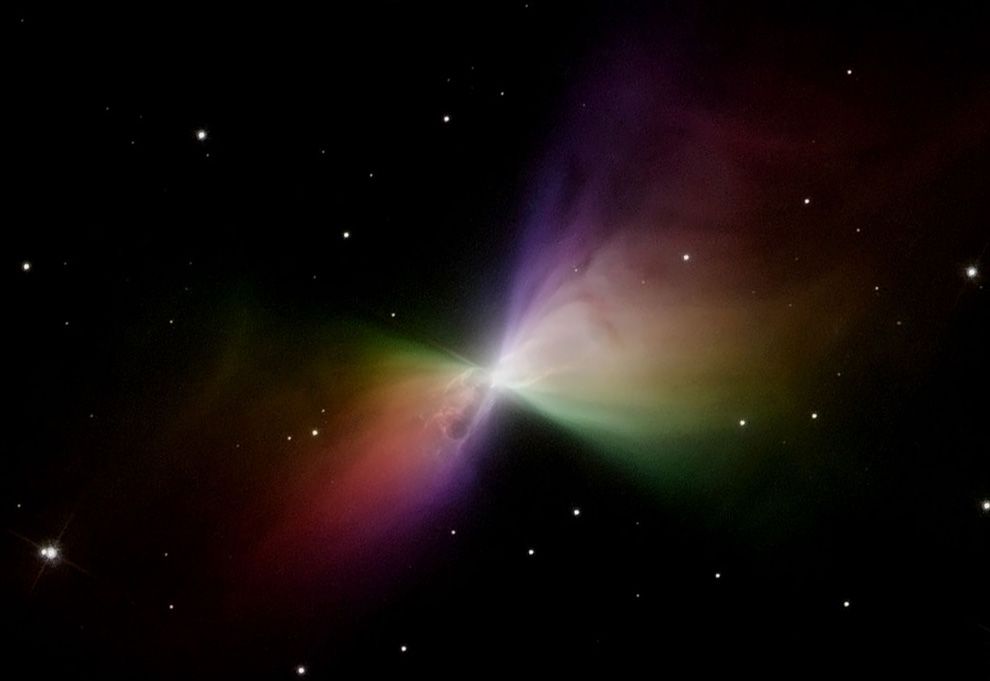
What resemble dainty butterfly wings are actually roiling cauldrons of gas heated to more than 36,000 degrees Fahrenheit. The gas is tearing across space at more than 600,000 miles an hour - fast enough to travel from Earth to the Moon in 24 minutes! A dying star that was once about five times the mass of the Sun is at the center of this fury. It has ejected its envelope of gases and is now unleashing a stream of ultraviolet radiation that is making the cast-off material glow. The Wide Field Camera 3 (WFC3), installed by NASA astronauts in May 2009, snapped this image of the planetary nebula, catalogued as NGC 6302, which lies within our Milky Way galaxy, roughly 3,800 light-years away in the constellation Scorpius. The glowing gas is the star's outer layers, expelled over about 2,200 years. NGC 6302 was imaged on July 27, 2009, with Hubble's Wide Field Camera 3 in ultraviolet and visible light. Filters that isolate emissions from oxygen, helium, hydrogen, nitrogen, and sulfur from the planetary nebula were used to create this composite image.
a11_2009-25-f.jpg
240.9 KB ·86 views
▼ PROMO FROM DOCUMENTING REALITY
Not what you expected? Here You know.
Join Now
Hidden for upgraded members.
  #12  
04-29-2010, 08:44 PM
güttsfükk's Avatar
güttsfükk
Offline:
Super *********
Poster Rank:89
Join Date: Nov 2008
Posts: 17,426
 
Mentioned: 5 Post(s)
Quoted: 99 Post(s)
Activity Longevity
0/20 18/20
Today Posts
0/11 ssss17426
Re: Hubble Space Telescope Advent Calendar 2009 (25 Pix)

An international team of astronomers using the NASA/ESA Hubble Space Telescope has discovered a ghostly ring of dark matter that was formed long ago during a titanic collision between two massive galaxy clusters. It is the first time that a dark matter distribution has been found that differs substantially from the distribution of ordinary matter. This image shows the galaxy cluster Cl 0024+17 (ZwCl 0024+1652) as seen by Hubble's Advanced Camera for Surveys. The image displays faint faraway background galaxies that had their light bent by the cluster's strong gravitational field. By mapping the distorted light and using it to deduce how dark matter is distributed in the cluster, astronomers spotted the ring of dark matter. One of the background galaxies is located about two times further away than the yellow cluster galaxies in the foreground, and has been multiple-imaged into five separate arc-shaped components, seen in blue.
a12_heic0709b.jpg
521.0 KB ·145 views
  #13  
04-29-2010, 08:45 PM
güttsfükk's Avatar
güttsfükk
Offline:
Super *********
Poster Rank:89
Join Date: Nov 2008
Posts: 17,426
 
Mentioned: 5 Post(s)
Quoted: 99 Post(s)
Activity Longevity
0/20 18/20
Today Posts
0/11 ssss17426
Re: Hubble Space Telescope Advent Calendar 2009 (25 Pix)

he planetary nebula, IC 4593, lies in the northern constellation Hercules, about 7,000 light-years away from Earth. Its colorful, intricate shape reveals how the glowing gas ejected by a dying Sun-like star evolved dramatically over time. Over thousands of years, the clouds of gas expand away and the nebula becomes larger. Energetic ultraviolet light from the star penetrates more deeply into the gas, causing the hydrogen and oxygen to glow more prominently. This snapshot was taken with Hubble's Wide Field Planetary Camera 2 in February 2007.
a13_2007-33-d.jpg
257.7 KB ·89 views
  #14  
04-29-2010, 08:45 PM
güttsfükk's Avatar
güttsfükk
Offline:
Super *********
Poster Rank:89
Join Date: Nov 2008
Posts: 17,426
 
Mentioned: 5 Post(s)
Quoted: 99 Post(s)
Activity Longevity
0/20 18/20
Today Posts
0/11 ssss17426
Re: Hubble Space Telescope Advent Calendar 2009 (25 Pix)

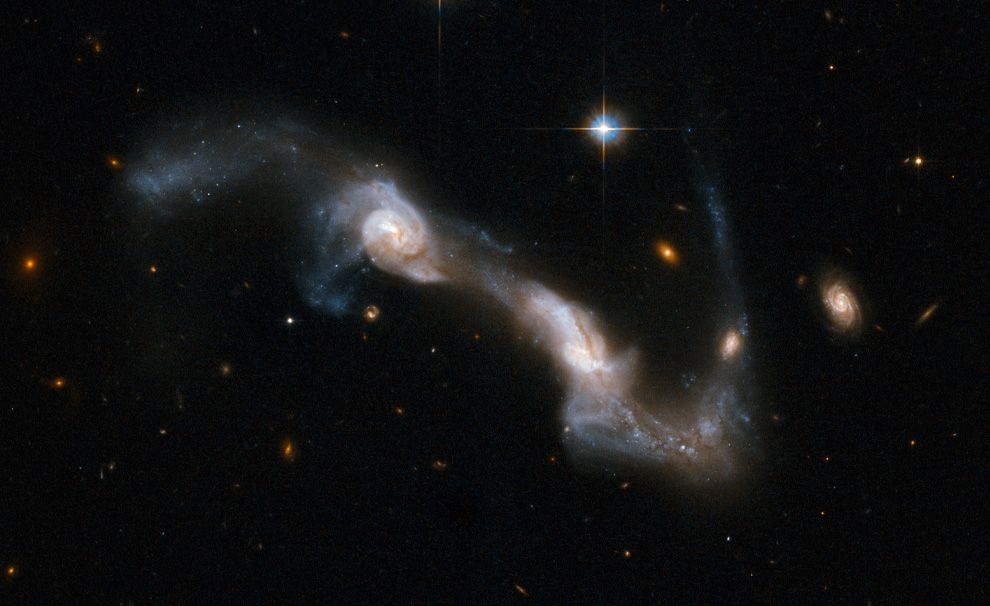
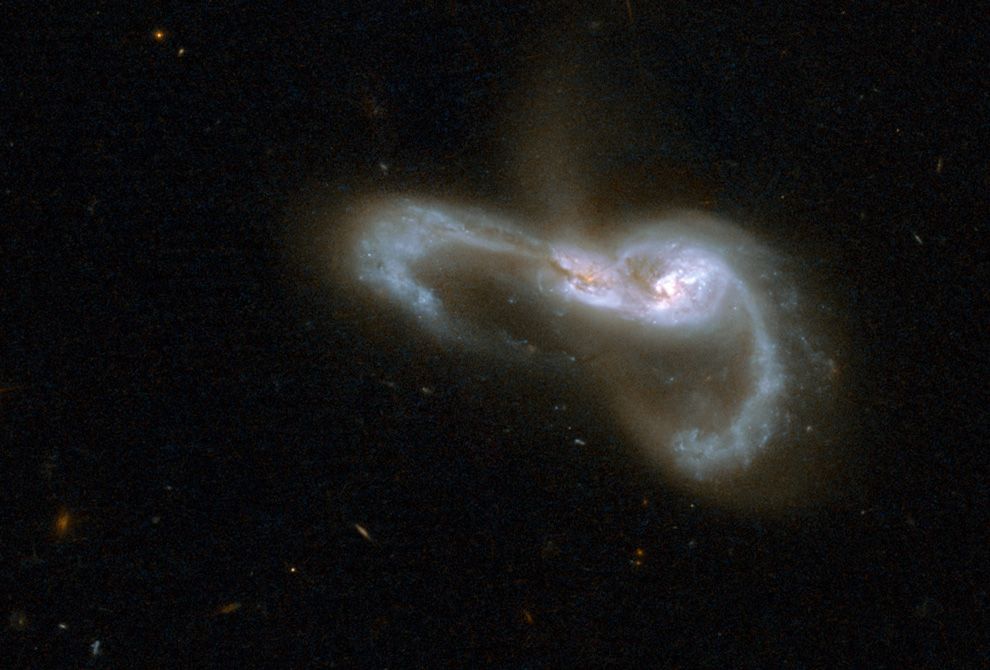
A peculiar system of interacting galaxies known as Arp 194 contains several galaxies, along with a "cosmic fountain" of stars, gas, and dust that stretches over 100,000 light-years. The northern (left) component of Arp 194 appears as a haphazard collection of dusty spiral arms, bright blue star-forming regions, and at least two galaxy nuclei that appear to be connected and in the early stages of merging. A third, relatively normal, spiral galaxy appears off to the right. The southern (lower) component of the galaxy group contains a single large spiral galaxy with its own blue star-forming regions. However, the most striking feature of this galaxy troupe is the impressive blue stream of material extending from the northern component. This "fountain" contains complexes of super star clusters, each one of which may contain dozens of individual young star clusters. The blue color is produced by the hot, massive stars which dominate the light in each cluster. Overall, the "fountain" contains many millions of stars. These young star clusters probably formed as a result of the interactions between the galaxies in the northern component of Arp 194. The compression of gas involved in galaxy interactions can enhance the star-formation rate and give rise to brilliant bursts of star formation in merging systems. Arp 194, located in the constellation Cepheus, resides approximately 600 million light-years away from Earth.
a14_2009-18-a.jpg
342.7 KB ·147 views
  #15  
04-29-2010, 08:46 PM
güttsfükk's Avatar
güttsfükk
Offline:
Super *********
Poster Rank:89
Join Date: Nov 2008
Posts: 17,426
 
Mentioned: 5 Post(s)
Quoted: 99 Post(s)
Activity Longevity
0/20 18/20
Today Posts
0/11 ssss17426
Re: Hubble Space Telescope Advent Calendar 2009 (25 Pix)

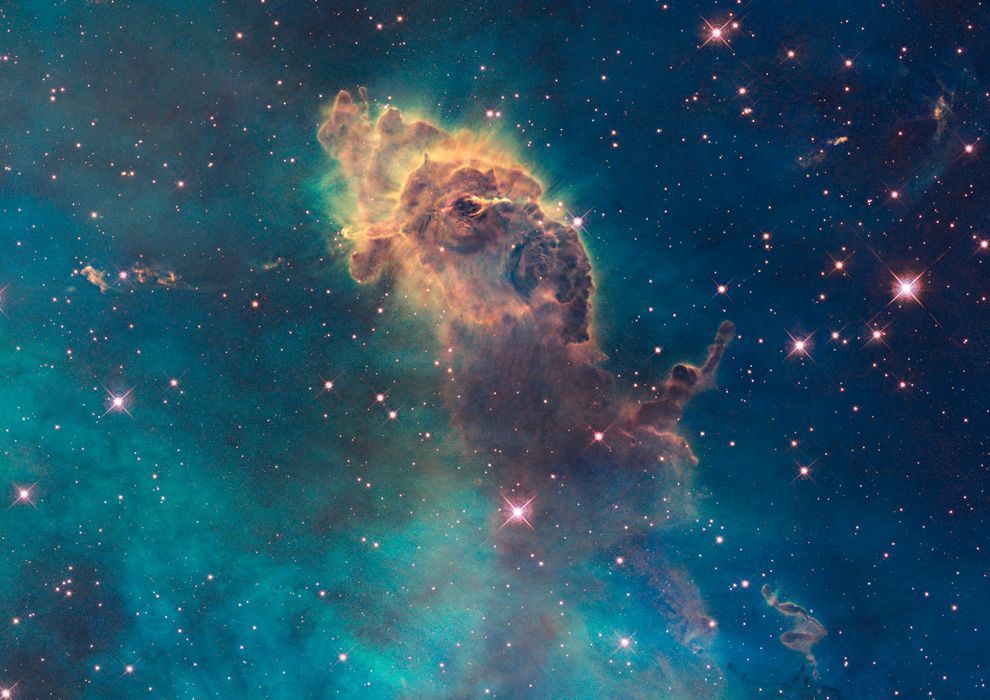
This image shows the edge of a giant gaseous cavity within the star-forming region called NGC 3324. The glowing nebula has been carved out by intense ultraviolet radiation and stellar winds from several hot, young stars. A cluster of extremely massive stars, located well outside this image in the center of the nebula, is responsible for the ionization of the nebula and excavation of the cavity. The image also reveals dramatic dark towers of cool gas and dust that rise above the glowing wall of gas. The dense gas at the top resists the blistering ultraviolet radiation from the central stars, and creates a tower that points in the direction of the energy flow. The high-energy radiation blazing out from the hot, young stars in NGC 3324 is sculpting the wall of the nebula by slowly eroding it away. Located in the Southern Hemisphere, NGC 3324 is at the northwest corner of the Carina Nebula (NGC 3372), home of the Keyhole Nebula and the active, outbursting star Eta Carinae. The entire Carina Nebula complex is located at a distance of roughly 7,200 light-years, and lies in the constellation Carina.
a15_280418.jpg
276.9 KB ·114 views
  #16  
04-29-2010, 08:47 PM
güttsfükk's Avatar
güttsfükk
Offline:
Super *********
Poster Rank:89
Join Date: Nov 2008
Posts: 17,426
 
Mentioned: 5 Post(s)
Quoted: 99 Post(s)
Activity Longevity
0/20 18/20
Today Posts
0/11 ssss17426
Re: Hubble Space Telescope Advent Calendar 2009 (25 Pix)

This portrait of Stephan's Quintet, also known as Hickson Compact Group 92, was taken by the new Wide Field Camera 3 (WFC3) aboard NASA's Hubble Space Telescope. Stephan's Quintet, as the name implies, is a group of five galaxies. The name, however, is a bit of a misnomer. Studies have shown that group member NGC 7320, at lower right, is actually a foreground galaxy about seven times closer to Earth than the rest of the group. NGC 7320 is 40 million light-years from Earth. The other members of the quintet reside 290 million light-years away in the constellation Pegasus. WFC3 observed the quintet in July and August 2009.
a16_2009-25-x.jpg
353.0 KB ·61 views
  #17  
04-29-2010, 08:49 PM
güttsfükk's Avatar
güttsfükk
Offline:
Super *********
Poster Rank:89
Join Date: Nov 2008
Posts: 17,426
 
Mentioned: 5 Post(s)
Quoted: 99 Post(s)
Activity Longevity
0/20 18/20
Today Posts
0/11 ssss17426
Re: Hubble Space Telescope Advent Calendar 2009 (25 Pix)

This very deep image taken with the NASA/ESA Hubble Space Telescope shows the spiral galaxy NGC 4921 along with a spectacular backdrop of more distant galaxies. It was created from a total of 80 separate pictures through yellow and near-infrared filters.
a17_heic0901.jpg
336.3 KB ·50 views
  #18  
04-29-2010, 08:50 PM
güttsfükk's Avatar
güttsfükk
Offline:
Super *********
Poster Rank:89
Join Date: Nov 2008
Posts: 17,426
 
Mentioned: 5 Post(s)
Quoted: 99 Post(s)
Activity Longevity
0/20 18/20
Today Posts
0/11 ssss17426
Re: Hubble Space Telescope Advent Calendar 2009 (25 Pix)

Huge waves are sculpted in NGC 6537, the Red Spider Nebula, a two-lobed nebula some 3000 light-years away in the constellation of Sagittarius. This warm planetary nebula harbours one of the hottest stars known and its powerful stellar winds generate waves 100 billion kilometres high. The waves are caused by supersonic shocks, formed when the local gas is compressed and heated in front of the rapidly expanding lobes. The atoms caught in the shock emit the spectacular radiation seen in this image.
a18_heic0109.jpg
329.8 KB ·55 views
  #19  
04-29-2010, 08:50 PM
güttsfükk's Avatar
güttsfükk
Offline:
Super *********
Poster Rank:89
Join Date: Nov 2008
Posts: 17,426
 
Mentioned: 5 Post(s)
Quoted: 99 Post(s)
Activity Longevity
0/20 18/20
Today Posts
0/11 ssss17426
Re: Hubble Space Telescope Advent Calendar 2009 (25 Pix)

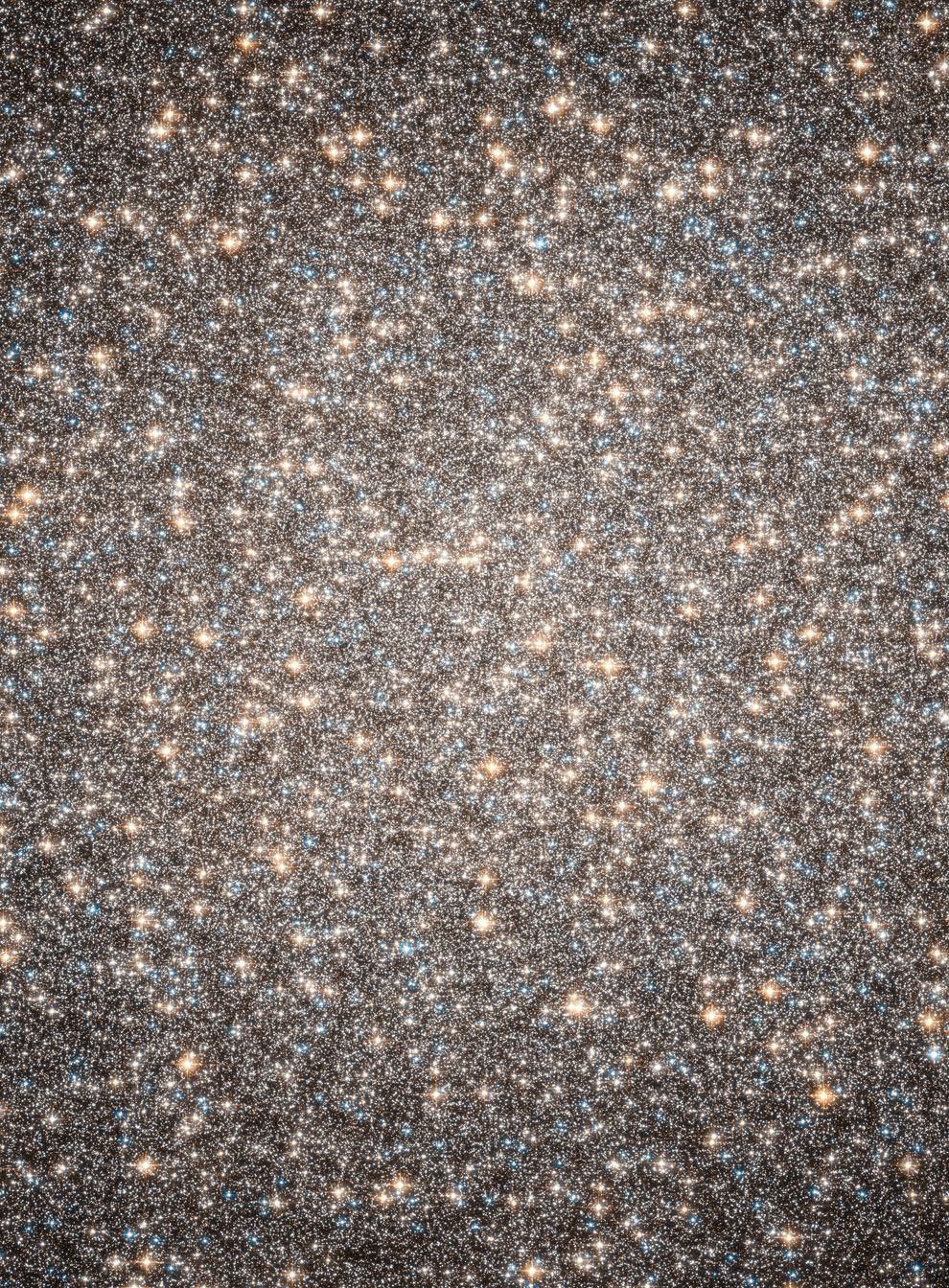
A small region inside the massive globular cluster Omega Centauri which boasts nearly 10 million stars. The stars in Omega Centauri are about about 16,000 light-years from Earth, and are between 10 billion and 12 billion years old. The majority of the stars in the image are yellow-white, like our Sun. These are adult stars that are shining by hydrogen fusion. Toward the end of their normal lives, the stars become cooler and larger. These late-life stars are the orange dots in the image. Even later in their life cycles, the stars continue to cool down and expand in size, becoming red giants. These bright red stars swell to many times larger than our Sun's size and begin to shed their gaseous envelopes. After ejecting most of their mass and exhausting much of their hydrogen fuel, the stars appear brilliant blue. Only a thin layer of material covers their super-hot cores. These stars are desperately trying to extend their lives by fusing helium in their cores. At this stage, they emit much of their light at ultraviolet wavelengths. When the helium runs out, the stars reach the end of their lives. Only their burned-out cores remain, and they are called white dwarfs (the faint blue dots in the image). White dwarfs are no longer generating energy through nuclear fusion and have gravitationally contracted to the size of Earth. They will continue to cool and grow dimmer for many billions of years until they become dark cinders. All of the stars in the image are cozy neighbors. The average distance between any two stars in the cluster's crowded core is only about a third of a light-year, roughly 13 times closer than our Sun's nearest stellar neighbor, Alpha Centauri. Although the stars are close together, WFC3's sharpness can resolve each of them as individual stars. If anyone lived in this globular cluster, they would behold a star-saturated sky that is roughly 100 times brighter than Earth's sky. Hubble observed Omega Centauri on July 15, 2009, in ultraviolet and visible light.
a19_2009-25q.jpg
821.4 KB ·75 views
  #20  
04-29-2010, 08:51 PM
güttsfükk's Avatar
güttsfükk
Offline:
Super *********
Poster Rank:89
Join Date: Nov 2008
Posts: 17,426
 
Mentioned: 5 Post(s)
Quoted: 99 Post(s)
Activity Longevity
0/20 18/20
Today Posts
0/11 ssss17426
Re: Hubble Space Telescope Advent Calendar 2009 (25 Pix)

This image from NASA's Hubble Space Telescope shows the diverse collection of galaxies in the cluster Abell S0740 that is over 450 million light-years away in the direction of the constellation Centaurus. The giant elliptical ESO 325-G004 looms large at the cluster's center. The galaxy is as massive as 100 billion of our suns. Hubble resolves thousands of globular star clusters orbiting ESO 325-G004. At the galaxy's distance they appear as pinpoints of light contained within the diffuse halo. Other fuzzy elliptical galaxies dot the image. Some have evidence of a disk or ring structure that gives them a bow-tie shape. Several spiral galaxies are also present. The starlight in these galaxies is mainly contained in a disk and follows along spiral arms. This image was created by combining Hubble science observations taken in January 2005 with Hubble Heritage observations taken a year later to form a 3-color composite. The filters that isolate blue, red and infrared light were used with the Advanced Camera for Surveys aboard Hubble.
a20_2007-08-a.jpg
250.3 KB ·73 views


Powered by vBulletin Copyright 2000-2010 Jelsoft Enterprises Limited.

Search Engine Friendly URLs by vBSEO