JavaScript and Cookies are required to view this site. Please enable both in your browser settings.
Hubble Space Telescope Advent Calendar 2009 (25 Pix)

Hubble Space Telescope Advent Calendar 2009 (25 Pix) 

Current Rating:

Unlimited Views No Ads No Algorithms Lifetime Account

Documenting Reality

Community Forum · Est. 2006

Join Now
Thread Tools
  #1  
04-29-2010, 08:38 PM
güttsfükk's Avatar
güttsfükk
Offline:
Super *********
Poster Rank:89
Join Date: Nov 2008
Posts: 17,426
 
Mentioned: 5 Post(s)
Quoted: 99 Post(s)
Activity Longevity
0/20 18/20
Today Posts
0/11 ssss17426
Hubble Space Telescope Advent Calendar 2009 (25 Pix)

http://www.documentingreality.com/fo...-25-pix-45084/

Once more, we enter the month of December and the traditional western Holiday Season, and once again, I'd like to present a Hubble Space Telescope imagery Advent Calendar for 2009. Keep checking this page, because every day, for the next 25 days, a new photo will be revealed here from the Hubble Space Telescope, some old and some new. I have felt extremely fortunate to have been able to share photographs and stories with you all this year, and I wish for a Happy Holiday to all those who will celebrate, and for Peace on Earth to everyone.
Source : http://www.boston.com/bigpicture/200..._advent_1.html

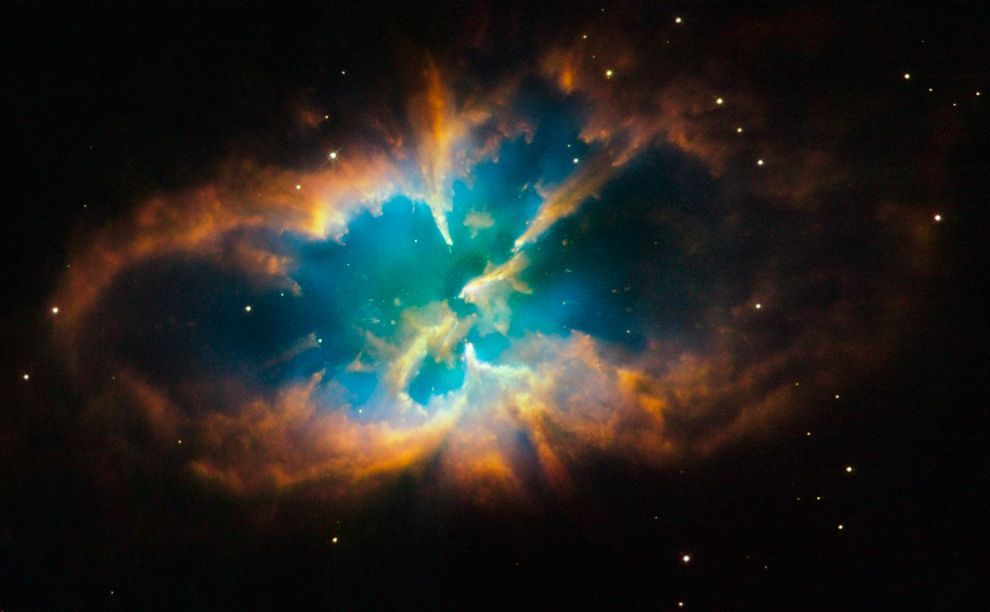
The spectacular structure of Planetary nebula NGC 2818 contains the outer layers of a star that were expelled into interstellar space. The glowing gaseous shrouds in the nebula were shed by the central star after it ran out of fuel to sustain the nuclear reactions in its core. This Hubble image was taken in November 2008 with the Wide Field Planetary Camera 2. The colors in the image represent a range of emissions coming from the clouds of the nebula: red represents nitrogen, green represents hydrogen, and blue represents oxygen.
a01_00000001.jpg
158.3 KB ·204 views
▼ PROMO FROM DOCUMENTING REALITY
Want to escape?
Join Now
Hidden for upgraded members.
  #2  
04-29-2010, 08:38 PM
güttsfükk's Avatar
güttsfükk
Offline:
Super *********
Poster Rank:89
Join Date: Nov 2008
Posts: 17,426
 
Mentioned: 5 Post(s)
Quoted: 99 Post(s)
Activity Longevity
0/20 18/20
Today Posts
0/11 ssss17426
Re: Hubble Space Telescope Advent Calendar 2009 (25 Pix)

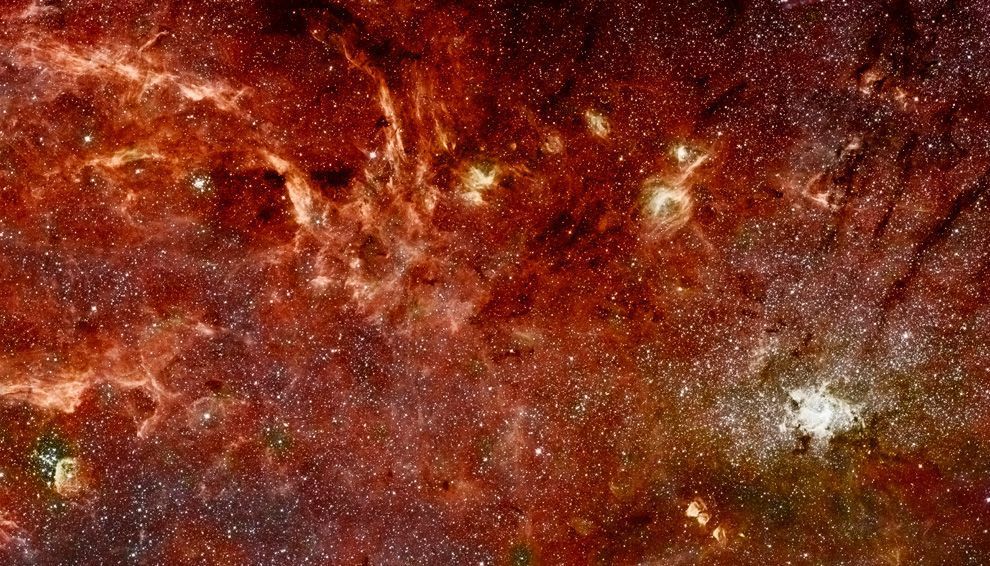
This composite color infrared image of the center of our Milky Way galaxy reveals a new population of massive stars and new details in complex structures in the hot ionized gas swirling around the central 300 light-years. This view combines the sharp imaging of the Hubble Space Telescope's Near Infrared Camera and Multi-Object Spectrometer (NICMOS) with color imagery from a previous Spitzer Space Telescope survey to make the sharpest infrared picture ever made of the Galactic core. The core is obscured in visible light by intervening dust clouds, but infrared light penetrates the dust. At this distance - 26,000 light-years away - Hubble reveals details in objects as small as 20 times the size of our own solar system.
a02_2009-02-a.jpg
387.3 KB ·173 views
  #3  
04-29-2010, 08:39 PM
güttsfükk's Avatar
güttsfükk
Offline:
Super *********
Poster Rank:89
Join Date: Nov 2008
Posts: 17,426
 
Mentioned: 5 Post(s)
Quoted: 99 Post(s)
Activity Longevity
0/20 18/20
Today Posts
0/11 ssss17426
Re: Hubble Space Telescope Advent Calendar 2009 (25 Pix)

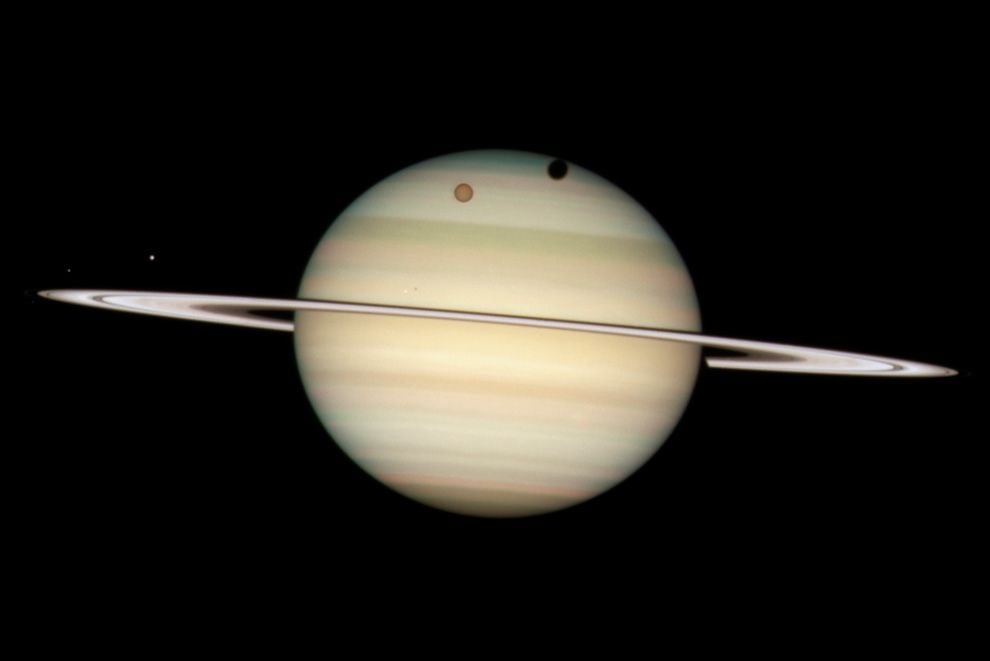
On February 24, 2009, the Hubble Space Telescope took a photo of four moons of Saturn passing in front of their parent planet. In this view, the giant orange moon Titan casts a large shadow onto Saturn's north polar hood. Below Titan, near the ring plane and to the left is the moon Mimas, casting a much smaller shadow onto Saturn's equatorial cloud tops. Farther to the left, and off Saturn's disk, are the bright moon Dione and the fainter moon Enceladus. These pictures were taken with Hubble's Wide Field Planetary Camera 2 when Saturn was at a distance of roughly 1.25 billion km (775 million mi) from Earth.
a03_2009-12-a.jpg
39.1 KB ·174 views
  #4  
04-29-2010, 08:40 PM
güttsfükk's Avatar
güttsfükk
Offline:
Super *********
Poster Rank:89
Join Date: Nov 2008
Posts: 17,426
 
Mentioned: 5 Post(s)
Quoted: 99 Post(s)
Activity Longevity
0/20 18/20
Today Posts
0/11 ssss17426
Re: Hubble Space Telescope Advent Calendar 2009 (25 Pix)

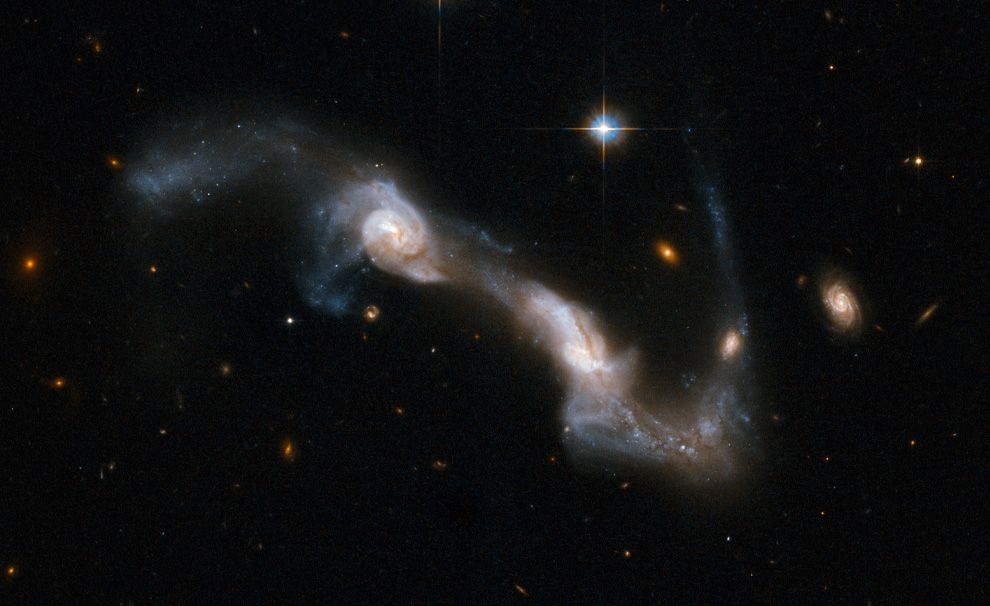
UGC 8335 is a strongly interacting pair of spiral galaxies. The interaction has united the galaxies via a bridge of material and has yanked two strongly curved tails of gas and stars from the outer parts of their bodies . Both galaxies show dust lanes in their centers. UGC 8335 is located in the constellation of Ursa Major, the Great Bear, about 400 million light-years from Earth. It is the 238th galaxy in Arp's Atlas of Peculiar Galaxies.
a04_2008-16-a.jpg
199.8 KB ·200 views
  #5  
04-29-2010, 08:40 PM
güttsfükk's Avatar
güttsfükk
Offline:
Super *********
Poster Rank:89
Join Date: Nov 2008
Posts: 17,426
 
Mentioned: 5 Post(s)
Quoted: 99 Post(s)
Activity Longevity
0/20 18/20
Today Posts
0/11 ssss17426
Re: Hubble Space Telescope Advent Calendar 2009 (25 Pix)

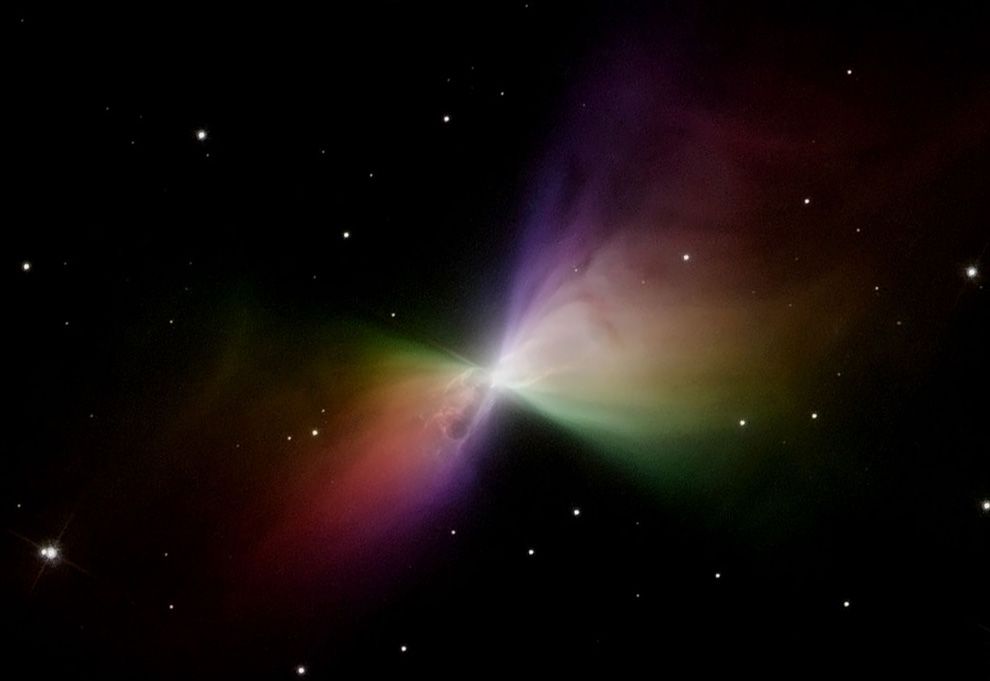
The NASA/ESA Hubble Space Telescope caught scattered light from the Boomerang Nebula in images taken with the Advanced Camera for Surveys in early 2005. This reflecting cloud of dust and gas has two nearly symmetric lobes of matter that are being ejected from a central star. Each lobe of the nebula is nearly one light-year in length, making the total length of the nebula half as long as the distance from our Sun to our nearest neighbors - the alpha Centauri stellar system, located roughly 4 light-years away. The Boomerang Nebula resides 5,000 light-years from Earth. Hubble's sharp view is able to resolve patterns and ripples in the nebula very close to the central star that are not visible from the ground.
a05_opo0525a.jpg
76.3 KB ·273 views
  #6  
04-29-2010, 08:41 PM
güttsfükk's Avatar
güttsfükk
Offline:
Super *********
Poster Rank:89
Join Date: Nov 2008
Posts: 17,426
 
Mentioned: 5 Post(s)
Quoted: 99 Post(s)
Activity Longevity
0/20 18/20
Today Posts
0/11 ssss17426
Re: Hubble Space Telescope Advent Calendar 2009 (25 Pix)

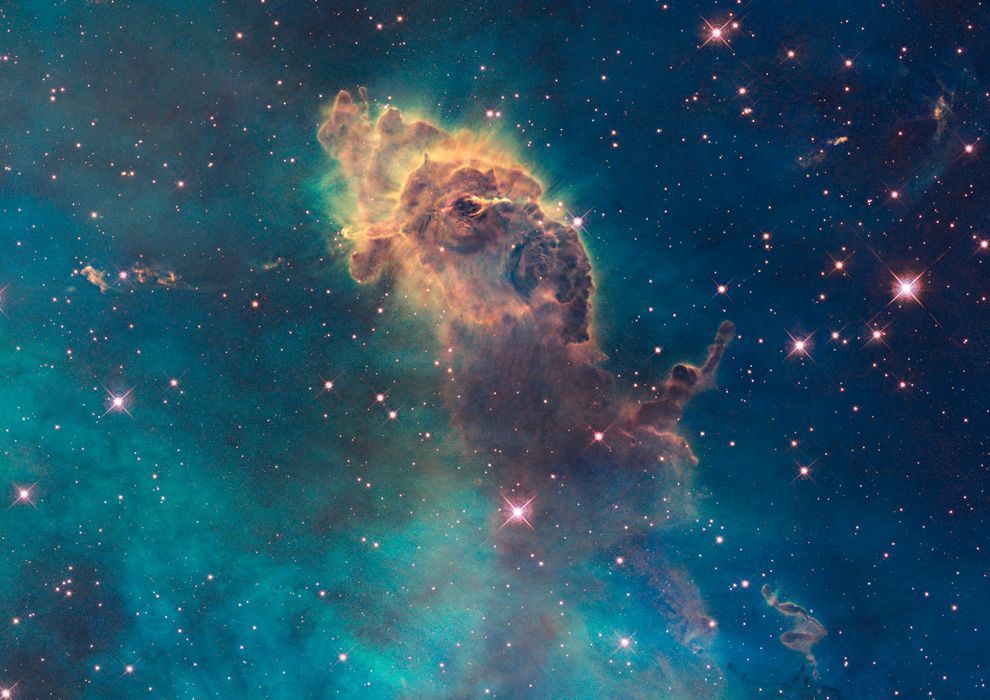
Stars burst to life in the chaotic Carina Nebula in this image of a huge pillar taken in visible and in infrared light by NASA's Hubble Space Telescope. Composed of gas and dust, the nebula resides 7,500 light-years away in the southern constellation Carina. This image, taken in visible light, shows the tip of the 3-light-year-long pillar, bathed in the glow of light from hot, massive stars off the top of the image. Scorching radiation and fast winds (streams of charged particles) from these stars are sculpting the pillar and causing new stars to form within it. Streamers of gas and dust can be seen flowing off the top of the structure. Nestled inside this dense structure are fledgling stars. They cannot be seen in this image because they are hidden by a wall of gas and dust. Although the stars themselves are invisible, one of them is providing evidence of its existence. Thin puffs of material can be seen traveling to the left and to the right of a dark notch in the center of the pillar. The matter is part of a jet produced by a young star. Farther away, on the left, the jet is visible as a grouping of small, wispy clouds. A few small clouds are visible at a similar distance on the right side of the jet. Astronomers estimate that the jet is moving at speeds of up to 850,000 miles an hour. The jet's total length is about 10 light-years.
a06_2009-25-l.jpg
363.9 KB ·240 views
  #7  
04-29-2010, 08:42 PM
güttsfükk's Avatar
güttsfükk
Offline:
Super *********
Poster Rank:89
Join Date: Nov 2008
Posts: 17,426
 
Mentioned: 5 Post(s)
Quoted: 99 Post(s)
Activity Longevity
0/20 18/20
Today Posts
0/11 ssss17426
Re: Hubble Space Telescope Advent Calendar 2009 (25 Pix)

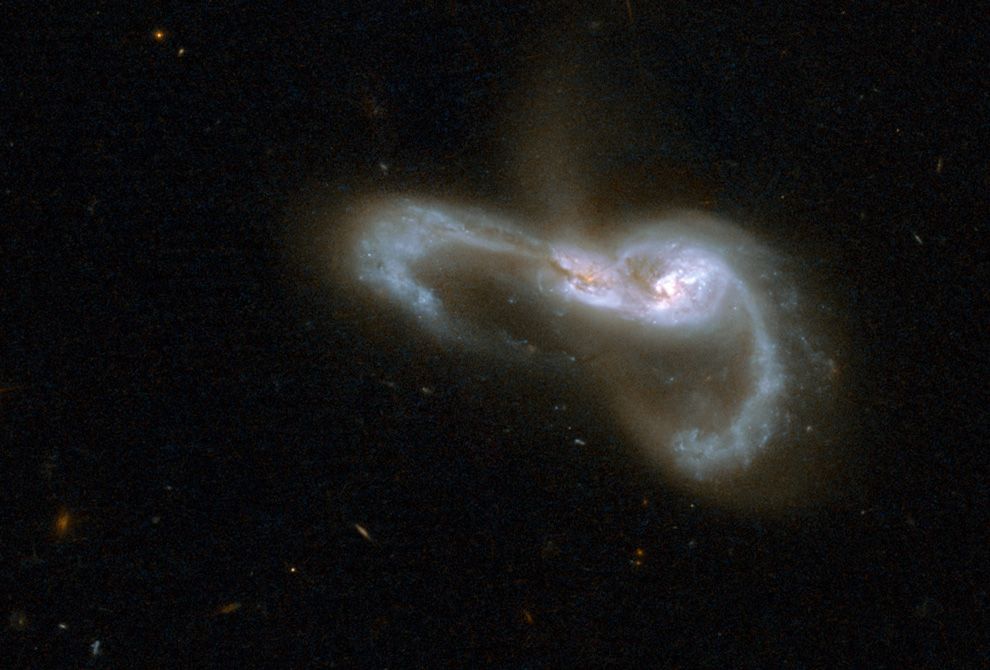
VV 705, or Markarian 848, consists of two galaxies that seem to be embracing each other. Two long, highly curved arms of gas and stars emerge from a central region with two cores. One arm, curving clockwise, stretches to the top of the image where it makes a U-turn and interlocks with the other arm that curves up counter-clockwise from below. The two cores are 16,000 light-years apart. The pair is thought to be midway through a merger. Markarian 848 is located in the constellation of Bootes, the Bear Watcher, and is approximately 550 million light-years away from Earth.
a07_2008-16-c.jpg
248.6 KB ·172 views
  #8  
04-29-2010, 08:42 PM
güttsfükk's Avatar
güttsfükk
Offline:
Super *********
Poster Rank:89
Join Date: Nov 2008
Posts: 17,426
 
Mentioned: 5 Post(s)
Quoted: 99 Post(s)
Activity Longevity
0/20 18/20
Today Posts
0/11 ssss17426
Re: Hubble Space Telescope Advent Calendar 2009 (25 Pix)

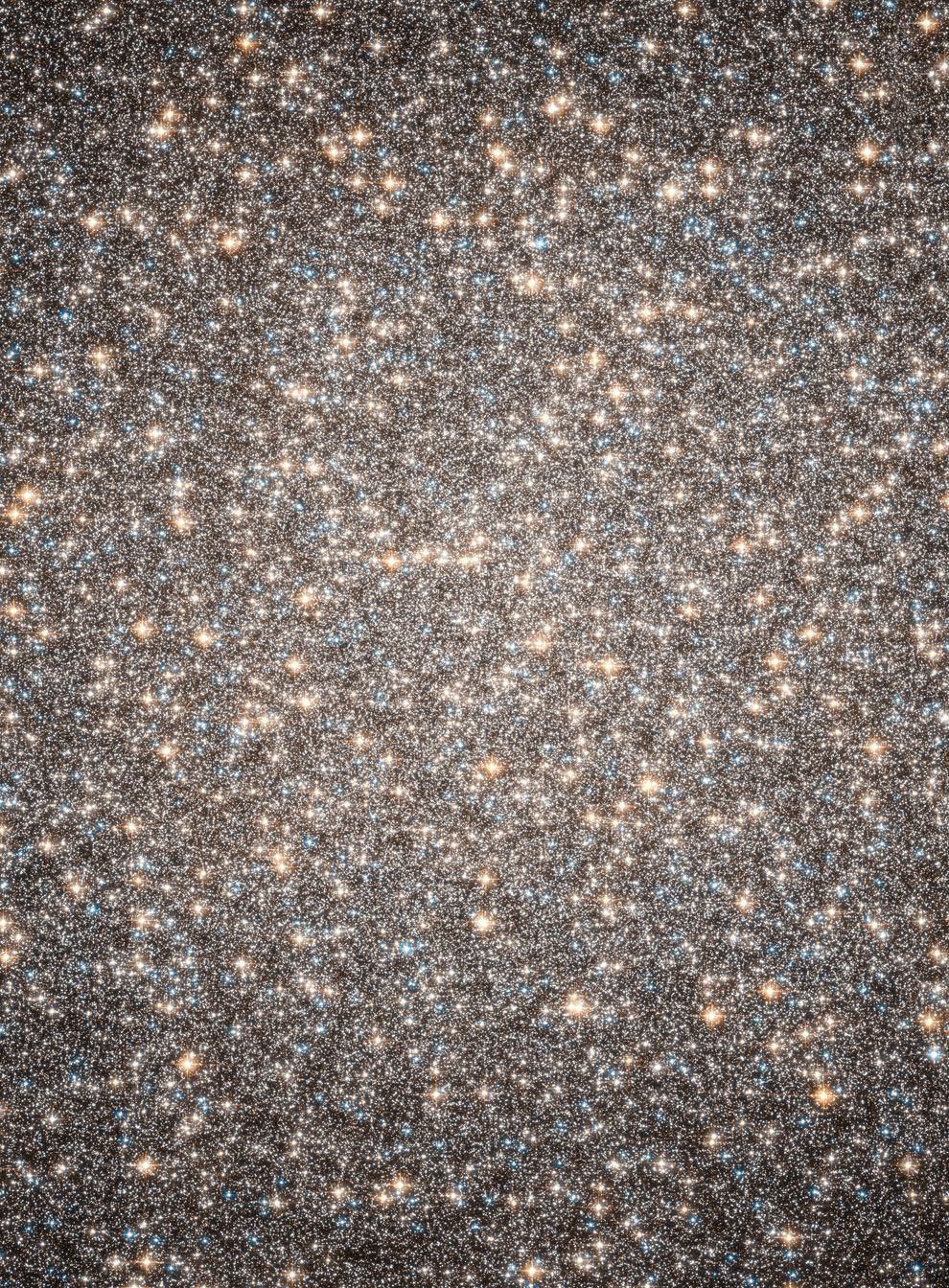
The core of the spectacular globular cluster Omega Centauri glitters with the combined light of 2 million stars. The entire cluster contains 10 million stars, and is among the biggest and most massive of some 200 globular clusters orbiting the Milky Way Galaxy. Omega Centauri lies 17,000 light-years from Earth. Image acquired in June of 2002.
a08_2008-14-a.jpg
1.13 MB ·146 views
  #9  
04-29-2010, 08:43 PM
güttsfükk's Avatar
güttsfükk
Offline:
Super *********
Poster Rank:89
Join Date: Nov 2008
Posts: 17,426
 
Mentioned: 5 Post(s)
Quoted: 99 Post(s)
Activity Longevity
0/20 18/20
Today Posts
0/11 ssss17426
Re: Hubble Space Telescope Advent Calendar 2009 (25 Pix)

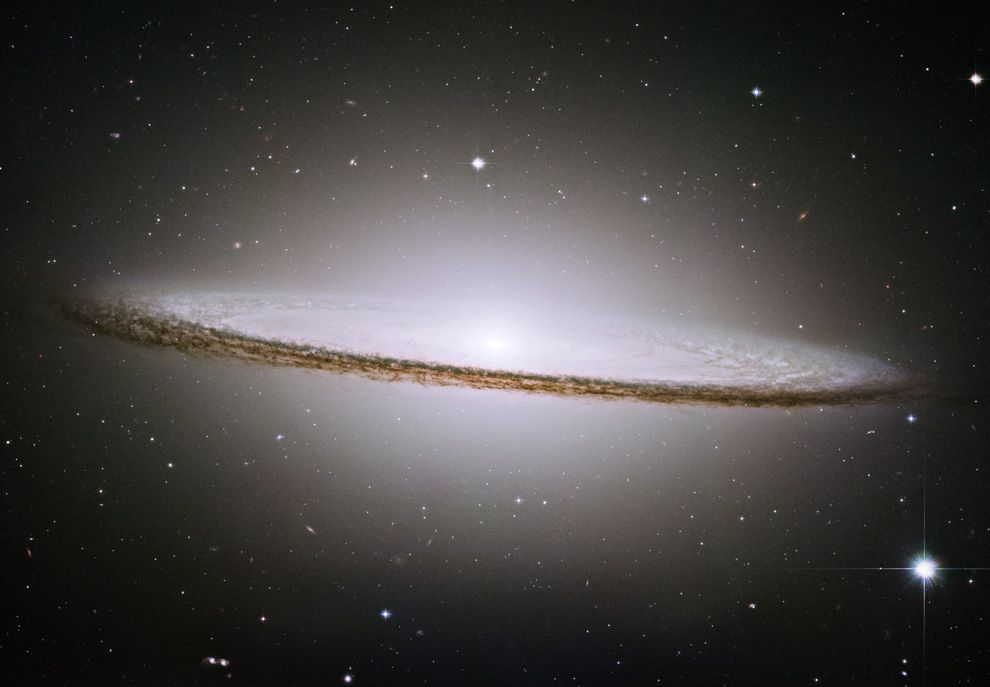
Messier 104 (M104), the Sombrero galaxy. has a brilliant white, bulbous core encircled by the thick dust lanes comprising the spiral structure of the galaxy. As seen from Earth, the galaxy is tilted nearly edge-on. We view it from just six degrees north of its equatorial plane. At a relatively bright magnitude of +8, M104 is just beyond the limit of naked-eye visibility and is easily seen through small telescopes. The Sombrero lies at the southern edge of the rich Virgo cluster of galaxies and is one of the most massive objects in that group, equivalent to 800 billion suns. The galaxy is 50,000 light-years across and is located 28 million light-years from Earth. X-ray emission suggests that there is material falling into the compact core, where a 1-billion-solar-mass black hole resides. In the 19th century, some astronomers speculated that M104 was simply an edge-on disk of luminous gas surrounding a young star, which is prototypical of the genesis of our solar system. But in 1912, astronomer V. M. Slipher discovered that the hat-like object appeared to be rushing away from us at 700 miles per second. This enormous velocity offered some of the earliest clues that the Sombrero was really another galaxy, and that the universe was expanding in all directions.
a09_2003-28-a.jpg
156.8 KB ·155 views
  #10  
04-29-2010, 08:43 PM
güttsfükk's Avatar
güttsfükk
Offline:
Super *********
Poster Rank:89
Join Date: Nov 2008
Posts: 17,426
 
Mentioned: 5 Post(s)
Quoted: 99 Post(s)
Activity Longevity
0/20 18/20
Today Posts
0/11 ssss17426
Re: Hubble Space Telescope Advent Calendar 2009 (25 Pix)

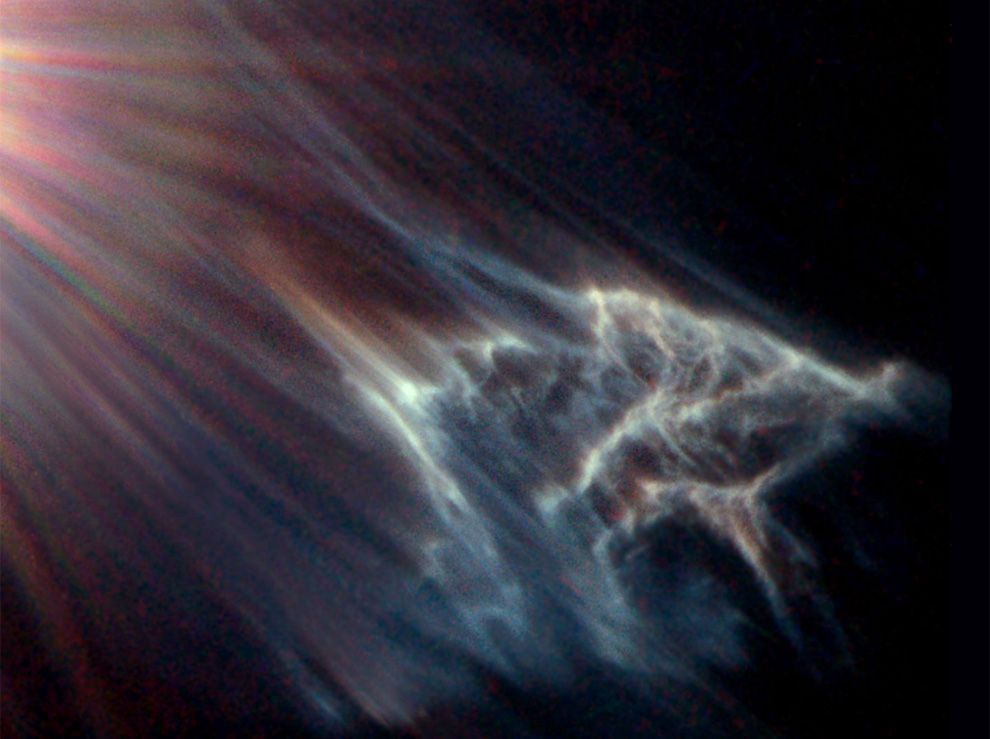
The Hubble Space Telescope caught the eerie, wispy tendrils of a dark interstellar cloud being destroyed by the passage of one of the brightest stars in the Pleiades star cluster. Like a flashlight beam shining off the wall of a cave, the star is reflecting light off the surface of pitch black clouds of cold gas laced with dust. These are called reflection nebulae.
a10_opo0036a.jpg
192.6 KB ·276 views


Powered by vBulletin Copyright 2000-2010 Jelsoft Enterprises Limited.

Search Engine Friendly URLs by vBSEO