|
#1152
●
07-28-2023, 09:25 PM
| ||||||||
 ☾ Administrator ☽ Poster Rank:76 ஜᎻᎬᎩᎾᏦᎪஜ Join Date: Dec 2011 Posts: 19,519
Contributions: 32
Mentioned: 171 Post(s) Quoted: 6844 Post(s)
| ||||||||
|
Re: Whiskey's Briefing Room II
"The liberated settlement of Staromayorske . There are already changes on the "DeepState" map." 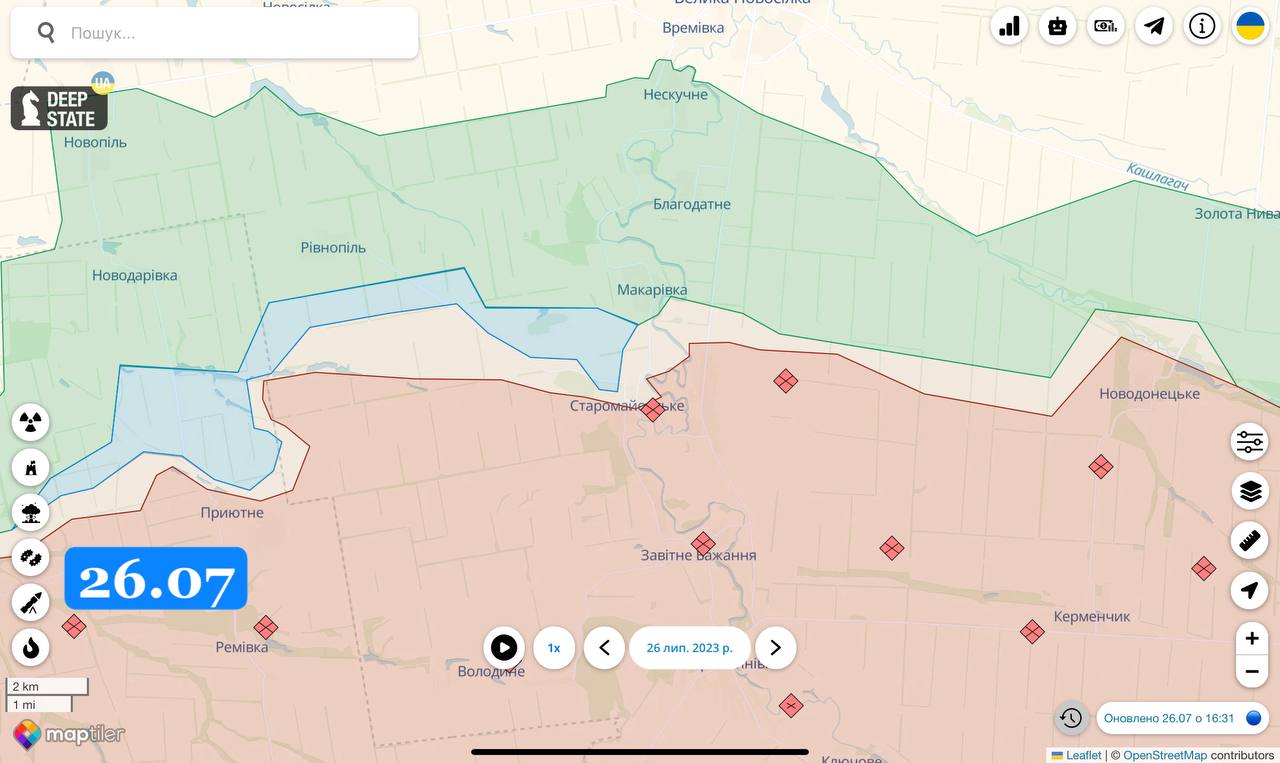 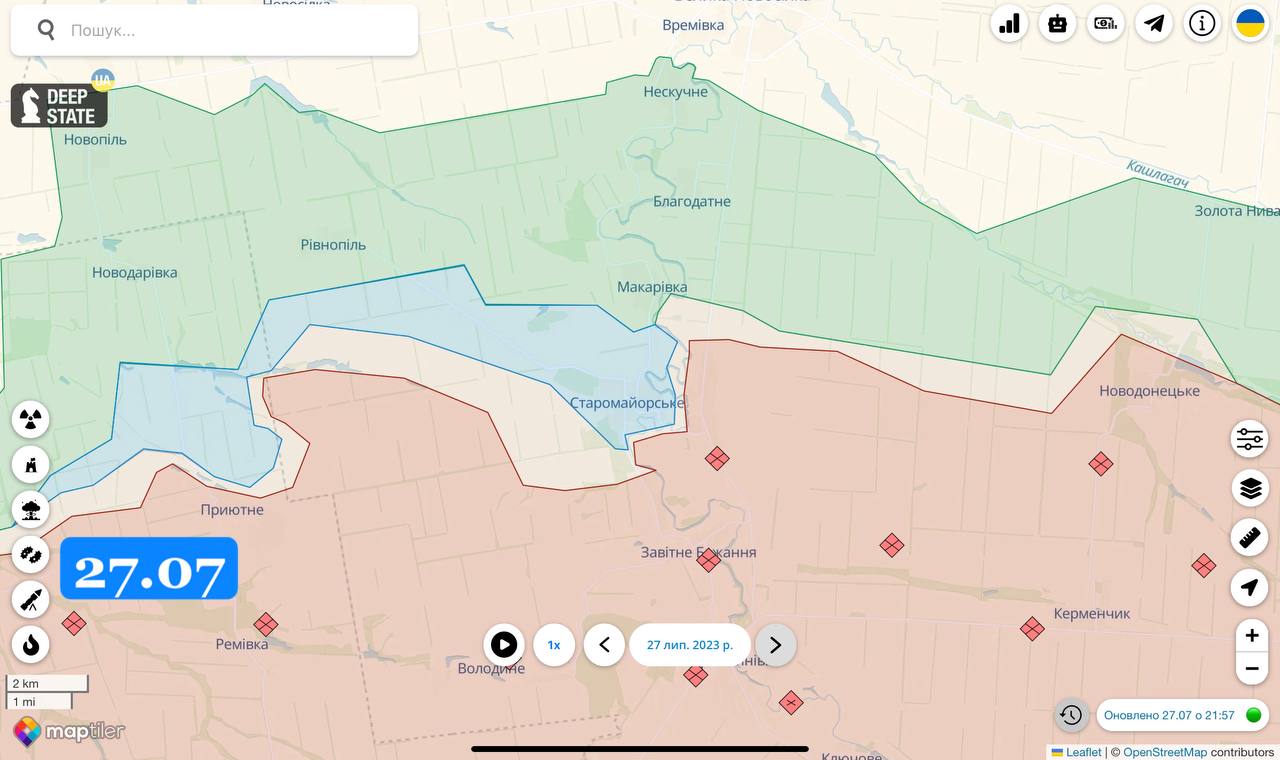 The following are posts from a Russian sources, the second a Russian soldier about the situation. The Ukrainian source that posted them indicates that the AFU will soon take Staromlynivka which is 8 km south of Staromayorske.  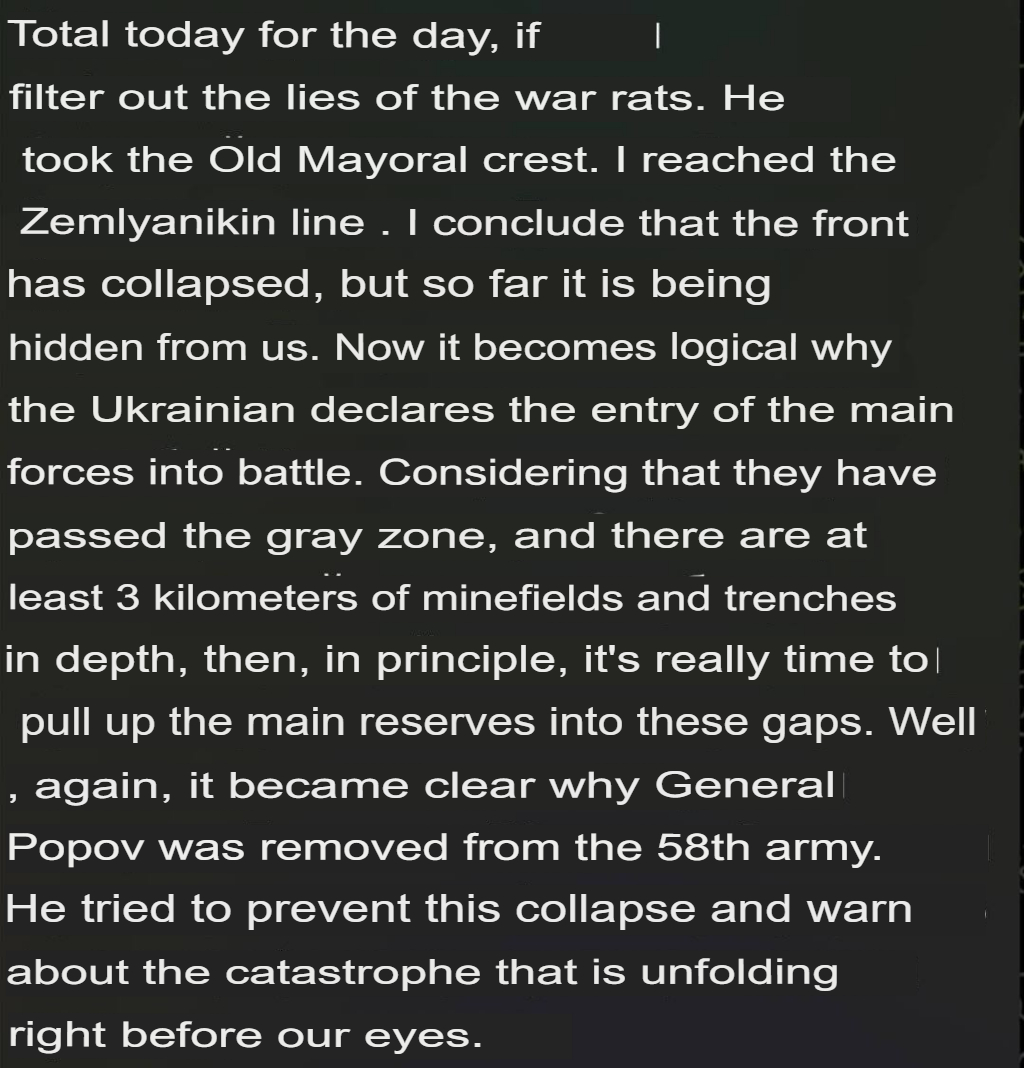 ⫘⫘⫘⫘⫘⫘ "Ukrainian units have already stabilized the situation near the settlements of Novoyehorivka and Nadiya in Luhansk region." 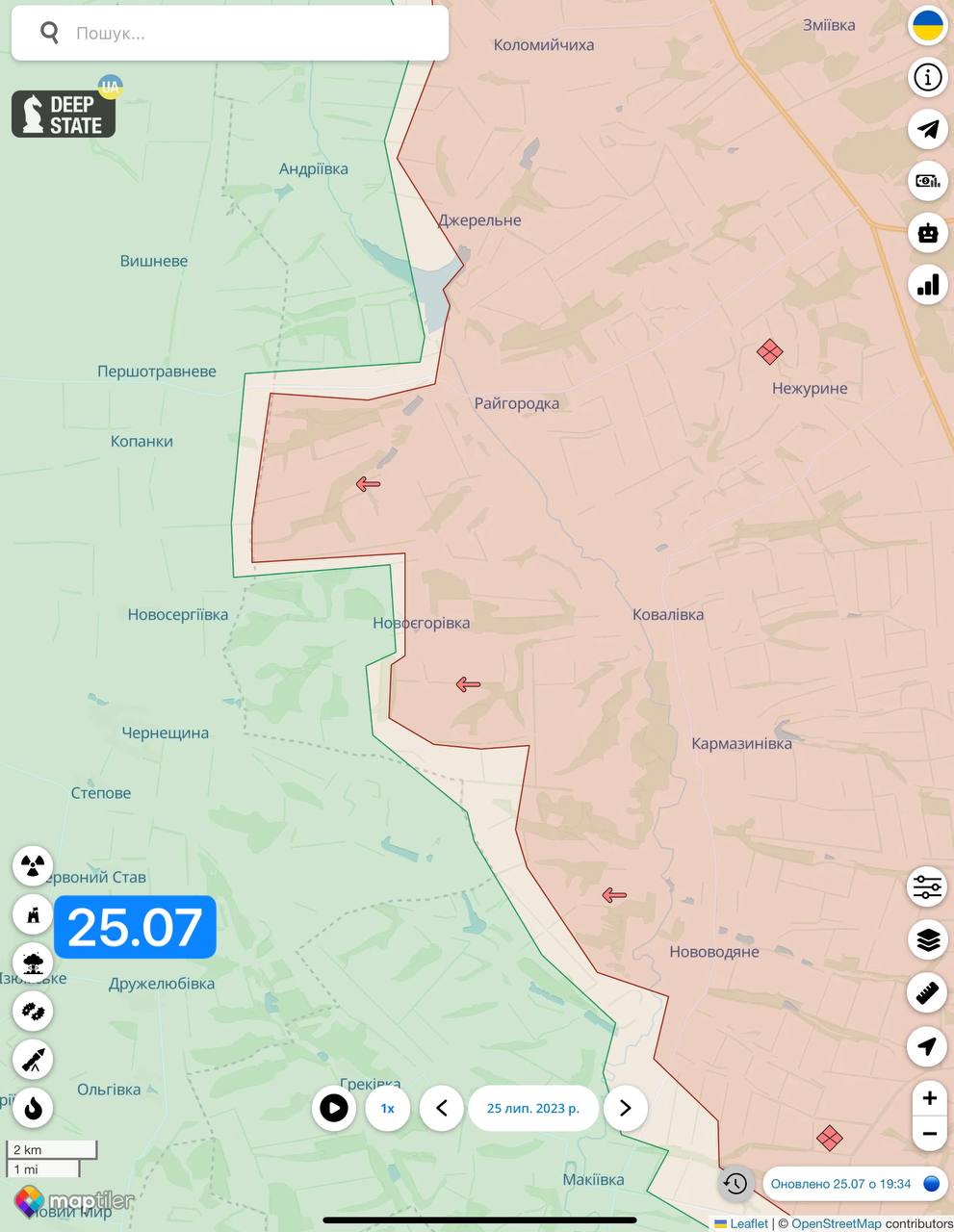 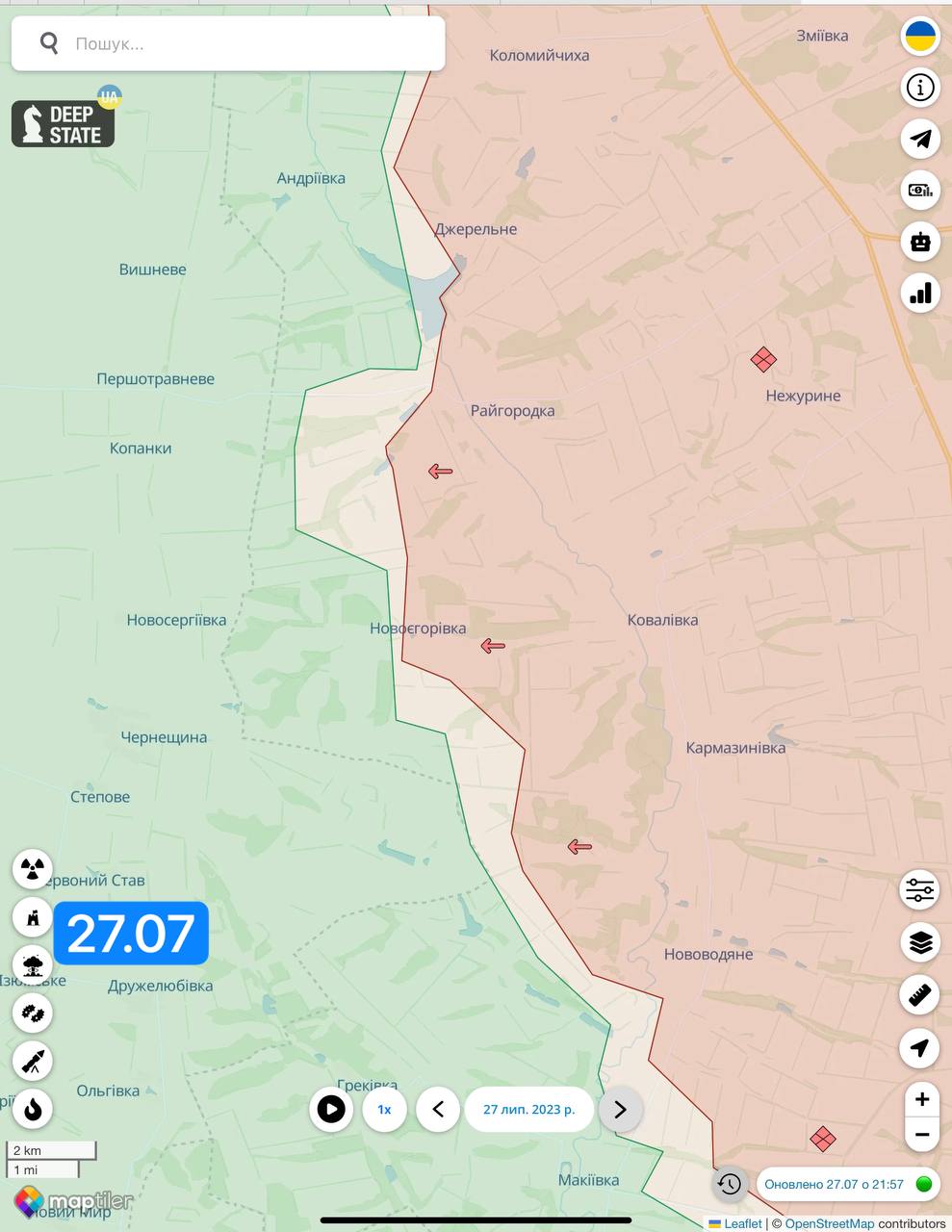
__________________ 💜🧿See Human | Be Human🧿💜 (War Section Hashtags) |
|
#1153
●
07-29-2023, 01:53 AM
| ||||||||
| ☾ Administrator ☽ Poster Rank:76 ஜᎻᎬᎩᎾᏦᎪஜ Join Date: Dec 2011 Posts: 19,519
Contributions: 32
Mentioned: 171 Post(s) Quoted: 6844 Post(s)
| ||||||||
|
Re: Whiskey's Briefing Room II
__________________ 💜🧿See Human | Be Human🧿💜 (War Section Hashtags) |
|
#1154
●
07-29-2023, 10:25 AM
| ||||||||
 ✝Mudderator from Hell✝ Poster Rank:10 e-mail Join Date: Oct 2006 Posts: 95,094
Contributions: 817
Mentioned: 472 Post(s) Quoted: 10104 Post(s)
| ||||||||
|
Re: Whiskey's Briefing Room II
Locals confirm that one strong explosion was heard early this morning in the area of the Chongar bridge. Some sources claim that the bridge was hit by a Storm Shadow and that the bridge was allegedly damaged. However, there is no video / photo evidence of the damage to the bridge yet. The Russian-appointed head of the occupied part of the Kherson region claims that there was a strike on the area of the railway bridge connection between the Kherson region and Crimea. The consequences of the impact on the Chongar railway bridge. Damage was caused to the janitor's booth, the contact line and part of the roadbed. Kiev regime tried to destroy railway between Kherson region and Crimea, firing 12 long-range Storm Shadow missiles. All missiles were shot down by our air defenses - Kherson region chief Saldo told and debris caused damage. 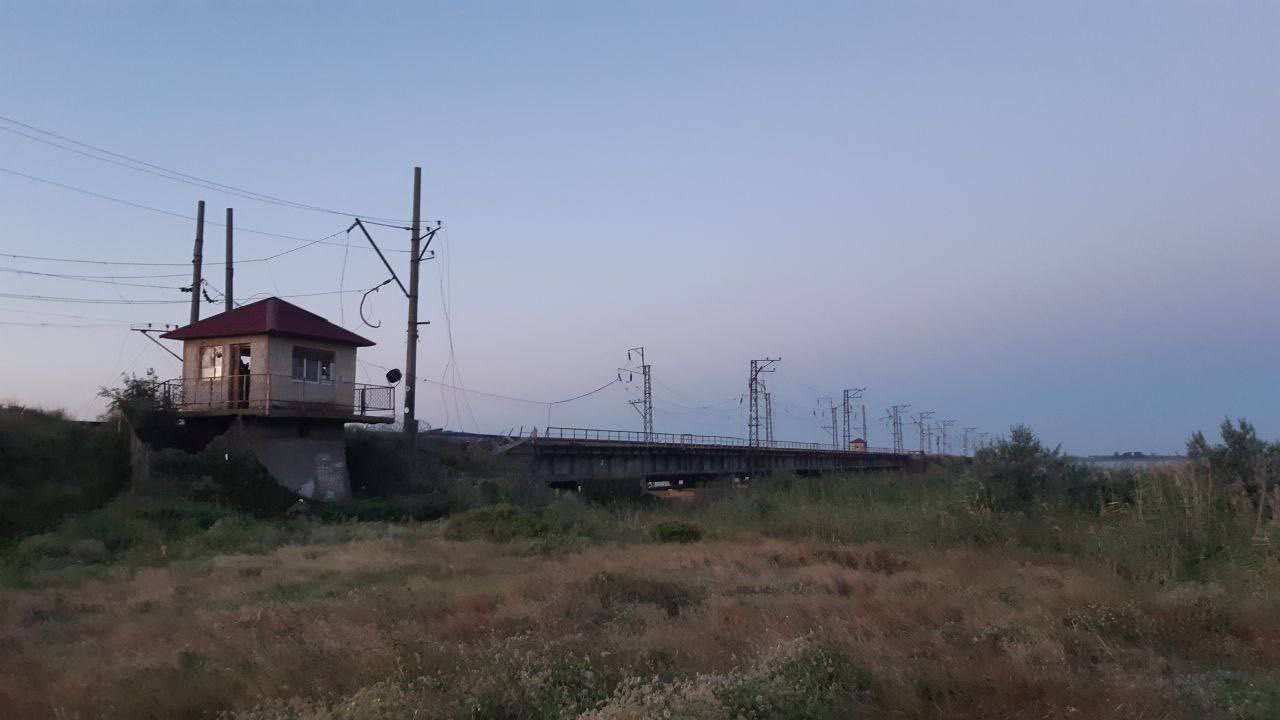 · |
|
#1155
●
07-29-2023, 07:54 PM
| ||||||||
 My Rank: MASTER GUNNERY SERGEANT Poster Rank:369 Join Date: Feb 2010 Posts: 3,202 Mentioned: 4 Post(s) Quoted: 553 Post(s)
| ||||||||
|
Re: Whiskey's Briefing Room II
How nice it would be to log on one day & find that Poo Tin is dead & the invasion / war / smo is over & everyone's gone back to their loved ones. Would be a good day indeed !  |
|
#1156
●
07-30-2023, 12:17 PM
| ||||||||
| So Fucking Banned Poster Rank:621 Orc of Mount Gundabad Join Date: Dec 2009 Posts: 1,446 Mentioned: 11 Post(s) Quoted: 900 Post(s)
| ||||||||
|
Re: Whiskey's Briefing Room II
Madyar is not happy apparently. But why? Everything's peachy.   |
|
#1157
●
07-30-2023, 03:42 PM
| ||||||||
| ☾ Administrator ☽ Poster Rank:76 ஜᎻᎬᎩᎾᏦᎪஜ Join Date: Dec 2011 Posts: 19,519
Contributions: 32
Mentioned: 171 Post(s) Quoted: 6844 Post(s)
| ||||||||
|
Re: Whiskey's Briefing Room II
 He doesn't sound unhappy. Magyar talks differently than any other Ukrainian speaker I've ever translated. He speaks largely in idioms that are very specific to where he's from and his cultural background with a bit of sarcastic smart assery thrown in. I've also seen him post when he's angry and trust me, that message is nothing. Speaking of Starlink, an article. I know Magyar is your favorite Ukrainian soldier ever (lol) so I've attached an accompanying song to play while you read the article. Source (paywall): https://www.nytimes.com/interactive/.../starlink.html Elon Musk’s Unmatched Power in the Stars The tech billionaire has become the dominant power in satellite internet technology. The ways he is wielding that influence are raising global alarms. By Adam Satariano, Scott Reinhard, Cade Metz, Sheera Frenkel and Malika Khurana July 28, 2023 On March 17, Gen. Mark A. Milley, the chairman of the Joint Chiefs of Staff, and Gen. Valeriy Zaluzhnyi, the leader of Ukraine’s Armed Forces, dialed into a call to discuss Russia’s invasion of Ukraine. Over the secure line, the two military leaders conferred on air defense systems, real-time battlefield assessments and shared intelligence on Russia’s military losses. They also talked about Elon Musk. General Zaluzhnyi raised the topic of Starlink, the satellite internet technology made by Mr. Musk’s rocket company, SpaceX, three people with knowledge of the conversation said. Ukraine’s battlefield decisions depended on the continued use of Starlink for communications, General Zaluzhnyi said, and his country wanted to ensure access and discuss how to cover the cost of the service. General Zaluzhnyi also asked if the United States had an assessment of Mr. Musk, who has sprawling business interests and murky politics — to which American officials gave no answer. Mr. Musk, who leads SpaceX, Tesla and Twitter, has become the most dominant player in space as he has steadily amassed power over the strategically significant field of satellite internet. Yet faced with little regulation and oversight, his erratic and personality-driven style has increasingly worried militaries and political leaders around the world, with the tech billionaire sometimes wielding his authority in unpredictable ways. Since 2019, Mr. Musk has sent SpaceX rockets into space nearly every week that deliver dozens of sofa-size satellites into orbit. The satellites communicate with terminals on Earth, so they can beam high-speed internet to nearly every corner of the planet. Today, more than 4,500 Starlink satellites are in the skies, accounting for more than 50 percent of all active satellites. They have already started changing the complexion of the night sky, even before accounting for Mr. Musk’s plans to have as many as 42,000 satellites in orbit in the coming years. The power of the technology, which has helped push the value of closely held SpaceX to nearly $140 billion, is just beginning to be felt. Starlink is often the only way to get internet access in war zones, remote areas and places hit by natural disasters. It is used in Ukraine for coordinating drone strikes and intelligence gathering. Activists in Iran and Turkey have sought to use the service as a hedge against government controls. The U.S. Defense Department is a big Starlink customer, while other militaries, such as in Japan, are testing the technology. But Mr. Musk’s near total control of satellite internet has raised alarms. A combustible personality, the 52-year-old’s allegiances are fuzzy. While Mr. Musk is hailed as a genius innovator, he alone can decide to shut down Starlink internet access for a customer or country, and he has the ability to leverage sensitive information that the service gathers. Such concerns have been heightened because no companies or governments have come close to matching what he has built. In Ukraine, some fears have been realized. Mr. Musk has restricted Starlink access multiple times during the war, people familiar with the situation said. At one point, he denied the Ukrainian military’s request to turn on Starlink near Crimea, the Russian-controlled territory, affecting battlefield strategy. Last year, he publicly floated a “peace plan” for the war that seemed aligned with Russian interests. At times, Mr. Musk has openly flaunted Starlink’s capabilities. “Between, Tesla, Starlink & Twitter, I may have more real-time global economic data in one head than anyone ever,” he tweeted in April. Mr. Musk did not respond to requests for comment. SpaceX declined to comment. Worried about over-dependence on Mr. Musk’s technology, Ukrainian officials have talked with other satellite internet providers, though they acknowledged none rival Starlink’s reach. “Starlink is indeed the blood of our entire communication infrastructure now,” Mykhailo Fedorov, Ukraine’s digital minister, said in an interview. At least nine countries — including in Europe and the Middle East — have also brought up Starlink with American officials over the past 18 months, with some questioning Mr. Musk’s power over the technology, two U.S. intelligence officials briefed on the discussions said. Few nations will speak publicly about their concerns, for fear of alienating Mr. Musk, said intelligence and cybersecurity officials briefed on the conversations. U.S. officials have said little publicly about Starlink as they balance domestic and geopolitical priorities related to Mr. Musk, who has criticized President Biden but whose technology is unavoidable. The federal government is one of SpaceX’s biggest customers, using its rockets for NASA missions and launching military surveillance satellites. Senior Pentagon officials have tried mediating issues involving Starlink, particularly Ukraine, a person familiar with the discussions said. The Defense Department confirmed it contracts with Starlink, but it declined to elaborate, citing “the critical nature of these systems.” Other governments are wary. Taiwan, which has an internet infrastructure that could be vulnerable in the event of a Chinese invasion, is reluctant to use the service partly because of Mr. Musk’s business links to China, Taiwanese and American officials said. China has its own concerns. Mr. Musk said last year that Beijing sought assurances that he would not turn Starlink on inside the country, where the internet is controlled and censored by the state. In 2020, China registered with an international body to launch 13,000 internet satellites of its own. The European Union, partly driven by misgivings about Starlink and Mr. Musk, also earmarked 2.4 billion euros, or $2.6 billion, last year to build a satellite constellation for civilian and military use. “This is not just one company, but one person,” said Dmitri Alperovitch, a cybersecurity expert who co-founded the Silverado Policy Accelerator think tank and has advised governments on satellite internet. “You are completely beholden to his whims and desires.” Reaching for the skies Sir Martin Sweeting, a British engineer who founded the satellite design and manufacturing company Surrey Satellite Technology, was encouraged by a business associate in 2001 to meet with a “chap who wants to put a greenhouse on Mars.” It turned out to be Mr. Musk. Mr. Sweeting and Mr. Musk met soon after for breakfast at a space conference in Colorado, where the tech entrepreneur criticized NASA and talked about building a private space fleet. “He was very focused,” said Mr. Sweeting, whose company later received an investment from Mr. Musk and had him on its board of directors before it sold to Airbus in 2009. Mr. Musk was also interested in an emerging field of research where small satellites are placed in the sky several hundred miles above sea level, an area known as “low-Earth orbit,” Mr. Sweeting said. Their work together was one of the earliest examples of Mr. Musk’s focus on a technology that would help underpin Starlink. Satellites dating to the 1960s are typically bigger — often the size of school buses — and located higher in space, in what is known as “geosynchronous orbit,” limiting their communication capabilities. Smaller satellites can orbit at a lower altitude, allowing them to link up with terminals on Earth to beam high-speed internet service to far-flung locations. Many small satellites are necessary for this to work. That’s because as one satellite moves above a Starlink terminal on land, it hands the internet signal to another satellite behind it to keep up a single, uninterrupted flow to users below. Mr. Musk launched his first Starlink satellites into orbit in 2019. At the time, satellite internet was viewed as a fool’s errand. In the 1990s and 2000s, other companies had pursued low-orbit communication satellites with little success because of the expense and technical difficulties of getting them into space. But Mr. Musk had an advantage. SpaceX’s rockets return to Earth after a trip to space and are partially reusable. This effectively gave him control of an express train to constantly deliver satellites to space, sometimes dozens at a time. Now nearly every week, a SpaceX rocket loaded with Starlink satellites takes off from a site in California or Florida. Each satellite is designed to work for about three and half years. There are so many in orbit that they are often mistaken for shooting stars. Astronomers have documented how the devices have interfered with research telescopes and warned about the risk of collisions. “The night sky is one of the most glorious shows that nature puts on and humans are changing it forever,” said Patrick Seitzer, an astronomer at the University of Michigan who studies orbital debris. Starlink provides internet download speeds typically around 100 megabits per second, comparable to many landline services. SpaceX generally charges individual customers about $600 for each terminal that receives a connection from space, plus a monthly service fee of about $75, with costs higher for businesses and governments. The company knows the location, movement and altitude of each Starlink terminal, experts said. The service, which officially debuted in 2021 in a handful of countries, is now available in more than 50 countries and territories, including the United States, Japan, much of Europe and parts of Latin America. In Africa, where internet access lags the rest of the world, Starlink is available in Nigeria, Mozambique and Rwanda, with more than a dozen other countries following by the end of 2024, according to Starlink’s website. “Everywhere on earth will have high bandwidth, low latency internet,” Mr. Musk predicted on the Joe Rogan podcast in 2020. Militaries, telecom companies, airlines, cruise lines and maritime shippers have flocked to Starlink, which has said it has more than 1.5 million subscribers. Rivals have struggled, though competition is growing. OneWeb, a British company, was so plagued by financial difficulties that it had to be bailed out by the British government and sold to a group of investors. Amazon, founded by Jeff Bezos, who owns the rocket company Blue Origin, plans a Starlink competitor, Project Kuiper, but it has yet to get a satellite into space. Lifeline on the battlefield No event has demonstrated Starlink’s power — and Mr. Musk’s influence — more than the war in Ukraine. More than 42,000 Starlink terminals are now used in Ukraine by the military, hospitals, businesses and aid organizations. During Russian bombing campaigns last year that caused widespread blackouts, Ukraine’s public agencies turned to Starlink to stay online. “Without Starlink, we cannot fly, we cannot communicate,” said one Ukrainian deputy commander who goes by the nickname Zub, or Tooth, and who spoke on the condition of anonymity for security reasons. Starlink entered Ukraine in February 2022, when Russia invaded and a cyberattack — later attributed to Russia — took down a satellite system run by the high-speed communications company Viasat that was being used by the Ukrainian military. With troops and commanders knocked offline, Mr. Fedorov, the digital minister, posted a plea to Mr. Musk for help. Within hours, Mr. Musk contacted Mr. Fedorov to say that Starlink had been activated in Ukraine. Days later, Starlink terminals arrived. The technology — found in forests, fields, villages and mounted on the roofs of military vehicles — has given Ukraine’s army a major advantage over Russian forces. It has enabled artillery teams, commanders and pilots to watch drone footage simultaneously while chatting online. The response times from finding a target to hitting it have been cut to about a minute from nearly 20 minutes, soldiers said. “The huge number of lives that Starlink has helped save can be measured in the thousands,” Mr. Fedorov said. “This is one of the fundamental components of our success.” But concerns among Ukrainian and Western officials about Mr. Musk’s hold over the technology have grown, coming to a head last fall when he repeatedly made comments about the war that raised questions about his commitment to Starlink’s service in Ukraine. In September, at a private event on world and business affairs in Aspen, Colo., which was attended by then-House Speaker Nancy Pelosi and others, Mr. Musk proposed a peace plan for Ukraine that included Russia annexing Ukrainian land. The proposal outraged many attendees. Around this time, questions arose about who would pay for Starlink’s service in Ukraine. SpaceX had initially covered some of the costs, with the United States and other allies also providing funding. That same month, SpaceX told the U.S. Defense Department that it could not continue the arrangement and asked the Pentagon to take over funding. The company estimated the cost at nearly $400 million over 12 months, according to a SpaceX letter reported by CNN, which was verified by The New York Times. The Biden administration directed a top Pentagon official, Colin H. Kahl, to mediate. On Oct. 7, Mr. Kahl called Mr. Musk, who expressed fears that Ukraine would use Starlink to not just defend itself, but also conduct offensive operations to regain territory seized by Russia, which could cause significant Russian military casualties, a former administration official said. Mr. Kahl told Mr. Musk more people in Ukraine would suffer if Starlink was shut down. Mr. Musk nonetheless turned off access for some Starlink terminals in Ukraine. Late last year, about 1,300 Starlink terminals purchased through a British supplier stopped working in the country after the Ukrainian government could not pay the $2,500 monthly fee for each, two people with knowledge of the matter said. Starlink access also fluctuated depending on the movements of the war as Russia won territory and Ukraine fought to take it back. As the battle lines shifted, Mr. Musk used a process called geofencing to restrict where Starlink was available on the front lines. SpaceX uses location data gathered by its service to enforce geofencing limits. This caused problems. When Ukrainian troops tried retaking cities like Kherson in Russian-controlled areas in the fall, they needed internet access to communicate. Mr. Fedorov and members of the armed forces messaged Mr. Musk and SpaceX employees requests to restore service in areas where the army was advancing. Mr. Fedorov said SpaceX responded “very promptly.” Mr. Musk had other red lines that he would not cross. He refused Ukraine’s request last year to provide Starlink access near Crimea, the Russian-controlled peninsula, so it could send an explosive-filled maritime drone into Russian ships docked in the Black Sea, two people familiar with the discussions said. Mr. Musk later said that Starlink could not be used for long-range drone strikes. Other U.S. officials have weighed in. In June, Defense Secretary Lloyd Austin approved a Pentagon deal to buy 400 to 500 new Starlink terminals and services. The deal gives the Pentagon control of setting where Starlink’s internet signal works inside Ukraine for those new devices to carry out “key capabilities and certain missions,” two people familiar with the deal said. This appeared intended to provide Ukraine with dedicated terminals and services to conduct sensitive functions without fear of interruption. Unlike traditional defense contractors, whose weapon sales to foreign countries are typically done through the federal government, Starlink is a commercial product. That allows Mr. Musk to act in ways that sometimes do not align with U.S. interests, such as when SpaceX said it could not continue funding Starlink in Ukraine, said Gregory C. Allen, a former Defense Department official who worked at Blue Origin. “It has certainly been a long time since we’ve seen a company and an individual like this go pretty openly against U.S. foreign policy in the middle of a war,” said Mr. Allen, who is now at the Center for Strategic and International Studies. Mr. Musk’s behavior has divided Ukrainian officials. Mykhailo Podolyak, an adviser to President Volodymyr Zelensky, said on Twitter in February that SpaceX needed to pick a side. But Mr. Fedorov said questions about Mr. Musk’s commitment were unfair. When Ukraine was under heavy bombardment and facing major power outages in November, Mr. Musk helped expedite the delivery of about 10,000 Starlink terminals, he said. “SpaceX and Elon Musk have shown through their deeds whose side they are actually on,” Mr. Fedorov said. From Taiwan to Europe In February, two undersea internet cables running between Taiwan’s main island and the outlying islands of Matsu were severed by Chinese shipping vessels. The incident interrupted online access across Matsu, intensifying concerns that Taiwan’s communications infrastructure was vulnerable. Taiwan, which China has claimed as its own territory, would seem to be an ideal place to bring in Starlink. But Taiwan was reluctant — a concern increasingly echoed elsewhere as governments weigh the power of satellite internet against the risks of working with Mr. Musk. Taiwanese officials had spoken with SpaceX about Starlink, said Jason Hsu, a former Taiwan legislator who advises the government on digital infrastructure. But talks slowed partly because of “tremendous concerns” about Mr. Musk, whose financial interests are tied to China, he said. With roughly 50 percent of new Tesla cars estimated to be manufactured in Shanghai, Taiwan did not trust Mr. Musk to provide Starlink access if Beijing applied pressure to turn off the service, he added. “We worry that if we order devices from Starlink, we’ll fall into some sort of trap,” said Mr. Hsu, now a senior research fellow at Harvard Kennedy School in Taipei. “Elon has huge commercial interests in China.” When a U.S. congressional delegation visited Taiwan in April, Representative Michael McCaul of Texas, a Republican and chairman of the House Foreign Affairs Committee, asked the Taiwanese president, Tsai Ing-wen, during a lunch about potentially using Starlink, according to committee staff on the trip. Ms. Tsai was noncommittal. Congressional aides concluded soon after that the service was not a viable option for Taiwan because of Mr. Musk’s links to China, the committee staff said. Audrey Tang, Taiwan’s digital minister, said the country struck a deal with OneWeb in June and had not ruled out working with any satellite provider. “We want to test as many constellations as possible,” she said. Mr. Musk’s influence has been debated elsewhere. In the European Union, concerns about Starlink’s dominance influenced the 27-nation bloc to set aside 2.4 billion euros last year for a “sovereign” satellite constellation, to launch as soon as 2027. “Space has become a highly contested domain where the European Union must safeguard its vital interests,” said Thierry Breton, the European commissioner overseeing the project. “The E.U. cannot afford to be reliant on others.” To address government needs, SpaceX last year introduced a Starlink-related service, Starshield, that offered stronger security for handling classified material and processing sensitive data. Starlink also faces criticism from more authoritarian governments. When anti-government protests broke out in Iran last year, Mr. Musk made Starlink available there to help activists stay online. The Iranian government accused SpaceX of violating its sovereignty. China complained this year to a United Nations panel that SpaceX was putting so many satellites into orbit that it would prevent others from accessing space. In February, Turkey refused Mr. Musk’s offer to provide Starlink access after a major earthquake, which civil society groups viewed as an effort to prevent unfavorable news from spreading online. “The government was afraid that Starlink is not under its control, and could represent a threat,” said Chérif El Kadhi, a policy analyst tracking Turkey for Access Now, a digital rights organization. Mr. Musk’s dominance in space is unlikely to be equaled any time soon. In May, Amazon prepared to put its first two satellites into orbit, but the launch was put on hold after a problem was discovered in rocket testing. Since then, Mr. Musk has sent at least 595 more Starlink satellites into space. Andrew E. Kramer contributed reporting from Kyiv, Ukraine, and Eric Schmitt from Washington. Sources for Starlink satellites over Ukraine: CelesTrak (satellite locations as of July 25); Institute for the Study of War with American Enterprise Institute’s Critical Threats Project (areas controlled by Russia as of July 24)
__________________ 💜🧿See Human | Be Human🧿💜 (War Section Hashtags) |
|
#1158
●
07-30-2023, 04:10 PM
| ||||||||
| ☾ Administrator ☽ Poster Rank:76 ஜᎻᎬᎩᎾᏦᎪஜ Join Date: Dec 2011 Posts: 19,519
Contributions: 32
Mentioned: 171 Post(s) Quoted: 6844 Post(s)
| ||||||||
|
Re: Whiskey's Briefing Room II
◖"155-mm cassette" Cassette=cluster munitions. I looked up the numbers on one of the shells and found the following info. 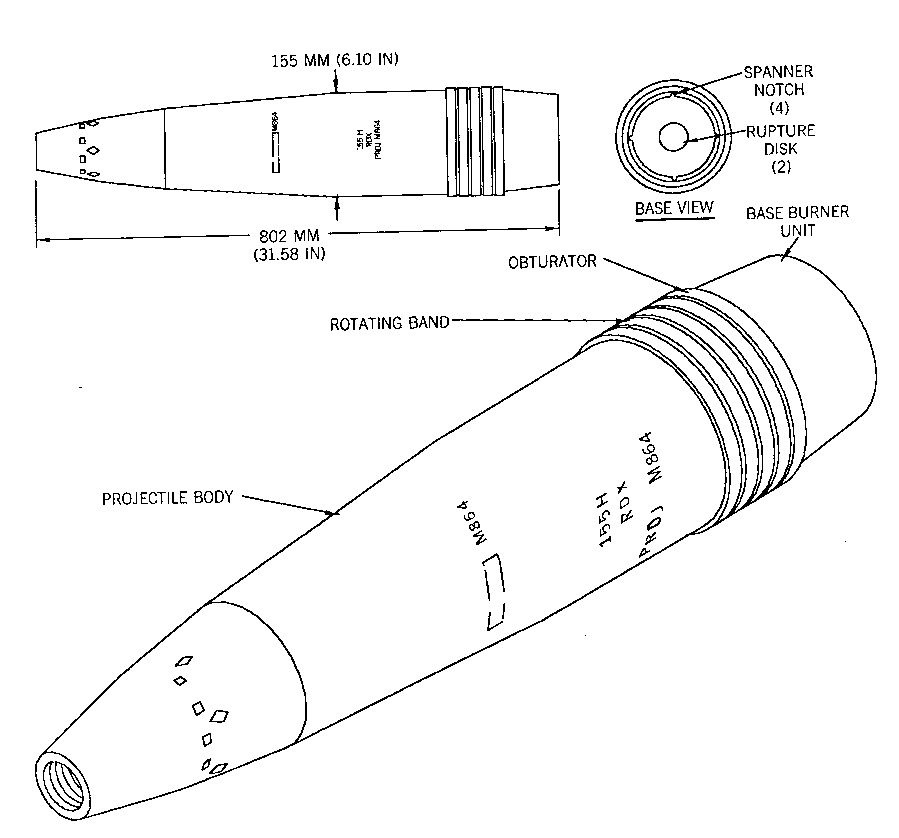 The Projectile, 155MM, HE, M864 is of the separate loading type. The fuze, propelling charge, and primer are handled and loaded separately. The projectile contains a total of the 72 dual-purpose grenades (48 each M42 and 24 each M46). A base burner assembly containing 2.6 pounds of HTPB- P propellant is assembled to the base of the projectile body. This propellant is ignited by the propelling charge when the weapon is fired. The projectile is assembled with a universal lifting plug which is replaced by an MTSQ or ET fuze prior to loading the projectile in the weapon. #cluster
__________________ 💜🧿See Human | Be Human🧿💜 (War Section Hashtags) |
|
#1159
●
07-30-2023, 04:19 PM
| ||||||||
| ☾ Administrator ☽ Poster Rank:76 ஜᎻᎬᎩᎾᏦᎪஜ Join Date: Dec 2011 Posts: 19,519
Contributions: 32
Mentioned: 171 Post(s) Quoted: 6844 Post(s)
| ||||||||
|
Re: Whiskey's Briefing Room II
"About Magyar's post on Starlink. They talked with Magyar. Neither Russians nor Martians can cheat the laws of physics. We are talking about the development and use by the Russians of field jammers on Starlink communication frequencies with the satellite. It works only at zero and only in clearly defined situations, when the Russians can drag such a EW to a high-rise, elevator or mobile phone tower and at a very high angle from above interfere with Starlink receiving signals from satellites. I tested this option, it works literally 500 meters. Summarizing 1. Our opponent is constantly trying to create something new. 2. There is no global threat, but the guys at ground zero should know that this is possible 3. The measures I have written about many times will help - deep digging into the ground - dense metal nets or "wells" made of corrugated board. 4. Such an EW system for this range requires a specific and noticeable antenna, just start installing it, I will show it to you right away."  ⫘⫘⫘⫘⫘ VIDEO: Repairs to the Crimean bridge are ongoing. Source of the video says "They are applying putty until the next time".
__________________ 💜🧿See Human | Be Human🧿💜 (War Section Hashtags) |
|
#1160
●
07-30-2023, 07:26 PM
| ||||||||
| My Rank: MASTER GUNNERY SERGEANT Poster Rank:369 Join Date: Feb 2010 Posts: 3,202 Mentioned: 4 Post(s) Quoted: 553 Post(s)
| ||||||||
|
Re: Whiskey's Briefing Room II
That's certainly a lot of "Howdy Fucking Dowdy" for the Orc's.  Let's see how they deal with that. :-) |