|
#1
●
08-07-2015, 09:44 PM
|
 They Lied. There ALL LIES Poster Rank:314 <--We Did It. So Can You Join Date: Mar 2013 Posts: 4,144
Contributions: 78
4,144Posts 9,704Thanked 894Quoted 23Mentioned 78Contrib. |
|
Thunderbird Crash Video From Mountain Home Air Force Base
On January 22, 2004, the Thunderbirds F-16C demonstration team experienced an incident during a September airshow held at Mountain Home Air Force Base, Idaho. At the center of this unfortunate incident was 31-year-old Captain Chris Stricklin, an experienced Thunderbirds pilot. The investigation report revealed that Captain Stricklin misjudged the altitude required to execute the challenging "Split S" maneuver. His miscalculation stemmed from using an incorrect mean-sea-level altitude reference for the airfield. Instead of reaching the prescribed 2,500 feet, he mistakenly climbed to a perilously low altitude of 1,670 feet above ground level before initiating the descent for the Split S maneuver. As Captain Stricklin realized the gravity of the situation, he reacted swiftly. He applied maximum back stick pressure and executed a slight left roll to ensure the aircraft would veer away from the spectators in case of an ejection. He ejected from the aircraft when it was a mere 140 feet above the ground, a mere 0.8 seconds before impact. Fortunately, his quick thinking paid off, and he suffered only minor injuries from the ejection. Remarkably, there was no damage to military or civilian property on the ground. The price of this error was steep. The F-16C, valued at approximately $20.4 million, was completely destroyed. One contributing factor to the mishap may have been the difference in altitudes between Nellis and Mountain Home. Nellis Air Force Base sits at an altitude of 2,000 feet, whereas Mountain Home Air Force Base is located at a higher elevation of 3,000 feet. It appears that Captain Stricklin briefly reverted to his accustomed altitude pattern from Nellis, adding to the complexity of the situation. Captain Stricklin had executed the Split S maneuver approximately 200 times during his tenure as a Thunderbird pilot, which made this error all the more unexpected. In light of this incident, Thunderbird commander Lt. Col. Richard McSpadden spoke highly of Captain Stricklin's skill, acknowledging the pilot's exceptional abilities. However, the unfortunate mistake led to Captain Stricklin's reassignment to Washington D.C., where he now serves in one of the agencies at the Pentagon. The Split S Maneuver, the intended stunt that day, necessitated a climb to 2,500 feet, a crucial detail that had been overlooked. Investigators noted that Stricklin's climb only reached 1,670 feet before the aircraft entered the spinning roll. The investigation board identified additional factors that contributed to this error, including the requirement to convert sea level altitude information from the F-16 instruments into their altitude above ground and verbally communicate that information to a safety operator below. 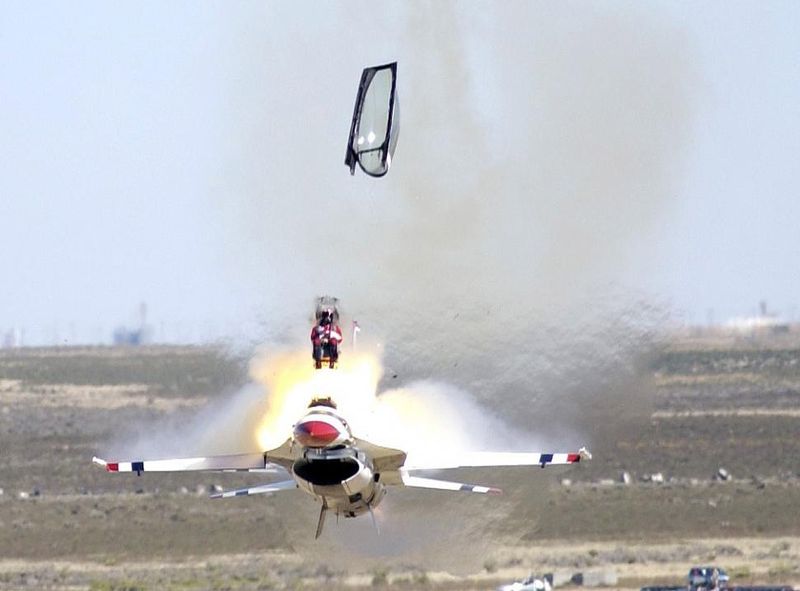 |
|
#2
●
08-09-2015, 12:07 AM
|
 ★ Legacy Member ★ Poster Rank:53 Join Date: Mar 2013 Posts: 28,044
Contributions: 33
28,044Posts 47,276Thanked 11,875Quoted 175Mentioned 33Contrib. |
|
Re: Thunderbird Crash Video From Mountain Home Air Force Base
So, he ejected and lived, hopefully.  |
|
#3
●
08-10-2015, 06:26 PM
|
 puelling pueman Poster Rank:176 m Join Date: Apr 2010 Posts: 8,888 8,888Posts 12,103Thanked 2,948Quoted 21Mentioned 0Contrib. |
|
Re: Thunderbird Crash Video From Mountain Home Air Force Base
meh...i was expecting the real thunderbirds  |
|
#4
●
08-10-2015, 09:38 PM
|
 ★ Legacy Member ★ Poster Rank:72 male Join Date: Apr 2010 Posts: 21,206
Contributions: 1
21,206Posts 24,311Thanked 4,957Quoted 52Mentioned 1Contrib. |
|
Re: Thunderbird Crash Video From Mountain Home Air Force Base
Oooops, 20 mil worth of fireworks |
|
#5
●
08-11-2015, 01:34 AM
|
| ★ Legacy Member ★ Poster Rank:53 Join Date: Mar 2013 Posts: 28,044
Contributions: 33
28,044Posts 47,276Thanked 11,875Quoted 175Mentioned 33Contrib. |
|
Re: Thunderbird Crash Video From Mountain Home Air Force Base
"The aircraft, valued at about $20.4 million, was destroyed." -  Damn...I bet they don't make him pay it back. Damn...I bet they don't make him pay it back.  |
|
#6
●
08-11-2015, 01:35 AM
|
| ★ Legacy Member ★ Poster Rank:53 Join Date: Mar 2013 Posts: 28,044
Contributions: 33
28,044Posts 47,276Thanked 11,875Quoted 175Mentioned 33Contrib. |
|
Re: Thunderbird Crash Video From Mountain Home Air Force Base
DOH....I should have read this before I commented!!
|