|
#471
●
03-27-2012, 08:38 PM
| ||||||||
| So Fucking Banned Poster Rank:5620 Join Date: Oct 2008 Posts: 43 Mentioned: 0 Post(s) Quoted: 0 Post(s)
| ||||||||
|
Re: A REAL World Trade Center Jumper
I want to learn everything I can about 9/11. It makes it more real and helps to keep me grounded about what is really important in life: life and love. You have my upmost respect Bill. I appreciate you sharing your story. I am sorry you lost your best friend. It has taken a lot of courage and strength to really open up about your experience. Truly a raw uncensored account. You sound like a decent guy.
|
|
#472
●
03-27-2012, 09:08 PM
| ||||||||
 My Rank: MAJOR Poster Rank:137 Male. Join Date: Apr 2010 Posts: 11,830 Mentioned: 0 Post(s) Quoted: 478 Post(s)
| ||||||||
|
Re: A REAL World Trade Center Jumper
Decent at times I suppose, other times............not so much. I have done a lot of shit I am not proud of. That adds to the whole survivor's guilt too. You take somebody like me, that makes it through something like that, then you take a 66 year old granny that has nothing bad to say about anyone, and they die. It can really do a number on your mind. All of that pales in comparrison to that poor pregnant woman though. That poor child should have had the chance to grow up and experience life, even if not all of it would have been good. It was robbed of that chance, as were so many others. Yet I am still here. That is why I am having so much trouble with the pictures I took, and people will understand when they see them. I doubt anyone that looks at them will be able to keep dry eyes, I know I can't, and I have seen about everything you can imagine. |
|
#473
●
03-27-2012, 10:29 PM
| ||||||||
| My Rank: MAJOR Poster Rank:137 Male. Join Date: Apr 2010 Posts: 11,830 Mentioned: 0 Post(s) Quoted: 478 Post(s)
| ||||||||
|
Re: A REAL World Trade Center Jumper
Well folks, I told you all that I'm no expert on 9/11, and here is proof. I was pretty sure it was a man that fell on firefighter Danny Suhr. I still am for the most part, but I could be wrong. Here is an artical I came across a little while ago, and according to it, a woman fell and struck him. I was sure it was the man that was climbing down the South Tower for several reasons. One is the other firefighters with him said so in another article I had read a while back. They also said it was Liberty Street, which ran along the South side of the South Tower, where the man fell in the video. Another reason is because the person that hit him, did so just a few minutes before the South Tower came down. That fact saved the lives of several other firefighters with him that day. They loaded him up and took him to a hospital, and that kept them from being killed when the South Tower came down. Another reason is because fewer than 12 people jumped or fell from the South Tower, and almost all that did where men. There was a woman that landed inbetween the South Tower's west side and Marriot Hotel's East side, but I have yet to see anything about a woman coming down on the South side of the South Tower. That doesn't mean it's impossible though. I'll add a small map at the end of it as well. Many would rather believe that those who fell from the World Trade Centre were forced from their offices as saying they jumped connotes suicide; a few, however, see courage in their decision to take charge of the manner of their dying. Eddie Torres had just started as a broker at the financial trading house Cantor Fitzgerald. September 11, 2001, was only his second day at work. He had left his pregnant wife Alissa at home when he set off for his office above the 100th floor of the north tower of the World Trade Center. They had argued the night before and only managed a cursory goodbye. Eddie left early, and that was the last Alissa ever saw of him. AA11, the American Airlines’ morning flight from Boston to Los Angeles, had 81 people on board when the lead hijacker, Mohamed Atta, piloted the plane into the north tower. Alissa would later note that Atta, who had just turned 33, was close in age to Eddie, who was 31. The time was 08:46:40. The point of impact was between the 93rd and 98th floors. Eddie was trapped above the resulting inferno. The story of exactly how Eddie Torres met his death on 9/11 is lost. And with a handful of exceptions, that is pretty much the case for all 2,753 people who died at the World Trade Center. Indeed, 10 years later, more than 1,000 of them have yet to be identified from remains. They have simply vaporised, their death certificates issued without them. And so, Eddie’s story exists only in the imagination of his widow. She has created her own legend. They said the sound of all those bodies hitting the ground, like a thud or a dull explosion, was both terrible and unforgettable. One afternoon, not long ago, Alissa and I sat on a bench in Central Park and talked. It was a difficult, painful conversation. “Are we done yet?” Alissa asked. She told me I was “disgusting” because of my curiosity about the people who jumped or fell from the Twin Towers. I understood, but I knew too that Alissa herself, much as she tried not to be, was haunted by that subject, not least because she believes that Eddie jumped. Like a dirty or embarrassing secret, the people who jumped or fell from the Twin Towers have been all but erased from the history of 9/11. Since the earliest days after the attacks, the American media have shown a collective reluctance to publish images of those who jumped or fell. And in official terms, the “jumpers” simply don’t exist. Not use the words At the New York office of the chief medical examiner — in charge of recording and investigating all the deaths on 9/11 — they will not even use the words “jump” or “jumper”. Nobody jumped, they say, they only fell or were forced from the towers. “We’re pretty firm on that position,” said the medical examiner’s spokeswoman, Ellen Borakove. “People were forced or pushed out by the force of the heat and the flames.” To be a jumper, many people feel, implies the act of suicide, an act that some perceive as shameful. The 9/11 Memorial Museum, which opens at Ground Zero in a year’s time, will include a small display devoted to those who died that way. The committee that set up the museum spent months agonising over how the story of the jumpers should be told. It was decided that visitors would need privacy to see the images — and should be given the choice of whether to view them at all — so the display will be hidden in an alcove. I assumed it would not be hard to establish the facts about how many people jumped, who they were, how their deaths were recorded and so on. In fact, it proved nigh on impossible at first. Nobody would talk, and people had stopped asking. There had never been an official count. Or so it appeared, until I discovered an account buried in a massive report devoted to how and why the towers fell, prepared by the National Institute for Standards and Technology (NIST). So hidden was the study that even NIST’s own press officer was initially unaware of it, and told me he thought no such account existed. Fortunately, he double-checked and found that among the report’s numerous appendices was a clinical analysis of the precise time that people jumped and fell, noting the floor and even the window they came out of. The report records 104 such deaths, although NIST says its tally is not definitive, and that the actual total is probably higher. Nevertheless, this is the first time any official figures on the subject have been published. I certainly faced great resistance in the US when I began researching this article. But the story of the “jumpers” was haunting, and I had always known I would end up writing about them one day. Nine years ago, I commemorated the first anniversary of 9/11 by spending some time with New York firefighters. They had spoken then of the “jumpers” who had fallen about them as they had entered the north tower — the first tower to be hit — on their rescue mission. The sound of those bodies landing, they said, like a thud or a dull explosion, was terrible and unforgettable, and I could not forget their affecting description of that noise. In the days after 9/11, the Fire Department of New York (FDNY) had conducted several hundred debriefing interviews with firefighters and emergency service workers. These were made public much later following a freedom of information request by The New York Times. In one or two cases, the interviewees were so traumatised by what they had seen they could barely speak. For many, it was the sight and sound of the falling bodies that had disturbed them more than anything else. They described moving through a surreal landscape in a cloud of smoke and dust, the sky full of fluttering paper and the ground littered with smouldering debris and body parts. Above them it was — an often-repeated phrase — raining bodies. “They were jumping now, one, two, three, four, smashing like eggs on the ground,” recalled emergency service lieutenant Rene Davila. Someone near him suggested they should collect names, keep a record. “I was like, you’re out of your mind.” Choosing to die “I felt like I was intruding on a sacrament,” said one firefighter, Maureen McArdle-Schulman. “They were choosing to die and I was watching them and shouldn’t have been, so me and another guy turned away and looked at the wall, and we could still hear them hit.” Did they choose to die that way? Was it a real choice? What would any one of us have done? The choice, to jump or not to jump, must have been so agonisingly real that the chief medical examiner Dr Charles Hirsch’s denial that the “jumpers” existed seemed insulting. In his version of events, nobody “jumped”; they were all victims of homicide, and the vast majority of death certificates carry the same wording: “Blunt trauma …” Only 176 complete bodies were returned to their families. Borakove said Hirsch was acting out of sensitivity for the bereaved families, and out of respect for those who died — “the families are our first priority” — but I know there are some people who take comfort from the idea that their lost partner or relative chose to jump and so actively took charge of the manner of their dying. I suspect, too, that for some the decision itself was an act of immense courage — albeit born of desperation — and deserves to be remembered as such. I discovered from the NIST study that in about four cases, people got out of the windows, 100 or more floors up, and began trying to climb up or down the outside of the building to imagined safety. Of course, they soon lost their grip and fell. Richard Pecorella had searched high and low for a trace of his beloved, Karen Juday, but it was not until Christmas Eve, 2001, that her jawbone was found. He had the remains cremated, and scattered them off the Verrazano-Narrows Bridge, which connects Staten Island to Brooklyn — the first place in the city Karen had seen when they started their lives together. Karen was a farm girl from Indiana, said Richard. And she had courage. Richard believed she had jumped. After the jawbone came another fragment, then another, and so Richard signed a waiver allowing the medical examiner’s office to dispose of any further remains. He couldn’t go on forever handling the pieces of her. When they met in 1997, Karen and Richard had both been married before. Richard said he knew she was “the one”. He worked at the trading house Bear Stearns, whose office on the Brooklyn side of the East River had a clear view of the Twin Towers. He helped Karen to get a job as an administrator at Cantor Fitzgerald. Sometimes she would call him to describe an amazing spectacle outside her window. “You can’t believe this, but a jet plane just flew by my window. It was so beautiful.” On the morning of 9/11 Richard had a bird’s-eye view of the whole thing. He saw the second plane hit the south tower and tried to call Karen, but there was no answer. Soon, his building was on a lockdown. Frustrated, desperate and enraged, Richard picked up a chair and threw it at the window. The nurse was called. She wanted to take his blood pressure. “I says, ‘Are you kiddin’ me?’ I said, ‘My fiancée probably just got killed and you wanna take my blood pressure? Of course it’ll be up!’” That was the Brooklyn in him coming out, he told me. Alissa has written about Eddie’s death, describing little people falling “like fairies”. She told herself that Eddie had skydived without a parachute. Richard used to look at the postings and the photographs on the internet and sometimes wondered if Karen had jumped. She was very vain and particular about her face, he knew; she used plenty of wrinkle cream, and he always figured if conditions were that bad she would jump rather than face the fires. He eventually made contact with Richard Drew, the Associated Press photographer who recorded many images of those who jumped or fell on 9/11 — so many he has never counted them, he told me — including one much-published image of a man frozen in a head-first dive that came to be known as the Falling Man. Very graphic Pecorella went to Drew’s office and was shown a collection of photographs. “Are you sure you want to do this? It’s very graphic,” Drew asked him, but he was sure — and there she was, in the first photograph he saw. She was wearing the familiar bandana she always put on at work and stood in the window frame, holding on, with the flames behind her. There were a lot of other people in the photograph, but Richard was sure he recognised her cream trousers and blue cotton top. There was a second photograph of a woman falling, hands over her face, legs raised as she came down, no bandana now, but the hair and body shape all too familiar. Drew was almost apologetic to Richard — his instincts had just taken over, he said, he had just recorded what was happening. Richard reassured him that, in fact, it gave him some closure to know that, at the end, Karen had made a choice. She had jumped; she did not, as he said, burn up and become toast. “She chose how she should die. It’s not a religious thing with me. A lot of people have problems because they consider it as suicide, which means you go to hell, but I don’t consider it like that, I think it’s more complicated.” Richard had never met anyone else who believed they knew a victim who had jumped. “Nobody talks about the jumpers,” he said. It made him feel like he was the only one who knew and had something to hold on to. In fact, as Richard later realised, there were others who were looking to claim ownership of the same images. When his own health deteriorated after 2001 — he developed a condition similar to emphysema that has restricted his mobility — he began spending more and more time on the internet, and noticed that some people were saying the images he thought were of Karen were of another woman, Edna Cintron. Cintron had worked on a different floor for a different company, Marsh & McLennan, and had also run a flower shop part time in Spanish Harlem with her husband, William. The shop was named Sweet William. She has since come to wider internet attention as the unlikely subject of a bizarre 9/11 conspiracy theory. Cintron is seen, in a third image — in fact, a fleeting few seconds of footage — waving out from a deep gash in the north tower with smoke and flames behind her. An FDNY photographer with a long lens saw someone “nudged out” as he watched. The impact zone in WTC-1. Edna Cintron in the red square died during the pulverization of the building. Where is the plane? Remember that a plane is a hollow tube of aluminium, while the tower was built with solid and massive steel columns. Some people claim it would be impossible for anyone to stand so close to an inferno, and that the photograph must be a hoax, and part of the whole “lie” of 9/11, which they believe was staged by the American government. Richard had been emailed by some of those people, who call themselves “truthers”, thanking him for confirming it was Karen and not Edna in the first two photographs, which in their view isolated the third image as a sure hoax. The NIST report took 10,000 pages to consider in very fine detail just how and why the buildings collapsed. The south tower was hit last but collapsed first, at 09:59. The north tower remained standing for just over 100 minutes before it fell at 10:28. Appendix M of that report, Observation of Falling Human Beings for WTC1, logged 101 falls from the north tower and the precise window and exact time at which each had fallen. The appendix was compiled by one person reviewing video footage and still photographs. It is the only record in existence of those who jumped or fell, and is presented as a table — a graphic display of the building’s upper floors and windows. The first fall occurred just over four minutes after the first plane hit, from the 149th window of the 93rd floor on the north face of the building. The cascade began seven minutes later, with 13 falls in two minutes. One person had climbed out and got from the 93rd to the 92nd floor before falling, one second after someone else had fallen from the same window — window 215 on the east face of the tower. At 10:06:59, two people had fallen together from the same window on the 95th floor; simultaneously, a third person fell from the next window, followed a second later by two more people falling together. Altogether, in six seconds nine people fell from five adjacent windows. The last person fell just as the building collapsed, at 10:28:09, from the 106th floor. Richard Drew of AP must have photographed that person: he told me he discovered later that he had two frames that showed someone clinging to debris as they fell with the building. Eyewitnesses have described people hugging or holding hands as they fell in pairs. An FDNY photographer with a long lens saw someone “nudged out” as he watched..He took half a dozen shots of people falling before saying to himself, “That’s enough of that.” Time and again, the hardened firefighters and paramedics would say they had never seen anything like it. Many looked away, but others were transfixed. The landings, of course, were the worst. The fall was said to have taken about 10 seconds, but would vary according to body position and the time taken to accelerate to terminal velocity, typically 120 miles per hour (193kph), but up to 200 mph (322kph) if the person fell with their body straight. As Alice Greenwald of the 9/11 memorial museum said, in a sense we were all victims of 9/11. It was watched by billions around the world, and few of us were unaffected. At the heart of it, most affected of all were the bereaved. Nancy had always known that Danny Suhr, her high-school sweetheart, wanted to be a firefighter. Nancy was Italian-American; Danny was Irish-American. Not long before 9/11, one of Danny’s oldest and closest colleagues, Harry Ford, had died and he had invited Nancy to attend the funeral, not least because a firefighter’s funeral was quite an event, he’d said. Danny was very moved by Harry’s death and gave Nancy instructions that, should he ever die in the line of duty, he wanted a closed coffin. Nancy had said there wouldn’t be anywhere big enough to hold a funeral for Danny, because he was widely known and popular, but he specified the Marine Park Funeral Home, and she promised. Looking back, she wondered: did he know? Danny was a strong man, not a bully, who made everything seem like it would be okay, especially for Nancy and for his daughter, Brianna, who was two years old and about to start nursery on the morning of 9/11, but never arrived there. Engine 216 got the call — the run, as they would say — and set off to the scene, where they were directed to assemble at the command post inside the south tower. The captain, Paul Conlon, who was leading them, described how they had about 200 yards to cover. Debris was falling and people were jumping as they surveyed the scene. Danny said something like, “Let’s make this quick,” so they set off together in a diagonal line, when Danny was hit. As Nancy recently told me, “She came out of the sky like a torpedo.” Was struck A woman had jumped or fallen, and landed on Danny. It was a freak accident, made all the more unlikely by the fact that few victims jumped or fell from the south tower. The NIST study only observed three people falling from the south tower — one at 09:30, about the time Danny was hit. His colleagues reacted quickly and carried him to the shelter of some nearby scaffolding. A photographer captured the moment they lifted him, which must have been seconds after he was struck. He was taken by ambulance and treated by a doctor and paramedics who soon realised he was “not viable”. Two of Danny’s closest friends and colleagues travelled with him to Bellevue hospital. They kept yelling his name. The medic with them knew Danny’s neck was broken because of the way his head moved every time they hit a bump. “Please stop staring at him,” he told Danny’s friends. “You’re going to burn this image into your head. I want you to remember a better image.” Nancy got home that morning to find a voicemail message from Danny. “Hey babe, it’s me. Just want to tell you that everything’s okay. I’ll talk to you later. I love you.”Not long afterwards, she received a phone call from the fire department, telling her that Danny had been hurt and they were coming to take her to him. She knew then, in her heart, that he was dead. At the hospital, the captain said: “I’m so sorry, Nancy.” It was like an out-of-body experience, she told me. Thinking of Brianna, she said: “Who’s going to walk her down the aisle?” They tried to stop her seeing Danny, but she insisted, and so she was taken to him, and saw his forehead cracked in half and his cheek and nose broken. “He is going to be so mad that he broke his nose,” she kept thinking. She was determined to keep her composure and not throw herself on the floor. She kissed him and whispered to him and walked out of the room. She had to go home now, she said, and do the laundry. Later that night she learnt how Danny had died, and all she could remember thinking was: “How horrendous for that poor person.” What had been going through their mind before they jumped or fell? How horrific for those people up there to have to choose. Danny did not choose, but they had to. Richard Drew told me he liked to think of the Falling Man as the photographic equivalent of the tomb of the unknown soldier, representing all those who had died by jumping or falling. The man in the picture has been identified by some as Jonathan Briley, a 43-year-old African American who worked at the Windows on the World restaurant on the top two floors of the north tower, right above the offices of Cantor Fitzgerald. Briley came from a religious family who were also entertainers. His sister, Gwendolyn, was an actress and his brother, Alex, was one of the Village People — the GI. Gwendolyn told me that Jonathan was a talented musician, working at the time of his death as a sound and video technician at the restaurant. The family had felt some relief when his body was found soon after 9/11. His younger brother, a police officer, had gone to identify him and had taken a shoe from Jonathan’s foot as a keepsake. Perhaps because the Falling Man’s feet and shoes were visible in Drew’s photograph, a photographer had turned up once at the Briley family home in Mount Vernon, asking to photograph the shoe. The family had a body that was intact, and so far as Gwendolyn was concerned that meant her brother could not be the Falling Man, even if the photograph had reminded her of him when she first saw it. “The truth is, that can’t be him, but if some people find comfort in believing it is him, then, no, I am not going to challenge that,” she said. She knew there were people who looked upon the act of jumping as suicide, and an unforgivable sin before God, but that was not the way she believed her God showed his love. Who were we to judge how anyone would react in that inferno? Nobody should feel any shame, she said. Those people were getting out of that situation as best they could. “They were falling into the arms of God, they really were.” |
|
#475
●
03-27-2012, 11:06 PM
| ||||||||
| My Rank: LANCE CORPORAL Poster Rank:3225 Join Date: Mar 2012 Posts: 116 Mentioned: 0 Post(s) Quoted: 3 Post(s)
| ||||||||
|
Re: A REAL World Trade Center Jumper
is there a thread with alot of 9/11 aftermath shots? I appologize I did not go through all 49 pages , this is a side of things I have been dieing to see no joke intended there I take this particular even extremely serious.
|
|
#476
●
03-28-2012, 12:04 AM
| ||||||||
| So Fucking Banned Poster Rank:1720 Male Join Date: Feb 2011 Posts: 309 Mentioned: 0 Post(s) Quoted: 0 Post(s)
| ||||||||
|
Re: A REAL World Trade Center Jumper
Yes I did. See and hear it. I'd rather not discuss it. Afterwards, we searched. Searched and searched through hundreds of tons of rubble. You'd find something...unidentifiable. Maybe? Maybe not. Other times, there was no question. After a few days, the true definition of "tunnel vision" came into play. You stopped "counting" the finds and you only concentrated on the end result - the clean up. I never made it even close to being that far, but I definitely felt the tunnel vision. I could be 90 years old with Alzheimers and there are still things that I know will never leave me. An elderly woman collapsing from what I assume was cardiac arrest. I tried to help her, but with the chaos, I had to move on. The FD helmets I found. The FD radios with the emergency tone going. I wont go into details, but the NYPD officer I found who had obviously sustained a fatal, but painful wound...and who had chosen to end his own pain. It was by far, and I'm sure, will remain, the worst day of my life. I can't get it out of my head. All I can do is bury it and concentrate on the job at hand. |
|
#477
●
03-28-2012, 04:38 AM
| ||||||||
| My Rank: LANCE CORPORAL Poster Rank:1937 Join Date: Apr 2010 Posts: 260 Mentioned: 0 Post(s) Quoted: 34 Post(s)
| ||||||||
|
Re: A REAL World Trade Center Jumper
You may find some of the things you are looking for in Bill's other threads:Here, here, here and here. Click here, here and here to find 3 more 9/11-threads, made by other members of the forum. And last, but not least, the infamous discussion about 9/11 and more, here. I suggest you to subscribe to those threads I've listed, so it's easier to check for updates by visiting the user control panel. Have a nice read! ;)
|
|
#479
●
03-28-2012, 12:20 PM
| ||||||||
| My Rank: MAJOR Poster Rank:137 Male. Join Date: Apr 2010 Posts: 11,830 Mentioned: 0 Post(s) Quoted: 478 Post(s)
| ||||||||
|
Re: A REAL World Trade Center Jumper
Yeah, sorry Mansonturtle, I should have included it. http://rafaelmartel.com/2011/09/11/s...ot-talk-about/ |
|
#480
●
03-28-2012, 03:46 PM
| ||||||||
| My Rank: MAJOR Poster Rank:137 Male. Join Date: Apr 2010 Posts: 11,830 Mentioned: 0 Post(s) Quoted: 478 Post(s)
| ||||||||
|
Re: A REAL World Trade Center Jumper
Sorry folks, my meds kicked my ass again last night. Here is the map I was going to add, and it will give you an idea of what I was talking about. The red square shows were the man that climbed down the the East wall of the South Tower on some sort of rope, and then fell about where the yellow rectangle is, the same spot where the fire fighter was when he was killed. The black X shows where Jack Talierco was when he recorded the incident. He was a cameraman for Fox News. He was partly brave, and partly crazy for venturing out onto the plaza because of shit that continuously fell. He was smart enough to stay under the overhang of WTC # 4. I could be wrong though, it may have been a woman that fell on him, but I seriously doubt it. I have been wrong before, and figured I would pass along the info for anyone that was interested. I am still checking, and if I find out anything, I will post it, even if I am wrong.  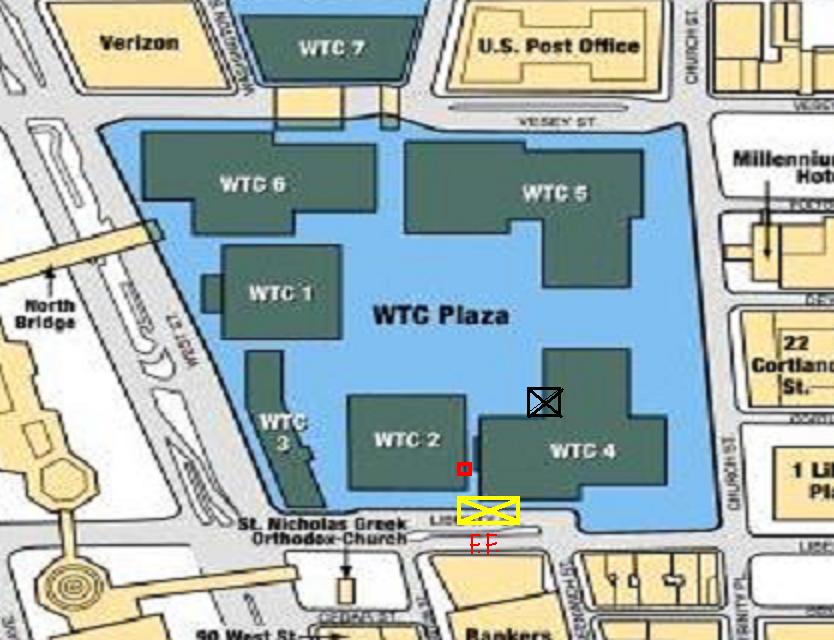 · |