|
#322
●
11-19-2013, 09:06 PM
| ||||||||
 My Rank: STAFF SERGEANT Poster Rank:877 Female Join Date: Feb 2010 Posts: 854 Mentioned: 1 Post(s) Quoted: 196 Post(s)
| ||||||||
|
Re: Death Pictures From Mount Everest
However I do believe that some places on this earth are not meant to be conquered. Just enjoy it's beauty from afar. Please.
|
|
#324
●
11-28-2013, 09:14 PM
| ||||||||
 My Rank: MASTER SERGEANT Poster Rank:540 Cock Join Date: Mar 2010 Posts: 1,856 Mentioned: 1 Post(s) Quoted: 65 Post(s)
| ||||||||
|
Re: Death Pictures From Mount Everest
Even though some say its a walk in the park to climb Everest, the facts are that it is a long, long grueling climb. To get to base camp it is an 11 mile hike from the airport. The temperature for this walk is usually between -4 and -6 degrees Celsius. You then camp at Base Camp to acclimate your body from 4 to 12 weeks. You then start climbing to Camp 1 until you acclimate your body to those heights. Then Camp 2, then Camp 3. After Camp 3 there is only one more Camp, Camp 4. Camp 4 is in the Death Zone. This is the area above 8000 meters where your body starts dying because of lack of Oxygen. Most can survive up to 48 hours without bottled Oxygen in the death zone. However you can sucumb to Acute Pulmonary Edema which is fluid that builds up in your lungs. You will start coughing and eventually you will drown in your own fluids. Or you could be unlucky enough to get Acute Cerebral Edema which is fluid that builds up on your brain, causing pressure to build up. This will cause seizures, dizziness, confusion, hysteria and possible hallucinations. Both can cause death, and if you are in an extreme area like Everest, it will cause symptoms and death faster. Temperatures at Everest's summit never get above -15C during the climbing months, and are usually at -20C to -30C. In the winter months the summit can easily get lower than -40C. There is only 2 months out of the year that climbers can climb on Everest. Wind speeds are usually low during climbing months. They can easily reach above 175 Miles Per Hour in the winter months. A category 5 Hurricane is only 156 MPH. A climber then is climbing after spending weeks in sub zero weather. They are walking through snow sometimes waist deep. They have to cross the ice field. This is a broken glaicer with blocks of ice you have to cross. Some as large as houses. The ravines between and throughout this area are so deep you cannot see the bottom. This is actually where most deadly accidents happen. The climbers try to cross a ravine and fall in. More climbers have been killed in this region, both comming down and going up, than any other part of Everest. Because this is an active glacier any bodies in this area are ground up and spit out in pieces. To reach the summit is a 12 hour ordeal. You have to cross the ice field climb, rappel, belay, hike through snow and ice in subzero temps and mind numbing wind, in the dark, all the while changing your oxygen bottles when they get empty. When you near the summit it will be light by then, but you have one last hurtle to cross. It is called The Hillary Step. You climb up this rock wall and snow and ice slope, then it is a short distance to the top of the world. Then, yes then, you have to do it all over again to get back down. No wonder people die more on the way down then the way up. |
|
#325
●
11-28-2013, 09:24 PM
| ||||||||
| My Rank: MASTER SERGEANT Poster Rank:540 Cock Join Date: Mar 2010 Posts: 1,856 Mentioned: 1 Post(s) Quoted: 65 Post(s)
| ||||||||
|
Re: Death Pictures From Mount Everest
I have studied this pic for a long time. This climber died in a most unusual position. Then I noticed one thing missing. Besides warm clothes there is one thing no climber is without. Know what it is? No climber could survive without a pack. This climber died with a pack on his back. He was leaning against it. Some time after he died some other climber took his pack. Leaving him in this unusual position. Also remember above when I said Everest has hurricane force winds in the Winter months? This means most exposed skin will be scoured from a body by the ice and high wind. So that is why the pics show skulls on the dead climbers. 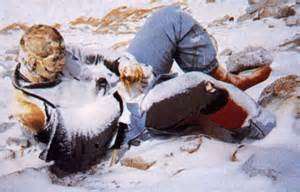 · |
|
#328
●
12-02-2013, 03:07 AM
| ||||||||
 My Rank: GUNNERY SERGEANT Poster Rank:650 Male Join Date: May 2013 Posts: 1,336 Mentioned: 3 Post(s) Quoted: 169 Post(s)
| ||||||||
|
Re: Death Pictures From Mount Everest
 Wow...that guy had been up there undiscovered since 1924  Imagine who else is up there that folks don't know about! |
|
#330
●
12-06-2013, 01:32 AM
| ||||||||
 My Rank: CORPORAL Poster Rank:1649 Male Join Date: Jun 2009 Posts: 331 Mentioned: 0 Post(s) Quoted: 33 Post(s)
| ||||||||
|
Re: Death Pictures From Mount Everest
If I ever climbed Mt. Everest, I'd tell my party that if I died, I want to be left up there with the rest of those guys, haha.
|