"The Wagnerites have established themselves on the borders of the Irkutsk region"
Can someone please tell me what's going on with the burning? Is it what I think it is?
Too bad they cleared a lot of trees for them
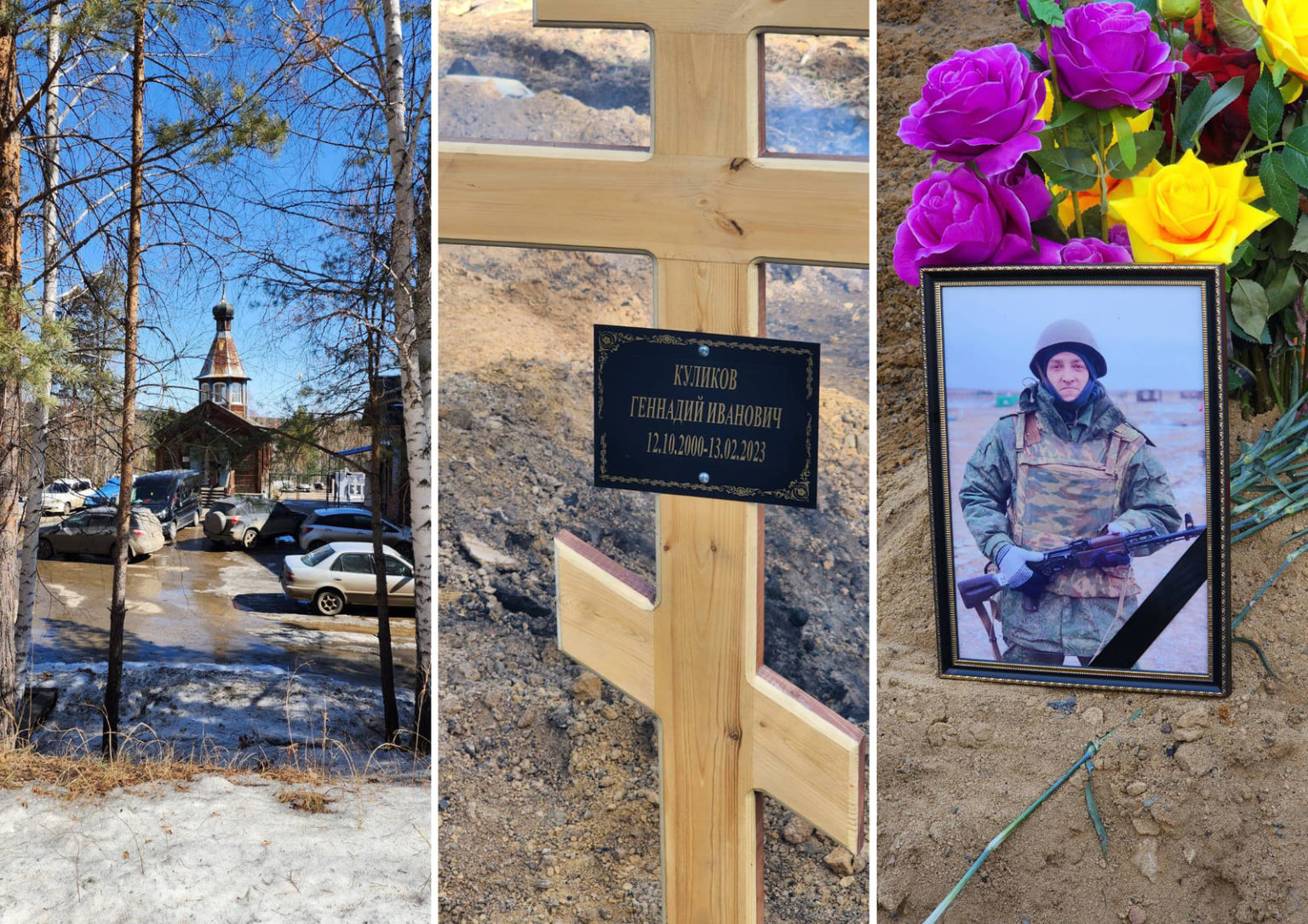
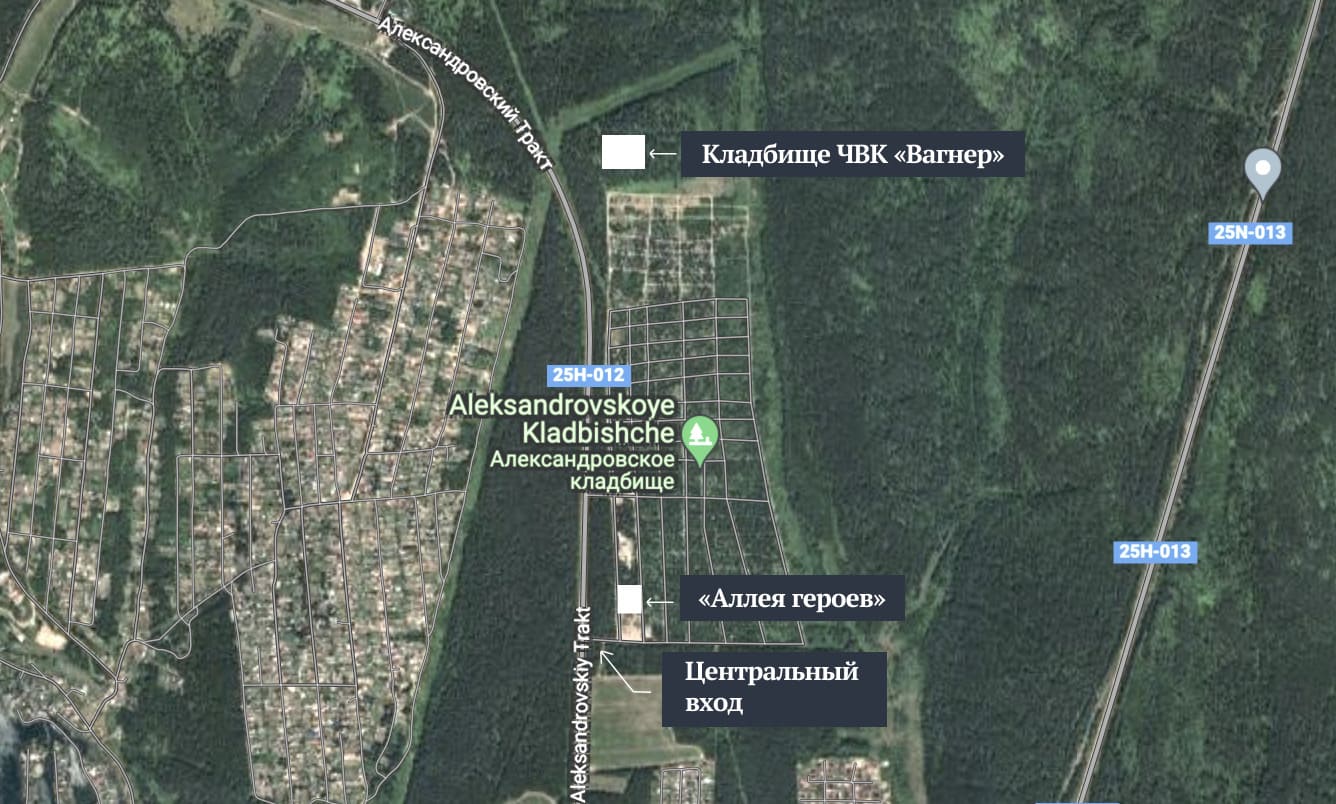
"People of Baikal" discovered two graves of soldiers killed in Ukraine. One of them was not known before. Both are located at the Alexander Cemetery near Irkutsk.
The first is the "Alley of Heroes" of 13 graves near the central entrance, the second is 53 graves of Wagner PMC mercenaries in the far corner of the cemetery. Relatives learned about the death of some of those buried there from LB journalists.
The sister of one of the victims in Wagner was told that such a cemetery does not exist.
Of the twenty hectares of land allocated for burial, only four are now occupied. “If I wanted to hide a mass grave away from prying eyes, I would bury it there,” said the former director of one of the Irkutsk cemeteries. All other city cemeteries have been used for a long time, it is difficult to find a large and empty area on them, which, obviously, will have to be expanded further.
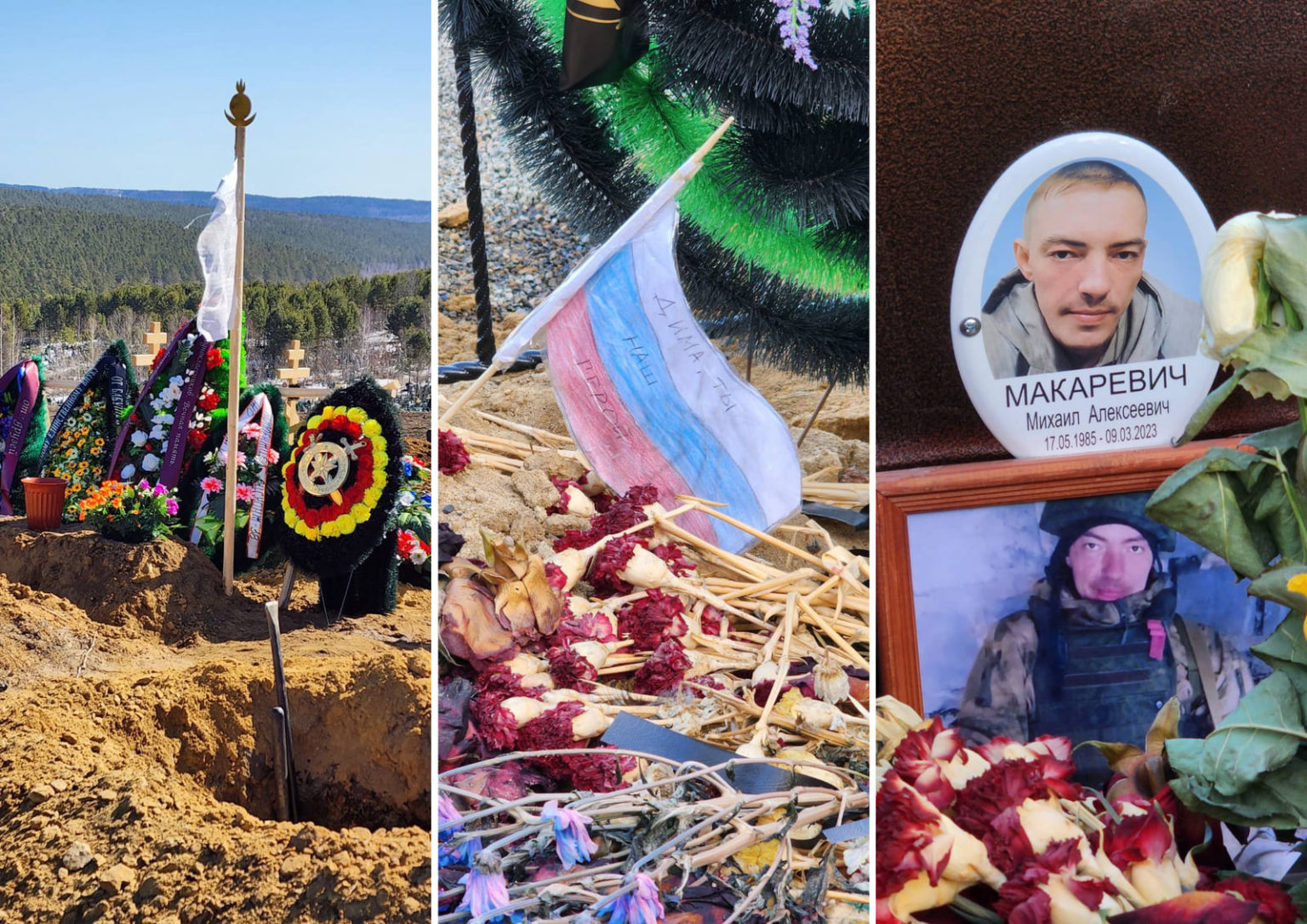
Mikhail Makarevich, a citizen of Irkutsk, was mobilized in the autumn and sent to regiment 1439. In January, February and March, soldiers from this regiment recorded video messages to Putin. It was said that they were sent for assaults without preparation, "for slaughter." Makarevich died in early March from shrapnel wounds - after the battle, he independently reached the hospital, but it was not possible to save him there.
Irina Makarevich, Mikhail's ex-wife, says that the Ministry of Defense offered her to choose any cemetery. But they warned that the Alley of Heroes had recently been opened on Aleksandrovsky. They promised that there "will be some kind of improvement." Irina decided to bury her ex-husband on the Alley, the funeral took place on March 23.
“The plot is flat, there are benches on both sides. Such a small parking lot is paved, next to a table and a brick wall - apparently, the names of the fighters will be knocked out. Everything is new, just [made],” says Irina.
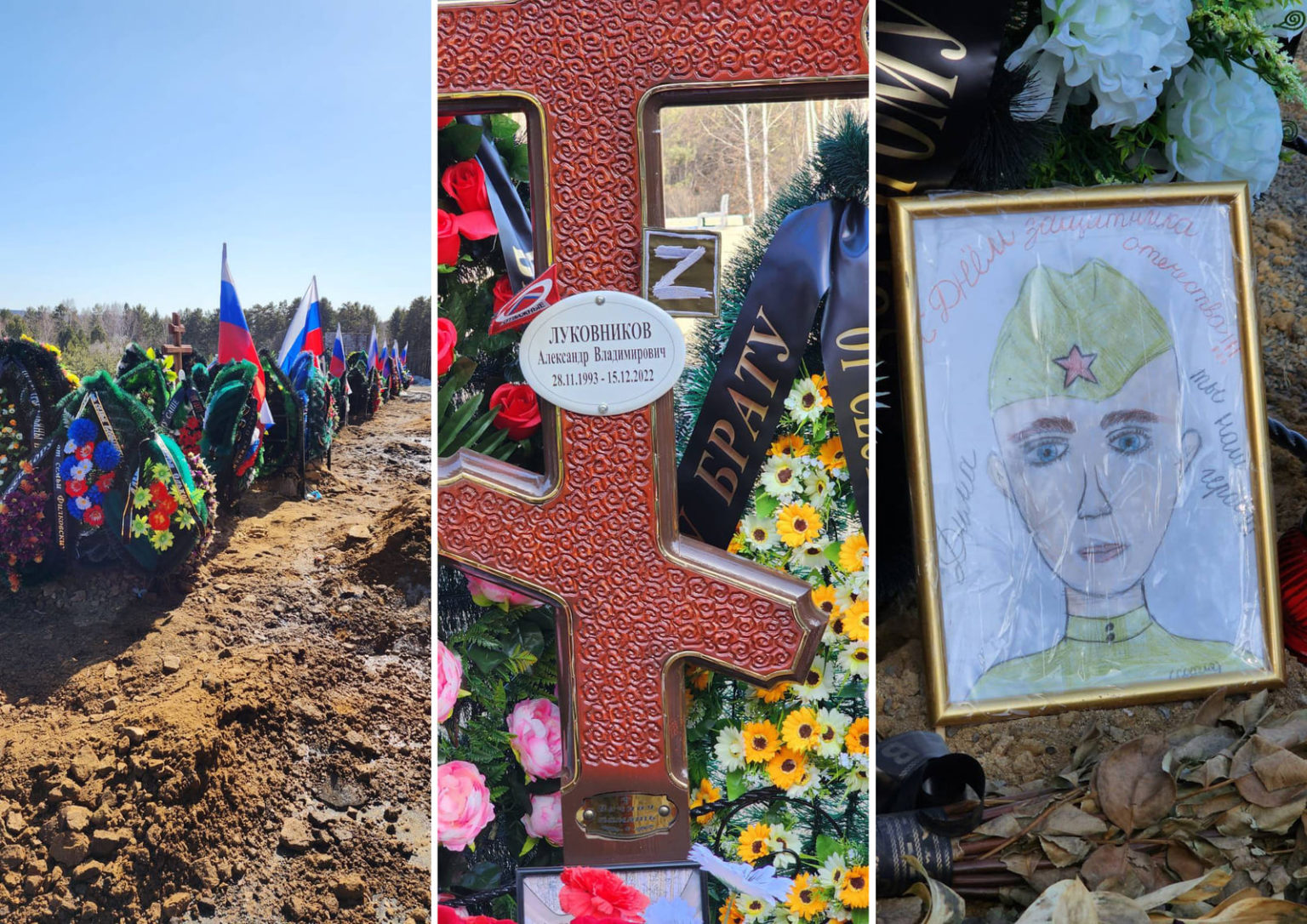
The first burial place of the dead soldiers is not far from the main entrance. 13 people are buried there, at least ten of them lived in the Irkutsk region. Where three more come from, LB journalists could not find out. Only six out of 13 people are on the list of the dead "People of Baikal", obituaries for them were published in open sources. The death of the rest was not reported anywhere.
It was possible to find out that at least three of the heroes buried on the Alley of Heroes were volunteers, two mobilized and one contract soldier. All of them died between December 2022 and March 2023. The youngest, 19-year-old Dmitry Vasiliev, signed a contract after two months of military service and died on December 3. The eldest, 53-year-old Igor Novoselov, died on December 12.
On the grave of 24-year-old Dmitry Kolbut there is a wooden cross, two lamps of red glass, a framed photograph. On a blue background, the inscription: “Beloved, only son. My hero. My memory. My life". Nearby is a children's drawing in a frame covered with cellophane film. The picture shows a soldier in a cap with a red star on his forehead and the caption: “Dima, you are our hero. Happy Defender of the Fatherland".
Makarevich saw the graves of Wagner PMC mercenaries at the Alexander Cemetery when she came to the burial service of her ex-husband. “They have a separate territory on a hillock,” she told LB. - When we were at Misha's funeral, there were also funerals. The guard of honor stood. Well, we didn't go there."
To get to the "Wagnerites" square, you need to go through the entire cemetery. PMC burial in the farthest corner, separate from the rest of the graves.
The site was cleared from the forest in late September - early October. It was at this time that the LB reader went to the Alexander cemetery and saw how it was being expanded - trees were being cut down on the edge of the plot.
She recorded a video and sent it to the editor. Satellite images also show that on September 15, trees grew in this place, and on October 2 they were gone.
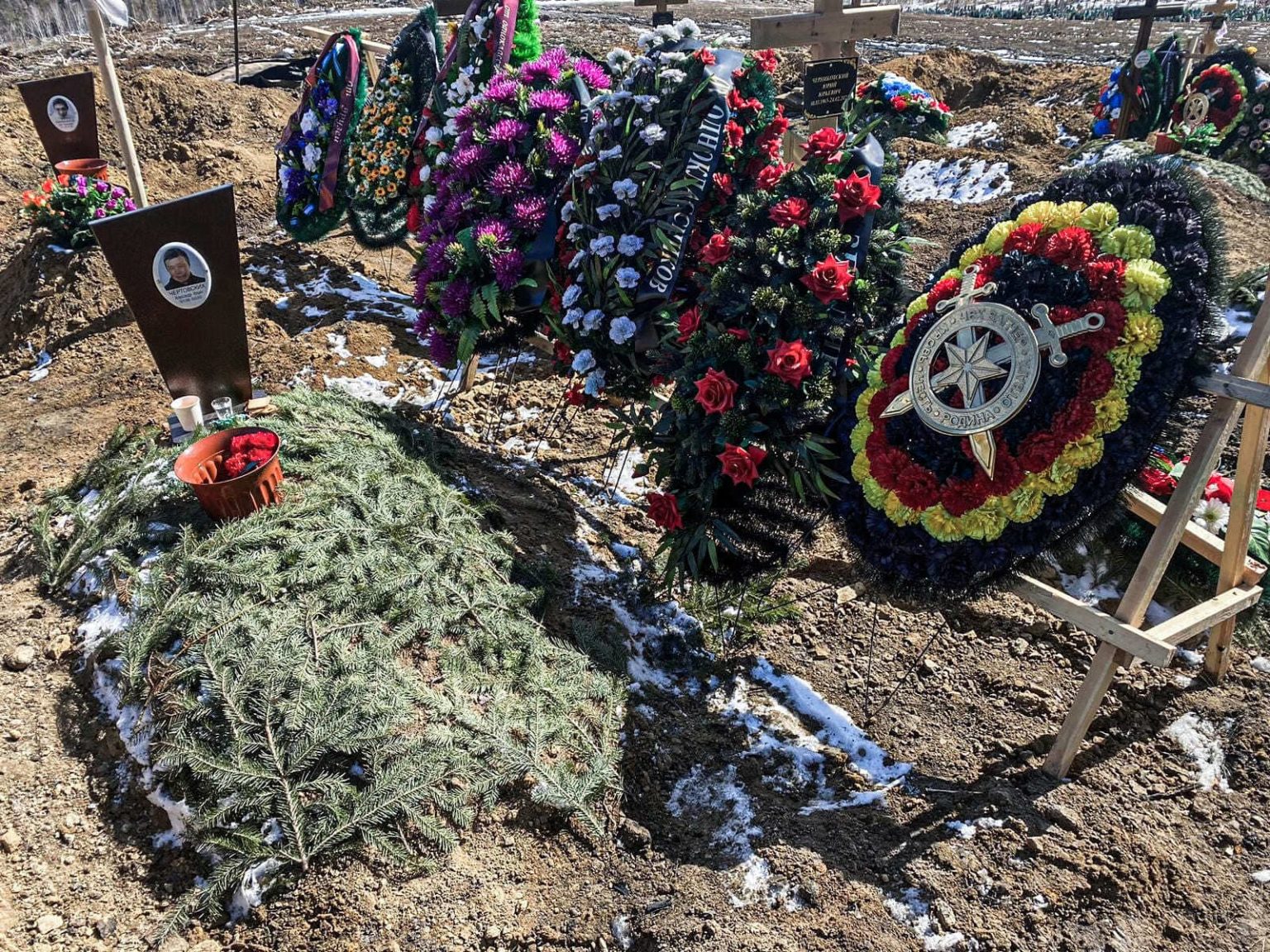
The graves begin immediately at the edge of the forest. The ground around is torn up, not completely uprooted tree roots stick out of it. There are no fences around the graves, at the head of each there is a wooden cross with a sign without a photograph. On the plates only the name, surname, patronymic, dates of birth and death. Each grave is covered with green spruce branches, on which lie two wreaths. One in the colors of the Russian tricolor, the second with the emblem of PMC "Wagner", which says: "Blood Honor Motherland Courage PMC Wagner." Only on some graves, in addition to crosses, are metal black monuments with photographs.
The graves are arranged in five rows. A sixth is being prepared behind them, more than a dozen empty graves have already been dug. The pits are black on the inside, some are covered with iron sheets from under which smoke rises. During the winter, the ground freezes to a depth of 2-2.8 meters. In March, snow still lies in the Irkutsk region, the earth does not have time to thaw, and it has to be warmed up with fires. The fire is kindled inside the pit, loosely covered with a metal sheet on top to retain more heat.
Kristina Chertovskikh, the sister of 62-year-old prisoner Alexander Chertovskikh buried here, says that she was promised by the PMC that the cemetery would be improved. “We were told not to buy a good monument, because they will decorate everything in the same style,” says Christina. “We erected an iron monument to Sasha.”
Of the 53 buried "Wagnerites", five are on the list of "People of Baikal", their obituaries were published in social networks or regional newspapers. These are Alexander Tashlykov, Sergey Gribachev, Vladimir Nokhoev, Ivan Pobokov, Alexander Chertovskikh. The death of the rest was not reported.
It was possible to find out that 17 of those buried at the "Wagner" cemetery were born or lived in Transbaikalia, 20 - in the Irkutsk region, 11 - in Buryatia.
At least 43 of the dead were prisoners, aged between 20 and 62. Their verdicts are in the open bases of the courts. 17 "Wagnerites" were convicted of murder, the rest - for theft and drugs. The convictions of ten "People of Baikal" could not be confirmed.
Vitaly Volkov, who was buried here, in 2021 killed a retired owner from whom he rented a summer kitchen. He tied up his wife, threatened to rape him, and beat him. Then he stole a jigsaw, a TV, a saw and a laptop and left. He received a sentence of 14 years in prison. The same term was given to Aleksey Saprankov, who beat a friend with a hammer, threw the corpse into the underground, took one hundred thousand rubles and disappeared. Gennady Zhdanov strangled a drinking buddy for calling him a "******". Then he went outside, found the police and confessed to the murder. They did not believe, then Zhdanov led them to the corpse. Got seven years.
Roman Markidonov, 59, was sentenced to 16 years for possession of a weapon, as well as the murder of one and the attempted murder of two people. It follows from the verdict that the guys who had a picnic by the river offended him with something. Having quarreled with them, he went home, took a gun and, returning, shot the company. At the trial, he said that "I did not want to kill, the bullet hit by fate." He signed a contract with PMCs in IK-5 of Chita, five months before his death.
At least four "Wagnerites" were orphans. Alexei Novikov lost his parents as a child, according to his lawyer. The fact that Grigory Rasputin and Igor Chipizubov also grew up without parents was confirmed by their classmates to LB. That Ivan Pobokov was an orphan, his cousin told.
Many had difficult relationships with relatives. Alexander Lesov and Sergey Gribachev are deprived of parental rights. Lebanon Borsch was limited in parental rights. Borsch stabbed his wife in the stomach. She did not die and said at the trial that she had no claims against Borsch. Alexander Yakovlev served nine and a half years for murder. When he got out, he beat his father and got another year in prison. Pavel Demidov robbed his uncle.
For the first time, we learned about the Wagner cemetery in Irkutsk in March 2023. An obituary appeared on social networks about a resident of Buryatia, 23-year-old Alexei Novikov, who, as the authors reported, was almost buried in the "fraternal cemetery in Irkutsk."
Novikov left the colony for the war as a volunteer for the Wagner PMC: he was imprisoned for possession of drugs. Alexey was buried by his former lawyer Elena Okladnikova - it turned out there was no one else. It was Okladnikova that Novikov indicated as a confidant - she was supposed to be informed if Alexei was killed.
Elena received a call from Wagner PMC on March 6th. A male voice said: "If [Novikov's] body is not claimed, he will be buried in the fraternal cemetery in Irkutsk." Then Okladnikova asked to bring the coffin to the village of Petropavlovka, Dzhidinsky district of Buryatia, where she herself lives. On March 8, Alexei's body was delivered to the village, the funeral took place at the local cemetery. LB journalists contacted Elena, but she did not know where exactly in Irkutsk the fraternal cemetery was located, which the representative of the PMC spoke about.
A couple of days later, Lyudmila Gilyazova from the Dzhidinsky district of Buryatia told the People of Baikal about the Wagner cemetery in Irkutsk. Her 24-year-old son Rasim Igumnov was also a Wagner PMC volunteer: he was serving a three-year sentence for stabbing a drinking buddy. Rasim died on December 31, 2022. “I was told: either you take the corpse, or we will bury it in a mass grave in Irkutsk,” Gilyazova recalls her conversation with Wagner representatives. Lyudmila asked to bring her son. The PMC delivered Igumnov's body to Ulan-Ude, but they refused to take it to the village. His relatives picked him up.
The first photo from the “fraternal cemetery” was published on social networks by the cousin of the “Wagnerian” Ivan Pobokov, Victoria Elsgolts. Pobokov, 24, is also an orphan from the Dzhidinsky district of Buryatia. As a child, he lost his father and mother. He ended up in a colony in 2022 for possession of drugs, died on December 30, 2022 near Bakhmut. He was buried on March 14 near Irkutsk. None of the relatives knew about Ivan's death and were not at the funeral.
Victoria told LB that before leaving for the war, Pobokov appointed his fellow villager as his confidant, whom he sometimes chopped firewood. Victoria suggests that when the woman was informed of Ivan's death, she replied that "he has no relatives, and she will not bury him here." So Pobokov ended up at the Alexander cemetery.
Relatives learned about Ivan's death after the funeral. “Rumors [that he was killed] appeared in the winter,” Elsholtz said. “We asked this woman from the village to call the PMC and find out where he is. She told us that he works as a nurse in Rostov. We calmed down. Then again rumors began to circulate about his death. We ourselves found Vanya's colleagues who informed us about this. And I started calling the Wagnerites.”
On March 20, a week after the burial, Victoria got through to the Wagner PMC, where Ivan's death was confirmed.
Victoria published on social networks a photo of Ivan's grave, which was sent to her by representatives of a private military company: two wreaths lie on coniferous branches, one black and red from Wagner PMC, the second, unsigned, in the colors of the Russian flag. A simple wooden cross, a black nameplate. Behind the photo are several more of the same graves.
Victoria Elsgolts told People of Baikal that the relatives decided not to transport Ivan's body from Irkutsk to Petropavlovka, where he lived. “The priest said: the earth is one, let's not disturb him,” she explained. - Let's make something like a grave next to Vanya's parents. We’ll just put up a photo, flowers, a monument so that we can at least go there.”
62-year-old Alexander Chertovskikh from the small Evenki village of Vershina Tutury, Kachug district, Irkutsk region, ended up in a colony for stealing a mobile phone. In September last year, he was sentenced to two years in prison. This was far from the first term for Alexander: the Kachugsky District Court had already tried him several times for theft, robbery and intentional infliction of moderate bodily harm.
On February 8, Chertovskikh called his older sister Kristina from the colony and said that he was being "taken away." On February 23, he died near Bakhmut. On March 10, Wagner PMC informed Kristina about the death of her brother. They buried him on March 22.
Kristina Chertovskikh told People of Baikal that she was offered to bury her brother at Aleksandrovsky in Wagner, but they did not insist on this particular cemetery. “At first I wanted to take him to my native village, but there were no relatives left there at all and the road there was terrible. My acquaintances told me that Wagner bought the land on Aleksandrovsky and would sort of ennoble the territory there. And I decided: well, Sasha - to fellow soldiers.
He had no wife and children. Alexander indicated his sister as a confidant. “The relatives all spat on him, I was the only one who was engaged in it,” Christina explains. - I made transfers, I wanted to rent a house for him when he would be released. In principle, he was a normal person, it’s just that life happened that way.”
Kristina showed the People of Baikal reporters a note that Alexander gave to his niece at the trial in September 2022. In the letter, Chertovskikh lists what he needs to give: sausage, lard, cookies, ointment from the fungus. At the bottom, in clear, legible handwriting, is written: “Thank you for everything! I won't bother you anymore!"
“Now I only think that maybe Sasha stole the phone in order to go to prison, and from prison to the war,” Chertovskikh thinks. - He was a patriot, our father is a front-line soldier. Maybe Sasha would have gone to the military registration and enlistment office, but they wouldn’t have taken him - 62 years old and a convict. You see, he had already made up his mind. A note like a farewell.
According to the sister, the body of the Chertovskys was brought to Irkutsk by military aircraft from Novosibirsk. From the airfield, Christina says, the coffin was brought to the ritual hall on Baikalskaya Street. There was no farewell in the hall: Alexander's relatives gathered in the yard and went to the cemetery after the hearse.
The funeral was attended by seven relatives of Chertovsky and four local soldiers with a commander who fired into the air. Who invited them, what unit they are from - the Chertovskys' relatives do not know. Among the guests was only the head of the district Evenki community. Christina also hired a mourning ceremony leader, which was recommended to her at Wagner. There were no representatives of the PMC itself at the funeral.
“I asked the presenter if anyone would be with the PMC,” recalls Christina Chertovskikh. - She answered: well, your brother has relatives. And she said that if no one comes to the funeral, then they come from the Wagner. The presenter also said that Sasha is the second age from this part of the cemetery. The rest are all young people. As I understand it, this is not the first time she has led such ceremonies for the Wagnerites.”
Several families of the victims immediately informed the People of Baikal that the funeral of their loved ones was organized by MUE Ritual. This is the largest ritual service in Irkutsk. In addition to Alexandrovsky, she manages three more municipal cemeteries.
They refused to talk to reporters. “I won’t talk to you about anything,” the service employee said. “We have an order from the [city] administration that only the director gives all interviews and gives only with the consent of the administration.”
"People of Baikal" sent a request to the press service of the administration of Irkutsk. At the time of publication, we have not received a response.
Several families that the "People of Baikal" managed to contact after visiting the Alexander cemetery did not know that their relatives had died in the war.
Alexander Dmitrievich Durnev was buried on the "Wagner" site. He was born on May 9, 1981. The journalists of the "People of Baikal" found a person with the same personal data. Durnev is a native of the village of Ulyatui in the Trans-Baikal Territory. Later he moved to Chelyabinsk to live with relatives, and in 2021 he received eight years in prison for murder in a drunken brawl.
Through social networks, the journalists of People of Baikal managed to contact Alexander's sister Ksenia Durneva. She lives in the village of Ulyatui, Trans-Baikal Territory. Xenia did not know that her brother was dead. She phoned the Wagner PMC, where Durnev's death was confirmed. Representatives of "Wagner" also told her that her brother was buried at the Alexander cemetery.
“I don’t know why I didn’t get a call [from the PMC] earlier,” Ksenia wonders. - I asked them - they answer that they could not get through. But I don't remember missing calls. Now I always take unfamiliar numbers - suddenly these are my guys.
Three brothers were taken from 26-year-old Durneva to the war. Dmitry was mobilized. Denis and Alexander became volunteers for the Wagner PMC: both served time in prisons. The fourth brother, Andrei, refused to fight: he was also convicted, but he had a few months left before his release.
Ksenia says that Alexander called her from the colony in November last year. “He said that he was going to Ukraine, took my phone number, passport data,” Durneva lists. - He said that the other day he wrote a will - and that I would receive the same salary as yesterday. I asked why he decided [to go to war]. He's like, well, he's decided. Let my nephews use my money.”
On January 16, Durneva was summoned to Chita by Wagner representatives. They told me to drive to a local hotel. There, Xenia was given Alexander's salary for January in cash. After that, the payments stopped. Durneva applied to Wagner in February and March, but they told her that they "did not have any information [about Alexander]." “They said that if something is known,“ we will inform you. And no one said anything, ”says Ksenia.
When the journalists of People of Baikal sent Xenia a photo of the grave where her brother might be buried, she again began to call the PMC. Durneva was given the phone number of a certain Sergei, who deals with the dead "Wagnerites". Ksenia contacted Sergey via WhatsApp, and he replied (the screenshot of the message is in the editorial office):
“Unfortunately, I confirm the death. He died on March 24 in Artyomovsk from an intracranial injury. The company called you, but you did not answer, so the body was interred in Irkutsk, the Alexander cemetery. Due to the fact that the company could not get through to you, the company buried it on its own.”
Durneva thanked the People of Baikal journalists for finding her brother’s grave: “God bless you, if it weren’t for you, I wouldn’t know anything at all ... And now I will be paid all the compensation due.”
The wife and children of 59-year-old Roman Markidonov from the village of Akima in the Trans-Baikal Territory also learned about the death of a relative from the journalists of People of Baikal. In 2021, Markidonov received 16 years in prison for murder, attempted murder and possession of a weapon. He died on January 28, 2023 in Ukraine. Buried at the Alexander Cemetery.
We found Roman's son Alexei Markidonov on social media. Alexey said that his father signed a contract with Wagner PMC about five months ago and "there was no more news from him." Markidonov Sr. served time in correctional colony No. 5 in Chita. “They said in the colony that they were not responsible for the former prisoners and they had no information,” Aleksey explained. He did not know whom his father had indicated as a proxy.
PMC "Wagner" did not inform the Markidonovs about Roman's death and where he was buried. After the "People of Baikal" contacted Alexei, he began to call "Wagner" himself. “Everything was confirmed, this is my father,” Markidonov wrote a few days later and refused to communicate, because “now everyone is not up to it.”
From the stories of relatives, "People of Baikal" managed to find out that for the death of a "Wagnerian" the family receives five million rubles "coffin". Another hundred thousand rubles are allocated for the funeral itself. If relatives are not found, the PMC conducts the funeral and does not pay compensation to anyone.
The curator from the PMC contacts the relatives of the volunteers in advance, sets the date and place of the meeting. Relatives are introduced simply by name. Most often - "Sergey", "Zhenya" and "Igor". The curator names the time and place where you need to come for money. Most often these are hotel rooms. There, "Sergey", "Zhenya" or "Igor" from PMCs give out salaries and "coffin" cash in cash.
Lyudmila Gilyazova from the village of Dzhida in Buryatia twice received 100,000 rubles (the salary of her son Rasim Igumnov, who spent two months in the war) at the Buryatia Hotel in Ulan-Ude. Igumnov died on December 31, the "coffin" for him was given to Lyudmila in mid-April - already in Irkutsk. “There was some kind of skyscraper, I don’t remember the address,” Lyudmila says. A man was sitting in a small office, his name is Zhenya. He said that he himself came from the front after being wounded. Wept with me."
Lyudmila received from Zhenya five million "coffin" rubles in cash. Another 100 thousand was given to her for the funeral. Gilyazov was also awarded the "Wagner" Rasim medals. Lyudmila signed for the money received in some kind of statement and went back to Buryatia.
Ksenia Durneva was summoned for the salary of her brother Alexander to a hotel in Chita. From her village Ulyatui to Chita - almost 350 kilometers. In January, she received 142 thousand rubles. Then the payments stopped because my brother died. Last week, "Sergey" from the PMC promised Durneva that she would receive the "coffin" in a month and a half.
“Sergey told me that, most likely, they would be called to Irkutsk,” said Ksenia LB. - I write to him: it’s far away, I have a five-month-old child, I’m closer to Chita. Sergey wrote that then the curator would have to explain, they would come up with something, they would get into position.
Kristina Chertovskikh from Irkutsk was asked to come for the "coffin" to her brother Alexander in Novosibirsk. “I say: so I am in Irkutsk. They answer me: planes fly, ”said Christina LB. “Well, my daughter took the tickets, I flew out the next day.”
Chertovskikh did not answer the question, where in Novosibirsk they gave out money from PMCs. But she noted that relatives of 47 victims from different Russian cities came to this place. “There were from Tomsk, Omsk, Altai Territory, even from Chita,” Christina recalls.
Wagner allocated 100,000 rubles to Kristina for the burial of her brother. She refused to name the amount of "coffin".
"People of Baikal" sent a request to PMC "Wagner" to find out how many more dead they plan to bury there and why people from different regions are being brought there. At the time of publication, no response had been received.
Maxim Sergeevich Gerchikov is buried at the Alexander Cemetery. His date of birth is June 4, 1999. With such data, there is only one person in the all-Russian database of bailiffs, as well as in the GAS "Pravosudie" system. Gerchikov was born in the village of Kurumkan in Buryatia, then moved to Ulan-Ude. In 2018, the Sovetsky District Court of Ulan-Ude sentenced Gerchikov to six years in prison for 12 thefts and carjacking.
Maxim Gerchikov's sister Lyubov also lives in Ulan-Ude. She confirmed that her brother was in a colony, and then became a volunteer for the Wagner PMC. “He went there [to the war] and didn’t tell me anything. I learned from strangers. We haven’t talked for a long time, ”wrote Love. She didn't know if Maxim was alive.
We sent Gerchikova a photograph of the grave where her brother may have been buried. Lyubov started dialing the Wagner PMC. She managed to do it three days later, on the seventh of April. In Wagner, Gerchikova was told that scammers could have sent the photo. “I just hinted at the cemetery in Irkutsk - they told me right away: this is a fake! — said Gerchikova in a voice message to the LB journalist. “Like don’t trust anyone until the official notice comes.”
However, a PMC employee named Sergei told Lyubov that he would be able to find out the exact information about Maxim Gerchikov the next day. On April 7, Sergei actually contacted Gerchikova and said that Maxim was not on the list of the dead. Lyubov demanded that the People of Baikal journalists give the names of those who were at the Alexander Cemetery, and promised to go to the prosecutor's office, as the editorial office "throws off false information."
“But you can go to the cemetery and find the grave,” suggested the journalist of People of Baikal.
“The fact that they said in the PMC is enough for me,” Lyubov answered.
PS While the publication was being prepared, from March 30 to April 16, four fresh graves appeared at the Wagner PMC cemetery. Sergey Kravchenko, Mikhail Plyaskin, Vladimir Sushkin, Vladimir Semin are buried in them. The journalists of "People of Baikal" did not find obituaries for these people. For 16 days, the workers dug out another two dozen empty graves. Now there are about thirty of them, ten holes each in three rows.
Truly. What I was expecting was an overwhelming display of technological and tactical prowess. What they have shown so far is the exact opposite.
Let's start with the giant "Z" or "V" on their battle tanks, APC's, launcher batteries, etc. FFS, can any Russian someone find a more subtle method to identify which equipment to not set on fire?!? Don't get me wrong, I love that they do it for obvious reasons, but damn... Some little IFF transponder would take care of business.
Well, both sides actually do this...especially if they share the same equipment(same soviet made stuff).
You are more likely to get killed by your own guys than the enemy that spots you thanks to the markings on your tanks/uniform.
That's why Ukrainians don't really bother with camouflage on their uniforms / faces either and identify themselves with bright yellow ribbons. It seemingly goes against the logic( why wear a camo-uniform ) and then break it's main purpose of concealment by making yourself clearly visible with those ribbons, but they have done the math and reached the conclusion that it's worth it.
Ukraine has even gone a step further and attacked with large Ukrainian flags on their vehicles.
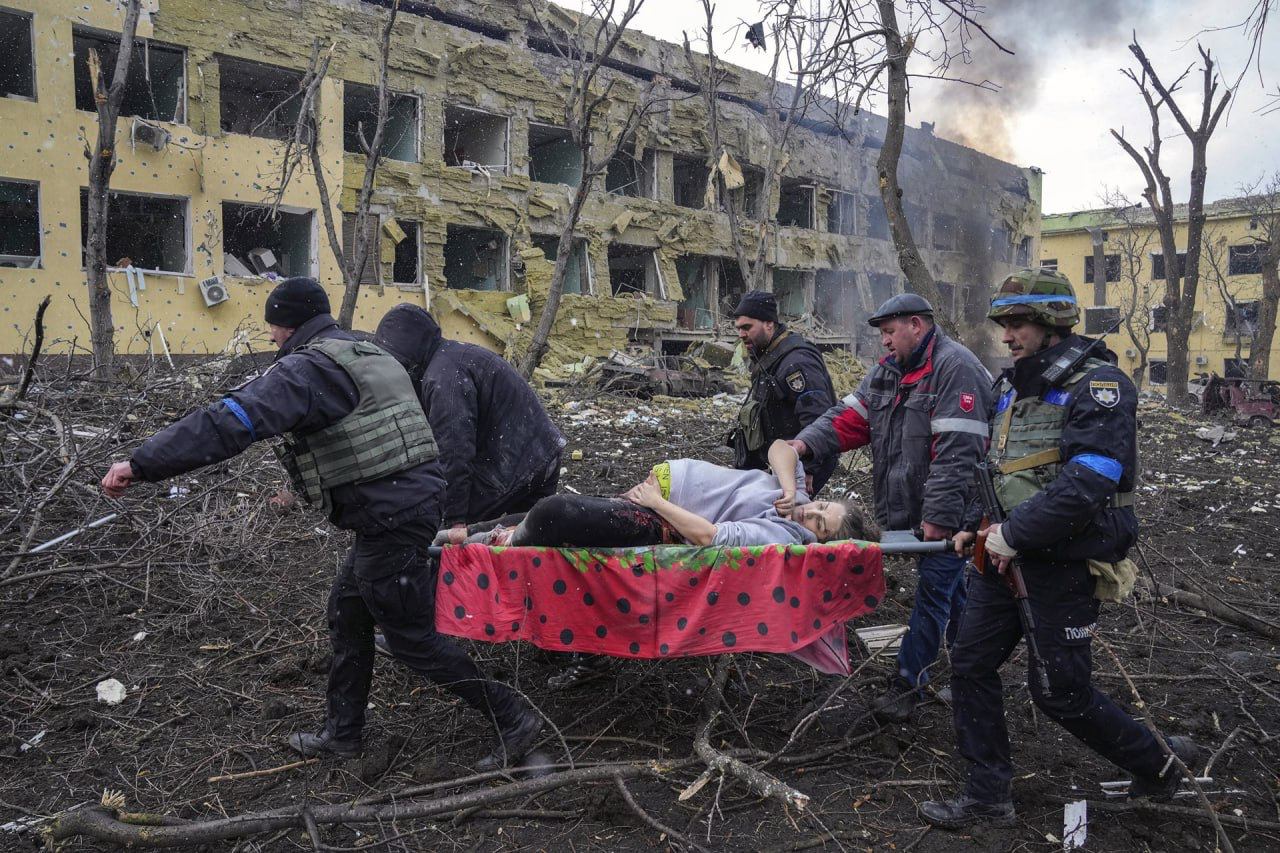
"Ukrainian photographer Yevhen Malolietka became the world winner of the World Press Photo contest. He was recognized for his photograph of a pregnant woman being carried by rescuers on a stretcher through the rubble after the bombing of a maternity hospital in Mariupol on March 9, 2022. The photo shows Iryna Kalinina, who first lost her child and died shortly afterward."
Darth Putin: "This giant sequence of fuck ups and goodwill gestures are all part of the plan. Please ignore all our previous predictions. We always intended to win slowly with catastrophic losses"
they have methodic war, with most of the people here dont even understand. For example, if they fought like barbaric USA, bombing directly cities, civilians etc. fast war - etc. Bakhmut would fall in few days with massive casaulties on citizens etc. with is not russian way of fighting.
Slowly I am starting to understand this Russian way of fighting.
The pits are black on the inside, some are covered with iron sheets from under which smoke rises. During the winter, the ground freezes to a depth of 2-2.8 meters. In March, snow still lies in the Irkutsk region, the earth does not have time to thaw, and it has to be warmed up with fires. The fire is kindled inside the pit, loosely covered with a metal sheet on top to retain more heat.
To thaw the hard frozen ground for easier digging.











 Some little IFF transponder would take care of business.


