JavaScript and Cookies are required to view this site. Please enable both in your browser settings.
Russian/Ukraine War Discussion Thread IX - Section 50

Russian/Ukraine War Discussion Thread IX 

Current Rating:

Unlimited Views No Ads No Algorithms Lifetime Account

Documenting Reality

Community Forum · Est. 2006

Join Now
Thread Tools
  #491  
09-23-2025, 03:50 PM
WonderMomma's Avatar
WonderMomma
Offline:
☾ Administrator ☽
Poster Rank:76
ஜᎻᎬᎩᎾᏦᎪஜ
Join Date: Dec 2011
Posts: 19,651
Contributions: 32
 
Mentioned: 181 Post(s)
Quoted: 6921 Post(s)
Activity Longevity
11/20 15/20
Today Posts
0/11 ssss19651
Re: Russian/Ukraine War Discussion Thread IX

I'm just curious what he thinks a round of tariffs will do that sanctions didn't? Russia seems to have an unending supply of weapons, will and determination to continue the war in Ukraine, regardless of any and all previous actions by nations against them.
__________________
💜🧿See Human | Be Human🧿💜
(War Section Hashtags)
▼ PROMO FROM DOCUMENTING REALITY
No surprises here
Join Now
Hidden for upgraded members.
  #492  
09-23-2025, 06:43 PM
scorpion9's Avatar
scorpion9
Offline:
My Rank: STAFF SERGEANT
Poster Rank:720
Join Date: Jul 2009
Posts: 1,140
 
Mentioned: 2 Post(s)
Quoted: 573 Post(s)
Activity Longevity
0/20 18/20
Today Posts
0/11 sssss1140
Re: Russian/Ukraine War Discussion Thread IX

I'm just curious what he thinks a round of tariffs will do that sanctions didn't? Russia seems to have an unending supply of weapons, will and determination to continue the war in Ukraine, regardless of any and all previous actions by nations against them.
He doesn't think anything imo. I'm sure asking Europe not to buy russian energy is something US oil and gas tycoons put into his head and told him to say. Its easy for the US not to by russian oil and gas because they produce enough oil themslelves. For europe to quick russian energy cold turkey is just not feasible.
Its like asking US not to use oil and gas for a few years, until they build new ports and energy infrastructure.
3 Users Say Thank You For This Post:
Guns N' Coffee, kellyhound, WonderMomma
  #493  
09-24-2025, 03:46 AM
kellyhound's Avatar
kellyhound
Offline:
✝Mudderator from Hell✝
Poster Rank:11
e-mail
Join Date: Oct 2006
Posts: 95,414
Contributions: 817
 
Mentioned: 473 Post(s)
Quoted: 10156 Post(s)
Activity Longevity
18/20 20/20
Today Posts
4/11 ssss95414
Re: Russian/Ukraine War Discussion Thread IX

He doesn't think anything imo. I'm sure asking Europe not to buy russian energy is something US oil and gas tycoons put into his head and told him to say.

Its easy for the US not to by russian oil and gas because they produce enough oil themslelves.

For europe to quick russian energy cold turkey is just not feasible.

It's like asking US not to use oil and gas for a few years, until they build new ports and energy infrastructure.

a little breakdown:
Amid last month's diplomatic efforts to pressure Russia into peace negotiations, new data showed that the European Union had imported Russian liquefied natural gas (LNG) worth around €4.48 billion ($5.23 billion) in the first half of 2025.

This was an increase from €3.47 billion over the same period last year, according to the EU statistics office Eurostat.

The bloc has been pushing to end its energy dependence on Russia since the full-scale invasion of Ukraine started in February 2022, aiming to curb Moscow's ability to finance the war.

Unlike Russian oil and coal, the EU has not imposed an outright ban on gas, due to ongoing dependencies among some member states.

LNG and gas via pipelines, including the TurkStream pipeline, continue to flow into the bloc, albeit at much lower levels than before 2022.

However, the European Commission has drawn up plans to phase out all Russian gas and oil imports by 2028.

Under the proposal, new contracts would be prohibited from January 1, 2026. Existing short-term contracts would end by June 17, 2026, and long-term contracts would be banned from January 1, 2028.

These measures still require approval from the European Parliament and by at least 15 of the 27 EU member states, representing 65% of the bloc's population.

Hungary, Slovakia rely on Russian oil:

Significant inroads have been made. Russian oil imports have shrunk from 27% at the beginning of 2022 to 3% in 2024, according to the commission.

By comparison, gas imports from Russia decreased from 45% in 2021 to 19% in 2024.


Hungary and Slovakia are the only two EU countries to still import large amounts of Russian oil. The pair, alongside the Czech Republic, were given an exemption to the EU embargo on Russian oil.

The Czech Republic made efforts to end its reliance and has not imported Russian oil since April, thanks to an expansion to the western Transalpine Pipeline (TAL), which transports oil from the Port of Trieste.

Hungary and Slovakia, on the other hand, have not sought to wean themselves off Russian energy.


Recent attacks by Ukraine on the Druzhba pipeline underlined their reliance and the resulting supply instability.

Ukraine regularly strikes Russian oil and gas infrastructure in response to attacks on its own territory since the start of Russia's full-scale assault.

There is a possible alternative, but the two countries are reluctant to rely on receiving their oil via the Adria oil pipeline.

"Since the capacity of the Croatian pipeline is smaller than Hungary's and Slovakia's demand for oil, if deliveries via the Druzhba pipeline become impossible for a long time, then the oil supply to Hungary and Slovakia will also become impossible," Hungarian Foreign Minister Péter Szijjárto said last week.

"Not for political reasons, but because of physical reality. Energy supply is not a political or ideological issue, you need the pipeline and the oil in it," he added.

Croatia disputes this, with Prime Minister Andrej Plenković and Economy Minister Ante Šušnjar stating that the Adria pipeline has sufficient capacity. They added that transport costs would decrease with higher volumes.

Despite these assurances, Hungary and Slovakia remain reluctant to rely more heavily on the Adria pipeline. (Because they are supported by the Kremlin imo)

Slovakia, which also receives natural gas from Russia, has said it will consider legal action if it is not granted an exemption from the new commission proposal or compensated for ending these imports.

Russian energy dependence wanes elsewhere:

Bulgaria stopped importing Russian gas in April 2022 when the government refused Gazprom's demand to be paid in roubles. Sofia received a temporary derogation for Russian crude oil until the end of 2024, but halted imports ahead of schedule in March that year.

Bulgaria continues to allow Russian gas to pass through its territory via the Balkan Stream pipeline, an extension of TurkStream that runs from Turkey to non EU-member Serbia.

This transit will be exempt under the proposed new ban as it is delivered to a country outside the bloc.

However, much of the gas ultimately reaches Hungary - a practice that will have to end under the new EU ban on Russian gas.


France fuels Russian LNG imports:

When it comes to Russian LNG, some European countries are more reliant than others.

In 2024, France, Spain and Belgium accounted for 85% of Europe's Russian LNG imports.

Last year's rise in imports was propelled by France as well as the Netherlands, which boosted their Russian LNG imports by 81% compared to 2023, according to the Institute for Energy Economics and Financial Analysis.


By contrast, other countries have much lower exposure to Russian gas overall. In Italy, the EU's third largest economy, less than 2% of total gas imports come from Russia.

Germany has completely ended Russian gas imports, although state-owned SEFE - formerly Gazprom Germania - continues to import Russian LNG into the EU under an old long-term contract.

To achieve a comprehensive phase-out of Russian energy imports by 2028, the bloc faces a complex task: balancing security of supply, market stability and political consensus, while continuing to diversify sources and infrastructure.
The content of this article is based on reporting by AFP, ANSA, BTA, CTK, dpa, HINA, TASR and STA as part of the European Newsroom (enr) project.

European capitals are speaking with increasing urgency about the need to cut off Moscow’s sources of revenue for the war in Ukraine.

But the sharper the rhetoric, the more glaring the gap with practice. London condemns Russian aggression yet continues to buy gas through France’s TotalEnergies.

Austrian machinery still finds its way into Russia despite sanctions. And in The Hague, a court recently lifted a freeze on Gazprom’s assets, allowing the company to regain control over parts of its overseas holdings.

This dissonance between rhetoric and reality is particularly stark in France. President Emmanuel Macron delivers some of the harshest statements against the Kremlin, vowing that “everything will be done to ensure Russia does not prevail in Ukraine.”

Yet at the same time, Paris in recent months has become the largest importer of Russian liquefied natural gas in the European Union. Since January the country has transferred roughly €600 million to Russia.

Paris argues that gas imports are necessary to maintain household supply and points to long-term contracts with Russia that are legally difficult to terminate.

Critics, however, insist that France could do more to reduce purchases across the bloc and place responsibility for inaction on TotalEnergies.

"This is not an easy issue," admitted a French energy ministry official.

While Russian LNG accounted for only 5% of EU gas consumption in 2024, member states paid Russia more than €8 billion for its exports, according to a new CREA report.

This year France leads both in absolute import volumes—1.5 million tonnes in total—and in year-on-year growth. It is followed by Belgium, Spain, and the Netherlands. All have declared intentions to cut purchases, but only in close coordination.
Think they feel somehow guilty over this and that's why the French and Dutch have a hard stance in favor of Ukraine and delivering them weapons/money etc.

The Netherlands initially increased imports of Russian gas to compensate for declining domestic production from the Groningen gas field and to ensure energy security during a period of uncertainty caused by Russia's war with Ukraine.

However, recent increases in Russian LNG imports may be a consequence of new EU sanctions that ban the transshipment of Russian LNG from the EU to third countries, but not its import into EU countries themselves.

This shift in trade routes towards EU-based terminals like the one in Rotterdam could be causing the rise in Dutch imports.
Serbia to sign three-year gas deal with Russia next month.

Serbia plans to sign a three-year natural gas import agreement with Russia in October, securing an annual supply of 2.5 billion cubic metres, according to Dusan Bajatovic, head of state gas company Srbijagas.

Speaking to public broadcaster RTS on Tuesday, Bajatovic revealed that Serbia has already arranged daily supplies of 2.5 million cubic metres of gas from Azerbaijan, while continuing to receive 9.5 million cubic metres daily from Russia.

The Srbijagas chief also provided details about the country’s gas storage capacity, noting that Serbia’s sole gas storage facility currently holds 780 million cubic metres of natural gas.

Bajatovic added that Serbia has an option to source an additional 200 million cubic metres from a storage facility in Hungary if necessary.

The current contract provides Serbia with 6.1mn cubic metres of gas per day at €290 per 1,000 cubic metres – a price well below European market rates. The temporary deal allowed Belgrade to top up storage at the Banatski Dvor facility, half of which is Russian-owned, and to secure additional capacity in neighbouring Hungary.

Vucic met Russian President Vladimir Putin in Beijing earlier this month, telling reporters that energy remained the most important area of cooperation with Moscow.

Putin, in turn, said Russia remained the guarantor of Serbia’s energy security, meeting around 85% of the country’s gas needs.
U.S. oil major Exxon Mobil and Russian state-run energy giant Rosneft have signed a non-binding initial agreement to help Exxon recoup a $4.6 billion write-down it made on its activities in Russia in 2022 following Moscow's invasion of Ukraine, according to two sources familiar with the talks.

The agreement marks a tentative step toward repairing commercial relations between the two countries, although little further progress is likely until Moscow makes enough advances toward a peace deal in Ukraine and both the United States and the European Union relax sanctions on Russia.

Exxon received permission to engage in talks with Rosneft under the administrations of both U.S. President Donald Trump and former president Joe Biden.

The talks on recouping the losses have been ongoing since 2023, chief executive Darren Woods told Reuters last week.

Exxon and Rosneft held talks as officials from the United States and Russia met to discuss Ukraine, Reuters reported in August.

Trump met Russian President Vladimir Putin in Alaska in mid-August in a bid to convince Moscow to agree to a peace deal with Ukraine.

Since then peace efforts have stalled but Exxon and Rosneft have continued talks, the sources said. The companies signed the agreement in late August or early September, one of the two sources said.

The new agreement with Rosneft sets the terms for talks that could help lead to Exxon recouping the $4.6 billion writedown and is not legally binding, the two sources said.

When asked in an interview whether Exxon and Rosneft had reached any agreement, Woods said discussions were about recouping losses, without elaborating further.

Exxon took a $4.6 billion impairment charge on its 30% operator stake in an oil and gas project off Russia's Pacific coast, known as Sakhalin-1, in April 2022.

Many Western companies including Exxon said they would pull out of Russia within days of Russia invading Ukraine in February 2022 as governments around the world condemned the invasion and began imposing sanctions.

Exxon said the exit from Russia meant it had lost access to 150 million barrels of proven reserves of oil equivalent.

The United States and the European Union have imposed multiple sanctions on Rosneft and its chief Igor Sechin, a close ally of Putin.

Russia expropriated multiple Western assets later in 2022 and 2023 in response to the U.S. and its allies freezing around $300 billion of Russian assets in the West and expropriating Moscow's stakes in various Western companies.
3 Users Say Thank You For This Post:
Guns N' Coffee, Hunted, WonderMomma
  #494  
09-24-2025, 04:11 AM
kellyhound's Avatar
kellyhound
Offline:
✝Mudderator from Hell✝
Poster Rank:11
e-mail
Join Date: Oct 2006
Posts: 95,414
Contributions: 817
 
Mentioned: 473 Post(s)
Quoted: 10156 Post(s)
Activity Longevity
18/20 20/20
Today Posts
4/11 ssss95414
Re: Russian/Ukraine War Discussion Thread IX

US president Donald Trump has said Ukraine can win back all territory it has lost to Russia – a dramatic shift from the American leader’s previous call on Kyiv to make concessions.

Mr Trump offered his position in a social media posting soon after meeting with Ukrainian president Volodymyr Zelensky on the sidelines of the United Nations General Assembly in New York.

Mr Trump wrote: “I think Ukraine, with the support of the European Union, is in a position to fight and WIN all of Ukraine back in its original form.

With time, patience, and the financial support of Europe and, in particular, NATO, the original borders from where this War started, is very much an option.”
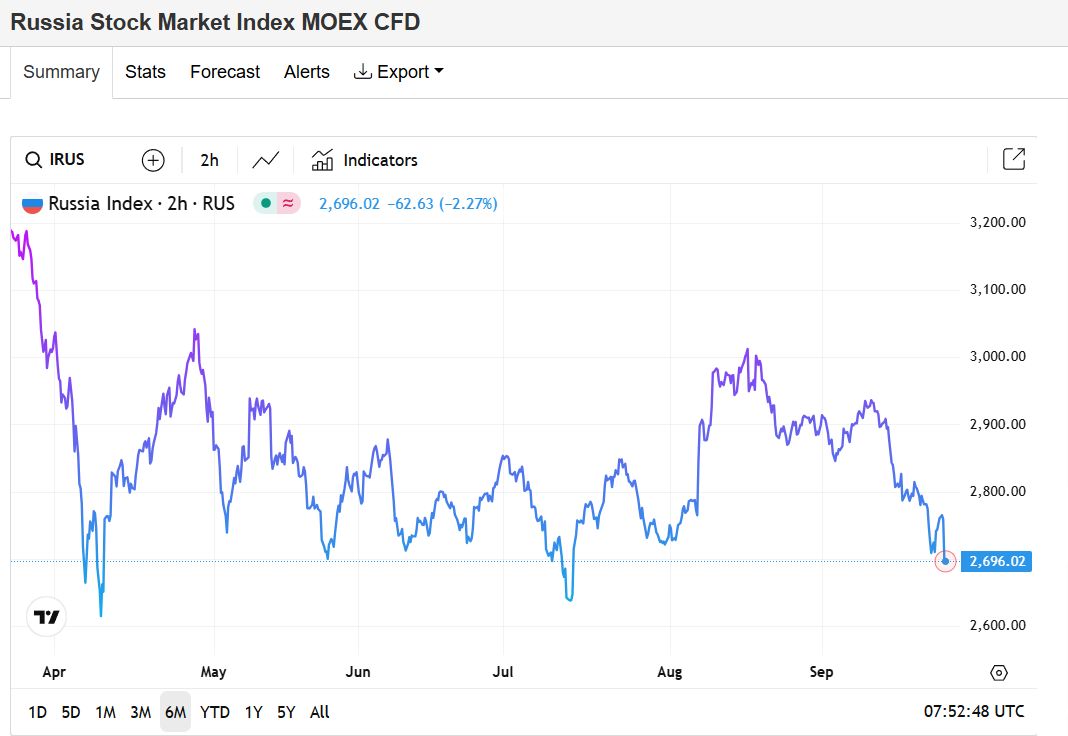
The Moscow Exchange index fell below 2,700 points for the first time in the last two months after US President Donald Trump announced that Ukraine, with the support of the EU, could regain lost territories. This is reported by RBC.

"The IMOEX2 index at a low of 22.06 Moscow time fell by 1.81% to 2,700.79 points. Before that, IMOEX2 was losing less than 0.5%, but after Trump's words, the decline accelerated sharply.

Later, the Moscow Exchange index dropped below 2,700 points for the first time since July 14.

As of 22.46 Moscow time, IMOEX2 was already losing 2.01% and was at 2,695.28 points. Eternal futures for the US dollar (USDRUBF) on the Moscow Stock Exchange, on the contrary, jumped by 1.21% and reached a maximum of ₽ 84.36," the agency reports.

It is noted that at 22.20 Moscow time the largest decrease was shown by ordinary shares of Rusal (-3.81%), Credit Bank of Moscow (-3.3%), Sovcombank (-3.02%) and AFK Sistema (-2.91%).
Click image for larger version

Name:	sc1.jpg
Views:	13
Size:	65.7 KB
ID:	1325441

GDP stagnation and falling bonds. the Russian economy is entering survival mode:

Fiscal pressure in Russia is increasing as the Kremlin seeks new ways to close the growing budget gap caused by the war against Ukraine and slowing economic growth.

According to the Institute of National Economic Forecasting of the Russian Academy of Sciences, GDP fell by 0.6% in the first quarter of 2025, and growth in the second quarter is estimated at zero.

This effectively marks the end of the economic expansion Moscow had tried to showcase in recent years.

Amid budget problems, the government is tightening control over tax revenues. From January to August 2025, the Federal Tax Service increased the number of field inspections of businesses by 15% year-on-year. The outcome: 98% of companies ultimately agree to pay additional charges. In Moscow alone, these additional assessments amounted to $1.4 million, and in Saint Petersburg nearly $3 million.

Fiscal authorities follow a strict procedure: before an inspection begins, they compile a list of potential violations and offer businesses the option to pay “voluntary additional charges.” If a company refuses, a formal audit is initiated.

For most businesses, agreeing to the voluntary option is more advantageous, as it helps avoid fines, reduces time costs, and lowers reputational risks.

The Kremlin sees this approach as a key tool for reducing the budget deficit. However, excessive tax pressure encourages growth of the shadow economy and accelerates the relocation of companies abroad.

A similar trend is expected for individuals.

Authorities are preparing to closely monitor citizens’ incomes to bring them out of the shadows. There is also discussion of raising taxes for the self-employed: the preferential regime currently in place is considered by the government to negatively affect the labor market, as people prefer self-employment over industrial jobs.

Pressure on businesses and citizens is increasing amid falling Russian government bond values, reflecting investor concerns about future tax policy and weak economic prospects.

The current budget model relies increasingly not on superprofits of major corporations but on stable taxes from medium, small, and non-oil-and-gas businesses.

The primary goal is to fund the war against Ukraine.

While additional tax collections provide the government with short-term relief, they create long-term risks for an economy already in stagnation.
Ukraine’s drone strikes on Russian oil refineries have disrupted domestic supplies and pushed Russia’s diesel exports towards their lowest levels since 2020.

Sixteen of Russia’s 38 refineries have been hit since the start of August, some of them multiple times, including one of Russia’s largest fuel-processing facilities, the 340,000 barrel-a-day plant at Ryazan, close to Moscow.

The strikes have disrupted more than 1mn barrels a day of Russia’s refining capacity, according to Energy Aspects, a research group. Diesel exports, if they maintain the current rate, will fall to the lowest monthly total in September since 2020, according to both OilX and Vortexa, which track cargoes.

“It seems to be the most effective campaign that Ukraine has carried out so far,” said Benedict George, head of European petroleum products pricing at Argus, which reports commodity prices.

Russia is the second-largest diesel exporter in the world, with about half its cargoes going to Turkey, followed by other markets in west and north Africa and Brazil — as the EU and UK do not directly import the Russian fuel.

While Moscow has imposed export bans on Russian gasoline for the most part of this year, its diesel sales abroad have so far been unrestricted.

George said Turkey had turned to India and Saudi Arabia to make up for the shortfall, and that premiums for diesel have risen this month to about $25 to $30 a barrel over the price of benchmark Brent crude oil.

This is the highest level since summer, when Israel’s war with Iran sent prices to a 15-month high over supply fears.

Amrita Sen, co-founder of Energy Aspects, said the impact of the attacks had taken time to be reflected on the markets, given Russia’s size. “You have a refinery going down, but it might take three weeks between that refinery producing and that diesel getting to the port,” she said.
The Salavat petrochemical complex, one of Russia's largest which is located in Bashkortostan region, was attacked by Ukrainian drones yesterday, the local governor said on Wednesday via his channel on Telegram, the second such attack in less than a week.

"Gazprom Neftekhim Salavat has been subjected to another terrorist drone attack. We are assessing the extent of the damage. All emergency services are on scene, and firefighting measures are underway," Radiy Khabirov said.

Ukrainian drones earlier this month also hit an oil refinery in Ufa, Bashkortostan's regional capital, about 1,400 kilometres (870 miles) from the Ukrainian border.

The Salavat petrochemical complex produces gasoline, diesel, kerosene and other petroleum products as well as liquefied gases, butyl alcohols, polyethylene, polystyrene and ammonia.

Also pumping stations on the Kuibyshev-Tikhoretsk pipeline in Russia’s Volgograd and Samara regions were struck in the past 3 days. Ukraine will continue efforts to disrupt “the cash flows” financing Russia’s war.

The Ukrainian General Staff later confirmed the operation, saying on its Telegram channel that long-range drones struck “a number of significant facilities” on Russian territory overnight.

Among them was the Saratov refinery in Saratov region, which accounts for more than 7 million tons of annual capacity—around 2.5% of Russia’s total refining volume. Explosions and a large fire were reported at the site.

Another strike targeted the Novokuybyshevsk refinery in Samara region, with a processing capacity exceeding 8.8 million tons of oil per year. Preliminary information indicated both explosions and a fire there, according to the Ukrainian military.

In addition, Ukrainian Special Operations Forces hit the Samara linear-production dispatching station near the village of Prosvet.

The station blends high- and low-sulfur crude to produce Russia’s Urals export grade, which represents up to half of the country’s total oil exports.

Ukrainian officials said the SBU and Special Operations Forces also struck the Zenzevatka station in Volgograd region and the Sovkhoznaya-2 station in Samara region, both linked to oil transport through Novorossiysk, one of Russia’s key Black Sea export terminals.
Click here to remove ›
2.73 MB ·2 views DownloadMember
Click here to remove ›
2.10 MB ·3 views DownloadMember
Click here to remove ›
974.7 KB ·6 views DownloadMember
Click here to remove ›
7.04 MB ·2 views DownloadMember
Click here to remove ›
182.3 KB ·4 views DownloadMember
Click here to remove ›
7.67 MB ·4 views DownloadMember
3 Users Say Thank You For This Post:
Guns N' Coffee, Hunted, WonderMomma
  #495  
09-24-2025, 02:05 PM
WonderMomma's Avatar
WonderMomma
Offline:
☾ Administrator ☽
Poster Rank:76
ஜᎻᎬᎩᎾᏦᎪஜ
Join Date: Dec 2011
Posts: 19,651
Contributions: 32
 
Mentioned: 181 Post(s)
Quoted: 6921 Post(s)
Activity Longevity
11/20 15/20
Today Posts
0/11 ssss19651
Re: Russian/Ukraine War Discussion Thread IX

Seems his opinion on Ukraine changes on a bipolar level.

__________________
💜🧿See Human | Be Human🧿💜
(War Section Hashtags)
This User Says Thank You For This Post:
Vincentsdream
  #496  
09-24-2025, 04:53 PM
kellyhound's Avatar
kellyhound
Offline:
✝Mudderator from Hell✝
Poster Rank:11
e-mail
Join Date: Oct 2006
Posts: 95,414
Contributions: 817
 
Mentioned: 473 Post(s)
Quoted: 10156 Post(s)
Activity Longevity
18/20 20/20
Today Posts
4/11 ssss95414
Re: Russian/Ukraine War Discussion Thread IX

Seems his opinion on Ukraine changes on a bipolar level.

Think he now realizes Putin isn't a real friend nor Putin is impressed by him as Trump said many things about this war but never really takes action plus Trump now realizes that russia doesn't want to end the war, without demanding over the top guarantees in the eyes of Ukraine.

His ego is hurt too as he always said to his voters and the whole world he would and could end the war in no time. Now this ain't gonna happen (soon) he probably realizes he will not be writing history and likely will not receive the Nobel peace prize.

Trump ended his message by saying I wish both countries well. That’s Trump's way for being bored/exhausted by 2 countries that seem to have other priorities in the world besides getting him a Nobel Prize.

Also:
US President Donald Trump says he is ready to impose sanctions on Russia, but only if NATO members agree do the same, as well as set massive tariffs on russia's main ally, China.
He puts the bar way too high so he can always hide behind this to not impose sanctions on russia imo but on the other hand you never know with him lol

also:
American public support for sending military and economic aid to Ukraine has increased since March—especially among Republican Party supporters.

Overall, six in 10 continue to support the United States sending arms and military supplies to Kyiv (62%, up from 52% in March) and providing economic assistance to Ukraine (61%, up from 55% in March)

The most substantial shifts are among Republicans (+9 percentage points for economic assistance, +21 military aid) and Independents (+7 economic, +10 military).

In fact, 51 percent of Republicans now support providing military aid to Ukraine.

Large majorities of both Republicans (74%) and Democrats (77%) support increasing sanctions against Russia.

The potential for Putin’s refusal of a peace deal does not seem to impact American public support for US policies toward Ukraine.

Six in 10 Americans (60%) express a favorable view of Ukrainian President Volodymyr Zelenskyy; just 10 percent view Putin favorably.
Americans, including some Republicans, are losing faith in Donald Trump across a range of key issues, according to polling released this week. One survey found a majority describing the president’s second stint in the White House so far as “scary”.

Along with poor ratings on the economy and Trump’s immigration policy, a survey released on Saturday found that only 24% of Americans believe Trump has focussed on the right priorities as president.

That poll comes as Trump’s popularity is historically low for a leader this early in a term. More than half of voters disapprove of Trump’s performance as president, and majorities oppose his tariff policies and slashing of the federal workforce.

The scathing reviews come as Trump next week marks 100 days of his second stint in office, and suggest Americans are already experiencing fatigue after a period that has seen global financial market nosedives and chilling deportations, including of documented people.
Maybe his mind shifts towards what his voters and all Americans want nowadays?
3 Users Say Thank You For This Post:
Guns N' Coffee, Hunted, WonderMomma
  #497  
09-25-2025, 10:51 AM
scorpion9's Avatar
scorpion9
Offline:
My Rank: STAFF SERGEANT
Poster Rank:720
Join Date: Jul 2009
Posts: 1,140
 
Mentioned: 2 Post(s)
Quoted: 573 Post(s)
Activity Longevity
0/20 18/20
Today Posts
0/11 sssss1140
Re: Russian/Ukraine War Discussion Thread IX

Seems his opinion on Ukraine changes on a bipolar level.

If you pay attention to his comments, you can see how he basically sees profit in this war now. It was always a tug-of-war between the us domestic oil and gas producers and arms lobbyists and Putin. Both hold trump by the balls, and the question was, which one squeezes harder.
His goal seems to almost entirely be war-profiteering. Thats why the requirement of EU quitting all russian energy( obviously US would take its place at much higher prices ). Same for arms deals. He clearly separated the US from this conflict by saing "EU and Ukraine together", not "The west together". No, he wants to sell weapons to the EU, and get profits.
3 Users Say Thank You For This Post:
Guns N' Coffee, kellyhound, WonderMomma
  #498  
10-04-2025, 06:04 AM
Vincentsdream's Avatar
Vincentsdream
Offline:
My Rank: MASTER GUNNERY SERGEANT
Poster Rank:327
I am
Join Date: Aug 2012
Posts: 3,901
 
Mentioned: 6 Post(s)
Quoted: 2469 Post(s)
Activity Longevity
3/20 14/20
Today Posts
1/11 sssss3901
Re: Russian/Ukraine War Discussion Thread IX

Ah trump
  #499  
10-05-2025, 05:48 PM
Guns N' Coffee's Avatar
Guns N' Coffee
Offline:
My Rank: FIRST SERGEANT
Poster Rank:469
Join Date: Apr 2013
Posts: 2,290
 
Mentioned: 1 Post(s)
Quoted: 572 Post(s)
Activity Longevity
5/20 14/20
Today Posts
1/11 sssss2290
Re: Russian/Ukraine War Discussion Thread IX


3 Users Say Thank You For This Post:
Hunted, kellyhound, WonderMomma
  #500  
10-05-2025, 07:46 PM
WonderMomma's Avatar
WonderMomma
Offline:
☾ Administrator ☽
Poster Rank:76
ஜᎻᎬᎩᎾᏦᎪஜ
Join Date: Dec 2011
Posts: 19,651
Contributions: 32
 
Mentioned: 181 Post(s)
Quoted: 6921 Post(s)
Activity Longevity
11/20 15/20
Today Posts
0/11 ssss19651
Re: Russian/Ukraine War Discussion Thread IX

I love that guy (the youtuber).
__________________
💜🧿See Human | Be Human🧿💜
(War Section Hashtags)
2 Users Say Thank You For This Post:
Guns N' Coffee, Vincentsdream


Powered by vBulletin Copyright 2000-2010 Jelsoft Enterprises Limited.

Search Engine Friendly URLs by vBSEO