
|
#1
●
10-26-2010, 11:41 PM
| ||||||||
 ☢ Poster Rank:83 Join Date: Oct 2006 Posts: 18,644
Contributions: 49
Mentioned: 96 Post(s) Quoted: 2921 Post(s)
| ||||||||
|
Microbursts...
A microburst is a small column of fast-sinking air, below a thunderstorm that reaches the ground and causes strong winds. A microburst, aka downdraft, is typically less than 2.5 miles wide, but it can produce winds of more than 100 mph and cause significant damage. It is also sometimes called a “downburst” or a “macroburst” if its path of destruction exceeds about 2.5 miles. Microbursts last only 5 to 15 minutes. They develop when rain falling from a thunderstorm evaporates underneath the cloud, cooling the air beneath it. This cold, heavy air plunges to the surface and “splashes” against the ground like a bucket of cold water. The air then rushes sideways and its advancing edge swirls upward. Wind from a microburst can cause as much damage as a small tornado, flattening trees and power lines. Microbursts that occur near airports are particularly dangerous. Strong winds from above, below, and sideways buffet aircraft in just a few seconds. Planes that are landing or taking off are pushed into the ground, causing deadly crashes. Microbursts have led to air disasters in New York City, Charlotte, New Orleans, and Dallas. Spurred by disasters, the U.S. government has spent millions of dollars on microburst detection equipment at airports. Fewer microburst-related disasters occur today, thanks to this technology and to extensive pilot training. Source:http://whyfiles.org/2010/ Diagram credits: http://whyfiles.org/2010/ http://www.srh.noaa.gov/jetstream/tstorms/wind.htm 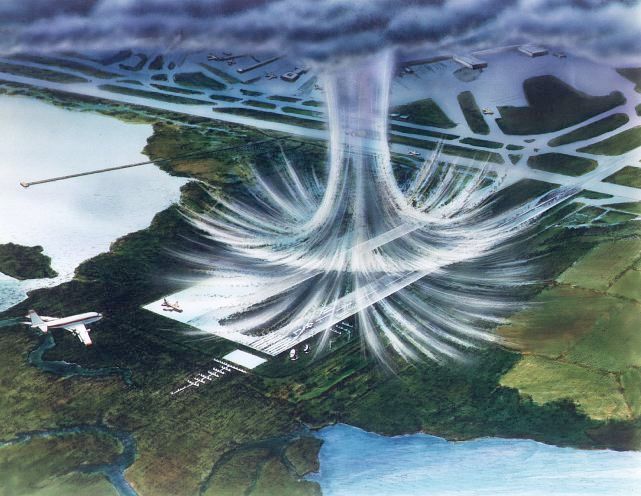 · 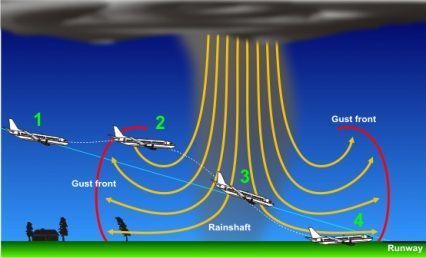 · |
|
#4
●
10-27-2010, 12:06 AM
| ||||||||
 ★ Legacy Member ★ Poster Rank:4 Join Date: Mar 2009 Posts: 118,371 Mentioned: 465 Post(s) Quoted: 34616 Post(s)
| ||||||||
|
Re: Microbursts...
It really is bad there. That's the area I moved to Charlotte from. In '94 I saw my first hail in Texas. Tore up my ride dammit! I'm sure you've heard the term "tornado alley". |
|
#5
●
10-27-2010, 12:15 AM
| ||||||||
| ☢ Poster Rank:83 Join Date: Oct 2006 Posts: 18,644
Contributions: 49
Mentioned: 96 Post(s) Quoted: 2921 Post(s)
| ||||||||
|
Re: Microbursts...
Have you had any experience with a burst? I suppose good old doppler takes most of the fun outta it these days. That hail sounds nasty! Yep, heard of tornado alley.....in fact, that's given me some ideas for future threads. Thanks.  |
|
#10
●
10-28-2010, 08:52 AM
| ||||||||
 *Born Retard* Poster Rank:101 Dude Join Date: Dec 2009 Posts: 16,032 Mentioned: 2 Post(s) Quoted: 57 Post(s)
| ||||||||
|
Re: Microbursts...
In August, 1983, then President Ronald Regan's jet, Air Force One, landed at Andrews Airforce Base, in Camp Springs, Maryland, five minutes after a microburst had struck the air base. Winds from the storm were recorded at 149.5 mph! To this day, this remains the highest wind gust ever measured from a non-tornadic thunderstorm.
|





 Why do I want to call you Saor like Boz does?


