|
#1
●
01-01-2010, 12:08 PM
|
| So Fucking Banned Poster Rank:463 Join Date: Sep 2009 Posts: 2,406 2,406Posts 4,322Thanked 0Quoted 0Mentioned 0Contrib. |
|
Mermaids Are Not Real, Yet These Pictures are Interesting
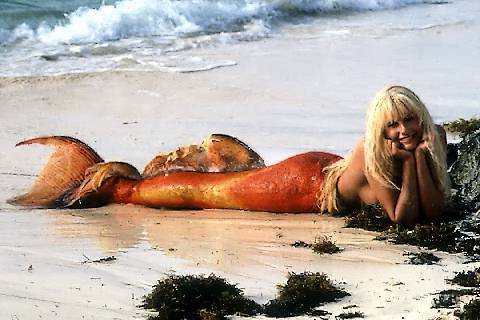
The sirens are one of the oldest myths of mankind. Everyone knows the basic model: It is a woman on top, but a fish on the bottom. The classic image is that of a handsome, bare-breasted mermaid sitting on a rock, ready to disappear beneath the waves with a moment's notice. First, we'll just make three things perfectly clear. 1) There are no sirens. 2) There are no sirens. 3) There are no sirens. Only two kinds of people seriously claim that mermaids are real: Hoaxers and idiots. We shall return to it. While they are not real, mermaids are interesting. Many myths can be directly attributable to a primary source, but the general concept of the mermaid seems to have a universal quality. References oldest and best known for mermaids are found in Syrian and Greek myth. The sirens of the Odyssey are often regarded as the sirens, but this is a tradition later and not part of the original text. Homer does not describe the sirens as having bit fishy, they were simply sea whose girls beautiful songs lured men to their deaths. Variations can be found everywhere in the world - throughout Europe, Asia and Africa, and even Native American mythology - but there is little common ground between different iterations, with very few details to find . This contrasts with the legendary creatures like vampires or Yeti, where very detailed legends have arisen around specific geographic areas. Often, creatures cryptozoological are linked together under the heading of your siren basis, but many of them belong to traditions unrelated. For example, there are many legends about shapechangers water, particularly in Europe and the British Isles, but most of these legends are not siren or even fish in particular. They include legends of the Celts Silkies (seals) that are most appropriate framework shapechanging approach with the traditions of fairy as the Tuatha Dé Danann. And then there are water nymphs, Faery overtly sexual-types who are all women, but magically linked to water (usually specific bodies of water). These stories are especially frequent in Asia and Europe, and they usually come across as the least complicated form of male fantasy. Real mermaid stories are fascinating precisely the opposite reason: they are the most complicated of the male fantasy. Sirens are sex objects for reasons at first sight, but they are not certain salient below the belt. And this is a tale, so to speak. Coupled with a lack of non-forensic evidence that fraudulent anything remotely similar to a siren never existed, the inconsistency of the legend suggests strongly sirens have much more to do with the zeitgeist of Zoology . This assumption gained much ground as the Freudian implications of the siren has become clearer and clearer with each story, culminating in the 1836 story The Little Mermaid by Hans Christian Andersen. Mermaid Andersen became a national symbol in Denmark, is represented in a bronze sculpture by Edvard Eriksen in 1913. The statue is probably best known for his frequent damage and dismemberment, sometimes showing up in the news, after being beheaded. The decapitation, the first of its kind was held April 24, 1964, crime remains a mystery until 1997, when the writer Jørgen Nash confessed to detach the head and thrown into a nearby lake. Since the first beheading of the statue has been subjected to numerous copycat crimes drunk, losing its share of arms and heads over the years, or be dressed in a top-painted purple bikini. Victorian notions of cleanliness aside, the siren is a collection of densely layered and complex sexual metaphors. She is always naked and wet, with long hair and bare breasts, but she has no vagina (perhaps) dominates the dreams of sailors need sex who meet her. In Little Mermaid, she trades her tongue for a vagina, but was forced to endure terrible pain stabbed when she walks, bleeding from his feet, which adds a menstrual pattern to a set of symbols already overcrowded. With all this subtext going for it, it is hardly surprising that the imagination of the 19th century was the idea of the siren and ran with it. People wanted to be real mermaids. The most spectacular manifestation of this trend is the "discovery" of the Fiji Mermaid by PT Barnum intrepid researcher. Unfortunately, in the hands of Barnum, the siren has proved to be the exact opposite of sexy. The Fiji Mermaid is supposed to have been the remains of a mermaid's true the "Fidgi" Islands in South America. Although Barnum announced the exhibition with pictures of naked beauty breasted traditions, the real siren Fidgi like a refugee from a land of Hollywood terribly wrong: "It's like Gremlins meets meets Ebirah Piranha! The Fiji Mermaid was probably inspired by some rare items and even bizarre historical objects found in Japan. The pedigree of the mummified creature has been witnessed by a buddy of Barnum himself as a teacher. With the support of several additional letters of authentication Scientific (coined by Barnum himself), the siren of Fiji became part an insanely popular Barnum traveling show, even after being exposed as a conglomerate of pieces glued together from several different animals. 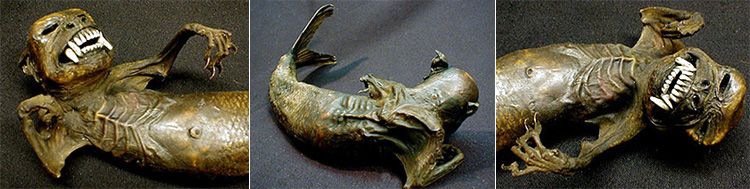 · 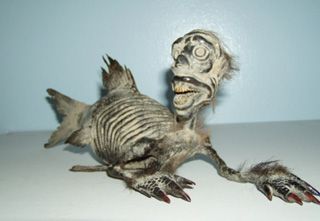 · 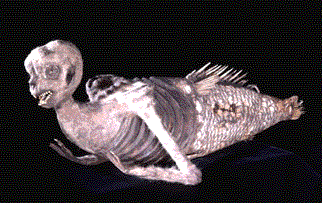 · 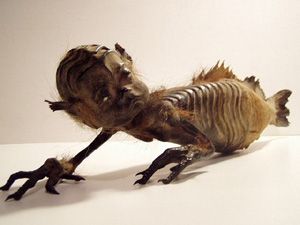 · 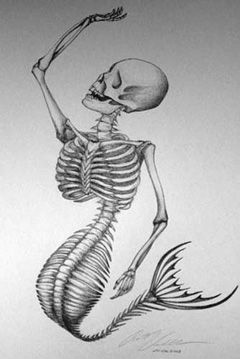 · |
|
#6
●
03-02-2010, 02:10 AM
|
 ★ realist-absurdist ★ Poster Rank:143 female Join Date: Feb 2010 Posts: 11,712 11,712Posts 2,870Thanked 16Quoted 0Mentioned 0Contrib. |
|
Re: Mermaids Are Not Real, Yet These Pictures are Interesting
"The ten year old girl, named Shiloh Pepin, known as the mermaid girl is dead. The girl was born with a condition known as Mermaid Syndrome died Friday after catching a cold that progressively worsened until he had pneumonia..." Oct.'09
 · |