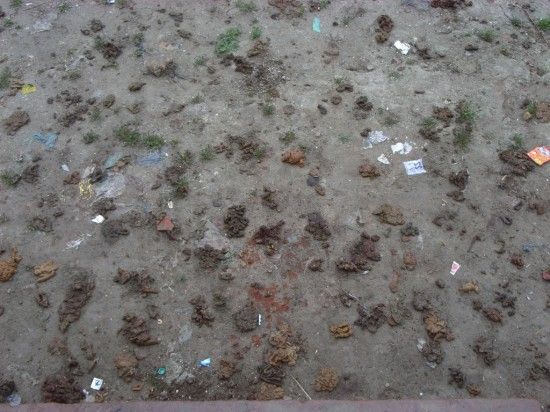
Far from his dwelling let him remove urine and excreta
–The Laws of Manu (Hindu sacred text), Chapter 4 verse 151
Over a billion people worldwide (15 percent of people in the world) practice open defecation, generally this is attributed to extreme poverty, however in India, the differences between the Hindu and Muslim demographics show that cultural practices play a larger role.
More than half of the Indian population, over 600 million people, defecate in the open, without the use of a latrine or toilet. The prevalence of open defecation is particularly high among India’s Hindu majority.
Data from the most recent wave of the National Health and Family Survey of India show that as of 2005, 67% of Hindu households defecate in the open—e.g. near roads, on beaches, railroad tracks, in fields and behind bushes.
In comparison, only 42% of the relatively poorer Muslim households do so.
In India, Muslim children are substantially more likely than Hindu children to survive to their fifth birthday, despite Muslim parents being poorer and less educated on average than Hindu parents.
More than half of Indian households defecate in the open without using a toilet or latrine, introducing pathogens into the environment that cause disease. Bacteria and worms contained in feces get transmitted via contact with skin and via ingestion, leading to both acute and chronic illness.
Recent medical and epidemiological research suggests that consistent exposure to the disease environment created by open defecation can result in chronic intestinal problems that block the absorption of nutrients in food.
In India, Muslims are about 40 percent more likely than Hindus to use latrines, which serve to safely dispose of excreta. More importantly, Muslims are more likely to have Muslim neighbours who follow the same practice. Differences in these sanitation behaviours can account for the entire mortality gap between Hindus and Muslims.
Muadh reported God’s messenger as saying,“Guard against the three things which produce cursing: relieving one self in watering-places, in the middle of the road and in the shade.”
–Mishkat-al-Masabih (Muslim sacred text) P:76
The Hindu tradition views excreta as something to be kept away from one’s home. The persistence of open defecation among Hindus in India is attributable to the persistence of the Hindu caste system: the ritual avoidance of excreta is maintained not only be keeping defecation away from the home, but also by relegating its cleanup to the untouchables.
The low-caste find employment in “scavenging”– manually removing human waste from open places. This link between human waste and the “polluted” castes reinforces the desire to defecate away from the home among higher caste Hindus, with the ironic implication that public places are everywhere soiled by human waste.
Therefore, perhaps contrary to intuition, the prominence of open defecation among Hindus is not merely a matter of the affordability of toilets. Instead, there is apparently little demand at any price to relieve oneself in or near the home. And toilets constructed or paid for by the government often remain unused or repurposed by Hindus.
Statistics show that Hindu–but not Muslim– households are much more likely to have electricity than to own use a public or private latrine. Estimates also show that even relatively wealthy Hindus who own large assets often choose to openly defecate.
A picture is worth a thousand turds.