|
#1
●
09-18-2008, 04:22 PM
| ||||||||
 ★ ★ GENERAL ★ ★ Poster Rank:37 male Join Date: Oct 2006 Posts: 42,196
Contributions: 35
Mentioned: 2268 Post(s) Quoted: 21215 Post(s)
| ||||||||
|
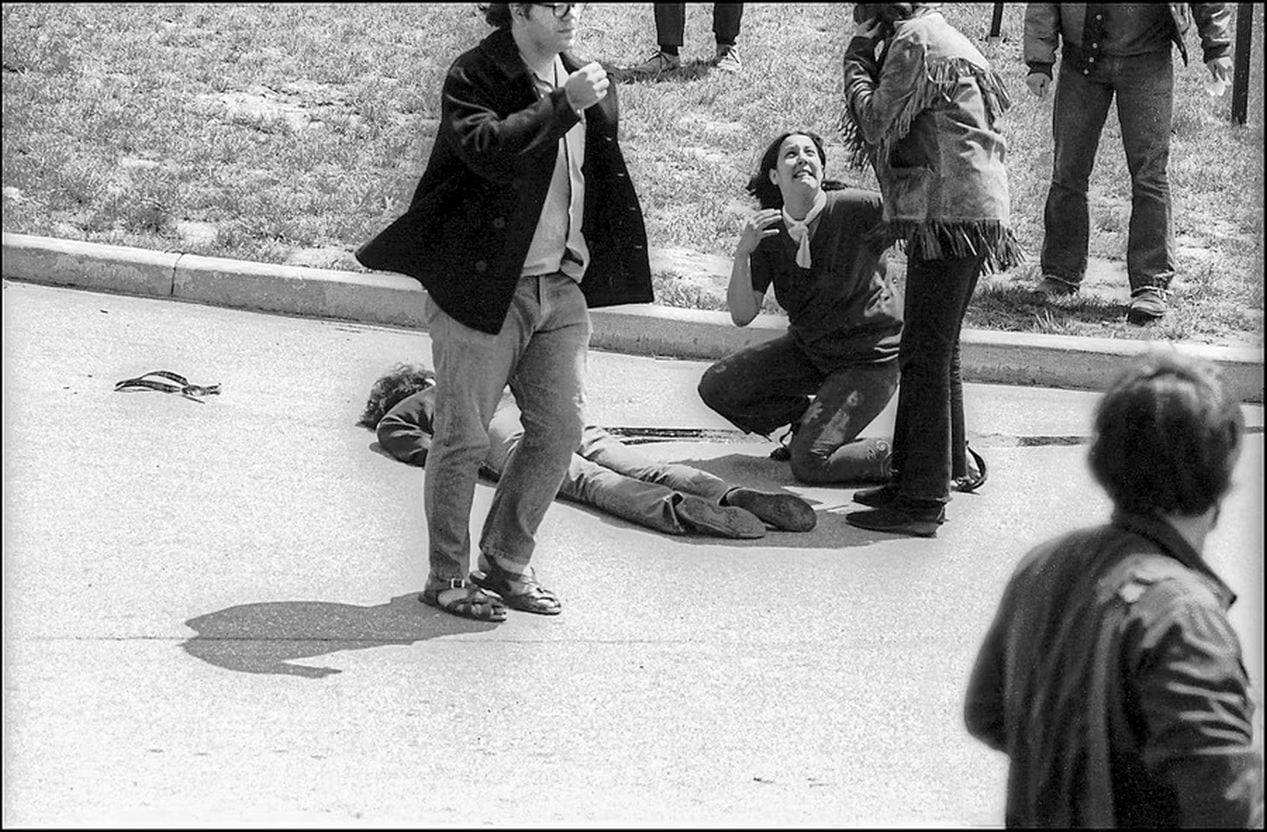
Photograph of the Kent State Shootings (May 1970)
On May 4, 1970, a protest against the expansion of the Vietnam War ended in tragedy at Kent State University in Ohio. President Richard Nixon had announced several days earlier that U.S. forces were entering Cambodia, setting off demonstrations on college campuses across the country. Tensions at Kent State were already high after disturbances in downtown Kent and the burning of the university’s ROTC building, leading Ohio Governor James Rhodes to send the National Guard onto the campus. Around noon on May 4, students gathered on the university Commons for a protest that school officials had prohibited. Guardsmen ordered the crowd to disperse and eventually advanced on the students while firing tear gas. Some protesters shouted at the soldiers, threw rocks, and tossed tear gas canisters back toward them. After pushing the crowd over Blanket Hill and toward a nearby parking lot and athletic field, the Guard began moving back up the hill. As the Guardsmen reached the top of the hill, 28 of them suddenly turned toward the students. Over the next 13 seconds, they fired between 61 and 67 rounds from rifles and pistols. Four students were killed: Allison Krause, Jeffrey Miller, Sandra Scheuer, and William Schroeder. Nine others were wounded. Scheuer and Schroeder were not taking part in the protest and had been walking between classes when they were shot. One of the most famous photographs of the Vietnam War era was taken moments afterward by Kent State photography student John Paul Filo. It shows 14-year-old Mary Ann Vecchio kneeling and screaming over the body of 20-year-old Jeffrey Miller, who had been shot in the mouth. The photograph appeared in newspapers around the world and later earned Filo a Pulitzer Prize. The Kent State shootings became one of the defining moments of the anti-war movement and triggered student strikes and demonstrations at colleges across the United States. 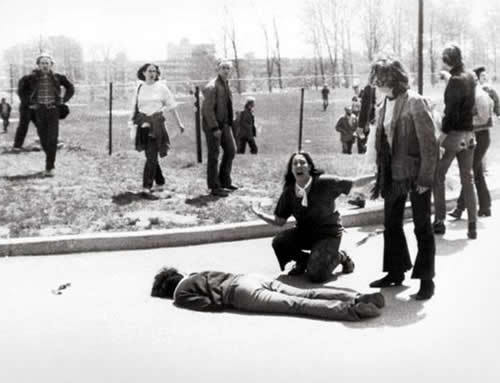 ·
__________________ Support the site and our continued existance by upgrading to a Green Name |
|
#2
●
09-18-2008, 05:33 PM
| ||||||||
 My Rank: SERGEANT Poster Rank:1140 Join Date: Sep 2008 Posts: 571 Mentioned: 0 Post(s) Quoted: 50 Post(s)
| ||||||||
|
Re: Photograph of the Kent State Shootings (May 1970)
Tiananmen Square is Chinese for Kent State University. The survivors spent decades trying to sue the National Guard, for accountability, and were stone walled at every step. |
|
#5
●
10-08-2026, 03:07 AM
| ||||||||
 ✝Mudderator from Hell✝ Poster Rank:10 e-mail Join Date: Oct 2006 Posts: 96,566
Contributions: 817
Mentioned: 476 Post(s) Quoted: 10354 Post(s)
| ||||||||
|
Re: Photograph of the Kent State Shootings (May 1970)
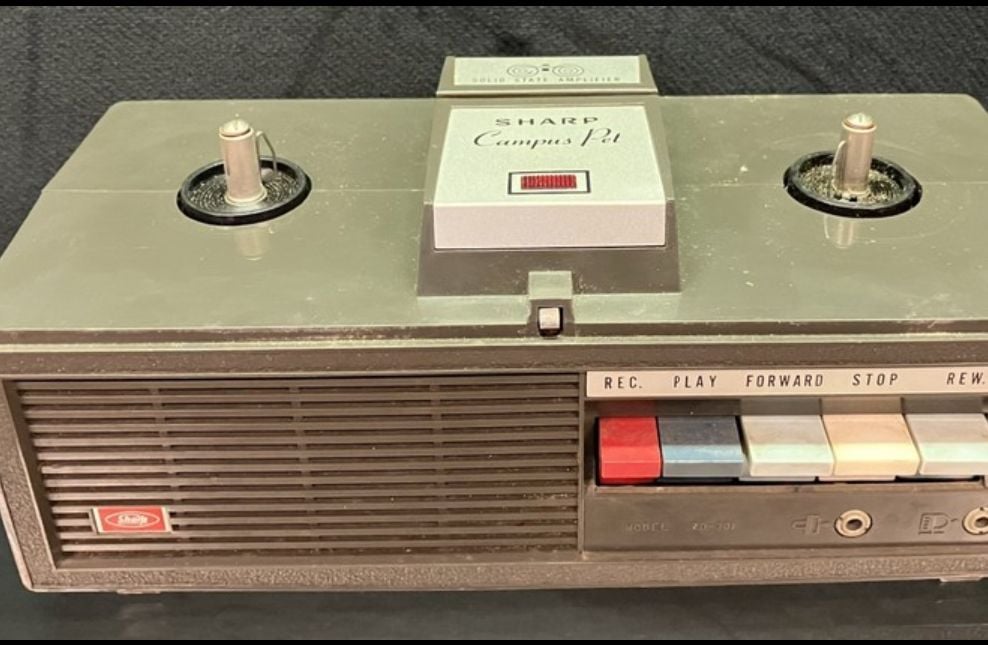
In October 1970, an Ohio state grand jury pinned the blame for the unrest primarily on the protesters. They indicted 25 individuals, mostly students and faculty, incl. student body president Craig Morgan, on riot and assault charges. However, the state's cases were incredibly weak. After a judge directed a not-guilty verdict for the first defendant, the Ohio Attorney General dropped all remaining charges against the rest of the group in late 1971. After the Watergate scandal forced a shuffle at the Department of Justice, the federal government reopened the case. In March 1974, a federal grand jury indicted 8 Ohio National Guardsmen on civil rights charges (specifically, depriving the students of their due process rights under color of law) but in November that year, U.S. District Judge Frank Battisti dismissed the charges and acquitted all 8 guardsmen before the jury could even deliberate. The judge ruled that the prosecution failed to prove beyond a reasonable doubt that the guardsmen had the specific criminal intent to violate the students' constitutional rights, even noting that the evidence showed their use of force was excessive and unjustified. The families of the four deceased students and the nine surviving injured victims filed a massive $46 million civil damages lawsuit. They sued Ohio Governor James Rhodes, the president of Kent State University, and various National Guard officers and members for negligence. The case went to trial in Cleveland and lasted 15 weeks, resulting in a 9-to-3 jury verdict completely clearing the Governor and the guardsmen of any liability. The victims' families appealed the decision. A federal appeals court overturned the verdict, citing procedural errors by the trial judge (incl. how a threat to a juror was handled), and ordered a brand new trial. The 8 Ohio National Guardsmen indicted by a federal grand jury in March 1974 were all lower-ranking enlisted men. They were divided into two groups based on the severity of the civil rights charges brought against them. 1. Lawrence A. Shafer (29, of Ravenna, Ohio) 2. James D. McGee (27, of Ravenna, Ohio) 3. James E. Pierce (29, of Amelia Island, Florida) 4. William E. Perkins (28, of Canton, Ohio) 5. Ralph W. Zoller (27, of Mantua, Ohio) The remaining 3 men were accused of lesser, misdemeanor violations related to the deprivation of civil rights. 6. Barry W. Norris (29, of Kent, Ohio) 7. Matthew J. McManus (28, of West Salem, Ohio) 8. Leon H. Smith (27, of Beach City, Ohio) While the troops also deployed tear gas canister launchers to disperse the crowds, the lethal 13-second volley of gunfire consisted of 3 specific types of weaponry. 1. M-1 Garand Rifles. The basic service weapon carried by the vast majority of the guardsmen. It is a high-powered, semi-automatic military rifle that fires .30-06 caliber steel-jacketed ammunition. These heavy rounds are designed for long-range warfare and easily retained enough velocity to kill students standing hundreds of feet away. Ballistics reports showed that 51 rounds fired that day came from these M-1 rifles. 2. Several officers and higher-ranking personnel carried handguns rather than service rifles. Investigation records indicate that five pistol shots were fired into the crowd during the chaos. 3. At least one guardsman discharged a shotgun blast during the confrontation. Additionally, the soldiers advanced on the student crowd with military bayonets fixed to the ends of their M-1 rifles to use as a physical deterrent before the shooting began. Because the National Guard unit failed to properly log individual control cards for the weapons before rushing out to the campus commons, the FBI ballistics teams faced severe challenges matching specific bullet fragments to individual guardsmen's rifle barrels. The official forensic map from The May 4 Shootings at Kent State University archives reveals that the vast majority of the dead and wounded students were standing hundreds of feet away, casting severe doubt on the Guard's claims that they opened fire out of imminent fear for their lives.  Jeffrey Glenn Miller was shot through the mouth and killed instantly at a distance of 265 feet (81 meters) while standing in an access road. Allison Beth Krause was hit in the left side of her chest from 343 feet (105 meters) away in the Prentice Hall parking lot. William Knox Schroeder was shot in the back at a distance of 382 feet (116 meters) in the parking lot. He was an ROTC student walking between classes. Sandra Lee Scheuer was fatally struck in the neck from 390 feet (120 meters) away. She was a bystander simply walking to her next class. Joseph Lewis Jr. got injured and was struck twice at a distance of just 60 feet (18 meters) from the guardsmen while standing still. Donald Mackenzie got wounded in the neck from an astonishing distance of nearly 750 feet (230 meters) away. The other 7 wounded students (John Cleary, Alan Canfora, Dean Kahler, Douglas Wrentmore, James Russell, Robert Stamps and Thomas Grace) were positioned at varying distances ranging from 60 feet to 500 feet away from the firing line. When the FBI ballistics laboratory stepped in to identify which specific guardsmen fired the fatal shots, they ran into a massive bureaucratic roadblock as the official weapon sign-out sheets had completely vanished.  In their rush to deploy onto the campus commons on May 4, the National Guardsmen did not fill out the military's standard individual weapons control cards. Instead, logistics officers used a casual lined paper notepad to log which soldier took which M-1 Garand rifle and how much ammunition was issued. The FBI discovered that this improvised lined logbook vanished from the National Guard arms room at the exact same time federal agents arrived to seize a batch of the weapons for forensic testing. Because the physical log was gone, federal prosecutors conceded during the 1974 civil rights trial (U.S. v. Shafer) that they had no definitive ballistics evidence link connecting any specific guardsman's rifle to a specific student's body. Many bullets passed entirely through the victims and were never found, and without the logs, matching the remaining bullet fragments to specific rifle barrels proved legally inconclusive. Ultimately, the missing weapon logs allowed individual soldiers to claim they either shot into the air or couldn't remember if they fired, forcing the prosecution to rely on a small group of eight guardsmen who openly admitted to firing in the direction of the crowd. During the protest, a Kent State communications student named Terry Strubbe placed a microphone out of his dorm window, inadvertently capturing the only known real-time audio recording of the tragedy. For decades, the official government narrative maintained that the Guard fired spontaneously out of panic, without an command. However, in 2007, survivor Alan Canfora located a copy of the tape in a Yale University library archive. In 2010, The Plain Dealer commissioned a digital analysis by nationally respected forensic audio experts Stuart Allen and Tom Owen. The enhanced audio revealed what the experts concluded was a distinct military order shouted to the Guardsmen. They translated the sequence of voices as: "Right here! Get Set! Point! Fire!". More shockingly, the analysis detected the distinct sound of four pistol shots being fired roughly 70 seconds before the National Guard opened fire with their rifles. The U.S. Department of Justice reviewed the tape in 2012 but formally rejected the experts' conclusions, stating the audio was unintelligible and that the sounds preceding the gunfire were likely just Strubbe’s dorm room door opening and closing. The discovery of the pistol shots on the Strubbe tape immediately pointed a finger back at Terry Norman, a 21-year-old law enforcement student who has remained the most shadowy figure of May 4. Norman was on the campus that day posing as a news photographer, but he was actually on the payroll of both the FBI and local campus police to take pictures and identify members of the activist group Students for a Democratic Society (SDS). Norman was the only civilian known to be carrying a firearm on campus that day, a concealed .38-caliber revolver. Minutes after the National Guard opened fire, terrified students spotted Norman fleeing a hostile crowd with his pistol visibly drawn. He ran to the safety of the National Guard line and surrendered his weapon to the police. Eyewitnesses later claimed they overheard Norman admit to firing the gun in self-defense after being cornered by protesters. Forensic expert Stuart Allen noted that the pre-fusillade shots captured on the Strubbe tape perfectly matched the acoustics of a .38-caliber pistol being the exact type confiscated from Norman. This gave rise to the prominent theory that an undercover government informant effectively acted as an agent provocateur, accidentally triggering the entire massacre by firing the first shots, which the Guardsmen may have mistaken for sniper fire. Norman was never charged, his weapon was returned to him, and he later relocated under a quiet profile. He initially found employment with the police department in Washington, D.C. Decades later, Norman transitioned to a highly private life. He lives in a secluded, heavily secured mountain area in North Carolina, maintaining a deeply quiet profile to avoid visitors and public scrutiny regarding his controversial role as a campus informant. In January 1979, just as the retrial was getting underway, both sides agreed to an out-of-court settlement. The State of Ohio agreed to pay a total of $675,000 to the victims and their families. Alongside the monetary payout, the 28 defendants (incl. Governor Rhodes) signed a public statement expressing deep regret for the tragedy. While the families viewed it as a long-awaited apology, the defendants' lawyers publicly maintained it was simply a statement of regret, not an admission of legal guilt. The May 4 Visitors Center at Kent State University is currently running a special exhibition focusing on the life and activism of survivor Dean Kahler, who was paralyzed from the waist down during the 1970 tragedy and went on to become a major disability rights advocate. Recent university memorials have paid tribute to two major figures connected to the tragedy who recently passed away: survivor John Cleary (who died in late 2025) and sociology professor emeritus Jerry M. Lewis (who passed away in early 2026 after decades of dedicating his life to preserving the memory of May 4). Kent State continues its push to digitalize first-hand accounts and student recordings from 1970, ensuring the archives remain accessible for future generations as fewer living witnesses remain. Dean Kahler was paralyzed from the waist down by a bullet to his spine, Kahler became a prominent, lifelong activist for disability rights and accessibility. He served as a county commissioner in Ohio and remains highly active in university commemoration panels. Alan Canfora, who famously waved a black protest flag right before being shot through the wrist, spent his entire life fighting for justice. He was the researcher who discovered the Strubbe audio tape in 2007. Canfora passed away in December 2020 at the age of 71. John Cleary was a 19-year-old freshman when he was shot in the chest, missing his heart by a mere fraction of an inch. He went on to become an architect and recently passed away in October 2025. Thomas Grace was shot through the left foot, Grace went on to earn a Ph.D. in history, writing extensively about the era. He became a history professor at SUNY Rockland Community College. Joseph Lewis Jr. was the closest student to the firing line, Lewis survived being hit twice (in the right abdomen and left leg) and has periodically spoken at university healing seminars. Donald Mackenzie was wounded in the neck from the furthest distance away (750 feet), Mackenzie relocated to the West Coast after graduating, maintaining a quieter profile while supporting the victims' legal funds. Rob Stamps, Douglas Wrentmore and James Russell also all survived minor to moderate wounds. While they participated in the landmark 1970's civil trials that won the collective $675,000 settlement, they largely chose to step out of the media spotlight to live private family lives. Because the original reel-to-reel recording made by Terry Strubbe has remained heavily protected, the specific digital analysis and breakdown of the audio can be reviewed directly through the official Forensic Audio Enhancement and Authenticity Report on the Truth Tribunal. The raw tape is filled with wind noise, screaming, and heavy static. When you listen to the unedited public clips, it sounds like absolute chaos. Without the forensic software used in the official report, the words "Get Set! Point! Fire!" are incredibly difficult to make out, leading many to think the "real" clear tape was being hidden. The original physical reel-to-reel tape was confiscated by the FBI in 1970. For decades, researchers could only access duplicate cassette copies stored in the Yale University archives. However, survivor Alan Canfora successfully obtained these copies and played the enhanced 20-second clip at a major media press conference in 2007. Kent State University has since digitized its collection, making the surrounding historical recordings available worldwide via the May 4 Audio Archive. In fact, Terry Strubbe's actual tape recorder was officially donated to the university museum collections. |