When I was still in high school, my literature/philosophy teacher once showed me a short story called
Patriotism. It was by the famous Japanese author Yukio Mishima, and it's possibly one of the most beautiful stories I've read.
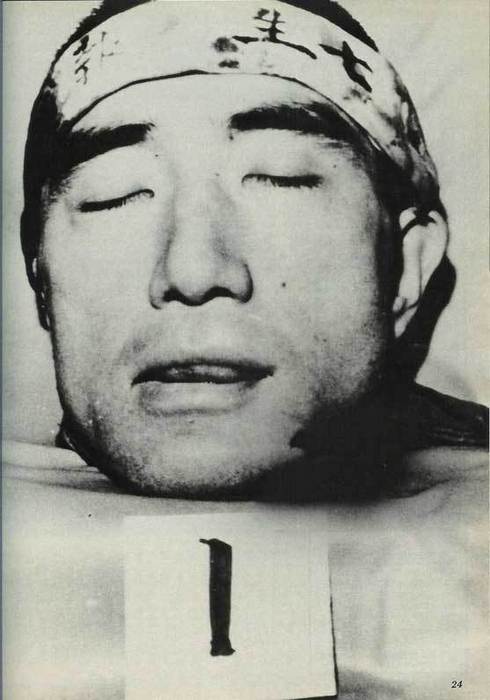
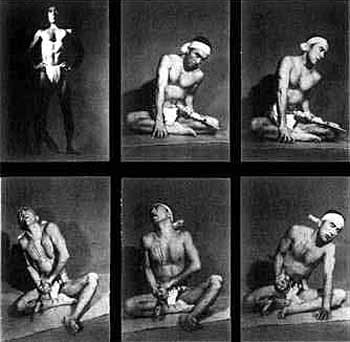
Since reading that story, I've become obsessed and fascinated with Yukio Mishima's life and works. While researching him, I came across a photo of his head after he committed seppuku. I'm including an additional photo of him, but I'm not sure if it's staged or not (most likely).
Anyways, here's some info on him. And if anyone has more pictures or better quality, feel free to post them.

Yukio Mishima (三島 由紀夫 Mishima Yukio) was the pen name of Kimitake Hiraoka (平岡 公威 Hiraoka Kimitake, January 14, 1925 – November 25, 1970), a Japanese author, poet, playwright, actor and film director, also remembered for his ritual suicide by seppuku after a failed coup d'état. Nominated three times for the Nobel Prize in Literature, Mishima was internationally famous and is considered one of the most important Japanese authors of the 20th century, whose avant-garde work displayed a blending of modern and traditional aesthetics that broke cultural boundaries, with a focus on sexuality, death, and political change.
Mishima was born in the Yotsuya district of Tokyo (now part of Shinjuku). His father was Azusa Hiraoka, a government official, and his mother, Shizue, was the daughter of a school principal in Tokyo. His paternal grandparents were Jotarō and Natsuko Hiraoka. He had a younger sister named Mitsuko, who died of typhus, and a younger brother named Chiyuki.
Mishima's early childhood was dominated by the shadow of his grandmother, Natsu, who took the boy and separated him from his immediate family for several years. Natsu was the illegitimate granddaughter of Matsudaira Yoritaka, the daimyo of Shishido in Hitachi Province, and had been raised in the household of Prince Arisugawa Taruhito; she maintained considerable aristocratic pretensions even after marrying Mishima's grandfather, a bureaucrat who had made his fortune in the newly opened colonial frontier and who rose to become Governor-General of Karafuto. She was also prone to violence and morbid outbursts, which are occasionally alluded to in Mishima's works. It is to Natsu that some biographers have traced Mishima's fascination with death. Natsu did not allow Mishima to venture into the sunlight, to engage in any kind of sport or to play with other boys; he spent much of his time alone or with female cousins and their dolls.
Mishima returned to his immediate family at 12. His father, a man with a taste for military discipline, employed such tactics as holding the young boy up to the side of a speeding train; he also raided Mishima's room for evidence of an "effeminate" interest in literature and often ripped up the boy's manuscripts.
At age six, Mishima enrolled in the elite Peers School (Gakushuin 学習院). At 12, Mishima began to write his first stories. He read voraciously the works of Oscar Wilde, Rainer Maria Rilke and numerous classic Japanese authors. After six years at school, he became the youngest member of the editorial board in its literary society. Mishima was attracted to the works of Michizō Tachihara, which in turn created an appreciation for the classical form of the waka. Mishima's first published works included waka poetry, before he turned his attention to prose.
He was invited to write a prose short story for the Peers' School literary magazine and submitted Hanazakari no Mori (花ざかりの森 The Forest in Full Bloom), a story in which the narrator describes the feeling that his ancestors somehow still live within him. Mishima’s teachers were so impressed with the work that they recommended it for the prestigious literary magazine, Bungei-Bunka (文芸文化 Literary Culture). The story, which makes use of the metaphors and aphorisms which later became his trademarks, was published in book form in 1944, albeit in a limited fashion (4,000 copies) because of the wartime shortage of paper. In order to protect him from a possible backlash from his schoolmates, his teachers coined the pen-name "Yukio Mishima".
Mishima's story Tabako (煙草 The Cigarette), published in 1946, describes some of the scorn and bullying he faced at school when he later confessed to members of the school's rugby union club that he belonged to the literary society. This trauma also provided material for the later story Shi o Kaku Shōnen (詩を書く少年 The Boy Who Wrote Poetry) in 1954.
Mishima received a draft notice for the Imperial Japanese Army during World War II. At the time of his medical check up, he had a cold and spontaneously lied to the army doctor about having symptoms of tuberculosis; he was thus declared unfit for service.
Although his father had forbidden him to write any further stories, Mishima continued to write secretly every night, supported and protected by his mother, who was always the first to read a new story. Attending lectures during the day and writing at night, Mishima graduated from the University of Tokyo in 1947. He obtained a position as an official in the government's Finance Ministry and was set up for a promising career.
However, Mishima had exhausted himself so much that his father agreed to his resigning from his position during his first year in order to devote his time to writing.
Mishima wrote novels, popular serial novellas, short stories and literary essays, as well as highly acclaimed plays for the Kabuki theater and modern versions of traditional Noh drama.
Mishima began the short story Misaki nite no Monogatari (岬にての物語 A Story at the Cape) in 1945, and continued to work on it through the end of World War II. In January 1946, he visited famed writer Yasunari Kawabata in Kamakura, taking with him the manuscripts for Chūsei (中世 The Middle Ages) and Tabako, and asking for Kawabata’s advice and assistance. In June 1946, per Kawabata's recommendations, Tabako was published in the new literary magazine Ningen (人間 Humanity).
Also in 1946, Mishima began his first novel, Tōzoku (盗賊 Thieves), a story about two young members of the aristocracy drawn towards suicide. It was published in 1948, placing Mishima in the ranks of the Second Generation of Postwar Writers. He followed with Confessions of a Mask, a semi-autobiographical account of a young latent homosexual who must hide behind a mask in order to fit into society. The novel was extremely successful and made Mishima a celebrity at the age of 24. Around 1949, Mishima published a series of essays in Kindai Bungaku on Yasunari Kawabata, for whom he had always had a deep appreciation.
His writing gained him international celebrity and a sizable following in Europe and the United States, as many of his most famous works were translated into English. Mishima traveled extensively; in 1952 he visited Greece, which had fascinated him since childhood. Elements from his visit appear in Shiosai (潮騒 Sound of the Waves), which was published in 1954, and which drew inspiration from the Greek legend of Daphnis and Chloe.
Mishima made use of contemporary events in many of his works. The Temple of the Golden Pavilion in 1956 is a fictionalization of the burning of the famous temple in Kyoto. Utage no Ato (After the Banquet), published in 1960, so closely followed the events surrounding politician Hachirō Arita's campaign to become governor of Tokyo that Mishima was sued for invasion of privacy. In 1962, Mishima's most avant-garde work, Utsukushii Hoshi (Beautiful Star), which at times comes close to science fiction, was published to mixed critical response.
Mishima was among those considered for the Nobel Prize for Literature three times and was the darling of many foreign publications. However, in 1968 his early mentor Kawabata won the Nobel Prize and Mishima realized that the chances of it being given to another Japanese author in the near future were slim.
Mishima was also an actor, and had a starring role in Yasuzo Masumura's 1960 film, Afraid to Die. He also has had roles in films including Yukoku (1966), Black Lizard (1968) and Hitokiri (1969). He also sang the theme song for Hitokiri.
Mishima was featured as a photo model in Ba-ra-kei: Ordeal by Roses by Eikoh Hosoe, as well as in Young Samurai: Bodybuilders of Japan and OTOKO: Photo Studies of the Young Japanese Male by Tamotsu Yatō. Donald Richie gives a short lively account of Mishima, dressed in a loincloth and armed with a sword, posing in the snow for one of Tamotsu Yato's photoshoots.
In 1955, Mishima took up weight training and his workout regimen of three sessions per week was not disrupted for the final 15 years of his life. In his 1968 essay Sun and Steel, Mishima deplored the emphasis given by intellectuals to the mind over the body. Mishima later also became very skillful at kendō.
Although it is known that he visited gay bars in Japan, Mishima's sexual orientation annoyed his widow : she wanted that part of his life downplayed after his death. However, the writer Jiro Fukushima published a revealing homosexual correspondence between himself and the famed novelist. Soon after publication, Mishima's children successfully sued Fukushima for violating Mishima's privacy.
After briefly considering a marital alliance with Michiko Shōda — who later married Crown Prince Akihito and is now Empress Michiko — he married Yoko Sugiyama on June 11, 1958. The couple had two children, a daughter named Noriko (born June 2, 1959) and a son named Ichiro (born May 2, 1962).
In 1967, Mishima enlisted in the Ground Self Defense Force (GSDF) and underwent basic training. A year later, he formed the Tatenokai (Shield Society), a private army composed primarily of young students who studied martial principles and physical discipline, and swore to protect the Emperor. Mishima trained them himself. However, under Mishima's ideology, the emperor was not necessarily the reigning Emperor, but rather the abstract essence of Japan. In Eirei no Koe (Voices of the Heroic Dead), Mishima actually denounces Emperor Hirohito for renouncing his claim of divinity at the end of World War II.
In the last 10 years of his life, Mishima wrote several full length plays, acted in several movies and co-directed an adaptation of one of his stories, Patriotism, the Rite of Love and Death. He also continued work on his final tetralogy, Hōjō no Umi (Sea of Fertility), which appeared in monthly serialized format starting in September 1965.
Mishima espoused a very individual brand of nationalism towards the end of his life. He was hated by leftists, in particular for his outspoken and anachronistic commitment to bushidō (the code of the samurai) and by mainstream nationalists for his contention, in Bunka Bōeiron (文化防衛論 A Defense of Culture), that Hirohito should have abdicated and taken responsibility for the war dead.
On November 25, 1970, Mishima and four members of the Tatenokai, under pretext, visited the commandant of the Ichigaya Camp — the Tokyo headquarters of the Eastern Command of Japan's Self-Defense Forces. Inside, they barricaded the office and tied the commandant to his chair. With a prepared manifesto and banner listing their demands, Mishima stepped onto the balcony to address the soldiers gathered below. His speech was intended to inspire a coup d'état restoring the powers of the emperor. He succeeded only in irritating them, and was mocked and jeered. He finished his planned speech after a few minutes, returned to the commandant's office and committed seppuku. The customary kaishakunin duty at the end of this ritual had been assigned to Tatenokai member Masakatsu Morita, but Morita was unable to properly perform the task. After several failed attempts, he allowed another Tatenokai member, Hiroyasu Koga, to behead Mishima. Morita himself attempted to commit seppuku that day as well. When he failed, Koga once again performed the kaishakunin duty.
Another traditional element of the suicide ritual was the composition of jisei no ku (death poems) before their entry into the headquarters. Mishima planned his suicide meticulously for at least a year and no one outside the group of hand-picked Tatenokai members had any indication of what he was planning. His biographer, translator and former friend John Nathan suggests that the coup attempt was only a pretext for the ritual suicide of which Mishima had long dreamed. Mishima made sure his affairs were in order and left money for the legal defense of the three surviving Tatenokai members.
Much speculation has surrounded Mishima's suicide. At the time of his death he had just completed the final book in his Sea of Fertility tetralogy. He was recognized as one of the most important post-war stylists of the Japanese language. Mishima wrote 40 novels, 18 plays, 20 books of short stories, and at least 20 books of essays, one libretto, as well as one film. A large portion of this oeuvre comprises books written quickly for profit, but even if these are disregarded, a substantial body of work remains.