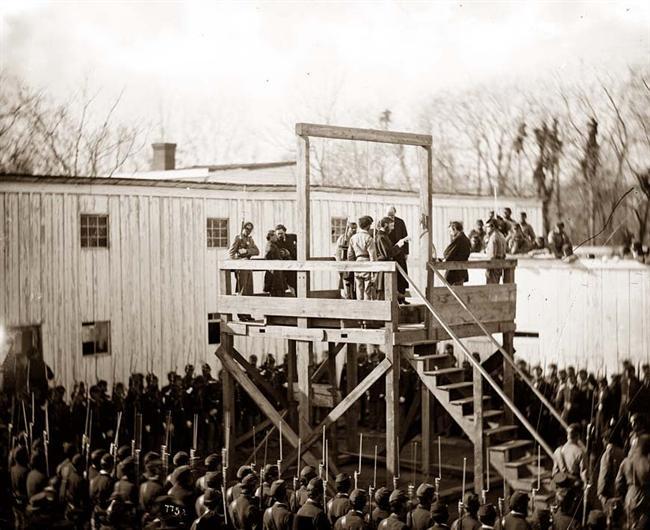
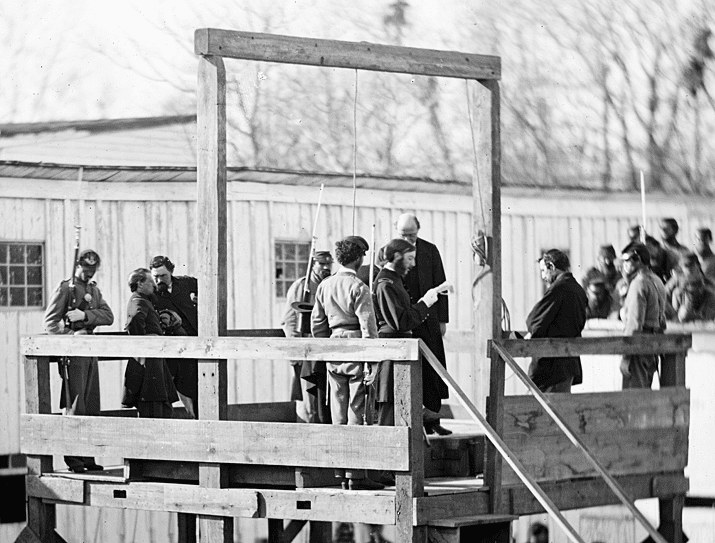
Reading the death warrant to Wirz on the scaffold.
Captain Henry Wirz was executed in November 1865 for inhumane treatment of prisoners at the Andersonville Prison, Missouri.
In late March 1864 Captain Hartmann Heinrich "Henry" Wirz took charge of the prison. The Swiss-born commander, a physician in Louisiana when the war broke out, tried to impose order and security, but his lack of authority over the guards and supply officers limited his effectiveness. He quickly became the primary target of prisoners' resentment and hostility.
Captain Wirz and another officer, James W. Duncan, were arrested and tried separately for war crimes by federal military courts in Washington, D.C. Duncan received a fifteen-year sentence but escaped after serving only one year at Fort Pulaski. Wirz was sentenced to death.
In November, 1865, he was hanged in the courtyard of the Old Capitol prison, just behind the Capitol in Washington. He was the only man executed for war crimes committed during the Civil War, and some southerners soon came to see him as a martyr. The United Daughters of the Confederacy erected a monument to him in the town of Andersonville, and each year on the anniversary of his execution, local residents hold a ceremony paying tribute to him.
A prison for Union soldiers during the Civil War, Andersonville is now maintained as a national cemetery and a major tourist attraction.
Wirz himself is almost completely obscured, sitting on a stool with only part of his right shoe visible, right center.
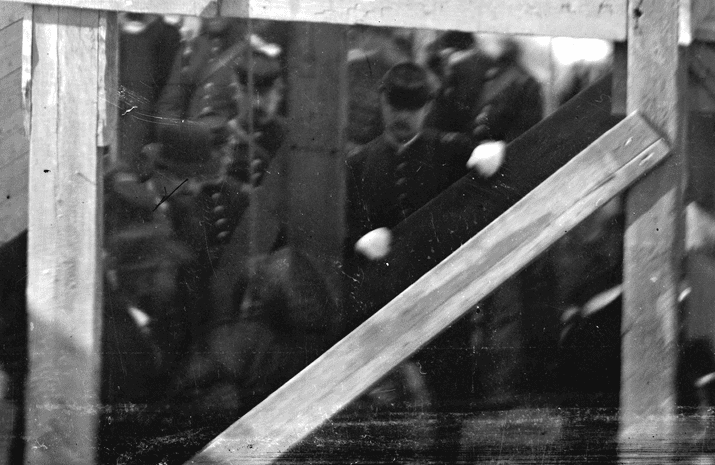
In the third image, you can make out the rope, Wirz’ hooded head and shoulders, and men gathered around the body as it’s being lowered from above. The rope itself has little or no slack, and the noose is still in place. At least three men stand by under the scaffold, at left, to handle the body. A white-gloved officer, likely from one of the two Pennsylvania regiments drawn up to witness the execution, stands by with his hands on the scaffold’s diagonal brace.
The Annapolis Gazette of November 16, 1865 describes this moment:
The body was allowed to hang fifteen minutes, when it was lowered and placed on a stretcher, and carried to the hospital, where it was examined by Dr. C. M. Ford, surgeon of the prison, Dr. Ensign, 18th V.R., and Drs. Notson and Bliss, who found that his neck had been broken. His body was placed in a coffin furnished by the Government, and delivered to Rev. Father Boyle, who received from the prisoner his dying requests as to the disposition of his remains.
Wirz was buried in the Mount Olivet Cemetery in Washington.