ok so I got it slightly wrong its not a da vinci behind a da vinci its a da vinci behind a vasari, still intresting though
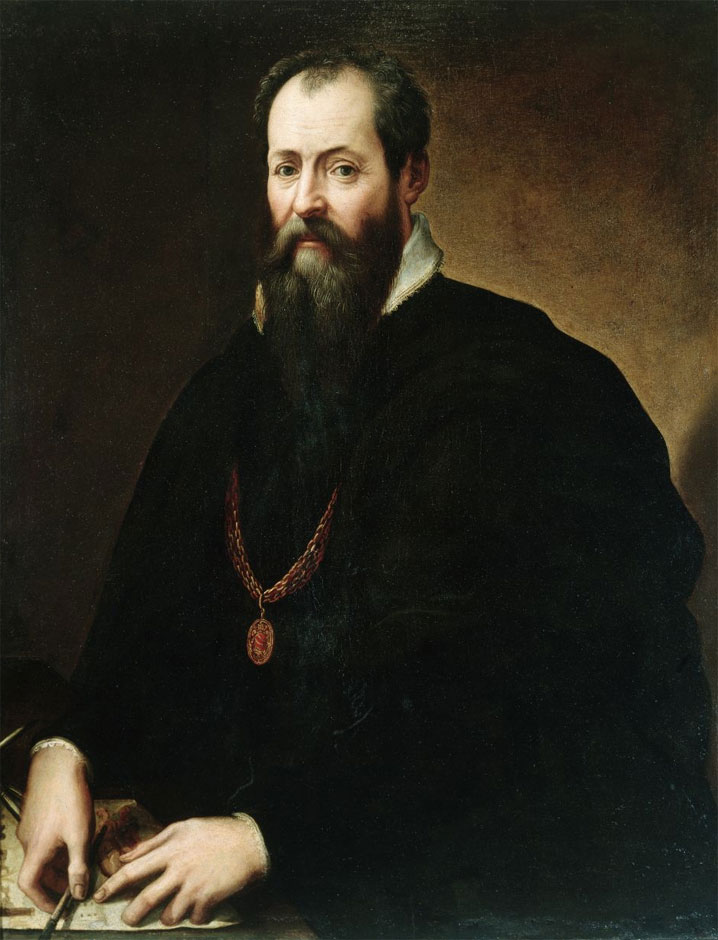
Self-Portrait by Giorgio Vasari
Art historians say they have found evidence of hidden Leonardo da Vinci
Researchers in Florence have claimed they have proof that a lost masterpiece by Leonardo da Vinci, entitled The Battle of Anghiari, exists on a wall in a cavity in Florence's town hall, where it has been hidden for five centuries.
Late last year researchers drilled tiny holes in a later fresco on the wall in the Palazzo Vecchio which conceals the cavity. They inserted a 4mm wide probe to film inside and retrieved samples of paint. They said the paint was similar to that used by Leonardo for the Mona Lisa.
"We need the courage to push on and resolve this mystery," said Matteo Renzi, the mayor of Florence, who is urging the Italian government to approve removal of parts of the later fresco, Giorgio Vasari's The Battle of Marciano in Val di Chiana, which was painted in 1563.
Leonardo, working in the Hall of Five Hundred in the Palazzo Vecchio in 1504, completed only the centrepiece of his work. This was later copied by Rubens, whose drawing hangs in the Louvre. After 1555 the palace room was renovated and Leonardo's half-finished painting was believed lost forever.
A team led by Maurizio Seracini, a researcher at the University of California, San Diego, obtained permission last year to drill six holes through Vasari's fresco in search of Leonardo's work.
The team found the 3cm-4cm (less than 2in) cavity, previously spotted with radar, behind masonry. "No other gaps exist behind the other five massive Vasari frescoes in the high-ceilinged hall," the team said.
A sample of black material removed from the back wall was analysed with a scanning electron microscope and was found to be similar to black pigment found by the Louvre in brown glazes on the Mona Lisa and the painting St John the Baptist, the team said.
"Leonardo painted the Mona Lisa in Florence at the same time," said Seracini. "It appears to be a pigment used by [him] and not by other artists."
Flakes of red material were identified as being possibly lacquer. "This type of material is unlikely to be present in an ordinary plastered wall," the team said.
High-definition endoscopic images also revealed beige material on the original wall that "could only have been applied by a paint brush".
Some art experts have petitioned against Seracini drilling through the Vasari fresco, claiming any paint found behind might have been left by another artist.
Speaking at a conference held in front of the shrouded wall on Monday, the head of Florence's state restoration centre, Marco Ciatti, said he was not yet convinced the Leonardo work was there.
Seracini said the holes had been drilled only in peripheral areas of the fresco which had been restored: he would now be asking permission to drill in other restored areas, within 10 sq metres at the centre of the Vasari fresco.
Seracini's suspicions that Vasari did not want to destroy Leonardo's work, preferring to add his own fresco over it, were reinforced in the 1970s, he said, when he found the artist had painted a soldier in his fresco with a flag upon which was written: "He who seeks, finds."
Seracini said a 10-sq-metre section of another giant Vasari fresco in the room – depicting an injured horse lying beside a bloodied warrior pulling a spear out of his back – had been removed and then replaced in a search for the Battle of Anghiari in the 1980s.
Did Vasari save a Da Vinci for us?
Giorgio Vasari's The Lives of the Artists, first published in Florence in 1550, is quite simply the most entertaining and enduring book ever written about art. It's stuffed with great stories about artists from the medieval painter Cimabue to Michelangelo, whom Vasari knew personally. Yet it is also threaded through with fascinating and acute critiques and descriptions – such as Vasari's passionate account of Leonardo da Vinci's lost painting The Battle of Anghiari:
"A work that was held to be very excellent and of great mastery … Seeing that in it rage, fury, and revenge are perceived as much in the men as in the horses, among which two with the forelegs interlocked are fighting no less fiercely with their teeth than those who ride them are fighting for that standard … While an old soldier in a red cap, crying out, grips the staff with one hand, and, raising a scimitar with the other, furiously aims a blow in order to cut off both the hands of those who, gnashing their teeth in the struggle, are striving … to defend their banner."
Now this painting, vanished for centuries, poses a threat to Vasari's works that decorate the great hall of the Palazzo Vecchio in Florence. Researchers have already, controversially, made small holes in one of Vasari's frescoes. If their dramatic announcement that they have found traces of an older painting below is fully confirmed and enough samples are taken to make it seem that Leonardo's unfinished and surely much-damaged battle survives, the pressure may be unstoppable to dig into Vasari's work and recover it.
What would Vasari think of that? And what can his work tell us about the likelihood of Leonardo's mural surviving?
Vasari dedicated The Lives of the Artists to Cosimo I de' Medici, first grand duke of Tuscany. Cosimo's portrait appears often in the frescoes and ceiling paintings that Vasari and his team created in the Palazzo Vecchio. So do other members of the Medici family, as well as Greek gods, mythological creatures, alchemy and pearl fishing. The interior of the Palazzo Vecchio, which he totally redecorated, turning a medieval civic building into one of the most luxurious palaces in Europe, is Vasari's masterpiece. And it is utterly charming, but its real magic is architectural.
The really clever touches in Vasari's reconstruction of the Palazzo Vecchio are tricks that metamorphosise the fabric of this old building. A private study is tucked away like an occult chamber. A vast hidden attic hangs above the hall where Leonardo painted The Battle of Anghiari, whose ceiling Vasari dramatically raised. Next door he began the Uffizi – Offices – which became today's art gallery, and which is linked by a secret corridor to the Boboli Gardens on the other side of the river Arno.
The same word keeps recurring as I describe his architecture: secret.
Giorgio Vasari lived in a paranoid time. The Medici had only recently crushed Florentine republicanism in a murderous siege. Artists now competed for court favour, and in their rivalry, he and Benvenuto Cellini accused each other before the duke of being gay or bisexual, which was probably true in both cases. Vasari shaped an image for himself of dignity and self-control: yet all the alcoves and false ceilings and hidden corridors that he built speak of repressed truths, troubling memories, and clues to be followed.
The researchers' claim to have found a space behind one of Vasari's frescoes, where an older painting may have survived, therefore rings true. It is exactly the kind of trick Vasari loved to play. His job in the Palazzo Vecchio was specifically to destroy traces of the republican history of this building, and Leonardo's painting was commissioned by the republic when the Medici were in exile. It would be true to Vasari's enigmatic character to preserve this great work in a secret recess. And if he did so, the tactic is a message to posterity to reveal what is hidden. Vasari had pride, but he knew he was a lesser artist than Leonardo da Vinci.







 Hell, I'll queue it up myself.
