|
#1
●
06-23-2026, 06:38 PM
| ||||||||
| So Fucking Banned Poster Rank:298 Join Date: Mar 2010 Posts: 4,325
Contributions: 1
Mentioned: 2 Post(s) Quoted: 1445 Post(s)
| ||||||||
|
Idaho: Firing Squad Will Be Primary Method of Execution
Effective July 1, 2026, Idaho is officially making the firing squad its primary method of execution. Governor Brad Little signed House Bill 37 making this change, alongside House Bill 380, which makes the aggravated sexual abuse of a child under the age of 12 a capital offense. Here's hoping there will be pics/vids either available officially or leaked, and posted here on DR. 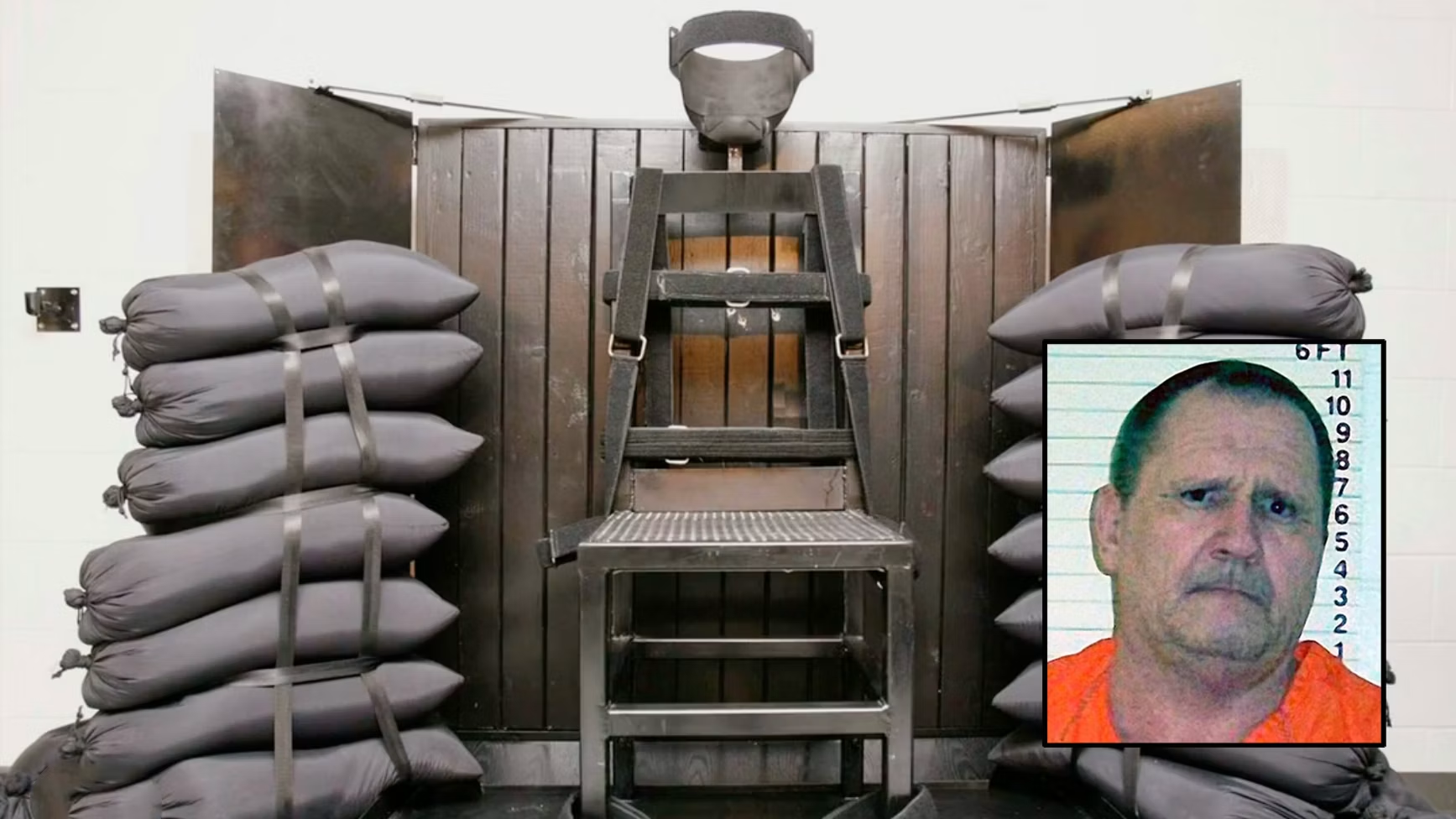 · |
|
#3
●
06-24-2026, 01:47 PM
| ||||||||
 My Rank: MASTER GUNNERY SERGEANT Poster Rank:364 I own a penis, only moderately happy with its size though Join Date: Nov 2021 Posts: 3,304 Mentioned: 1 Post(s) Quoted: 1719 Post(s)
| ||||||||
|
Re: Idaho: Firing Squad Will Be Primary Method of Execution
Do they take interns in the firing squads ? resume.pdf |
|
#4
●
06-25-2026, 03:00 AM
| ||||||||
 ✝Mudderator from Hell✝ Poster Rank:11 e-mail Join Date: Oct 2006 Posts: 95,828
Contributions: 817
Mentioned: 473 Post(s) Quoted: 10215 Post(s)
| ||||||||
|
Re: Idaho: Firing Squad Will Be Primary Method of Execution
To pursue the death penalty under this aggravated charge, prosecutors must prove at least 3 of 17 strict statutory aggravating factors beyond a reasonable doubt. 1. Multiple incidents: The defendant committed the act of lewd conduct against the same victim three or more separate times. 2. Prior sex convictions: The defendant has a previous conviction for an offense that requires sex offender registration. 3. Position of trust: The defendant was in a position of trust, authority, or had supervisory/disciplinary power over the child. 4. Sexual penetration: The offense involved actual sexual penetration of the victim. 5. Kidnapping: The victim was kidnapped during or in connection with the crime. 6. Human Trafficking: The child was a victim of human trafficking facilitated by the defendant. 7. Torture/Brutality: The crime involved torture or the infliction of extreme and prolonged acts of brutality. 8. Force or coercion: The defendant used physical force or coercion to commit the act. 9. Armed with a weapon: The defendant was armed with a deadly weapon, or an object fashioned to make the victim reasonably believe it was a weapon. 10. Great bodily injury: The defendant caused great bodily injury or physical mutilation to the victim. 11. Multiple victims: The commission of the offense involved more than one child victim under the age of 12. 12. Multiple perpetrators: The commission of the offense involved more than one perpetrator acting together. 13. STD Transmission: The victim contracted a sexually transmitted disease as a direct result of the lewd conduct. 14. Impregnation: The victim was impregnated as a result of the lewd conduct. 15. Choking/Strangulation: The defendant willfully and unlawfully choked or attempted to strangle the victim. 16. Drug/Alcohol facilitation: The defendant knowingly provided alcohol, drugs, or other intoxicating substances to incapacitate the victim. 17. Vulnerability/Disability: The defendant knew, or had reason to know, that the child suffered from a temporary or permanent mental or physical disability. Defense attorneys and legal experts are actively preparing to challenge House Bill 380. Because the law expands the death penalty to a non-homicide crime, it creates a direct, intentional collision with established federal constitutional law. The primary argument for defense attorneys is that HB 380 is unconstitutional on its face. In the 2008 landmark case Kennedy v. Louisiana, the U.S. Supreme Court ruled 5–4 that executing someone for the rape of a child, where the crime did not result in the victim's death, violates the Eighth Amendment's prohibition against "cruel and unusual punishment". Defense attorneys will argue that Idaho cannot override a Supreme Court precedent. Beyond constitutional theory, Idaho faces a severe operational problem in its justice system: Statistically, Idaho files roughly 30 first-degree murder charges a year. In contrast, prosecutors file roughly 380 lewd conduct charges annually. Even if only a fraction of those cases meet the "aggravated" threshold, the number of potential capital cases will skyrocket. Capital defense attorneys require specialized, highly rigorous state certifications to handle death penalty cases. Legal experts warn that Idaho simply does not have enough qualified capital public defenders to handle a massive influx of death penalty trials, which could stall the court system and lead to claims of a violated right to a speedy trial. The sponsors of HB 380, incl. attorney and Representative Bruce Skaug, freely admit that the law violates the 2008 ruling. However, the law was intentionally drafted to serve as a vehicle to get back to the U.S. Supreme Court. The conservative majority of the current U.S. Supreme Court has shown a willingness to overturn long-standing precedents (most notably Roe v. Wade in 2022). Idaho is not acting alone. Florida and Tennessee recently passed highly similar child-rape death penalty laws. State attorneys general are coordinating to present a unified front, arguing that the "evolving standards of decency" in America have changed since 2008 and that the ultimate punishment is justifiable to protect young children. Because the law is expected to face immediate injunctions, the death penalty portion of HB 380 will likely be paused by a federal judge before it can ever be applied to a defendant. This will kickstart a years-long appellate process traveling up through the 9th U.S. Circuit Court of Appeals and eventually to the Supreme Court stairs. Meanwhile, Idaho's Department of Correction is continuing its $900,000-plus retrofit of its maximum-security facility south of Boise to build the new firing squad chamber, preparing for the moment the legal battles conclude. |
|
#5
●
06-25-2026, 02:47 PM
| ||||||||
 ★ Legacy Member ★ Poster Rank:114 Secret Agent Join Date: Dec 2009 Posts: 13,921 Mentioned: 6 Post(s) Quoted: 2908 Post(s)
| ||||||||
|
Re: Idaho: Firing Squad Will Be Primary Method of Execution
Idaho’s laws about cannabis are insane. I’m surprised they don’t execute offenders for weed. That fucking state is one I rarely drive through if I can avoid it on my cross country trips. I’ll go around that state…  |
|
#6
●
06-26-2026, 12:51 AM
| ||||||||
 D.R.'s PM Casanova Poster Rank:27 ҍɘҍɘn Join Date: Feb 2017 Posts: 52,779
Contributions: 1
Mentioned: 165 Post(s) Quoted: 31778 Post(s)
| ||||||||
|
Re: Idaho: Firing Squad Will Be Primary Method of Execution
imagine having to be the one arguing against executing the freak who destroyed a child like that. that's gotta be a tough position to hold. "well, it wasn't that bad, he only raped her, maiming her soul, tainting her internal light forever... its not like he killed her. thus the crime doesn't deserve death." difficult position to argue for, that's fer sure. although i can understand why somebody would have to do it. |
|
#7
●
06-26-2026, 12:52 AM
| ||||||||
| D.R.'s PM Casanova Poster Rank:27 ҍɘҍɘn Join Date: Feb 2017 Posts: 52,779
Contributions: 1
Mentioned: 165 Post(s) Quoted: 31778 Post(s)
| ||||||||
|
Re: Idaho: Firing Squad Will Be Primary Method of Execution
its cool the firing squad is the default method now tho. it should've always just been that, if not hanging.
|
|
#8
●
06-26-2026, 10:13 PM
| ||||||||
 •Sofa King Band• Poster Rank:425 The external genitalia are that of an otherwise normal adult male. (I was in the pool!) Join Date: Oct 2020 Posts: 2,714
Contributions: 1
Mentioned: 0 Post(s) Quoted: 432 Post(s)
| ||||||||
|
Re: Idaho: Firing Squad Will Be Primary Method of Execution
When have we ever seen a genuine government sponsored execution that was carried out in the US?
|