JavaScript and Cookies are required to view this site. Please enable both in your browser settings.
China to End One-child Policy and Allow Two

China to End One-child Policy and Allow Two 

Current Rating:

Unlimited Views No Ads No Algorithms Lifetime Account

Documenting Reality

Community Forum · Est. 2006

Join Now
Thread Tools
  #1  
10-30-2015, 04:31 AM
gatagato's Avatar
gatagato
Offline:
★ ********* ★
Poster Rank:247
Male
Join Date: Jul 2009
Posts: 5,565
Contributions: 368
 
Mentioned: 66 Post(s)
Quoted: 932 Post(s)
Activity Longevity
1/20 18/20
Today Posts
0/11 sssss5565
China to End One-child Policy and Allow Two

China has decided to end its decades-long one-child policy, the state-run Xinhua news agency reports.
Couples will now be allowed to have two children, it said, citing a statement from the Communist Party.
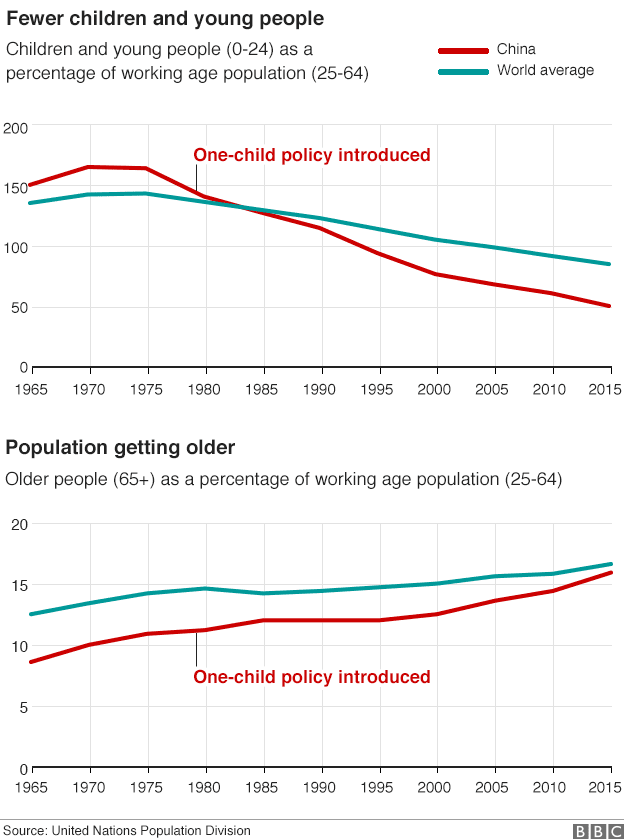
The controversial policy was introduced nationally in 1979, to slow the population growth rate.
It is estimated to have prevented about 400 million births. However concerns at China's ageing population led to pressure for change.
Couples who violated the one-child policy faced a variety of punishments, from fines and the loss of employment to forced abortions.
Over time, the policy has been relaxed in some provinces, as demographers and sociologists raised concerns about rising social costs and falling worker numbers.
Click image for larger version

Name:	ch1.png
Views:	364
Size:	24.5 KB
ID:	649227

The decision to allow families to have two children was designed "to improve the balanced development of population'' and to deal with an aging population, according to the statement from the Community Party's Central Committee carried by the official Xinhua News Agency (in Chinese) on Thursday.
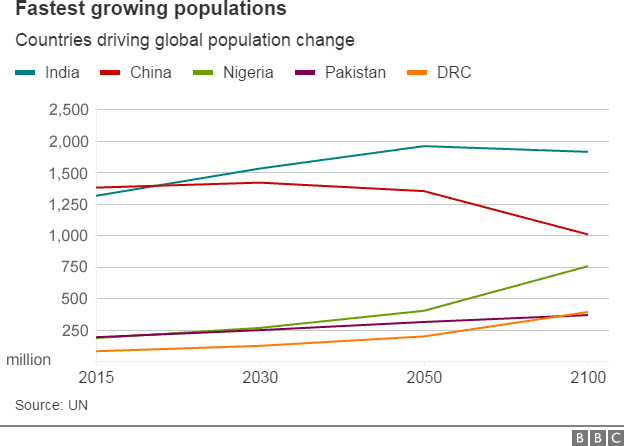
Currently about 30% of China's population is over the age of 50. The total population of the country is around 1.36 billion.
The Communist Party began formally relaxing national rules two years ago, allowing couples in which at least one of the pair is an only child to have a second child.
China's one-child policy
  • Introduced in 1979, the policy meant that many Chinese citizens - around a third, China claimed in 2007 - could not have a second child without incurring a fine
  • In rural areas, families were allowed to have two children if the first was a girl
  • Other exceptions included ethnic minorities and - since 2013 - couples where at least one was a single child
  • Campaigners say the policy led to forced abortions, female infanticide, and the under-reporting of female births
  • It was also implicated as a cause of China's gender imbalance

Correspondents say that despite the relaxation of the rules, many couples may opt to only have one child, as one-child families have become the social norm.
Critics say that even a two-child policy will not boost the birth rate enough, the BBC's John Sudworth reports.
And for those women who want more than two children, nor will it end the state's insistence on the right to control their fertility, he adds.
"As long as the quotas and system of surveillance remains, women still do not enjoy reproductive rights," Maya Wang of Human Rights Watch told AFP.
I lost two siblings - by Juliana Liu, BBC News Hong Kong correspondent
Click image for larger version

Name:	_86394051_juliana.jpg
Views:	475
Size:	28.6 KB
ID:	649228
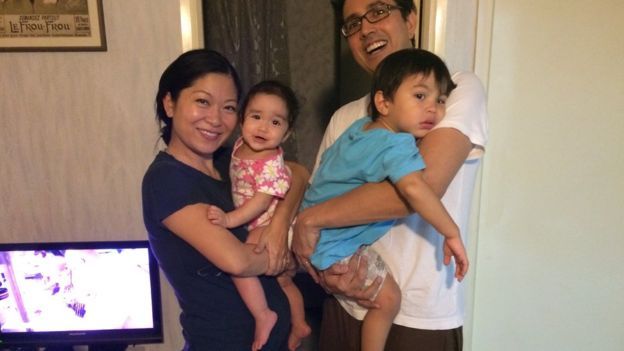
The BBC's Juliana Liu, pictured with her family

I was born in 1979, the year the one-child policy was implemented. And even then, I wasn't supposed to be born.
In my parents' work unit, there were also quotas for babies. By the time my mother announced her pregnancy, the quotas were all used up for the year.
But kind-hearted officials decided to look the other way and allowed my birth. My would-be siblings were less lucky.
As a result of the policy, my mother had to endure two abortions. Even today, she talks about 'Number Two' and 'Number Three' and what they might have been like.
Writing in The Conversation, Stuart Gietel-Basten, associate professor of social policy at the University of Oxford, says the reform with do little to change China's population and is instead a "pragmatic response to an unpopular policy that made no sense".
The announcement in China came on the final day of a summit of the Communist Party's policy-making Central Committee, known as the fifth plenum.
The party also announced growth targets and its next five year plan.
Click image for larger version

Name:	_84574763_un_pop_countries_624.png
Views:	377
Size:	19.0 KB
ID:	649229

http://www.bbc.com/news/world-asia-34665539
https://en.wikipedia.org/wiki/One-child_policy

Related (DR):

http://www.documentingreality.com/fo...n-year-106803/
http://www.documentingreality.com/fo...-death-111060/
http://www.documentingreality.com/fo...ortion-134324/
http://www.documentingreality.com/fo...ickers-138541/
http://www.documentingreality.com/fo...-alive-127964/
2 Users Say Thank You For This Post:
AceGoober, kellyhound
▼ PROMO FROM DOCUMENTING REALITY
Some regrets are real. Membership isn’t one of them
Join Now
Hidden for upgraded members.
  #2  
10-30-2015, 05:06 AM
kellyhound's Avatar
kellyhound
Offline:
✝Mudderator from Hell✝
Poster Rank:11
e-mail
Join Date: Oct 2006
Posts: 95,759
Contributions: 817
 
Mentioned: 473 Post(s)
Quoted: 10211 Post(s)
Activity Longevity
17/20 20/20
Today Posts
0/11 ssss95759
Re: China to End One-child Policy and Allow Two

They made a bad and too abrupt birth regulation system back than as

The one-child policy has had several unintended consequences, including a dearth of workers, a reduced female population due to gendercide, and fewer young people to take care of a quickly aging population. Moreover, the policy has created conditions conducive to a severe regional human-trafficking and human-smuggling epidemic to compensate for the lack of Chinese women. It has already facilitated the practice of mail-order brides and created a burgeoning illegal-adoption market.

China cannot rely on immigration to bridge the gap. (The United States, for instance, makes up for its below-replacement-level birth rate through immigration.) China’s decision to implement a closed immigration system and closely monitor freedom of movement (even within the country) makes solutions to the associated economic challenges extremely difficult.

Economic tumult in China is, at this point, inevitable—even if the Chinese government reverses the one-child policy today. Why? Because those who will constitute the working-age population of the 2020s and the 2030s have already been born; the size of this particular subset of the population cannot increase.
I wonder if they gonna use foreign workers to fill the gap. Ironic with all the chinese that immigrated to almost every country in the past 80 years or so.
2 Users Say Thank You For This Post:
AceGoober, gatagato


Powered by vBulletin Copyright 2000-2010 Jelsoft Enterprises Limited.

Search Engine Friendly URLs by vBSEO