JavaScript and Cookies are required to view this site. Please enable both in your browser settings.
Challenger Remembered!! - Section 2

Challenger Remembered!! 

Current Rating:

Unlimited Views No Ads No Algorithms Lifetime Account

Documenting Reality

Community Forum · Est. 2006

Join Now
Thread Tools
  #11  
01-30-2016, 01:49 AM
kellyhound's Avatar
kellyhound
Offline:
✝Mudderator from Hell✝
Poster Rank:10
e-mail
Join Date: Oct 2006
Posts: 94,965
Contributions: 817
 
Mentioned: 472 Post(s)
Quoted: 10077 Post(s)
Activity Longevity
18/20 20/20
Today Posts
0/11 ssss94965
Re: Challenger Remembered!!

The morning of January 28 was unusually cold, and engineers warned their superiors that certain components—particularly the rubber O-rings that sealed the joints of the shuttle’s solid rocket boosters—were vulnerable to failure at low temperatures. However, these warnings went unheeded, and at 11:39 a.m. Challenger lifted off.

The commission also found that Morton Thiokol, the company that designed the solid rocket boosters, had ignored warnings about potential issues. NASA managers were aware of these design problems but also failed to take action. Famously, scientist Richard Feynman, a member of the commission, demonstrated the O-ring flaw to the public using a simple glass of ice water.

McDonald, the director of the Space Shuttle Solid Rocket Motor Project for the engineering contractor Morton Thiokol, was concerned that below-freezing temperatures might impact the integrity of the solid rockets' O-rings.

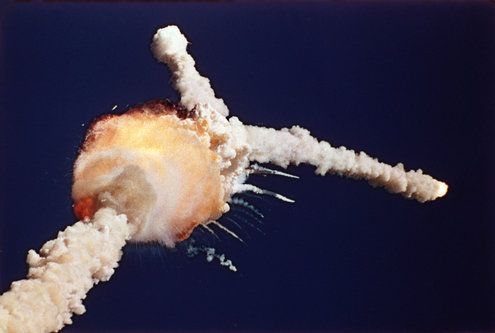
He would soon learn that his worst fears had come true. But as he watched the Challenger disintegrate at the Launch Control Center that cold, sunny January morning, he was baffled. He had predicted that if the O-rings were to fail, the rockets would explode before the shuttle ever lifted off from the launch site. Instead, following the break-up, the rockets remained intact and continued flying.

"I was as shocked as everybody else was in the room," he said. "They couldn't believe what they were seeing -- and I couldn't either, frankly. There were a lot of people sobbing."

McDonald, who has detailed his experiences with the Challenger disaster and its aftermath in a book, "Truth, Lies, and O-Rings: Inside the Space Shuttle Challenger Disaster," was the featured speaker Tuesday, Oct. 2, at the Colloquium at NASA's Langley Research Center.

The day after the Challenger tragedy, McDonald went to Huntsville, Ala., to join the failure team. At that point, he was convinced that engine failure or a problem with the fuel tank structure was to blame.

In fact, McDonald was actually leaving the building at the Huntsville Operations Support Center to catch a flight home when someone ran out and told him he needed to come back. The man who came out to get McDonald told him that while watching films, someone from the Science and Engineering Director at Cape Canaveral had noticed that the right solid rocket had a hole in it that he suspected had caused the problem.

"Tell him he doesn't know what the hell he's talking about," McDonald said. "This solid rocket isn't going to go flying around with holes in it."

McDonald relented, though, and was soon presented with indisputable evidence that the scenario he had most feared had, in fact, taken place—but in an unexpected way.

An O-ring seal had failed at launch, but the hole was quickly resealed by aluminum oxides before any flames could escape and cause an explosion. Strong wind shear that began 37 seconds into flight then tore the seal back open, resulting in the catastrophic breakup.

The following months were anything but easy for McDonald. He had to testify before a Presidential commission, during which he explained to commission Chairman William Rogers that Morton Thiokol had been so concerned about the O-rings that they recommended that NASA not launch the shuttle in temperatures below 53 degrees. They just didn't have enough data to determine if the O-rings would seal properly at lower temperatures.

According to McDonald, Rogers' response was: "If I heard what I think I heard, this will be in litigation for years to come."

"My life changed when he said that," said McDonald. Realizing that he would be at the center of much of that litigation—including litigation from the families of the astronauts—McDonald decided to keep detailed written records of the events leading up to the launch and the long aftermath. He ended up with 1,400 pages of handwritten notes.

"Twenty years later I was up in my attic cleaning out some stuff," he said. "It was probably 120 degrees up there. And I opened this box and started reading and said, 'Oh my God, this would make a real good book.' "

In his book and lecture, McDonald talks about being removed from his job and demoted in the wake of the Challenger incident. His decision to tell the truth was not taken well by his employers. But the Presidential commission eventually vindicated McDonald, who chose to stay on with Morton Thiokol. He was reinstated to his position and put in charge of the redesign and requalification of the solid rocket motors.

"I decided that that's better than thinking about what could've been and should've been—is to make sure it never happens again," he said. "And I felt very good about that."

The resulting improvements led to 110 shuttle missions in which the boosters came back pristine. McDonald says that because of the improvements, shuttle astronauts felt that the boosters were the safest piece of equipment on the shuttle. That was a rewarding result for McDonald, of course, but also emotionally therapeutic in light of the Challenger accident.

In his lecture, McDonald, who retired from ATK Thiokol Propulsion in 2001 as vice president and technical director for advanced technology programs, discussed some of the important lessons that have come out his experiences. He placed particular emphasis on communication.

"In my career, I don't know how many times people have raised their hand and said, 'This may be a dumb question, but…' I always stood up and said, 'In my entire career I've never, ever heard a dumb question. I've heard a lot of dumb answers," he said.

He also emphasized the importance of feeling comfortable speaking up and offering one's professional opinion. He illustrated that point—and laced it with a bit of humor—when discussing his fateful choice not to sign the launch recommendation.

"I made the smartest decision I made in my lifetime -- I'd say second smartest if my wife was here," he said.
Always people have to die, despite warnings o plenty, before improvements take place. This shouldn't have happened but i guess prestige and time pressure took its toll.
You see the same with cars. Last couple of years call backs for cars with malfunctions are spectacular rising. They don't take enough time anymore to test things properly because of economics and competition from other brands and even hold back complaints about certain faulty parts for yeeeears. Some people even have to die because of that. But now with all the suing going on suddenly they call back cars way faster. Just rat bastards imo.
6 Users Say Thank You For This Post:
b0g, Clubhouse, Oswald2001, rob666, Steve, WTFFTW
▼ PROMO FROM DOCUMENTING REALITY
Where there is will, there's a way
Join Now
Hidden for upgraded members.
  #12  
08-01-2016, 08:54 PM
rohmell's Avatar
rohmell
Offline:
My Rank: SERGEANT MAJOR
Poster Rank:298
Join Date: Mar 2010
Posts: 4,282
Contributions: 1
 
Mentioned: 2 Post(s)
Quoted: 1436 Post(s)
Activity Longevity
6/20 17/20
Today Posts
0/11 sssss4282
Re: Challenger Remembered!!

Video from Post # 11 blocked in my country...I'm in the USA... what the hell?
  #13  
11-19-2023, 10:28 PM
Patriotpride16t's Avatar
Patriotpride16t
Offline:
My Rank: CORPORAL
Poster Rank:1469
Male
Join Date: Feb 2015
Posts: 392
 
Mentioned: 0 Post(s)
Quoted: 6 Post(s)
Activity Longevity
1/20 12/20
Today Posts
0/11 ssssss392
Re: Challenger Remembered!!

From what I remember, NASA investigators isolated the video and it showed the cockpit was completely intact as it descended into the ocean. They also stated the crew was alive and alert until ocean impact. How fucking horrifying!!? So sad.
  #14  
11-24-2023, 07:02 AM
Clubhouse
Offline:
★ Legacy Member ★
Poster Rank:12
Join Date: Jun 2009
Posts: 81,663
 
Mentioned: 282 Post(s)
Quoted: 32531 Post(s)
Activity Longevity
0/20 18/20
Today Posts
0/11 ssss81663
Re: Challenger Remembered!!

1. The Challenger didn’t actually explode.

A cloud of fire engulfed the space shuttle just 73 seconds after liftoff, at an altitude of some 46,000 feet (14,000 meters). It looked like an explosion, the media called it an explosion and even NASA officials mistakenly described it that way initially. But later investigation showed that in fact, there was no detonation or explosion in the way we commonly understand the concept.

A seal in the shuttle’s right solid-fuel rocket booster designed to prevent leaks during liftoff weakened in the frigid temperatures and failed, and hot gas began pouring through the leak. The fuel tank itself collapsed and tore apart, and the resulting flood of liquid oxygen and hydrogen created the huge fireball believed by many to be an explosion.

2. The astronauts aboard the shuttle didn’t die instantly.

A seal in the shuttle’s right solid-fuel rocket booster designed to prevent leaks from the fuel tank during liftoff weakened in the frigid temperatures and failed, and hot gas began pouring through the leak. The fuel tank itself collapsed and tore apart, and the resulting flood of liquid oxygen and hydrogen created the huge fireball believed by many to be an explosion.

After the collapse of its fuel tank, the Challenger itself remained momentarily intact and actually continued moving upwards. Without its fuel tank and boosters beneath it, however, powerful aerodynamic forces soon pulled the orbiter apart. The pieces—including the crew cabin—reached an altitude of some 65,000 feet before falling out of the sky into the Atlantic Ocean below.

It’s likely that the Challenger’s crew survived the initial breakup of the shuttle but lost consciousness due to loss of cabin pressure and probably died due to oxygen deficiency pretty quickly. But the cabin hit the water’s surface (at more than 200 mph) a full 2 minutes and 45 seconds after the shuttle broke apart, and it’s unknown whether any of the crew could have regained consciousness in the final few seconds of the fall.


more@


https://www.history.com/news/5-thing...uttle-disaster
2 Users Say Thank You For This Post:
kellyhound, Krusen72
  #15  
11-28-2023, 02:43 PM
metalhead66
Offline:
My Rank: PRIVATE
Poster Rank:7047
Join Date: Apr 2015
Posts: 29
 
Mentioned: 0 Post(s)
Quoted: 1 Post(s)
Activity Longevity
1/20 12/20
Today Posts
0/11 sssssss29
Re: Challenger Remembered!!

I’ll never forget those words… Obviously a major malfunction
  #16  
02-22-2024, 08:22 PM
condor5
Offline:
So Fucking Banned
Poster Rank:1209
Join Date: Sep 2009
Posts: 519
 
Mentioned: 1 Post(s)
Quoted: 50 Post(s)
Activity Longevity
0/20 17/20
Today Posts
0/11 ssssss519
Re: Challenger Remembered!!

And they were almost certainly conscious until they hit the sea.
yup.
They had audio and telemetry, confirmed alive until impact.


Powered by vBulletin Copyright 2000-2010 Jelsoft Enterprises Limited.

Search Engine Friendly URLs by vBSEO