|
#1
●
01-30-2013, 03:38 PM
| ||||||||
 ♚ Legacy Gold Member ♚ Poster Rank:34 Female Join Date: Nov 2008 Posts: 43,403
Contributions: 204
Mentioned: 95 Post(s) Quoted: 2281 Post(s)
| ||||||||
|
"Waterloo Teeth"
In the eighteenth and nineteenth centuries people dreaded losing their teeth  The toothless had sunken cheeks and looked old before their time. Replacement teeth were traditionally made from ivory (hippopotamus, walrus, or elephant) which deteriorated quicker than real teeth. The toothless had sunken cheeks and looked old before their time. Replacement teeth were traditionally made from ivory (hippopotamus, walrus, or elephant) which deteriorated quicker than real teeth. More costly dentures were made with an ivory base and then set with real human teeth. The biggest purveyors of teeth were the resurrectionists who stole corpses to sell to medical schools. A set of teeth was one of the perks of the job. Even if they dug up a body too far gone for the anatomy lesson, they could still sell the teeth. Unfortunately for some unlucky recipients, syphilis and tuberculosis were unknowingly transmitted into their mouths from infected donors. When the fighting at Waterloo ended, night was closing in. Battlefield scavengers flitted from corpse to corpse, gathering up weapons and looking for valuables. The final act of desecration followed. They pulled and pocketed any intact front teeth. As a result, the sudden flood of teeth onto the market was enormous. Dentures made from second-hand teeth acquired a new name – Waterloo Teeth. Far from putting clients off, this was a selling point. Better to have teeth from a soldier killed in battle than those plucked from the jaws of a decaying corpse or a hanged person  Apparently, Waterloo teeth still appeared in dental supply catalogues of the 1860s. 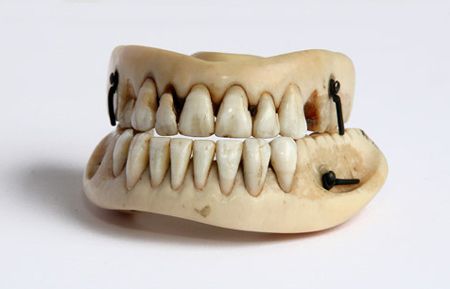 · |
|
#6
●
01-31-2013, 01:30 AM
| ||||||||
 My Rank: CORPORAL Poster Rank:1331 Femme Fatale Join Date: Nov 2009 Posts: 454 Mentioned: 0 Post(s) Quoted: 64 Post(s)
| ||||||||
|
Re: "Waterloo Teeth"
Okay I can't believe I'm going to admit this, but I got dentures when I was only 35. I am a recovering heroin addict, and I lost all my teeth when I had been going to a methadone clinic for a while. It makes your teeth decay really bad. This is very interesting, though. I never knew they made dentures that long ago, and the materials that were used to make them... Shocking!  |
|
#7
●
01-31-2013, 04:21 AM
| ||||||||
 My Rank: FIRST SERGEANT Poster Rank:417 Male Join Date: Dec 2012 Posts: 2,771
Contributions: 30
Mentioned: 6 Post(s) Quoted: 387 Post(s)
| ||||||||
|
Re: "Waterloo Teeth"
Looks like they must drill a hole through your jaw and then you use those pins to hold them in. Pretty neat, I had never heard of this, thanks for the info. |
|
#8
●
02-01-2013, 04:41 PM
| ||||||||
 My Rank: LANCE CORPORAL Poster Rank:2286 Join Date: Jul 2012 Posts: 202 Mentioned: 0 Post(s) Quoted: 36 Post(s)
| ||||||||
|
Re: "Waterloo Teeth"
Anyone else singing ABBA's 'Waterloo' in their head after reading the title? *crickets* ok, I'll leave now.... |