|
#1
●
08-19-2024, 09:40 PM
|
 These are the rooms Poster Rank:26 of ruin. Join Date: Sep 2014 Posts: 54,008 54,008Posts 87,658Thanked 30,403Quoted 145Mentioned 0Contrib. |
|
Treatment of Severe Keloids
This 63-year-old woman started developing keloids on her trunk and upper limbs when she was an elementary school student (Fig 1). The exact cause (eg, trauma or burns) was not clear, although she remembered that her upper arm keloids developed from a BCG vaccination. When she was 12 years old, she underwent keloid-removal surgery, but the keloids recurred rapidly and the one on her upper arm became even bigger. The first medical examination in our department revealed that her right thumb, wrist, and elbow joints had such severe contractures that she could not move these joints at all. At that same time, her blood pressure was found to be 150/95 (stage I hypertension: JNC7). The internal medicine clinic started her on a Ca-channel blocker (amlodipine besilate) and an angiotensin II blocker (candesartan cilexetil). We planned to release the contractures of the right thumb, wrist, and elbow joints by using flaps designed on the adjacent normal skin along with postoperative radiation therapy. A distally based radial artery flap was selected for the thumb and wrist joints (Fig 2), and simple excision and suture were selected for the elbow joint. Starting the day after surgery, both the donor and recipient sites were subjected to 4 MeV electron beam irradiation (15 Gy/3 fractions for 3 days). Two years after the surgical and postoperative radiation therapy, the scar contractures had been released completely and keloid recurrence was not observed (Fig 3). The range of motion of the affected joints was also nearly fully restored (radial abduction of thumb, 55°; palmar abduction of thumb, 80°; flexion of the MCP joint, 55°; extension of the MCP joint, 10°; flexion of the wrist joint, 80°; extension of the wrist joint, 60°; flexion of the elbow joint, 140°; extension of the elbow joint, 5°). She continued to take her blood pressure medication, which was then 120/80. Interestingly, the remaining keloids also seemed to have improved, particularly the keloids on her right chest (Fig 4): there was considerably less redness and elevation compared to when she first presented (Fig 1), even though these keloids had not been treated directly in any way. 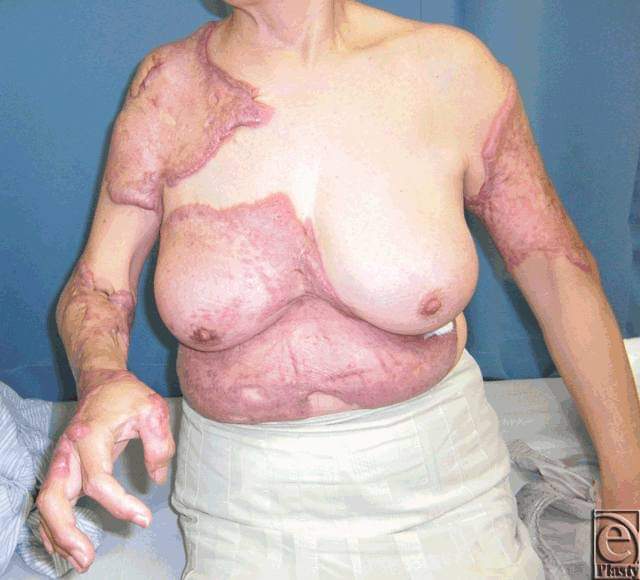 · 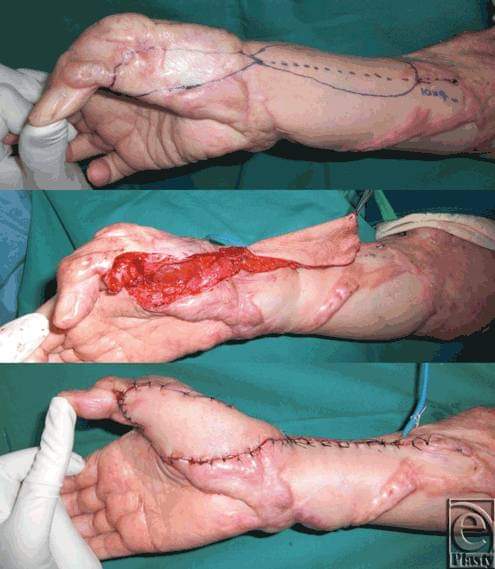 · 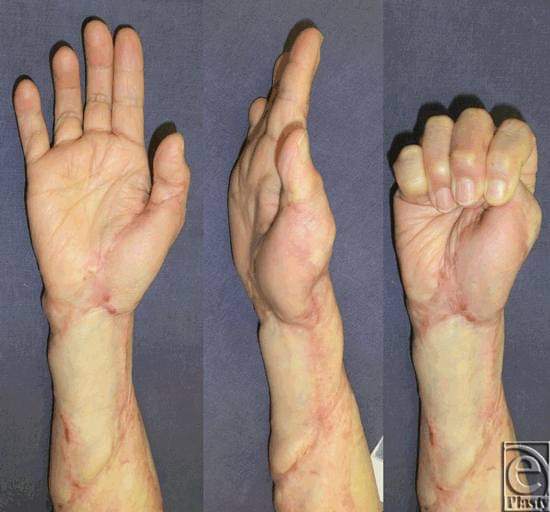 · 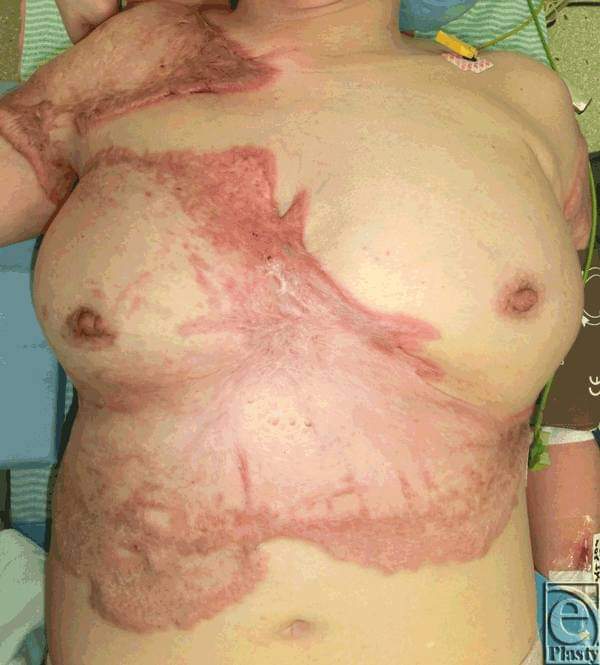 · |
|
#2
●
08-20-2024, 03:51 AM
|
 ★ Legacy Member ★ Poster Rank:110 Secret Agent Join Date: Dec 2009 Posts: 14,828 14,828Posts 49,282Thanked 3,057Quoted 6Mentioned 0Contrib. |
|
Re: Treatment of Severe Keloids
Interesting how some other parts got better without treatment . Just her mind getting better was all it took for some of that..  |
|
#3
●
08-20-2024, 03:30 PM
|
 ✝Mudderator from Hell✝ Poster Rank:10 e-mail Join Date: Oct 2006 Posts: 96,683
Contributions: 901
96,683Posts 543,615Thanked 10,371Quoted 479Mentioned 901Contrib. |
|
Re: Treatment of Severe Keloids
Of the 1443 patients with diagnosis of keloids, 131 patients had childhood-onset keloids. Of these, 106 patients (80.9%) were female, 38.9% of patients had family history of keloids, and 48.9% of patients had allergies or allergy-related conditions (asthma, atopic dermatitis, or allergic rhinitis). Vaccination (47.5%) and chickenpox (19.9%) were the most common triggers. Of vaccinations, BCG was the most common trigger. The majority of keloids from BCG were in female patients (92.9%). The most common location was the chest in male patients (30.0%) and the arm in female patients (41.1%).
|