|
#1
●
07-25-2024, 08:51 PM
|
 These are the rooms Poster Rank:26 of ruin. Join Date: Sep 2014 Posts: 54,008 54,008Posts 87,658Thanked 30,403Quoted 145Mentioned 0Contrib. |
|
Severe Facial Trauma
A 30-year-old white woman was the victim of severe facial trauma stemming from a rollover automobile accident after the driver had lost control of the vehicle. It was a small automobile not equipped with airbags and was transporting five passengers. The patient was on the back seat and was not wearing a seatbelt. On initial evaluation, the patient was conscious, oriented, pale, tachypneic, tachycardic and tracheostomized and had a cranial tomogram revealing no neurosurgical lesions. Physical examination revealed severe facial trauma with a broad laceration–contusion injury with a high degree of contamination (sticks, grass, sand and food scraps). No damage to had occurred to the patient’s vision, subsequently confirmed by routine ophthalmological examination. The initial surgical procedure lasted 6 h, after which the patient was sent to the post-anaesthesia care unit. At that point, she was conscious and hemodynamically stable, did not require mechanical ventilation and was taking venous antibiotics and pain killers, in addition to enoxaparin prophylaxis for venous thrombosis. 10 days later, new imaging examinations were performed, including an angiogram, which revealed adequate vascularization of the face and areas suggesting vascular neoformation ( Fig. 3 A, B). Despite the injury to her left facial nerve and aesthetic impairments, characterized by traumatic telechantus and a drooping right eyelid, her progress was deemed quite satisfactory, as her masticatory function had been preserved and there were no signs of tissue necrosis or infection ( Fig. 4 ).  · 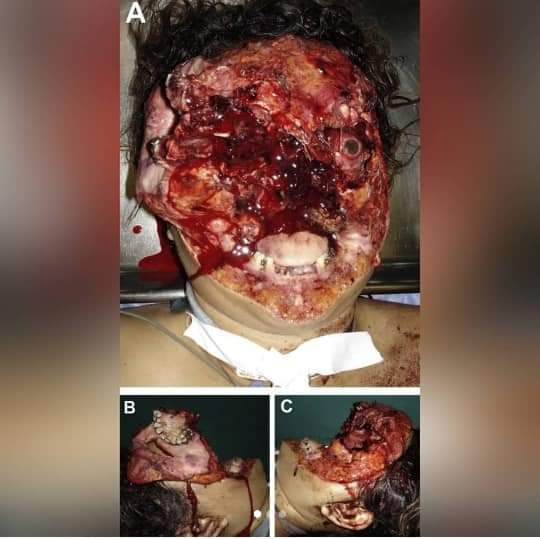 · 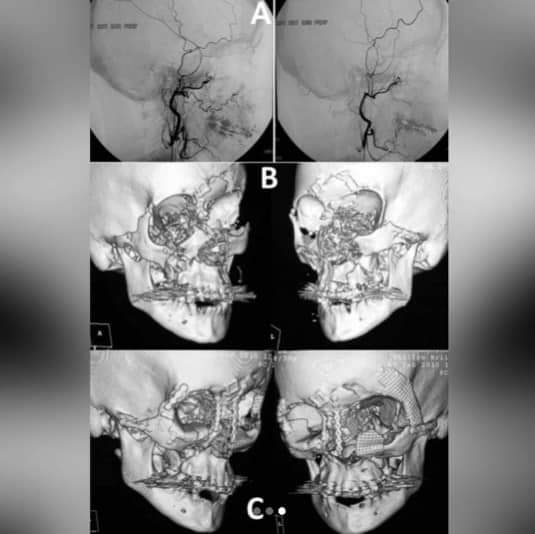 · |
|
#3
●
07-25-2024, 10:57 PM
|
 ★ Legacy Member ★ Poster Rank:110 Secret Agent Join Date: Dec 2009 Posts: 14,844 14,844Posts 49,316Thanked 3,059Quoted 6Mentioned 0Contrib. |
|
Re: Severe Facial Trauma
Facial trauma doesn’t even come close to describing this.  |
|
#4
●
07-27-2024, 09:10 AM
|
 ✝Mudderator from Hell✝ Poster Rank:10 e-mail Join Date: Oct 2006 Posts: 96,702
Contributions: 902
96,702Posts 543,776Thanked 10,372Quoted 479Mentioned 902Contrib. |
|
Re: Severe Facial Trauma
neat job by the surgeon  |