|
#1
●
12-13-2022, 01:57 AM
| ||||||||
 These are the rooms Poster Rank:26 of ruin. Join Date: Sep 2014 Posts: 54,011 Mentioned: 145 Post(s) Quoted: 30403 Post(s)
| ||||||||
|
Necrotizing Fasciitis Part 88
A 45-year-old gentleman presented to our emergency department with a five-day history of perianal discharge, a three-day history of high-grade fever and a one-day history of acute shortness of breath. The patient revealed that he had felt something protruding around his perianal region and had previously consulted a traditional healer who had prescribed an ointment - the contents of which were not identified. The ointment had provided him no relief. He had a respiratory rate of 42 breaths/minute, a pulse of 132 beats/minute, blood pressure of 111/50 mmHg and a temperature of 39.5 degrees Celsius. Chest auscultation revealed bilateral equal air entry. The abdomen was firm, distended and non-tender with audible gut sounds. He was drowsy with a Glasgow coma scale (GCS) score of 12/15. Local examination revealed foul smelling, small necrotic patch on his perianal region with purulent discharge (Figure 1). The patch was tender and swollen and there was associated erythema extending to the entire perineal region. Suspecting a case of necrotizing fasciitis, the patient was rushed to the operating room for debridement. During local debridement, necrotic foul-smelling pus was found throughout the ischiorectal fossae bilaterally and was communicating between the retropubic spaces (Figure 2). It was also involving the retroperitoneal spaces on both sides. A midline laparotomy was also performed with thorough irrigation, along with bilateral flank incisions and drainage of pus. A diverting colostomy was attempted, however, there was continuous drainage of pus from the abdominal cavity. A relook debridement procedure was performed 24 hours later to remove any further necrotic tissue, irrigate the involved areas and remove any remaining pus. The rectus sheath was closed and a transverse loop colostomy was formed. A final debridement of the perineal wound was carried out nine days later with a washout of the abdominal cavities and spaces with peroxide. The patient was transferred to the surgical intensive care unit (SICU) where he remained intubated for the next three days. The patient was administered meropenem, vancomycin, and clindamycin during the procedure and afterward in the SICU as well to address ongoing sepsis. For pain control morphine was administered for the first two days then switched to tramadol. After the first two days in the SICU, renal function started deteriorating and a diagnosis of acute kidney injury secondary to sepsis was made. He was started on hemodialysis and vasopressor support. The patient remained in the SICU for 15 days and after successful reduction of creatinine to near baseline values, the patient was discharged after a total hospital stay of 25 days. 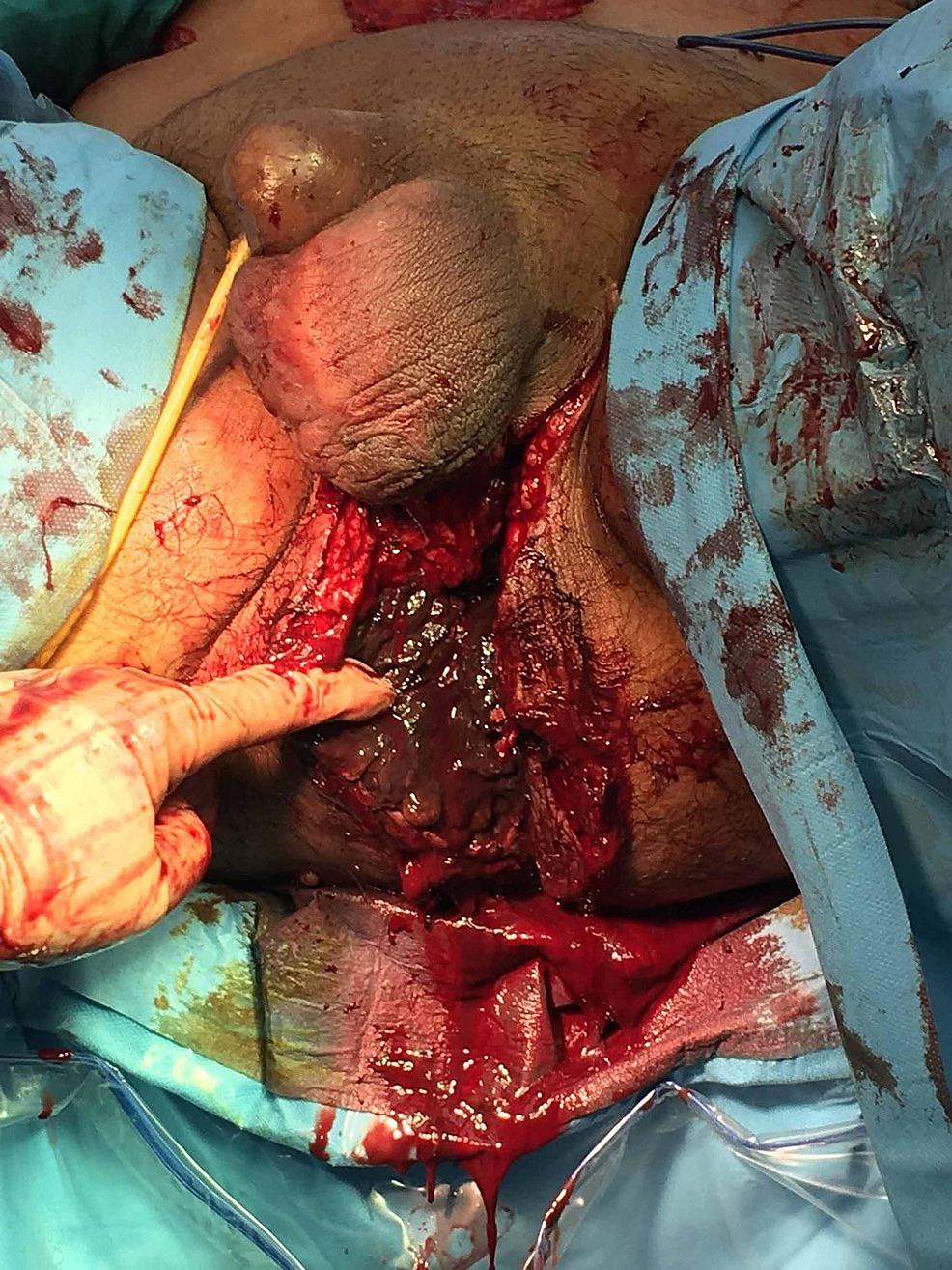 · |
|
#2
●
12-13-2022, 08:20 AM
| ||||||||
 ♚ Legacy Gold Member ♚ Poster Rank:206 Iceman Join Date: Aug 2017 Posts: 7,505 Mentioned: 19 Post(s) Quoted: 3630 Post(s)
| ||||||||
|
Re: Necrotizing Fasciitis Part 88
Gross. I have to say that's the smallest saddest looking dick I've ever seen and it's not even involved in the rot. |
|
#3
●
12-13-2022, 08:33 AM
| ||||||||
 ★ Legacy Member ★ Poster Rank:252 So many choices now Join Date: Jul 2015 Posts: 5,548 Mentioned: 15 Post(s) Quoted: 2120 Post(s)
| ||||||||
|
Re: Necrotizing Fasciitis Part 88
Moral of the story? Take care of dem pimples in yo ass crack and make sure you don't wipe too aggressively with an open top zit.
|
|
#5
●
12-13-2022, 06:08 PM
| ||||||||
 My Rank: MASTER SERGEANT Poster Rank:485 male Join Date: Nov 2009 Posts: 2,191 Mentioned: 11 Post(s) Quoted: 591 Post(s)
| ||||||||
|
Re: Necrotizing Fasciitis Part 88
For the people who don't know the long medical terms used .. He got a shitty stinky arsehole |