|
#1
●
03-22-2012, 02:10 PM
|
 ★ ********* ★ Poster Rank:251 Male Join Date: Jul 2009 Posts: 5,547
Contributions: 415
5,547Posts 25,719Thanked 932Quoted 66Mentioned 415Contrib. |
|
Firearms (Gunshot Wound Deaths Part. II)
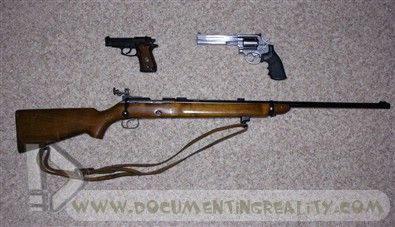 Two handguns (semiautomatic and revolver) and a rifle 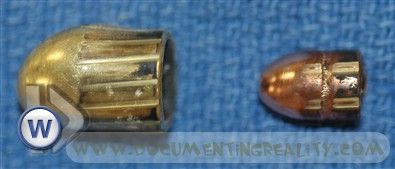 Two bullets with rifle marks 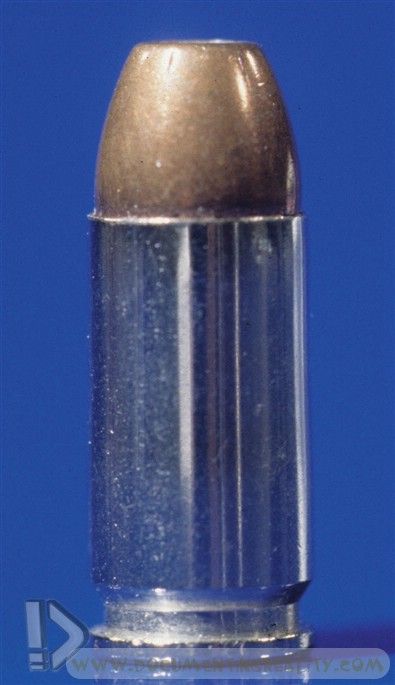 An unspent (unfired) handgun cartridge. The silver-colored casing contains the unspent bullet, which has a copper jacket 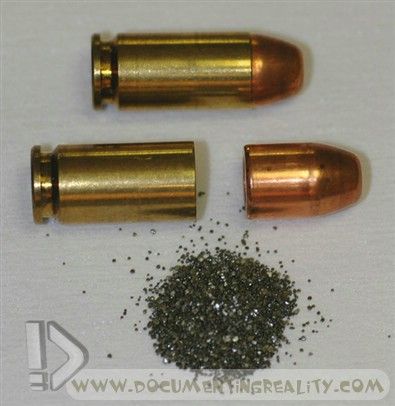 An intact cartridge and an opened cartridge, showing the casing, the gunpowder and the bullet 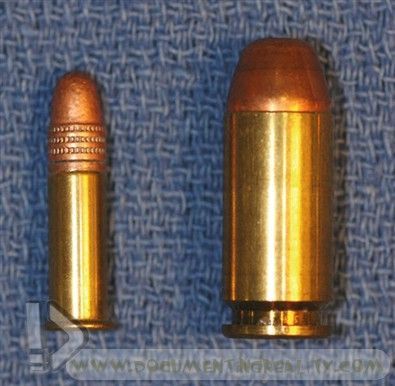 Comparison of a rimfire cartridge (left) and a centerfire cartridge (right) 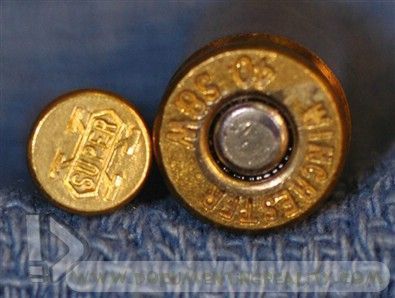 Additional comparison of rimfire (left) versus centerfire (right) cartridges. In rimfire cartridges, the primer material is embedded in the rim of the casing, while in centerfire cartridges, the primer material is within the centrally located, circular area 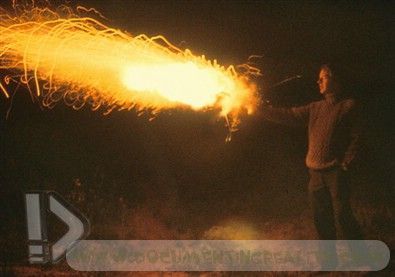 Typical muzzle flash from a handgun  Diagram of a discharging firearm, showing a small amount of flame at the muzzle, a cloud of smoke/soot, particles of gunpowder, and the bullet 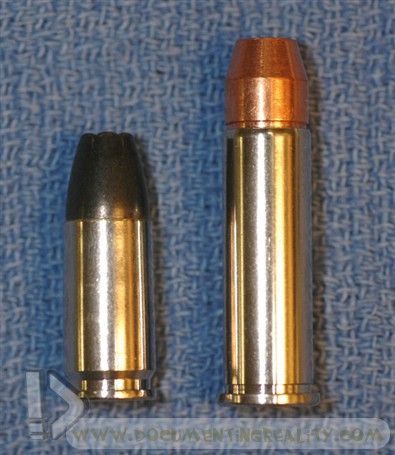 Comparison of semiautomatic (left) and revolver (right) cartridges. Notice that the rim of the semiautomatic cartridge casing is recessed compared to that of the revolver, where the outer edge of the rim extends beyond the outer diameter of the remainder of the casing 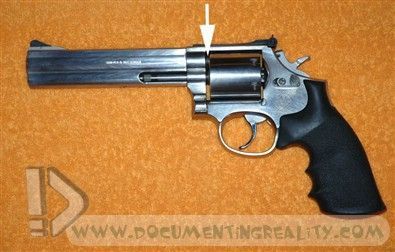 A 0.357 revolver. The cylinder in this particular model holds 6 cartridges and has a smooth contour (it is ‘‘non-fluted.’’ Many revolver cylinders are ‘‘fluted’’ – they have indentations). Note the narrow gap between the front of the cylinder and the beginning of the barrel (arrow). This is referred to as the ‘‘cylinder-barrel gap’’ and is important because gunshot residue exits this area when the gun is discharged 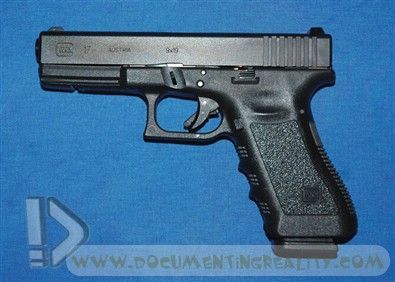 A 9 mm semiautomatic pistol 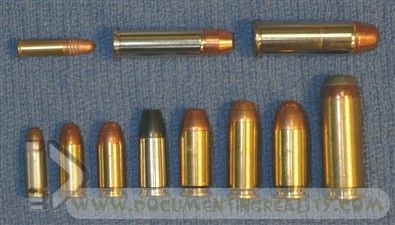 Examples of handgun ammunition of various calibers. Top (L to R): 0.22, 0.38 special, 0.44 magnum; Bottom (L to R): 0.25, 0.32, 0.380, 9 mm, 0.40 S&W, 10 mm, 0.45 ACP, 0.50 caliber 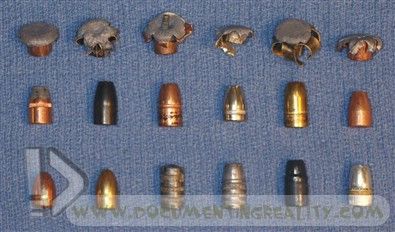 A variety of special bullet types. The lower row shows unfired bullets only, while the upper two rows show unfired bullets (middle row) immediately below an example of the corresponding fired bullet (upper row). Lower row (L to R): full-metal-jacketed bullet, brass-colored full-metal-jacketed bullet, wadcutter, semi-wadcutter, Nyclad, aluminum-jacketed bullet. Middle and upper rows (L to R): jacketed soft point, Black Talon, Hydrashok, Silvertip, Golden Saber, Gold-Dot 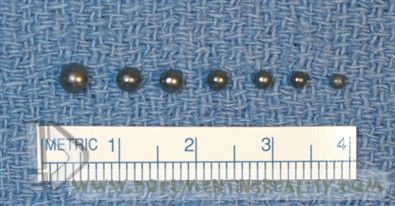 A variety of different sized birdshot pellets. L to R: #2, #4, #5, #6, # 7 ½, #8, and #9 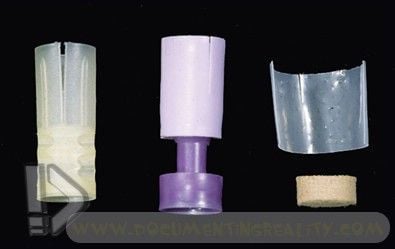 Various types of wadding material from within shotgun cartridges 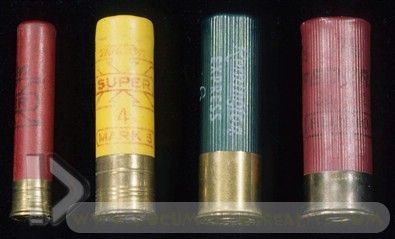 Shotgun shells of various sizes (gauges) 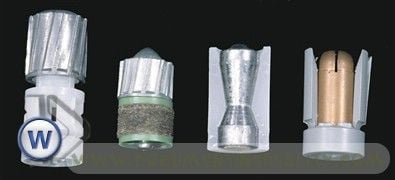 Various types of shotgun slugs 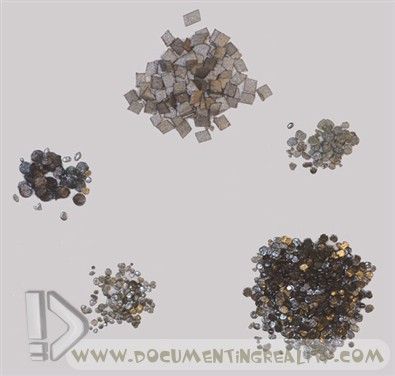 Examples of different gunpowder types from five different cartridges 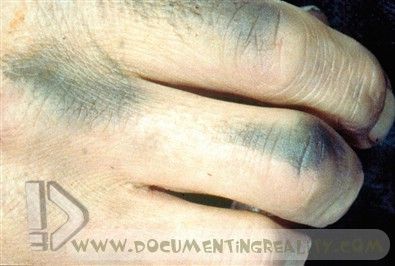 Soot present on the hand of a gunshot suicide victim 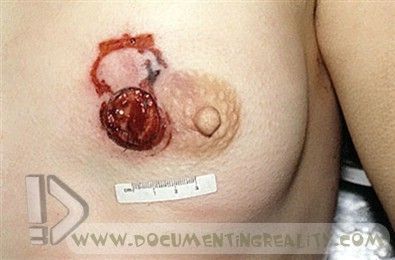 Contact wound of the left breast from a double barrel 0.12 gauge shotgun with a muzzle impression from a non discharged barrel 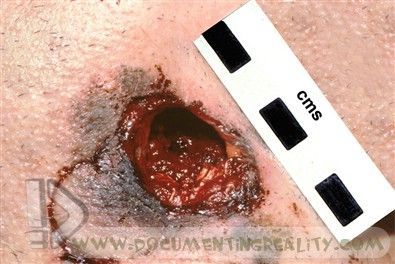 Contact wound from a double barrel 0.12 gauge shotgun with soot soiling and a muzzle impression from the non discharged barrel 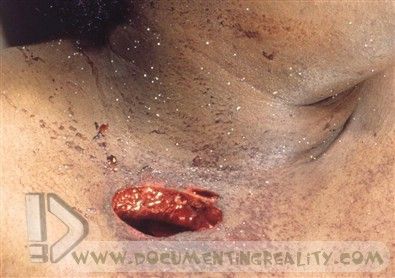 Extensive stipple marks related to shotgun filler material from a buckshot charge. Note the presence of the small white filler material within and around the entrance defect 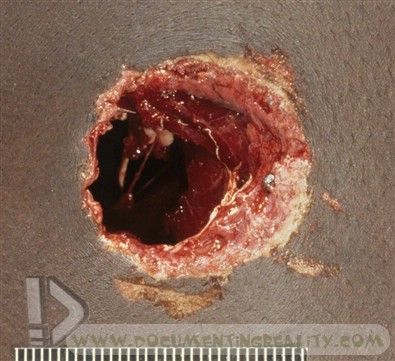 A shotgun wound with ‘‘scalloped’’ margins, indicating that the mass of shot pellets remained relatively tightly packed when they struck the skin. Note also the irregular abrasion adjacent to the central defect caused by plastic wad material 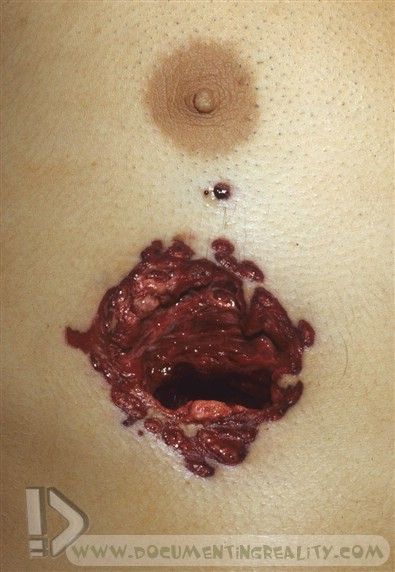 A shotgun wound with a central defect, as well as occasional satellite pellet wounds 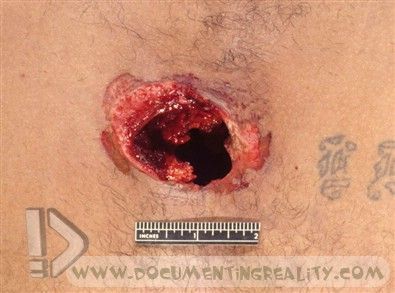 A shotgun entrance wound with petal strike marks from wadding evident along the wound’s margins 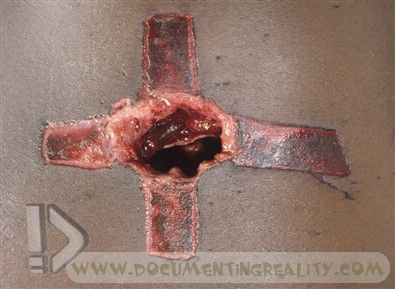 Shotgun wadding petal marks on the skin around an entrance wound. In this case, the plastic wadding had very firm petals, thus causing very well-defined abrasions 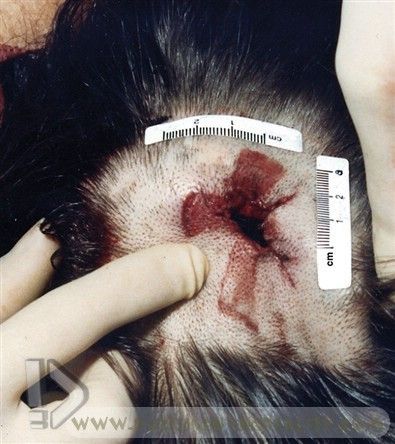 Petal marks from shotgun wadding around an entrance wound of the scalp only revealed once the hair had been shaved 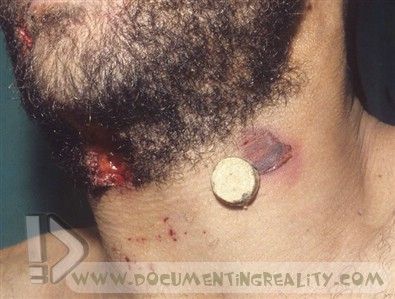 A shotgun wad strike mark, with the wadding material adjacent to the injury. The photo was taken prior to shaving beard hair from around the pellet entry site, which is in the central neck 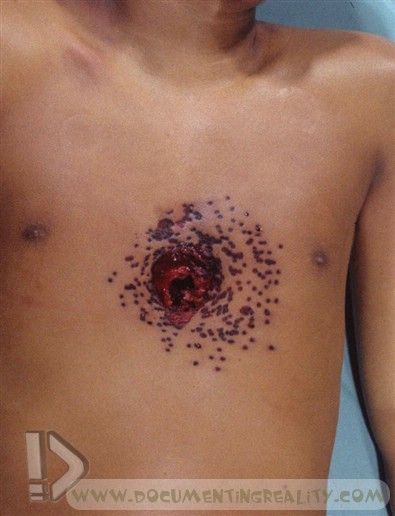 A shotgun entrance wound with a central defect and numerous individual pellet entrances  A shotgun wound with a central defect surrounded by numerous satellite pellet entrance wounds. The upper arm was also involved 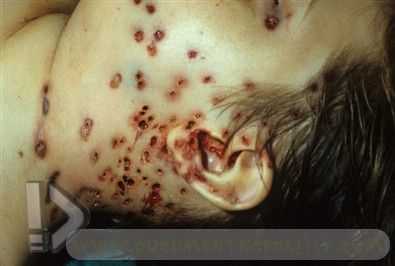 A shotgun entrance wound complex, with absence of a central defect. The shot pellets have spread apart prior to striking the body 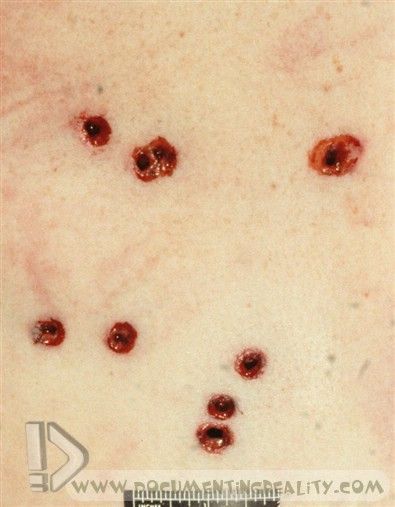 Buckshot entrance wounds  A cluster of entrance wounds in the left side of the chest from a 0.12 gauge shotgun using 00 buckshot 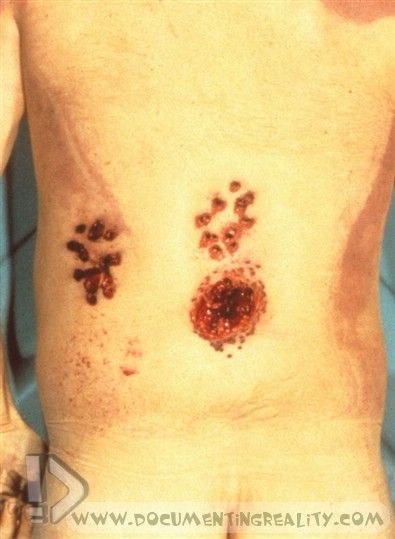 A homicide victim with three shotgun wounds of the back. All were fired from the same weapon at a similar range. Both bird and buckshot were used 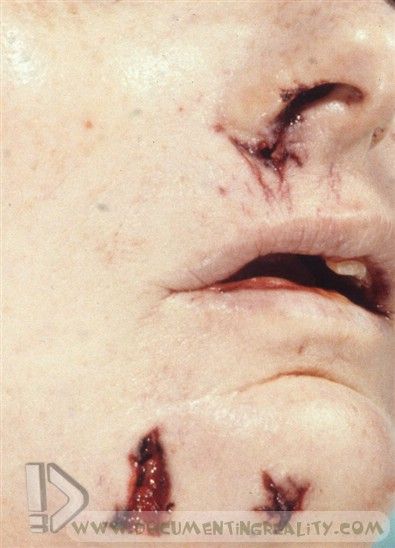 Three buckshot exit wounds: one just under the nose and two on the chin. Note that the exit wounds mimic those caused by handgun bullets 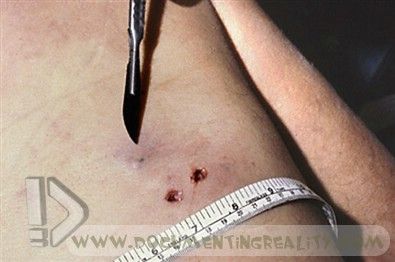 Shotgun pellets located immediately beneath the skin of the back 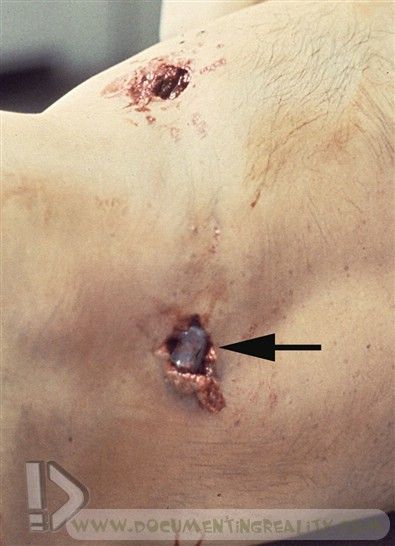 Plastic wadding can be seen plugging a shotgun exit wound of the back 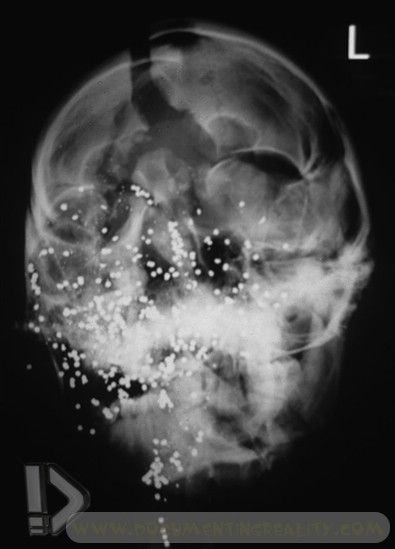 The typical appearance of a birdshot shotgun wound X-ray 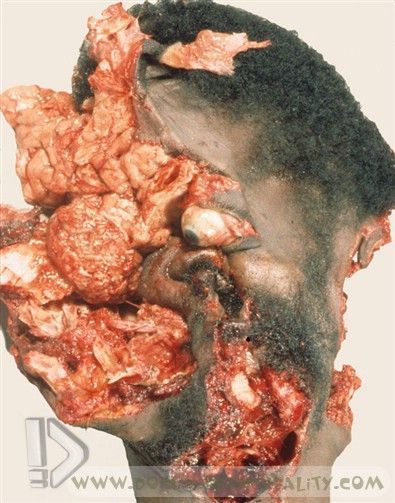 A noncontact shotgun slug wound of the head with massive destruction 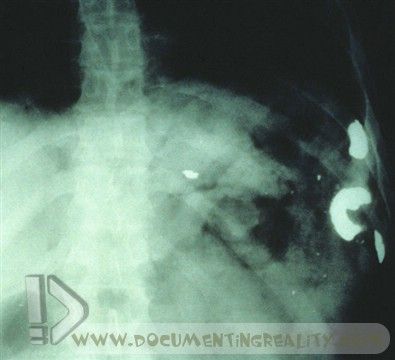 Shotgun slug fragments as seen on X-ray. Note the ‘‘C’’-shape of the largest fragment 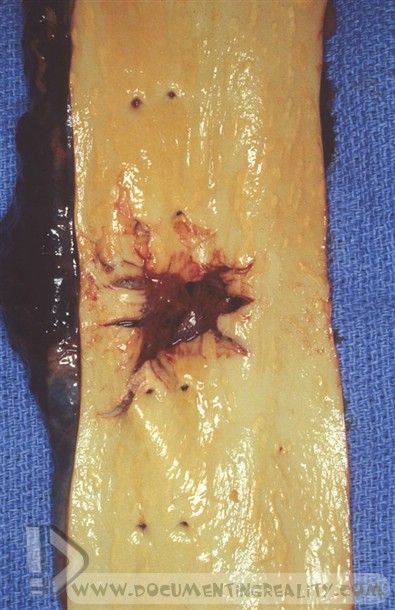 A gunshot wound of the aorta 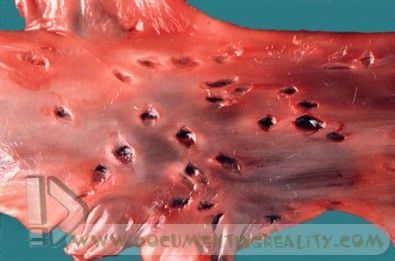 Multiple shotgun pellet wounds of a large blood vessel 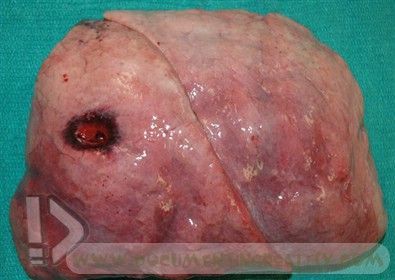 A gunshot wound of the lung 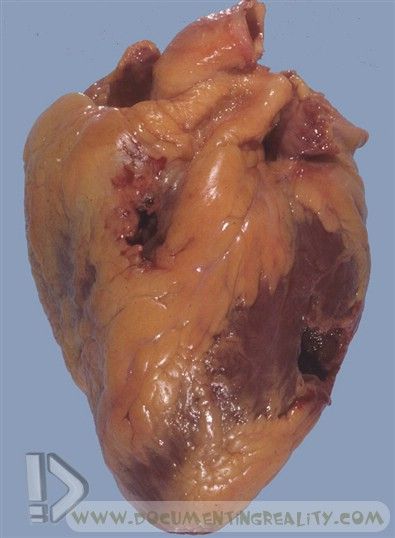 A gunshot wound of the heart 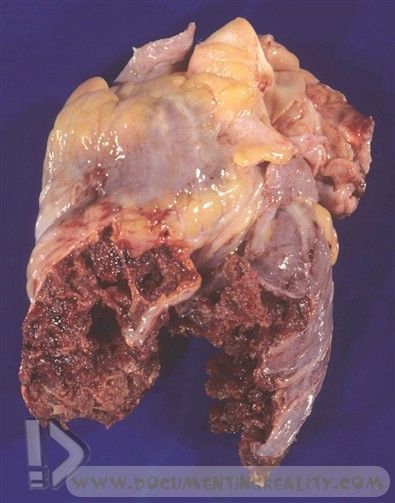 A shotgun slug wound of the hear 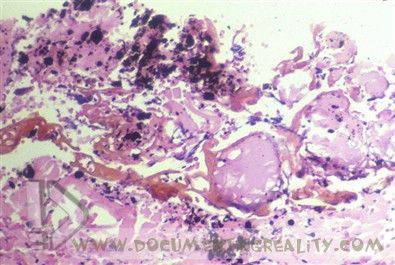 A microscopic section of a contact gunshot entrance wound, showing extensive black particulate matter (soot) deposition 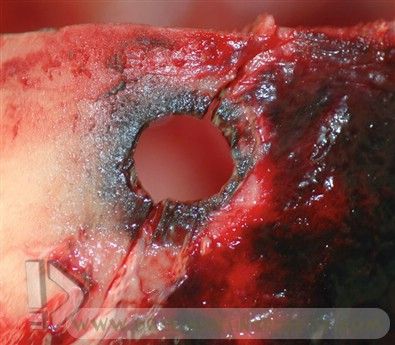 Soot soiling of the bone underlying a contact gunshot wound of the head. In occasional cases, identification of soot on external examination is quite difficult. Finding soot on the skull is beneficial in such cases 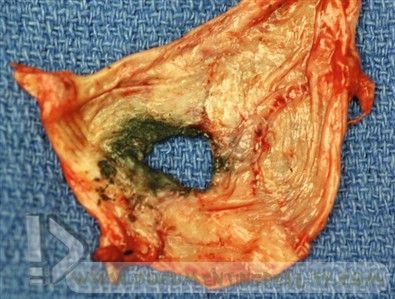 Soot staining the dura underlying a contact gunshot wound of the head. Finding such soot can confirm that a wound represents a contact gunshot wound 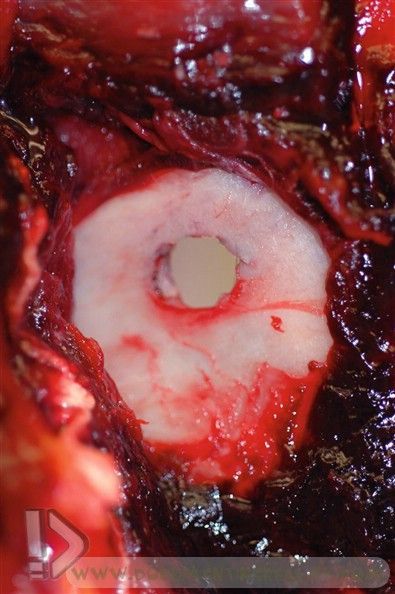 An outer view of a gunshot entrance wound of the skull, after scalp reflection (and after peeling away the soft tissue normally adherent to the outer surface of the skull) showing no beveling (shelving) 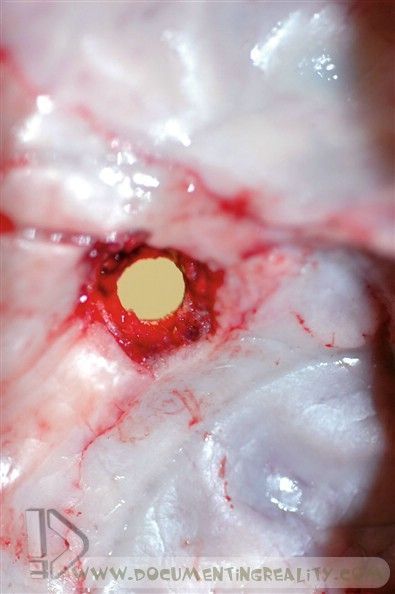 An inner view of a gunshot entrance wound of the skull, showing classic internal beveling. Entrance wounds are characterized by internal skull beveling 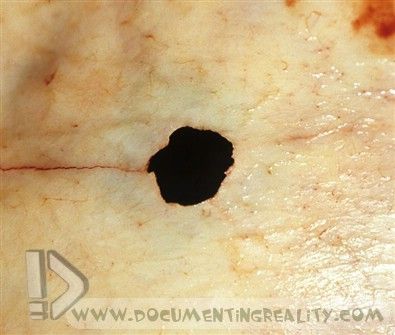 An inner view of a gunshot exit wound of the skull with no beveling 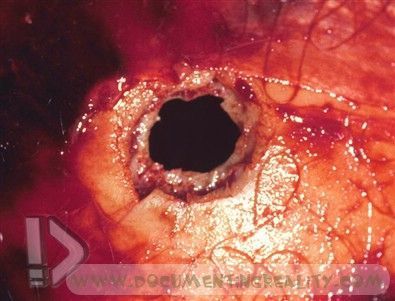 An outer view of a gunshot exit wound of the skull, showing classic external beveling. Exit wounds are characterized by external skull beveling 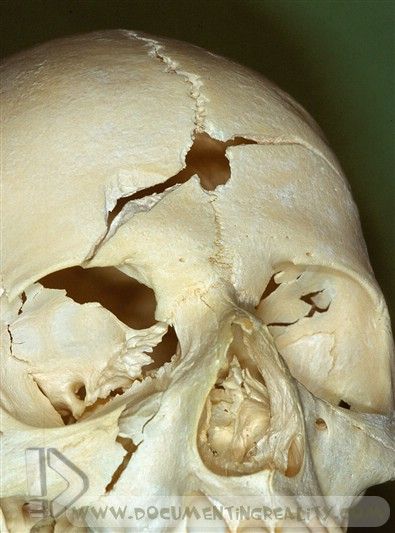 Bevelling may be hard to detect if the entrance / exit wounds are through particularly thin skull bones 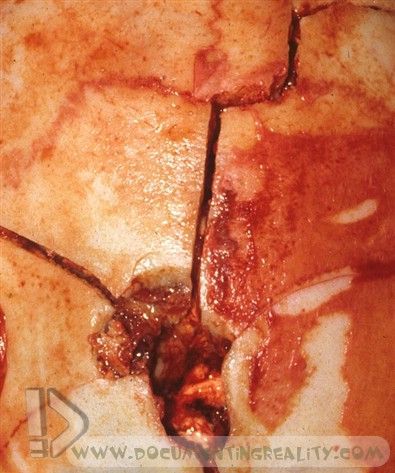 An external skull view of a ‘‘keyhole’’ defect produced by a relatively tangential shot of the head, with the bullet traveling from bottom to top of the photograph  Bilateral (involving both sides) periorbital (around the eyes) ecchymosis (bleeding) caused by basilar skull fractures produced by a gunshot wound 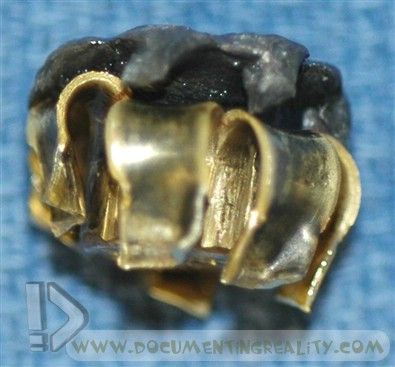 A deformed (‘‘mushroomed’’) bullet collected as evidence 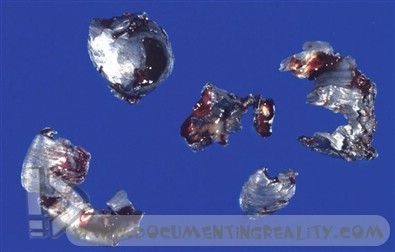 Multiple bullet fragments collected from a single gunshot wound 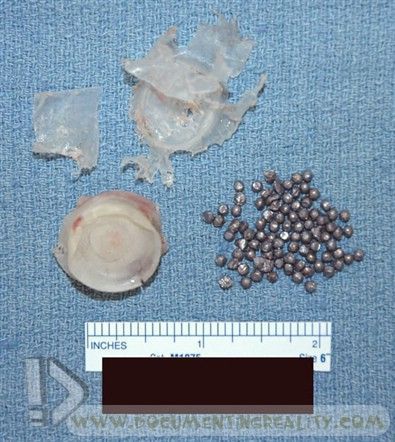 Evidence collected from the victim of a shotgun injury. Note the representative sampling of birdshot pellets as well as plastic wadding material 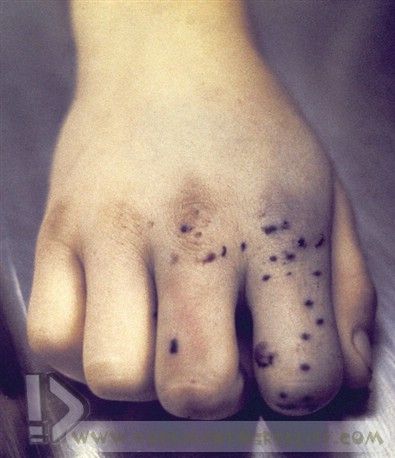 Defense wounds of the fingers from a 0.12 gauge shotgun (birdshot pellets 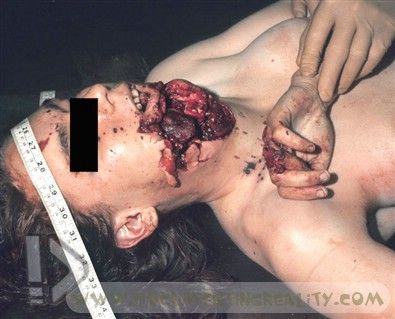 Defense wounds of the left hand that had been placed in front of the neck 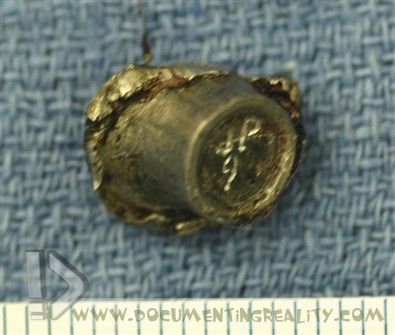 An inscription on the base of the bullet. Some pathologists inscribe the case number and their initials on the base of the bullet. Others choose not to do this 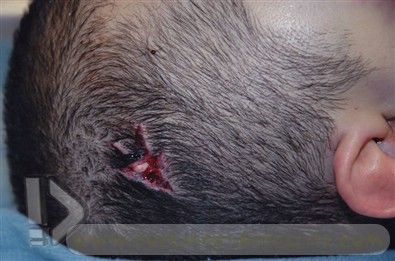 A photograph showing a suicidal gunshot wound of the head, prior to shaving the hair from around the entrance wound 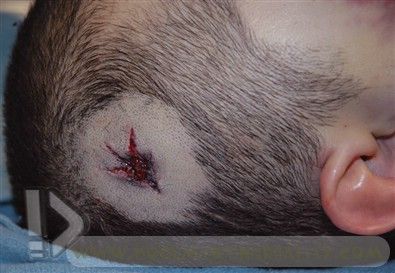 A photograph taken after cleaning the body and shaving the hair from around the entrance wound 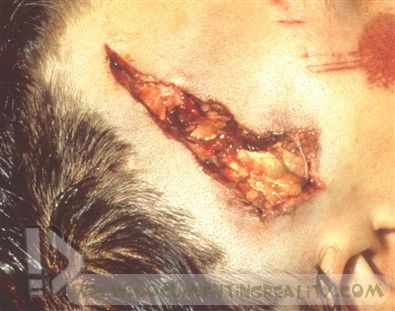 Contact gunshot wound of head, after cleaning and shaving 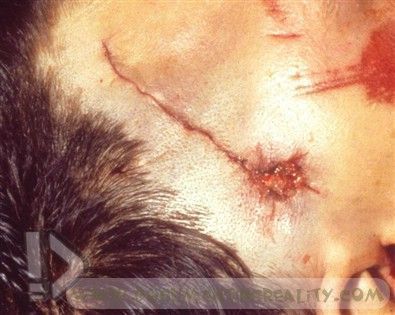 Contact gunshot wound of head after cleaning, shaving, and reapproximating wound edges using cyanoacrylate (strongbonding glue) 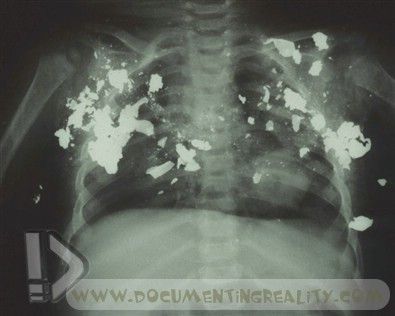 An X-ray taken prior to clothing removal in a toddler who was being held in his mother’s arms when she was shot multiple times 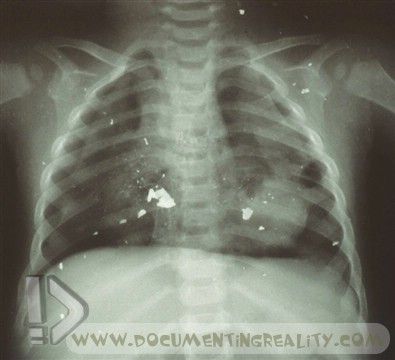 An X-ray taken after clothing removal in the case shown in the previous pic. Note that a majority of the bullets exited the body but were retained within the clothing 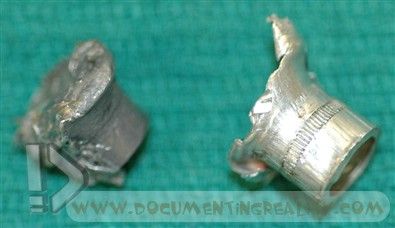 Aluminum-jacketed bullet, with the lead core separated from the jacket. Aluminum jackets are not necessarily visible by X-ray exam 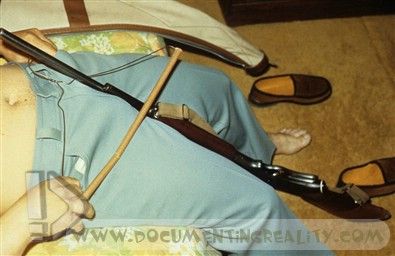 A suicide victim who used a coat hanger to depress the trigger of his shotgun 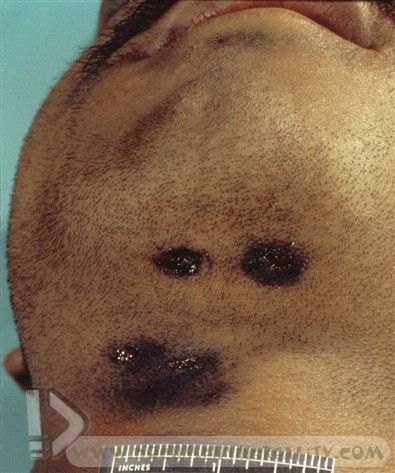 Suicidal gunshot wounds occasionally have more than one entrance wound. In this case, a suicide victim was witnessed by numerous people to place the small-caliber weapon under his chin and discharge the weapon. After each of the first three shots, he looked at the weapon, placed it back under his chin, and fired again, for a total of four shots. At autopsy, only one bullet was found to have entered the brain 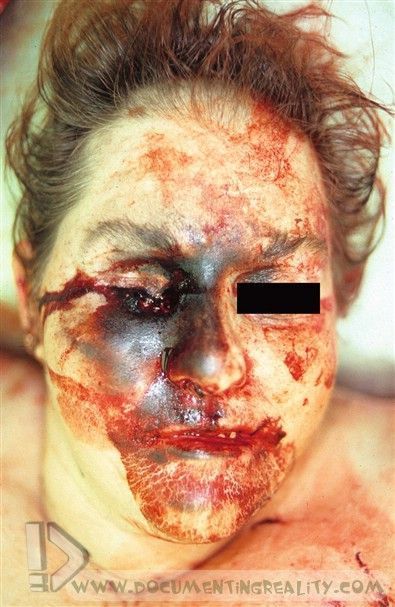 An example of the dense soot produced with a black powder weapon 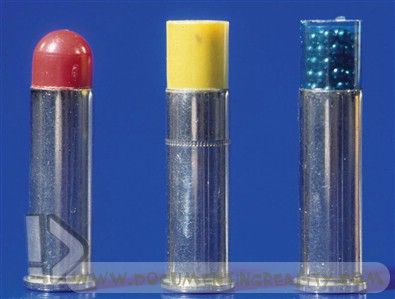 Snakeshot or ratshot cartridges are handgun shot cartridges that contain numerous small shot pellets (similar to shotgun cartridges) 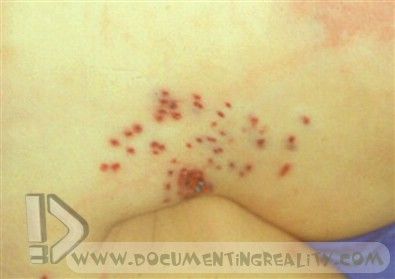 An example of the appearance of a wound produced by a handgun shot cartridge 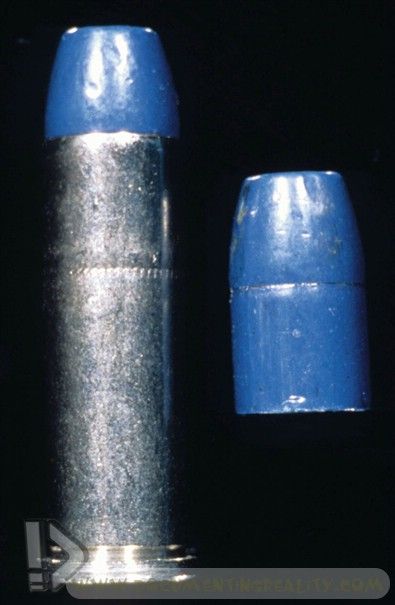 NYCLAD cartridge and bullet. Note that the bullet is covered with a blue material. This material is made of nylon and presumably reduces the amount of residue buildup within the barrel of a weapon, thus keeping it clean. The nylon material makes ballistic comparison difficult as the material does not show microscopic striations as well as lead or various metal jacket materials 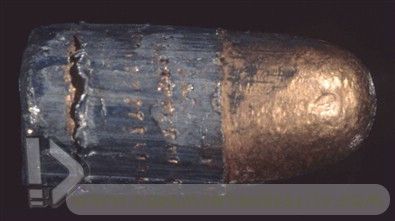 A ‘‘gilded’’ small-caliber bullet recovered from a body at autopsy. A gilded bullet has a copper-colored material coating the bullet, but it is not the same as a metal jacket. Note that the copper-colored material has ‘‘flaked off’’ the sides of the bullet. Such bullets can cause difficulty for firearms examiners when attempting to evaluate striations microscopically 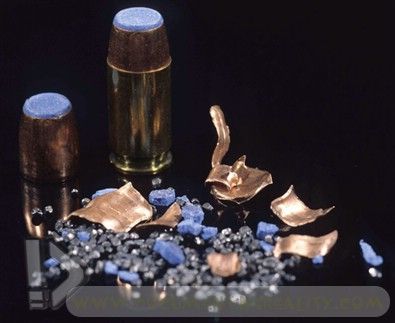 A Glazer cartridge, unfired bullet, and fired bullet. These bullets are designed to fragment on impact, presumably making them safer (if a shooter misses their target and the bullet strikes a wall, the bullet will not continue through the wall and possibly strike someone on the other side) 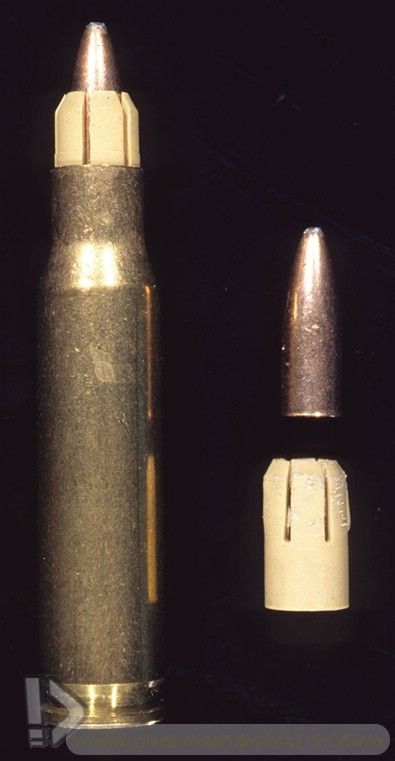 A sabot rifle cartridge, plastic sabot, and bullet 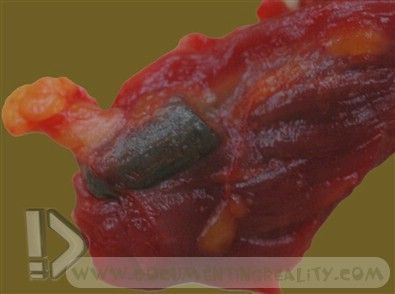 A retained bullet recovered at autopsy. Note that the bullet is embedded within muscle with no surrounding hemorrhage 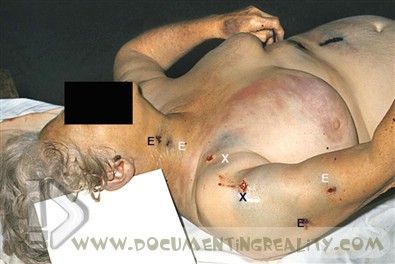 Multiple entrance (E) and exit (X) wounds caused by two bullets References The Atlas of Forensic Pathology for Police, Forensic Scientists, Attorneys and Death Investigators (2012) Byard RW, Haas E, Marshall DT, Gilbert JD, Krous HF. Characteristic features of pediatric firearm fatalities – comparisons between Australia and the United States. J Forensic Sci. 2009;54:1093–6. Cina SJ, Ward ME, Hopkins MA, Nichols CA. Multifactorial analysis of firearm wounds to the head with attention to anatomic location. Am J Forensic Med Pathol. 1999;20:109–15. Clark MA, Micik W. Confusing wounds of entrance and exit with an unusual weapon. Am J Forensic Med Pathol. 1984;5:75–8. Cunliffe CH, Denton JS. An atypical gunshot wound from a home-made zip gun – the value of a thorough scene investigation. J Forensic Sci. 2008;53:216–8. DiMaio VJM. Gunshot wounds. 2nd ed. Boca Raton: CRC Press; 1999. Dodd MJ. Terminal ballistics – a text and atlas of gunshot wounds. Boca Raton: Taylor & Francis; 2006. Hartwig S, Tsokos M, Byard RW. Black powder handgun deaths remain anuncommon event. Am J Forensic Med Pathol. 2009;30:350–3. Hartwig S, Tsokos M, Schmidt S, Byard RW. Self-constructed shooting devices utilizing direct-impact firing pins – (suicide machines). Am J Forensic Med Pathol. 2010;31:192–4. Jacob B, Huckenbeck W, Daldrup T, Haarhoff K, Bonte W. Suicides by starter’s pistols and air guns. Am J Forensic Med Pathol. 1990;11:285–90. Juvin B, Brion F, Teissiere F, Durigon M. Prolonged activity after an ultimately fatal gunshot wound to the heart: case report. Am J Forensic Med Pathol. 1999;20:10–2. Karger B, Kneubuehl BP. On the physics of momentum in ballistics: can the human body be displaced or knocked down by a small arms projectile? Int J Leg Med. 1996;109:147–9. Kury G, Weiner J, Duval JV. Multiple self-inflicted gunshot wounds to the head: report of a case and review of the literature. Am J Forensic Med Pathol. 2000;21:32–5. Molina DK, Wood LE, DiMaio VJM. Shotgun wounds: a review of range and location as pertaining to manner of death. Am J Forensic Med Pathol. |
|
#2
●
03-22-2012, 02:25 PM
|
 My Rank: MAJOR Poster Rank:12 Join Date: Jun 2009 Posts: 93,062
Contributions: 239
93,062Posts 137,687Thanked 2,009Quoted 91Mentioned 239Contrib. |
|
Re: Firearms (Gunshot Wound Deaths Part. II)
excellente  |
|
#3
●
03-22-2012, 02:31 PM
|
 ★Grave Robber★ Poster Rank:222 Male Join Date: Jun 2009 Posts: 6,674 6,674Posts 6,831Thanked 58Quoted 13Mentioned 0Contrib. |
|
Re: Firearms (Gunshot Wound Deaths Part. II)
Excellent post as usual  |
|
#4
●
03-22-2012, 04:04 PM
|
| So Fucking Banned Poster Rank:265 Join Date: May 2010 Posts: 5,333 5,333Posts 2,326Thanked 41Quoted 4Mentioned 0Contrib. |
|
Re: Firearms (Gunshot Wound Deaths Part. II)
Very nice post G!!! I used to make round's(load bullet's at home) for A 357 mag. They also shoot 38 round's!!  |
|
#6
●
03-22-2012, 05:55 PM
|
 My Rank: MAJOR Poster Rank:144 Male. Join Date: Apr 2010 Posts: 11,675 11,675Posts 10,723Thanked 478Quoted 0Mentioned 0Contrib. |
|
Re: Firearms (Gunshot Wound Deaths Part. II)
Yes they do, you can also fire a .380 round through a 9mm gun, but can't fire a 9mm round through a .380 gun, at least not the one I have. The 9mm round is too long and will not let the breach close. |
|
#7
●
03-22-2012, 05:56 PM
|
| My Rank: MAJOR Poster Rank:144 Male. Join Date: Apr 2010 Posts: 11,675 11,675Posts 10,723Thanked 478Quoted 0Mentioned 0Contrib. |
|
Re: Firearms (Gunshot Wound Deaths Part. II)
Great post man, that will explain a lot to people. |