|
#13
●
12-20-2017, 11:46 PM
| ||||||||
 My Rank: STAFF SERGEANT Poster Rank:782 goy Join Date: Sep 2013 Posts: 1,007 Mentioned: 0 Post(s) Quoted: 162 Post(s)
| ||||||||
|
Re: Decapitation By Rope
Well, he calculated the rope length to his weight well enough to perform a successful decapitation. doubt that's worth much in Japan though.
|
|
#17
●
12-26-2017, 03:49 AM
| ||||||||
 ✝Mudderator from Hell✝ Poster Rank:10 e-mail Join Date: Oct 2006 Posts: 94,983
Contributions: 817
Mentioned: 472 Post(s) Quoted: 10078 Post(s)
| ||||||||
|
Re: Decapitation By Rope
Actually this was a case were no rope or hanging was involved. A 41-year-old man was found dead from decapitation. The separated head and body were apart from each other. The place was the roof of second story in the apartment with fourteen stories where he lived. The railings of the roof were bloodstained severely. The floor and the wall were also bloodstained. In the head side, the bloodstain ran toward to the body. Police speculated that the man had fallen from 14th story (40 m), after then, the body had been attached to the railing. His shoes were left at the exit at the 14th story. The railings of 14th story were blood stained. A blood stained knife was found in his room and huge bloodstains were also left everywhere in his room. Autopsy was performed for diagnosis of cause of death. The height and weight were 167.5 cm and 54.2 kg, respectively. Postmortem lividity was space throughout the body. Any petechiae in the mucosa was not apparent. The blood in the head and body was almost lost and remained blood did not show coagulation. The wounds of the edge of the neck were relatively sharp around the neck and several incised wounds existed in parallel to the edge. Abrasions or bruises did not exist in the neck lesion. On the other hand, there were some cut wounds in his right forearm and left upper abdomen. The head was accompanied with the larynx, pharynx and the part of lungs and heart. In the chest, the recessus ran from right shoulder to left lateral chest at an equal width. The tissues including muscle, bone, connective tissue and internal organs under the recessus were separated in the chest. Hemorrhage was observed slightly surrounding these tissues. There were middle cranial base fractures, mandibular bone fracture, multiple costal bone fractures in the dorsal side, and left ankle fracture. Vertebral bones were crush-fractured and separated between Th9 and Th10. And aorta was separated in the same height of vertebral bone fracture. Heart and lungs were divided into two parts, respectively. Autopsy findings indicated that the victim died from decapitation. In the present case, the autopsy finding showed that the head was separated from the body, but neither ligature mark nor tissue decompression except for the several cut wounds existed in the neck. Subcutaneous tissue hemorrhages were only found under the cut wounds. In the chest, there was remarkably recessus which ran from right shoulder to left lateral abdomen. The heart was separated to two parts, and the one of the heart accompanied the head and the other remained body. The lungs and trachea were also divided into two parts, as same way of the heart, the one of the lung and trachea accompanied the head and the other remained the body. The spine was separated at T9/T10, however, cervical spine fractures and separation were not found. These findings indicate that the hard, sharpless, round and thin object attacked the body of the victim from his right shoulder to left abdomen. It is considered that the cut wounds had already existed in the neck for the reason of the vital reaction such as the subcutaneous hemorrhage and hematoma. Neck had vulnerability for holding the head as the incised wounds had already existed. As the result of vulnerability of neck, decapitation was caused by the indirect force to the neck. Circulation was remained shortly after decapitation because the hemorrhages around the muscle, spinal bone and internal organ under the recessus were found, which indicates that the victim had lived just after decapitation. Furthermore, the remained blood in the body did not show coagulation, which is indicative of acute death. So, the victim died from decapitation accompanied huge hemorrhage and neuronal shock. It is difficult to diagnose this case as suicidal, homicidal or accidental because the place of the cut wounds were able to be injured by himself and the depth of wound was not so much. We presumed that his position was prone at the time of hitting to the railing, and after hitting the chest, the head with the attachments was pulled out by the force of inertia. It is unknown whether he cut his neck by himself for suicide or the other people cut his neck for homicide. The head was separated and accompanied the tissues which included the larynx, pharynx, the part of lungs and the part of heart. The bloodstains existed not only on the floor but also on the separated body. Therefore, it is speculated that the man fell to the railing and hit his chest. After then, the head was separated from the body and jumped upward while bleeding. In regardless of the present case, decapitation had been occurred by the direct force to the neck. Generally, forensic pathologists can consider any objects for decapitation. It seems that decapitation by the force to the body cannot occur in the intact neck. The huge force such as the falling from high altitude and car accident can be necessary for decapitation in the indirect force to the neck. In the present case, no cervical spine fracture was observed, but thoracic spine was crushed and separated. Zhu et al. reported the case with self-decapitation by suicidal hanging from a river bridge. In that case, there were fractures in the axis at the parts interarticulares, which indicates a traction force combined with anteroflexion of the head by falling from a height. Cervical spine fractures in the decapitation are indicative of head movement at the time of decapitation. In the present case, however, cervical spine fractures were not recognized, and we considered that severe head movement did not occur. In car accident, the seat belt on the chest and abdomen of the driver or assistant can operate huge force to the chest. If the accident is head-on collision or nearly accident, the front-grasses crash and run to the driver and assistant, which can cause incised wounds. And if the force is very gigantic, head can be separated from the neck resembling to the present case. We recommend that drivers and assistants, especially children, should put on the seat belt following manufacture’s manual. In conclusion, we showed a decapitation case in which the considerable force acted to the chest and caused decapitation in vulnerable neck. The decapitation can be caused by the indirect force to the neck if there are some wounds in the neck. So, we should check carefully the edge of the neck and consider the mechanism of decapitation if there are some wounds in other region. 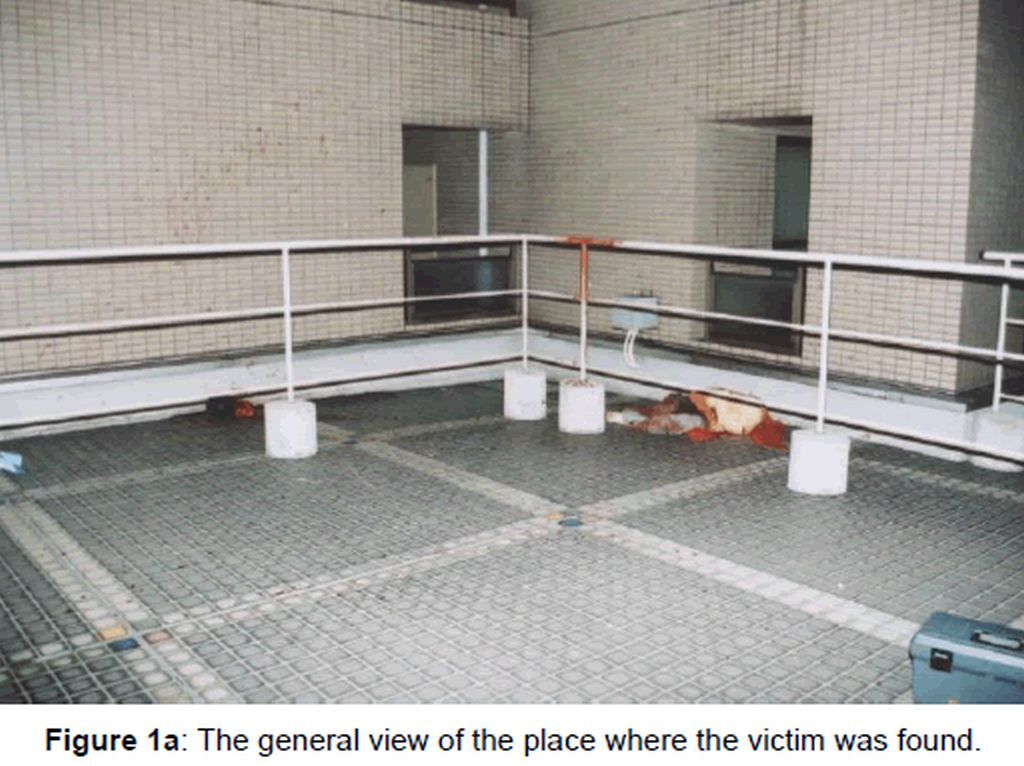 · 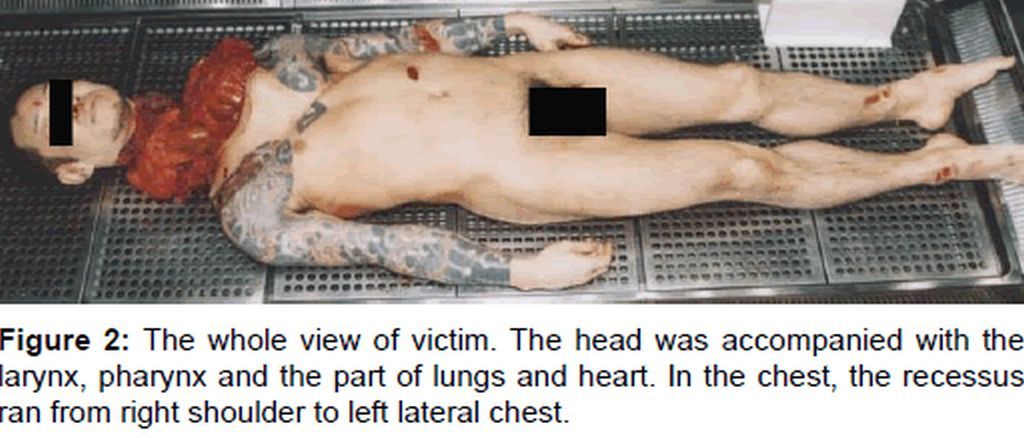 · |