|
#1
●
05-23-2021, 03:20 PM
| ||||||||
 ♚ Legacy Gold Member ♚ Poster Rank:912 Join Date: Jul 2020 Posts: 822
Contributions: 10
Mentioned: 13 Post(s) Quoted: 173 Post(s)
| ||||||||
|
Contact Blanching on the Back of the Body Depicting a Pistol [Colorized]
I colorized and upscaled the original black and white image, I obviously had to guess the color of the lividity so I used real color photos for reference but I don't know enough about the case to estimate a color. Fig.2 is the original version. I don't have any info about this specific case other than the individual died on top of a pistol, but here's some knowledge about livor mortis and contact blanching. 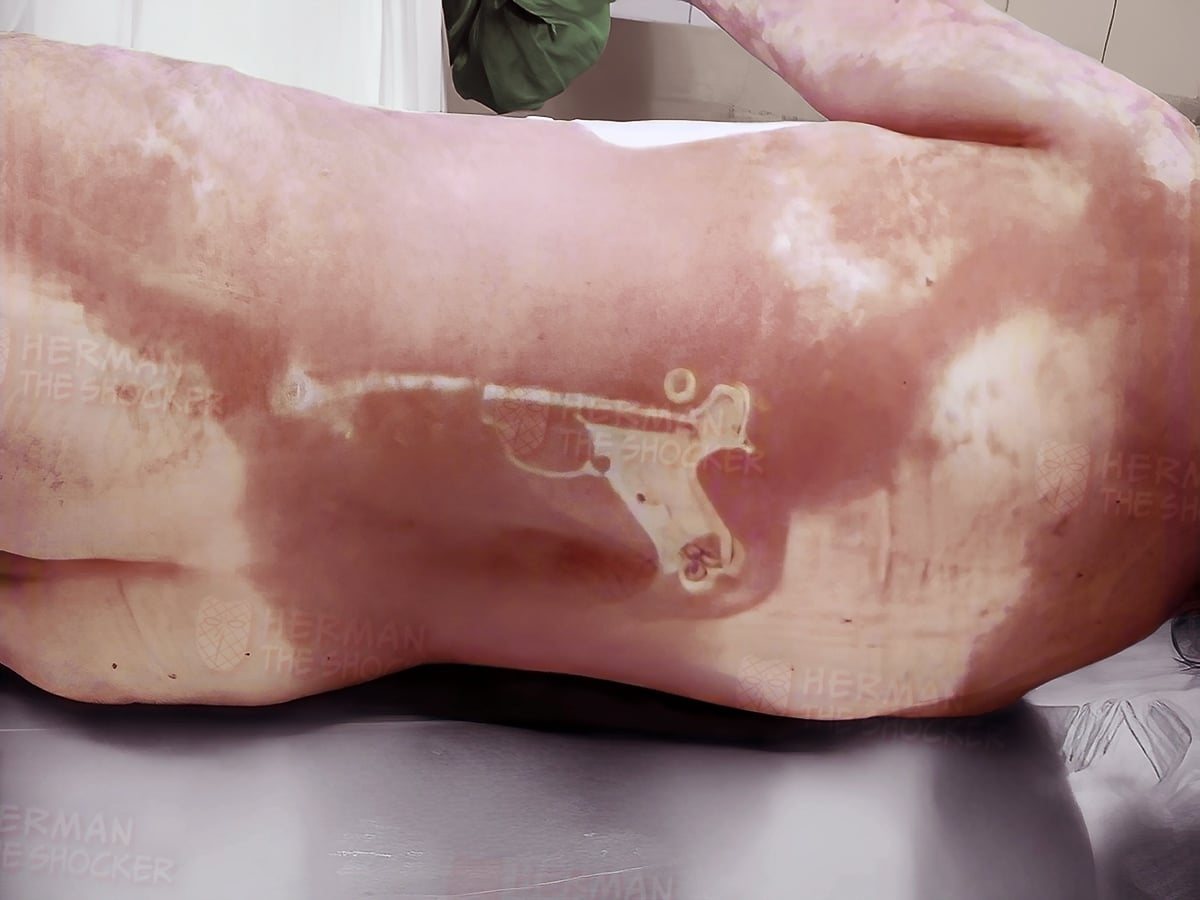 Fig.1 Contact blanching on the back of the body depicting a pistol. [Upscaled/colorized] 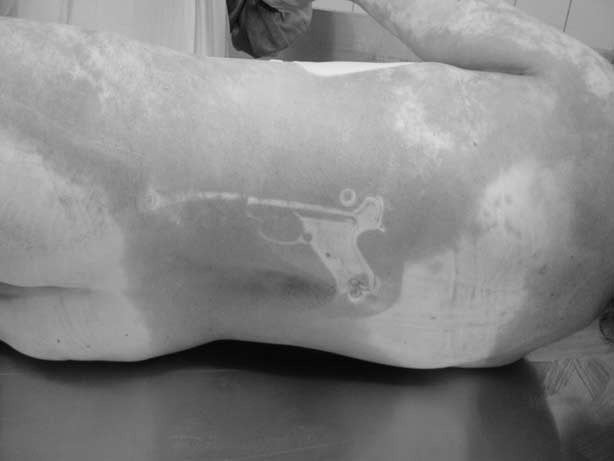 Fig.2 Contact blanching on the back of the body depicting a pistol. [Original] Livor mortis (synonyms: livores, postmortem lividity, postmortem hypostasis) is visible as a usually bluish-violaceous to purple coloration appearing on lower (dependent) parts of the body within 30min to 3h after death. Livor mortis is frequently patterned since the appearance of livores is hindered when the vessels in dependent parts of the body are obstructed due to outer-surface compression, for example, when prominent parts of the body such as areas over bony structures firmly adhere to a rigid surface due to the weight of the body or when tight clothing compresses the involved vessel lumina. In such areas, livor mortis is absent: the involved outer-body surface appears pale to white, in contrast with the surrounding livor mortis. This contact blanching may image the exterior of objects that were in contact with the dependent parts of the body surface during livor mortis formation and occasionally the distinctive morphological appearance of contact blanching may give the death investigator valuable hints about the case in question. Creasing of the skin or tight clothing may produce contact blanching on the neck which may resemble ligature marks. Therefore, knowledge of the position of the head and neck, as well as the cloth worn at the time of death, is important for the death investigator. In the early phase of their formation, livores have a reddish color, due to the prevailing number of erythrocytes carrying oxygenated hemoglobin. With an increase in the length of the postmortem interval, livores become darker, and when fully developed, the normal color of livor mortis is bluish-violaceous to purple. This is a result of oxygen dissociation from both the postmortem hemoglobin of erythrocytes and continuous oxygen consumption from cells that initially survive the cessation of cardiovascular function (e.g., skeletal muscle cells survive cessation of the cardiovascular system for 2–8 h). The resulting product is deoxyhemoglobin, which is bluish-violaceous to purple in color. - This post is for educational purposes only and is nonprofit. Under Section 107 of the US Copyright Act of 1976; Allowance is made for "Fair Use" for purposes such as criticism, comment, news reporting, teaching, scholarship, and research. OP is not a medical expert. No copyright infringement intended. This post does not encourage or glorify violence/harassment. Images might have been upscaled and enhanced. Text might have been shortened and simplified/reorganized for online view. Original case report by Tsokos M. - Elsevier Ltd. 2005. |
|
#2
●
05-23-2021, 03:23 PM
| ||||||||
 My Rank: LANCE CORPORAL Poster Rank:1833 Male but Gay and if someone Hate´s me: Excuse me ich havent Choose it freely. Join Date: May 2017 Posts: 282 Mentioned: 1 Post(s) Quoted: 80 Post(s)
| ||||||||
|
Re: Contact Blanching on the Back of the Body Depicting a Pistol [Colorized]
Looks like a Luger P08 Pistol.
|
|
#3
●
05-23-2021, 03:40 PM
| ||||||||
 My Rank: STAFF SERGEANT Poster Rank:858 Flesh and Blood Join Date: Apr 2012 Posts: 895 Mentioned: 3 Post(s) Quoted: 352 Post(s)
| ||||||||
|
Re: Contact Blanching on the Back of the Body Depicting a Pistol [Colorized]
Pretty sure it is. Classic pistol. Thanks Hermie  |
|
#4
●
05-24-2021, 10:16 AM
| ||||||||
 My Rank: FIRST SERGEANT Poster Rank:480 Male Join Date: Dec 2009 Posts: 2,258 Mentioned: 0 Post(s) Quoted: 293 Post(s)
| ||||||||
|
Re: Contact Blanching on the Back of the Body Depicting a Pistol [Colorized]
The blanching looks so detailed that you might even be able to read the serial number!
|
|
#5
●
05-26-2021, 10:55 AM
| ||||||||
| My Rank: MASTER GUNNERY SERGEANT Poster Rank:350 "IT"-Species; Genus-genius Join Date: Jan 2013 Posts: 3,614 Mentioned: 0 Post(s) Quoted: 618 Post(s)
| ||||||||
|
Re: Contact Blanching on the Back of the Body Depicting a Pistol [Colorized]
Thanks, Picasso Shocker
|