
|
#1
●
06-04-2021, 01:21 PM
|
 My Rank: PRIVATE FIRST CLASS Poster Rank:5007 Female Join Date: Jan 2021 Posts: 54 54Posts 613Thanked 21Quoted 0Mentioned 0Contrib. |
|
Circular Saw Fatality Caused by Tangled Scarf
Fatal injuries caused by circular saws are rare and mainly self-inflicted. To the best of our knowledge this is the first recorded case of accidental death of a woman caused by an injury to the head region inflicted by a saw blade. Fatalities involving power tools, such as a circular saw, warrant a high degree of suspicion of criminal activity and require a comprehensive medicolegal investigation. Placing guards over the blade and around the driving system, i.e. the motor, belt, arbor, is of great importance for the prevention of potentially fatal injuries. A 67-year-old woman, without any somatic or psychiatric comorbidities, was found dead in the shed in her backyard. Not having seen her in a while, her husband had started looking for her and found her lying over a circular saw which was off at that moment because of a recent power cut. At the death scene, the circular blade was mounted on an arbor, which was driven by an electric motor with a real power output of 220 V (Figs. 1, 2). 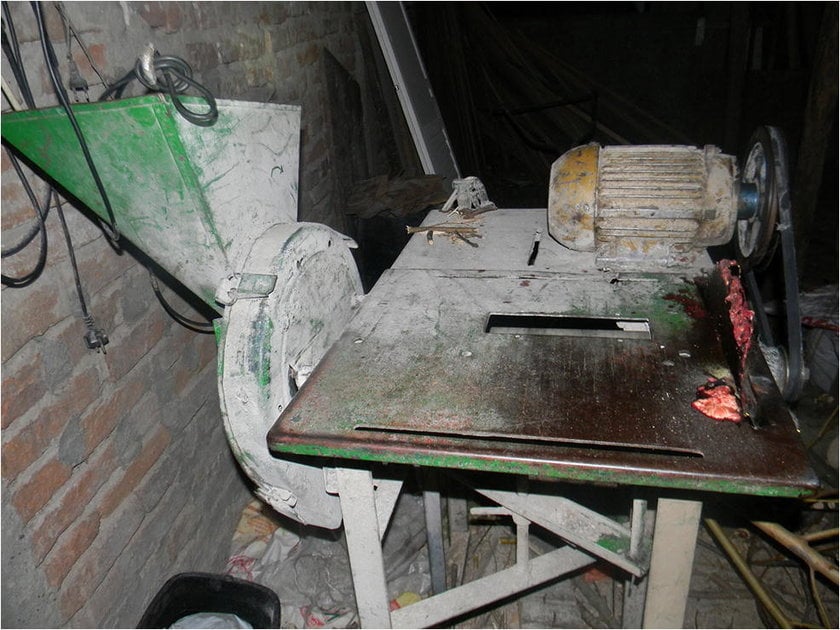 Figure 1. The home made table-mounted circular blade saw. 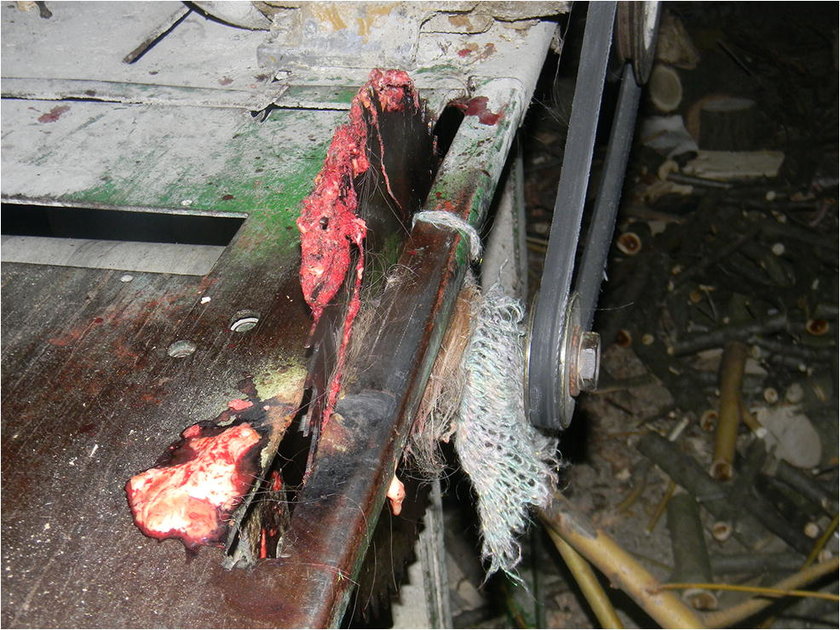 Figure 2. Close view of circular blade saw showing fragments of the damaged brain tissue, blood and tangled victim’s scarf. The saw blade, electric motor and belt were not protected by any kind of guard. Fragments of damaged brain tissue and traces of blood were noticeable on the blade and its surroundings. The blood spatter was consis- tent with the position of the circular saw blade. Around the victim’s neck was a scarf which was torn and stained with blood. The autopsy was performed the next day, revealing a 35 cm long incised wound, extending from the right half of the jaw along the right side of the face and the right temporal region up to the parietal region (Figs. 3 and 4). 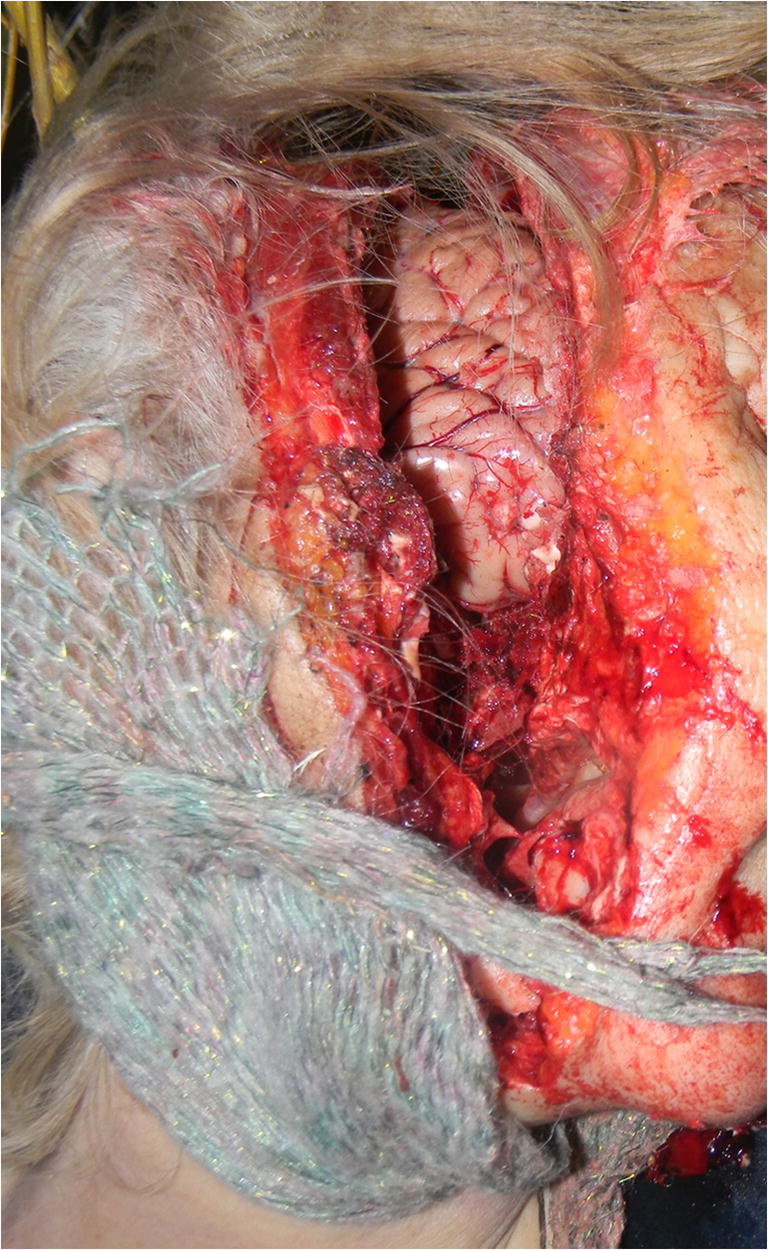 Figure 3. Longitudinal facial and cranial wound inflicted by circular saw. 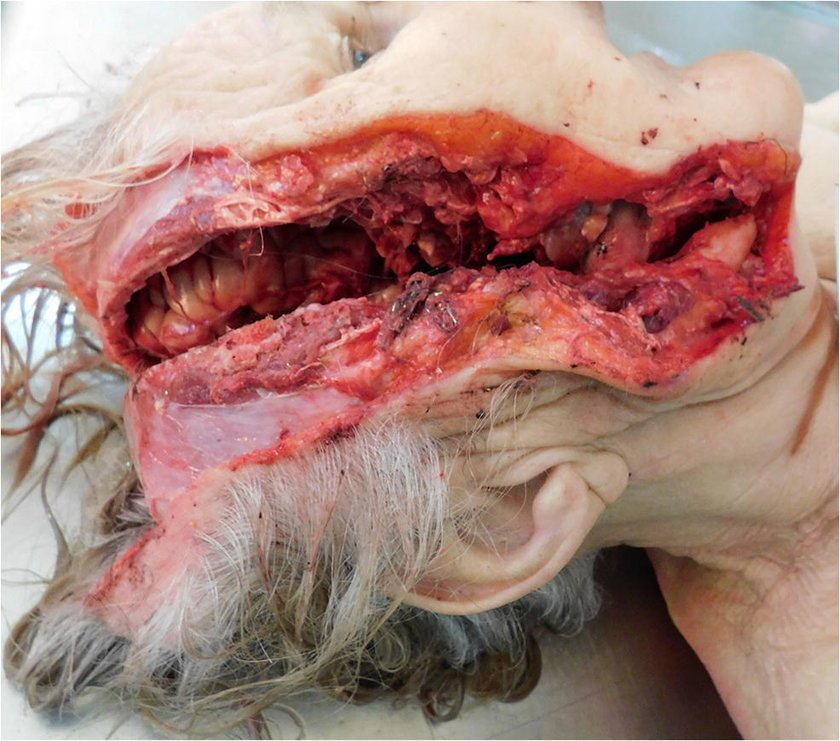 Figure 4. Close view of incised wound. The autopsy showed a 35 cm long wound, stretching from the right half of the jaw along the right side of the face and the right temporal region up to the parietal region. The cut went through the right hemisphere of the brain in the temporal and parietal lobe regions, damaging the sagittal sinus. Air embolism was considered to be the cause of death. The edges of the wound were mostly regular. The right ramus of the mandibula, the right zygomatic bone, and the right temporal and parietal bones were severed. The space of the incised wound widely communicated with the cranium, oral cavity and the right wall of the pharynx. The cut went through the right hemisphere of the brain in the temporal and parietal lobe regions, going 5 cm deep into the inner surface of the left parietal lobe. A fracture line emerged from the cut on the parietal bone, running along the left half of the calvaria down to the base of the skull over the pyramid of the temporal bone and the Turkish saddle. The brain had no contusions, but the superior sagittal sinus was damaged. Also, there was a ligature mark on her neck at the level of the laryngeal prominence and above it. The mark was dry and brownish and most prominent on the left and front side of the neck. There was no hemorrhage in the soft tissue of the neck, and no blood in the trachea. Special Thank You To: Hermantheshocker for help with this post! |
|
#2
●
06-04-2021, 01:38 PM
|
 ♚ Legacy Gold Member ♚ Poster Rank:914 Join Date: Jul 2020 Posts: 820
Contributions: 13
820Posts 27,652Thanked 173Quoted 13Mentioned 13Contrib. |
|
Re: Circular Saw Fatality Caused by Tangled Scarf
Great post! Glad to help  |
|
#3
●
06-04-2021, 01:51 PM
|
 My Rank: GUNNERY SERGEANT Poster Rank:674 Male Join Date: Jul 2013 Posts: 1,292 1,292Posts 3,771Thanked 349Quoted 1Mentioned 0Contrib. |
|
Re: Circular Saw Fatality Caused by Tangled Scarf
Suicide? Or was she operating the saw when her scarf got caught  |
|
#5
●
06-04-2021, 02:46 PM
|
 My Rank: FIRST SERGEANT Poster Rank:481 Male Join Date: Dec 2009 Posts: 2,252 2,252Posts 5,941Thanked 293Quoted 0Mentioned 0Contrib. |
|
Re: Circular Saw Fatality Caused by Tangled Scarf
Scarves may be fashionable or warm, but they're not quite the right garments for operating machinery!
|
|
#7
●
06-04-2021, 04:57 PM
|
| ♚ Legacy Gold Member ♚ Poster Rank:92 Male Join Date: Nov 2009 Posts: 17,231 17,231Posts 45,019Thanked 4,711Quoted 8Mentioned 0Contrib. |
|
Re: Circular Saw Fatality Caused by Tangled Scarf
My first question (Actually, my SECOND question, as the first thing I would ask is if there were any chocolate chip cookies.) would be "Where is the wood she was thinking of/attempting/planning to cut?" If there is no piece of wood there, then I would start thinking about either murder, or suicide. If there is no wood, and no suicide note, then my next question would be "When did you last have a fight?" |
|
#8
●
06-04-2021, 08:54 PM
|
| My Rank: PRIVATE FIRST CLASS Poster Rank:5007 Female Join Date: Jan 2021 Posts: 54 54Posts 613Thanked 21Quoted 0Mentioned 0Contrib. |
|
Re: Circular Saw Fatality Caused by Tangled Scarf
I think I cut too much out for the sake of brevity, but it was an accidental fatality. Her scarf got caught in the saw.
|


 No?
No?


