|
#1
●
06-25-2009, 12:47 AM
| ||||||||
 Super ********* Poster Rank:88 Join Date: Nov 2008 Posts: 17,426 Mentioned: 5 Post(s) Quoted: 99 Post(s)
| ||||||||
|
Tasmanian Tiger: End of Extinction
Oct. 21, 2003 — From its vault in Sydney's Australian Museum, a pickled Tasmanian tiger pup has brought the prospect of reviving an extinct species to the verge of reality, bringing mixed reactions of wonder and terror. More than 60 years after its extinction, the museum launched a project to clone the Tasmanian tiger, more correctly known as the thylacine, a lost icon of Australia's island state. This pup's DNA was the starting point, due to its remarkable state of preservation. For proponents, it is a chance to undo a terrible mistake that humans made. Human hunting was responsible for wiping out the thylacine in Tasmania, its final refuge. But for diehard critics, it is "playing God." The driving force behind the project is museum director Michael Archer, who has dismissed the frequent comparisons with Jurassic Park. "The thylacine's world is not gone," Archer told AFP. "The ecological system of which it was the top carnivore is still the same. "I think we have a moral obligation to bring it back if we can do it," he continued. "I think this as a terrible thing humans did, and most religious people agree. The thylacine was hailed as a wonder of nature when Europeans first saw it. A doglike marsupial, it is considered a perfect case of "convergent evolution", where similar environments and lifestyles produce similar features in totally unrelated species. By the time Europeans arrived in Australia, the introduction of the dingo had already eliminated the thylacine from the mainland. European farmers in Tasmania soon dubbed it a pest, hunting it to extinction. The last thylacine died in captivity in 1936. Remarkably little is known about the pup, which has been in the museum’s possession since 1866. Researchers have deduced that it had been in its mother's pouch for about four months and was nearly full term. It is assumed that the mother was killed. By pure chance, whoever preserved it used alcohol, an unusual step that left most of its DNA intact more than a century later. Work with its DNA provided the impetus to get the project going, and genetic material has since been obtained from at least three additional thylacines. Because hundreds of thylacine remains are in collections around the world, Archer said the possibility is wide open for eventually returning a viable population to the wild. Among the hurdles to be overcome is getting dead DNA to act again as living DNA. The DNA must be extracted and multiplied, using yeast or bacteria cells. A suitable host animal will be needed, probably the thylacine's distant cousin, the Tasmanian devil. More needs to be known about that animal's breeding cycle and its DNA needs to be sequenced. If the thylacine can be cloned, however, it has huge implications for conservation. Some critics fear people may cease to care about conservation at all. Researchers said the project is massively under-funded. Only a single researcher has been working fulltime on the project, with limited laboratory facilities. The roughly $120,000 Australian ($83,000 U.S.) so far spent has been largely funded privately, partly by a trust with Tasmanian connections. Archer and his colleagues are seeking more funding, promising in return one of the most exciting scientific projects of the present day. Source : Animal Planet :: Thylacine to Return? 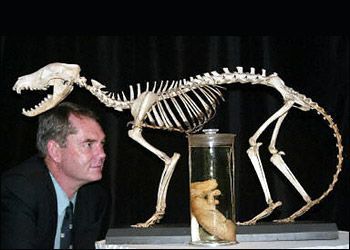 Professor Mike Archer of the Australian Museum in Sydney displays the skeleton of a Tasmanian tiger, or thylacine, and a 130-year-old thylacine female pup specimen preserved in ethanol. 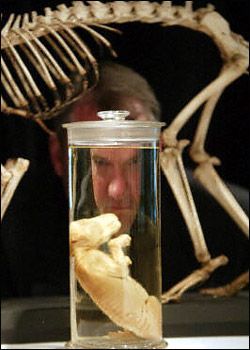 Professor Archer takes a closer look at the 130-year-old, preserved thylacine pup. Archer has led a team of scientists who have successfully replicated DNA from the pup specimen and now plan to recreate the extinct species within a decade. 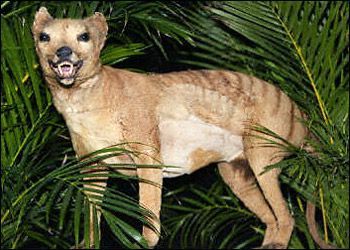 A stuffed Tasmanian tiger, or thylacine, is displayed at the Australian Museum in Sydney. Once the world's largest carnivorous marsupial, the thylacine was hunted to extinction early last century, the last one dying in captivity in 1936. |
|
#9
●
06-25-2009, 01:54 AM
| ||||||||
 Cunt Poster Rank:154 Was für eine Scheiße Join Date: Apr 2009 Posts: 10,452 Mentioned: 0 Post(s) Quoted: 15 Post(s)
| ||||||||
|
Re: Tasmanian Tiger: End of Extinction
But isn't she cute though?? Like, seriously! She's the most adorable thing on the planet and she likes cuddles! That's so sweet! I'd cuddle Dolly any day  |