
| Go to Page... |
|
| Current Rating: | |
Community Forum · Est. 2006
|
#1
●
08-14-2011, 05:01 AM
| ||||||||
 ★ ********* ★ Poster Rank:251 Male Join Date: Jul 2009 Posts: 5,564
Contributions: 368
Mentioned: 66 Post(s) Quoted: 932 Post(s)
| ||||||||
|
"Swatting": Prank 911 Calls Send SWAT Teams to Unsuspecting Homes
Swatting ... From Wikipedia, the free encyclopedia Swatting is an attempt to trick an emergency service (such as a 911 operator) into dispatching an emergency response team. The name is derived from SWAT (Special Weapons and Tactics), one type of such team. History and current status Swatting has its origins in prank calls to emergency services. Increasing sophistication of the techniques employed and the objectives, notably attempts to direct response units of particular types, and in particular attempts to cause SWAT teams to be dispatched to particular locations, spawned the term swatting. The term may have been coined by the FBI, which investigates these activities that are in the United States or are US-related. Blind phreaker Matthew Weigman pled guilty to charges of conspiracy including attempting to retaliate against a witness. He was sentenced to over 11 years in federal prison. Techniques Caller ID spoofing, social engineering, prank call and phone phreaking techniques may be combined. 911 systems (including telephony and human operators) have been tricked by calls placed from cities hundreds of miles away. Two examples: using a service that permits people to call using a spoofed caller-id, the prankster uses the phone number of the victim, calls the police and pretends there is a hostage situation. Other possibility; prankster signs up for internet-based phone VOIP service in the victim's area code, signs on to the website of the VOIP provider, and registers the victim's address as theirs for 911, then calls 911 and again, misinforms the police that there is a hostage situation. See also: Blind Hacker Sentenced to 11 Years in Prison Needless to say, DON'T try this at home. Here are some stories. 'Swatting' prank sends police to unsuspecting residents Police kicked down the door of a North Toronto apartment last month after a caller warned them about a "possible murder" taking place inside. But all they found was a guy wearing noise-cancelling headphones who had the misfortune to be working from home that day. "I didn't hear them knocking or banging on the door saying: ‘Please open up,'" said software consultant Jason Myles, describing the incident to CTVNews.ca in a recent telephone interview. "The first thing I heard was when they attempted to kick down the door." The headphones drowned out the initial commotion and by the time Myles heard the kicks, it was too late for the door. When Myles came face to face with the law, he put his hands up and found "a number of police officers pointing their weapons in my general direction." He was handcuffed and police quickly searched his apartment, which is located in the Yonge and Lawrence area. But there was no body to be found and the only victim was Myles, who was the unfortunate target of a prank phonecall to police. "Immediately they knew that nobody was murdered in the apartment or about to be murdered, so they picked me up off the ground, uncuffed me, then we spent the next couple of hours trying to figure out why they were in my apartment and why they came to this address," said Myles. They determined that someone had contacted 911 from a landline number that Myles had cancelled about two weeks before police arrived at his apartment looking for a murder that didn't occur. Myles believes he was a victim of something called "swatting," a prank in which a caller reports a fake emergency with the intent of getting police to mobilize a SWAT team. In this case, it wasn't a SWAT team that arrived at Myles' door, but uniformed officers, as well as firefighters and paramedics who also responded to the scene. "They were expecting a lot of violence and therefore probably needed their assistance," said Myles, who noted that the caller told police that at least one victim was involved. An emerging trend in Canada? Myles read an article about a similar case that happened in British Columbia last month, and as far as he can tell, it appears that this was the exact same type of prank. In the case targeting his Toronto apartment, it appears the prankster "spoofed" the number on the call that went into police, likely through a computer or voice-over-Internet protocol setup, which has been used in dozens of other incidents in the United States. "Somebody spoofed that number calling 911, somehow, and what they told police on the 911 call was that they had just killed their mother and were about to kill their sister," said Myles. "And since they spoofed that number, the number was still registered to my name and address, so that's where they came." But he has no idea why his number was selected for use in the apparent swatting prank. "I don't know if the number was targeted because it was recently cancelled, or whether they just targeted a number at random, or whether they had inside information as to what numbers were currently or recently in use," said Myles. "I have no clue as to why they picked that number." Police subsequently apologized for what had happened and made arrangements to pay for the damage to the door. Toronto police Const. Tony Vella said that while the July 14 call was determined to be a hoax, he said that all such emergency calls have to be treated seriously. "As soon as a call is made to police, they will always send a police car to investigate," Vella told CTVNews.ca in a recent telephone interview. For his part, Myles has "no issues" with the way police handled the situation and was impressed by their bravery. "They came through that door expecting a very serious situation and they came through that door anyway," Myles said. "So I have nothing but respect for the police and for how they acted and what they did." 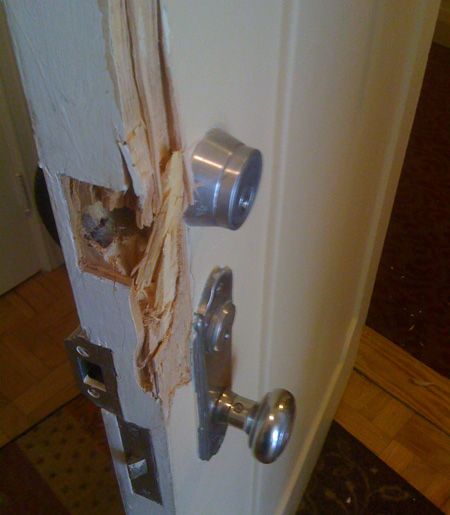 This photo shows the door that police broke through after they received a false report of a possible murder taking place inside a North Toronto apartment, July 14, 2011. (Courtesy of Jason Myles) 'Swatting' a high-tech trend in 911 hoaxes A California couple with a 2-year-old daughter is awakened late at night by heavily armed police storming their home after a false report of a shooting. A Texas family is stunned when officers with automatic weapons respond to their house expecting a drug-fueled murderer who is demanding $50,000 in exchange for hostages. And a Wyckoff neighborhood is put on lockdown as the Bergen County SWAT team shoots tear gas into what proves to be a home occupied only by a cat.  In each case, the people who wound up in the crosshairs were actually victims of a dangerous and increasingly common hoax known as "swatting," so called because a bogus emergency call prompts the response of a SWAT team. It is typically perpetrated by young, savvy computer hackers who exploit the limitations of the 911 emergency system and advances in computer technology to cover their tracks, experts and law enforcement officials say. They do it for bragging rights or revenge, but it costs taxpayers and puts innocent people at risk, experts say. A federal law signed late last year takes aim at swatting by imposing large fines on those who are caught, but in recent years authorities have also sent swatters to prison on federal fraud convictions. "This is a federal crime, and I'd say to these people that, if you persist pursuing this type of entertainment, it's just a matter of time before local and state authorities and the FBI come knocking on your door," said Kevin Kolbye, assistant special agent in charge of the FBI's Dallas office. That office spearheaded the first federal swatting case in 2008 and has tracked more than 100 other swatting incidents nationwide since then. Last weekend's swatting incident at the Wyckoff home of cybercrime expert Parry Aftab was the first in Bergen County, said Lt. Mike Devine, who oversees Bergen's SWAT team and has been with the unit for 13 years. A man called the Wyckoff police station Saturday afternoon reporting that he had killed four people and held two hostages inside Aftab's home. Thirty officers quickly surrounded the house. They told neighbors to stay inside. They sent remote-controlled robots to peer into windows. They reached Aftab on her cellphone. She was out of town but told police to do what they needed to do. After a three-hour standoff, police discovered that the phone number that appeared on the call display in the station was spoofed to disguise the caller's true location and identity. Wyckoff police are investigating the call, but Police Chief Benjamin Fox has said the probe may be difficult. "It's not like the prank phone calls of years ago," Devine said. Fools the 911 system Part of why swatting is so alarming to emergency responders is that virtually anyone with access to the Web can do it. Voice-over-IP phones, which rely on an Internet connection, allow a caller to choose the number that the recipient sees. Many companies also offer caller ID spoofing services online. They have legitimate uses: a doctor who wants his office number to appear when he is responding to a patient's emergency call from his cellphone, for example. But it also allows swatters to appear to be calling from the home phone number of their targets, as they report a gruesome murder or a home intrusion. "The reason it's become so popular is because it's relatively simple to fool the 911 network because of how it's built," said Mark J. Fletcher of Passaic County, a public-safety product manager for the business communications company Avaya. "Nationally, it seems to be happening a couple of times a month," he said, although those are only the cases that draw headlines. The 911 system was created in 1968, long before wireless signals and Internet connections. So most call centers don't have equipment capable of determining if a call is coming through a computer phone line — information that could be used to assess the credibility of an emergency call, Fletcher said. That could change in the coming years. But for now, the system is susceptible to the likes of Matthew Weigman — nicknamed "Li'l Hacker." The blind Massachusetts 18-year-old pleaded guilty in 2009 to charges related to swatting a family in Texas and other phone fraud schemes. He also hacked into phone company accounts to retrieve information about customers and intimidated witnesses, prosecutors said. One of five swatters tracked down by the Dallas FBI office, he was sentenced to 11 years in prison. "It seems to be more bragging rights and ego than monetary gain," Kolbye of the Dallas FBI said of swatters' motives. He said he has also seen instances when swatters targeted females who refused online sexual advances. "They tend to be very reclusive, sometimes social misfits, and computer savvy," he said. Swatters are typically males in their 20s and 30s who sometimes brag about their hoaxes in online forums and chat rooms, he said. Often they are hundreds of miles away from their victims. In Aftab's case, police are trying to determine if she was targeted by hackers because of her frequent appearances on national television to speak out about online bullying and Internet security. Her websites were hacked into last July when she appeared on a "Good Morning America" segment about a young Florida girl who had been bullied by members of a Web forum. Anonymous members of the forum, 4Chan, bragged about taking down her websites and posting Aftab's personal information and malicious rumors online. Costly and dangerous When a SWAT team is called out on a hoax, taxpayers foot the bill for the extra manpower. But the potential costs of swatting go well beyond dollars and cents. "There's the opportunity cost of not being able to help out other people because you're tied up on a hoax," said Devine, the leader of the Bergen County SWAT team, who added that team members were pulled away from barbecues with their families to respond to last weekend's swatting incident. "This could also be a mechanism that terrorists use to cause a distraction at one location while the real event is happening at another location," said Roger Hixson, technical issues director at the National Emergency Number Association. And then there's the real possibility of someone getting hurt or killed. In 1993, Paramus Officer Vincent Brock died after he hit a utility pole on Route 4 while responding to a false 911 call from a stolen cellphone. "They're putting themselves in harm's way over a prank," Devine said. "It's not a joking matter." Lawmakers and authorities have tried to curtail the practice through legislation and prosecutions. Last month, the Federal Communications Commission implemented the Truth in Caller ID Act, which prohibits caller ID spoofing "with the intent to defraud, cause harm, or wrongfully obtain anything of value." It allows the agency to levy fines of up to $10,000. While adopting the new rules, the agency noted the increase in swatting. Kolbye, of the FBI, said "law enforcement is becoming more aware of these kinds of incidents" and his office has given presentations to local and state authorities nationwide. Some experts said advances in the telecommunications system will also help. "The current network will not process advanced information available from today's telephones for 911," said Fletcher, the public-safety product manager from Ringwood. He and others said a new system called next-generation 911 that is slowly being adopted will provide dispatchers with additional information such as whether a call is coming from a computer. It would allow emergency call centers to receive data — video, GPS coordinates, for example — as well as the caller's voice. Swatters could get around next-generation 911 by calling non-emergency land lines, said Rick Jones, operations issues director for the Emergency Number Association. But he said he expects 10-digit land lines at emergency call centers to also have the capability to see if a call is coming from a computer or mobile device in three to four years. |
|
▼ PROMO FROM DOCUMENTING REALITY
 Cheaper than the doctor visit tomorrow Join Now Hidden for upgraded members. |


