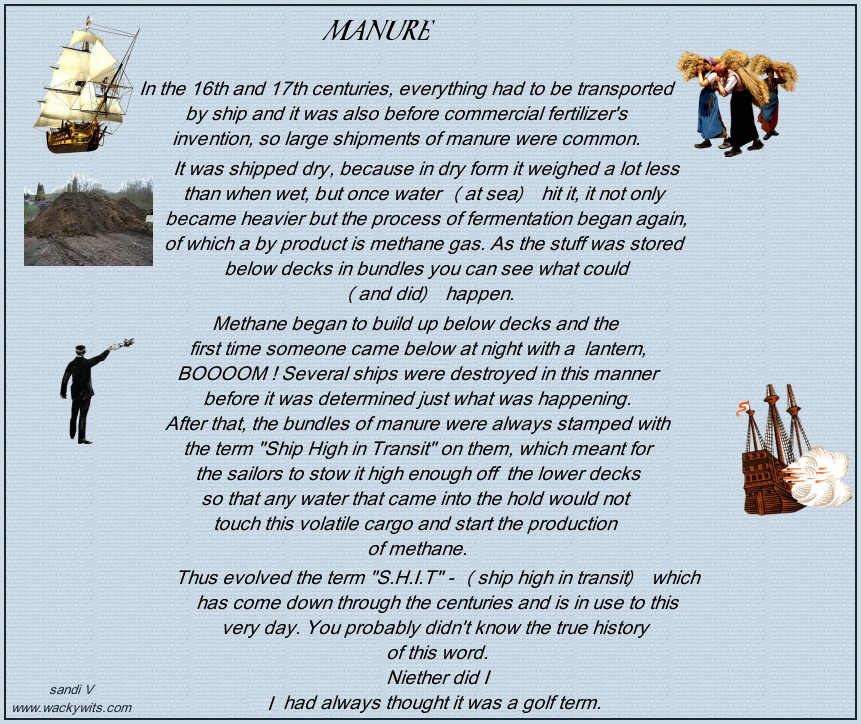
SHIT didn't form from an acronym, like most words of this nature...it came from the Irish! LOL:bow, please forgive me.
It's what they call a
false etymology. These stories are good fun, but acronyms were not in common use until the mid-20th century. Shit was around a long time before written history... both the word and the object!
In the English language, the widespread use of acronyms, initialisms, and contractions is a relatively new linguistic phenomenon, becoming increasingly evident since the mid-20th century. As literacy rates rose, and as advances in science and technology brought with them more complicated terms and concepts, the practice of abbreviating terms became increasingly convenient. The Oxford English Dictionary (OED) records the first printed use of the word initialism as occurring in 1899; acronym, in 1943. The word acronym comes from Greek: ακρος, akros, "topmost, extreme" + ονομα, onoma, "name."
Nonetheless, earlier examples of acronyms in other languages exist. The early Christians in Rome used the image of a fish as a symbol for Jesus in part because of an acronym—fish in Greek is ΙΧΘΥΣ (ichthys), which was said to stand for Ιησους Χριστος Θεου Υιος Σωτηρ (Iesous CHristos THeou (h) Uios Soter: Jesus Christ, Son of God, Savior). Evidence of this interpretation dates from the 2nd and 3rd centuries and is preserved in the catacombs of Rome. And for centuries, the Church has used the inscription INRI over the crucifix, which stands for the Latin Iesus Nazarenus Rex Iudaeorum ("Jesus the Nazarene, King of the Jews").
Initialisms were used in Rome dating back even earlier than the Christian era. For example, the official name for the Roman Empire, and the Republic before it, was abbreviated as SPQR (Senatus Populusque Romanus).
Acronyms pronounced as words may be a 20th century phenomenon. Linguist David Wilton in Word Myths: Debunking Linguistic Urban Legends states that "forming words from acronyms is a distinctly twentieth (and now twenty-first)-Century phenomena. There is only one pre-twentieth-century word with an acronymic origin and it was in vogue only for a short time in 1886. The word is colinderies or colinda, an acronym for the Colonial and Indian Exposition held in London in that year. [8][9]
Source SHIT
Etymology
Scholars trace the word back to Old Norse origin (skīta), and it is virtually certain that it was used in some form by preliterate Germanic tribes at the time of the Roman Empire. It was originally adopted into Old English as scitte, eventually morphing into Middle English schītte. The word may be further traced to Proto-Germanic *skit-, and ultimately to Proto-Indo-European *skheid-, ". Ancient Greek language had 'skor' (root 'skat-' from which modern Greek 'skatá'). The words 'skítur' (noun) and 'skíta' (verb), still exist in the Icelandic language today, and in other Scandinavian languages variations of 'skit' are also often used.
False etymology
An urban legend has arisen to explain the word as an acronym (similar to the false etymology of the word "fuck"). As the story goes, the word can be traced back to merchant sailing vessels from the 17th to 19th century. Supposedly, bales of dry manure were once transported in the holds of these ships. If the bales were stored low enough, they would come into contact with water that inevitably leaked into the bilge. The water would then cause the manure to decompose, creating methane gas. The sailor sent to investigate the smell would take with him a candle or lantern to light the dark area below deck. The open flame would ignite the methane/air mixture in the confined space, causing a massive explosion and sinking the ship. When the cause of these strange accidents was discovered, bales of manure to be transported by ship were marked "store high in transit" or "ship high in transit" to remind those loading them to keep them above the bilge water. This was eventually shortened to "S.H.I.T." and this is how the story claims the word was born. However, this story has little historical backing and most likely originates from a 1999 Usenet post.[1]
Source