|
#131
●
11-05-2023, 07:45 PM
| ||||||||
 ☾ Administrator ☽ Poster Rank:76 ஜᎻᎬᎩᎾᏦᎪஜ Join Date: Dec 2011 Posts: 19,650
Contributions: 32
Mentioned: 180 Post(s) Quoted: 6920 Post(s)
| ||||||||
|
Re: Whiskey's Briefing Room III
Once upon a time I was going to start a therapy animal non-profit for Veterans with PTSD/TBI/Moral Injury. To prepare, I spent 2011-2014 doing intensive daily research on veterans of Iraq/Afghanistan from around the world. This research is what led me to Documenting Reality. Most people know about this subject but few truly understand it or how all-encompassingly detrimental it is. No one could possibly know unless it happens to them or someone they love. But the entities who put them in the situations that caused these things, the military, did not do too much to help but throw pills at veterans, which often times only exacerbated the issues. But this has been classic MO with the military for decades. They've never really been very good at handling aftercare after they throw someone in a combat zone. Those 4 years were some of the most heart wrenching days of my life. The knowledge I gained, the stories I heard rocked my foundations and forever changed me to my core in more ways than I can explain. This story caught my attention so I'm sharing it. Source: https://www.nytimes.com/2023/11/05/us/us-army-marines-artillery-isis-pentagon.html A Secret War, Strange New Wounds, and Silence From the Pentagon A secret U.S. offensive in 2016 and 2017 used an unusual strategy to defeat the Islamic State.  The plan: Put a minimal number of American boots on the ground, and have the troops pound the enemy with relentless artillery fire. What no one foresaw was the devastating toll it would take on the troops who did the firing. Many U.S. troops who fired vast numbers of artillery rounds against the Islamic State developed mysterious, life-shattering mental and physical problems. But the military struggled to understand what was wrong. By Dave PhilippsPhotographs by Matthew Callahan Nov. 5, 2023 Updated 3:20 p.m. ET When Javier Ortiz returned home after a secret mission in Syria, the ghost of a dead girl appeared in his kitchen. She was pale and covered with chalk dust, as if from an explosion, and her eyes looked at him dark and heavy as oil. The 21-year-old Marine was part of an artillery gun platoon fighting against the Islamic State (ISIS) and he knew his unit's huge field guns had killed hundreds of enemy fighters. He was sure that the ghost was their revenge. A tremor seized him. He returned to another room in his apartment in California and turned on the light, convinced that it was a hallucination. But she was still there. A few days later in the barracks, 22-year-old Marine Austin Powell , in tears and stuttering, knocked on his neighbor's door: "There's something in my room! I hear something in my room!" His neighbor, 20-year-old Brady , searched the room, but found nothing. "It's okay - I had problems too ," said the junior corporal. The day before, he had bent down to tie his shoes, and he was suddenly overcome by an avalanche of emotions so overwhelming and strange that he could not find words for them. "We'll go to the doctor," he said to his friend. "We will get help." The entire unit - Battery "Alpha" of the 1st Battalion of the 11th Marine Brigade returned home with a feeling of damnation. The same thing happened in other units of the Marine Corps and related artillery units. An investigation by The New York Times found that many troops deployed to bomb the Islamic State in 2016 and 2017 returned to the US suffering from nightmares, panic attacks, depression and, in some cases, hallucinations. Once healthy Marines have become unpredictable and strange. Some of them became homeless. A striking number of them ended up committing suicide, or attempted to do so. 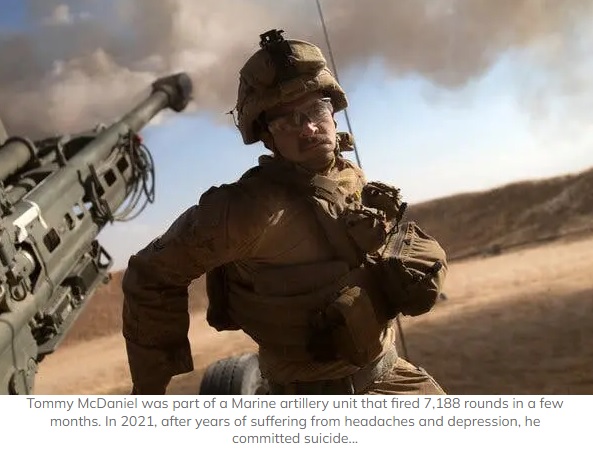 Interviews with more than 40 veteran artillerymen and their families revealed that the military repeatedly struggled to understand what went wrong after troops returned from Syria and Iraq. All gun calculations filled out questionnaires to detect post-traumatic stress disorder and passed tests to detect signs of brain injuries received from explosions of enemy munitions. But the crews were many kilometers from the front line when they fired their long-range guns, and most of them had never seen combat or sustained the kind of combat injuries the tests targeted. Several members of the cannon calculations were eventually diagnosed with PTSD, but it didn't make much sense to them. In most cases, they did not even see the enemy. The only thing impressive about their actions was the large number of artillery shells they fired. The United States has made a strategic decision not to send large numbers of ground troops to fight the Islamic State. Emphasis was placed on airstrikes and several powerful artillery batteries. The strategy worked: The positions of the Islamic State were almost destroyed, and almost none of the American soldiers were killed. But that meant that a small number of troops had to fire tens of thousands of high-explosive shells - far more per member of the force than had been fired by any American artillery battery since the Vietnam War. Military instructions state that firing these projectiles is safe. What happened to the crews shows that these instructions were wrong. The explosions of the guns were powerful enough, and each of them caused a shock wave that passed through the bodies of the gunners, vibrating the bones, passing through the lungs and hearts and with the speed of a cruise missile piercing the most sensitive organ - the brain. A year after the Marines began experiencing problems, Marine Corps Command tried to figure out what was going on by ordering a study of one of the hardest-hit units, Fox Battery, 2nd Battalion, 10th Marines. The study was limited to reviewing the medical records of military personnel. No Marines were examined or interviewed. Despite this, a report published in 2019 made a striking conclusion: the calculations of the guns received "wounds" from their own weapons. Most of the Marines in the battery were eventually diagnosed with traumatic brain injury. Experience in Syria has shown that firing a large number of rounds day after day can disable a soldier "faster than you can prepare a combat replacement". Safety training — for both gun crews and medical personnel — was so inadequate that the risks of repeated exposure to the blasts were "ignored." 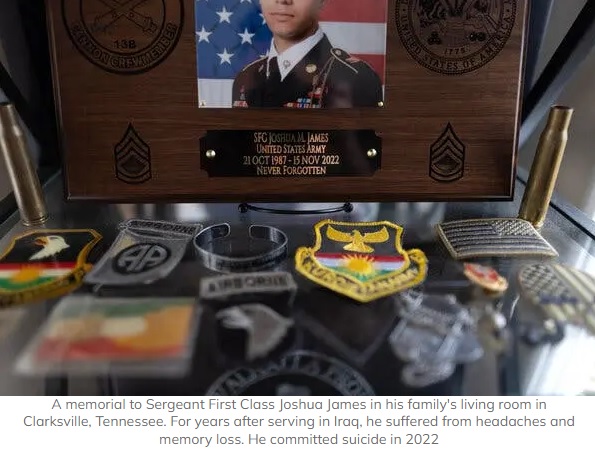 Contrary to the concern expressed in the report, no one appears to have alerted the commanders responsible for the gun calculations. And no one reported this to the hundreds of soldiers who fired these shells. Instead, on a case-by-case basis, the military treated aircrews' combat injuries as ordinary mental disorders, if they were treated at all. The soldiers were told that they had attention deficit disorder or depression. Many were given powerful psychotropic drugs, which complicated the functioning of the nervous system and did not bring significant relief. Others who started behaving strangely after a business trip were simply dismissed as problems, punished for misdeeds and kicked out of the army. The Marine Corps has never publicly commented on the study's findings. She refused to say who commissioned the study and why. Officers in charge of the artillery batteries declined to comment. The silence forced the affected veterans to try to figure out what was happening for themselves. But many of them could not do it. Lance Corporal Powell , who heard something in his room, left the Marine Corps and became a tow truck driver in Kentucky. Often on the road, he continued to have panic attacks. In 2018, a year and a half after returning from Syria, he shot himself. His barracks neighbor, Junior Corporal Zipoy , returned to his parents' home in Minnesota and entered college. In 2020, he began hearing voices and seeing hidden messages in street signs. A few days later, in the grip of a psychotic delusion, he entered a house he had never been in before and killed a man he had never met. When the police arrived, they found him wandering barefoot in the driveway. As he was being handcuffed, he asked, "Are you going to take me to the moon?" In 2021, he was found not guilty of manslaughter by reason of mental illness and committed to a locked ward in a Minnesota mental hospital. He is still there. "My God, I was out of my mind — I didn't understand what was going on," he recalled in a recent interview from the hospital. "I'm angry because I tried to get help in the Marine Corps ," he said. "I knew something was wrong, but they just brushed me off." 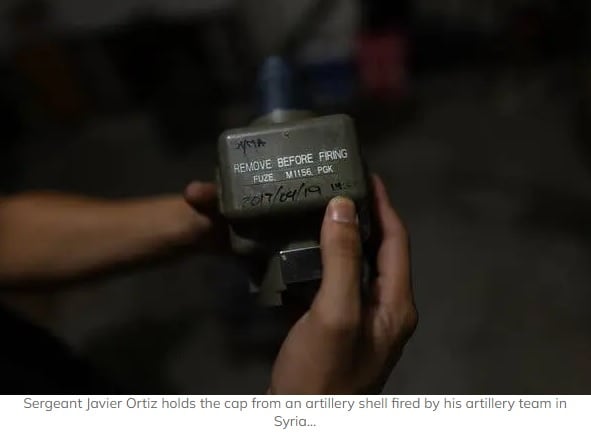 When Junior Corporal Ortiz saw the apparition a few days after returning from Syria, it didn't occur to him that he had been "wounded" by his own 155mm field gun. Instead, he was convinced that the enemy had placed a curse on him. He attempted to purify himself by building a bonfire on the beach near Camp Pendleton and burning his old combat gloves and combat journal. But after the ashes cooled, the ghost was still there. For the next four years, he tried to ease his problems and pursue a career in the Marine Corps. He created a family. Received the rank of sergeant. He was diagnosed with PTSD and given various medications, but the panic attacks and hallucinations did not go away. He started having problems with his heart and digestion. Eventually, he asked to be transferred to a special medical battalion created to help Marines wounded in action recover. But there was nothing on his record to indicate that he had been in combat or had been wounded. His request was rejected. 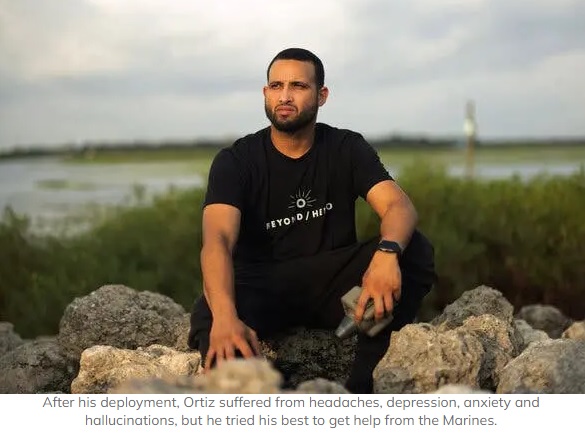 One Friday night in October 2020, he had visions of ghosts trying to pull him into another dimension. He stretched naked across his kitchen floor, hoping the cool touch of the tiles would bring him back to reality. But it didn't help. In a panic, he called a cousin who was serving in Iraq. Cousin said marijuana always helped him with his PTSD. Sergeant Ortiz bought it from a civilian pharmacy. Although it is a crime to use marijuana in the military, he took a few puffs, relaxed and fell asleep. The following Monday, he confessed to his commander what he had done. He apologized and said he had already checked into the Marine Corps substance abuse program. The Marine Corps has rules to ensure that Marines who violate the rules due to PTSD or traumatic brain injury will not be punished for their actions if their condition makes them unfit for duty. But records show the Marine Corps determined Sergeant Ortiz did not have qualifying injuries. He was fired in 2021 for willful misconduct, which cut him off from access to therapy, medication, disability benefits and other supports meant for wounded veterans.  Ortiz has two young children and is struggling to hold down a job. The bills piled up. According to him, the headaches are unbearable, and he feels that his memory is deteriorating. When he was asked about the ghost of the dead girl, he burst into tears and lowered his voice so that his wife would not hear. He admitted that he still sees a ghost. And other things. "I gave the Marines everything, " he said. "And they spat me out with nothing." Invisible risks Shooting a weapon is as important a part of military service as kicking the ball in football. And research has begun to show that, as with kicks in football, repeated blasts from heavy weapons such as cannons, mortars, rocket launchers and even heavy machine guns can cause irreversible brain damage. This is a large-scale problem that the military is only beginning to realize. The science is still in its infancy, but evidence suggests that while individual blasts that penetrate brain tissue may not cause obvious, long-term damage, repeated exposure creates scarring that can eventually disrupt neural connections. "Think of it as a rubber band, " says Gary Kamimori , a senior Army explosives researcher . For the hundred and first time, she tears up." According to Dr. Daniel Pearl , a neurologist who runs a Department of Defense tissue bank that stores the brains of fallen veterans for research, these blasts may never cause a person to see stars or experience other signs of a concussion, but over time they can lead to insomnia, depression, anxiety and other symptoms, which in many ways resemble post-traumatic stress disorder. "A blast brain injury can often be mistaken for something else because when you get to the clinic, it looks like a lot of other things," Dr. Pearl said. His laboratory examined samples from hundreds of deceased veterans who had been exposed to enemy explosions and gunfire during their military careers. The researchers discovered a unique and consistent pattern of microscopic scars. 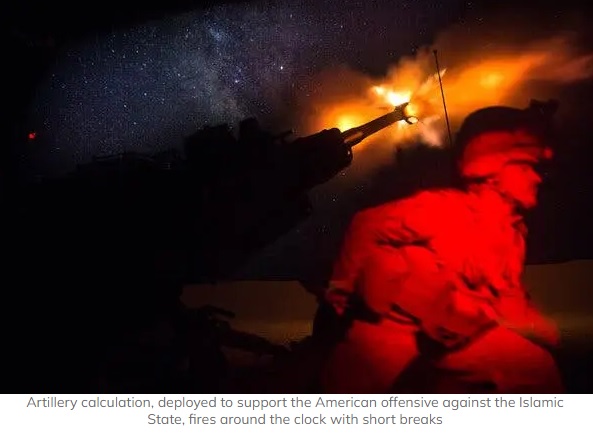 Another thing is to discover this regularity in living veterans. According to Dr. Pearl, there are currently no brain scans or blood tests that can detect minor injuries; damage can only be seen under a microscope after a service member has died. So there is no sure way to tell if a living person has been injured. Even if that were the case, there is no therapy that would fix it. The lab hasn't studied the brains of artillery units sent to fight the Islamic State, but Dr. Pearl says he wouldn't be surprised if many were affected. "A blast wave at the speed of sound passes through the most complex and intricate organ in the body, " he said. "Don't you think it will be damaged?" For generations, the military has set maximum safe levels of impact of the blast wave on the eardrums and lungs, but never on the brain. Anything that didn't stun the soldiers was considered safe. But recently that has changed. Over the past decade, veterans suffering from traumatic brain injury-like symptoms after years of firing weapons have forced Congress to rethink the potential danger, and lawmakers passed a series of bills from 2018 to 2022 that would require the Pentagon to launch a massive " Initiative on Soldier Brain Health" to try to measure the impact of the blast and develop protocols to protect service members. "There is a very clear understanding that this can be seen as a threat to brain health," said Kathy Lee , director of casualty care at the Defense Department's Office of Health, which oversees the initiative. In response to questions from The Times, both the Army and the Marine Corps acknowledged that some gun crews had been hit by explosions during operations against the Islamic State. Partly because of this experience, they now have programs to track and limit the effects of explosions on artillery fire. But the Marine officer now in charge of the artillery battery doubts that is the case. He recently stated that he had never seen or heard of the new safety rules, and that nothing was being done to document the impact of the explosions on his subordinates. The officer, who asked not to be named because he is not authorized to speak publicly, said he has been experiencing stabbing headaches and cramps but fears his injuries will go unrecognized because there is no record that he ever- was ever exposed to something dangerous. In short, he said, there is little in the military statutes now to prevent what has happened to artillery troops in Syria and Iraq. Secret Task Force 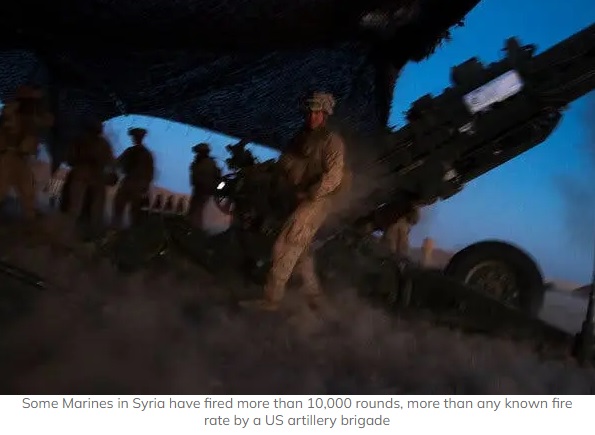 Paradoxically, the point of sending artillery batteries to Syria was to avoid American casualties. American military planners knew they needed to confront the Islamic State, but they also knew the American public was tired of protracted wars in the Middle East. The American artillery fired a lot, but there were hardly any American boots on the ground. A battery with four howitzers and about 100 soldiers could conduct heavy fire day and night, in any weather. "The people who are fighting this war have made a choice, " said Lt. Col. Jonathan O'Gorman , the Marine officer who directed artillery operations during the offensive, " and choices have consequences." Soldiers from Alpha Battery set up their big guns in March 2017 on a dirt field in Syria within sight of the enemy-held city of Raqqa and opened fire almost immediately. During the next two months, they rarely stopped firing. 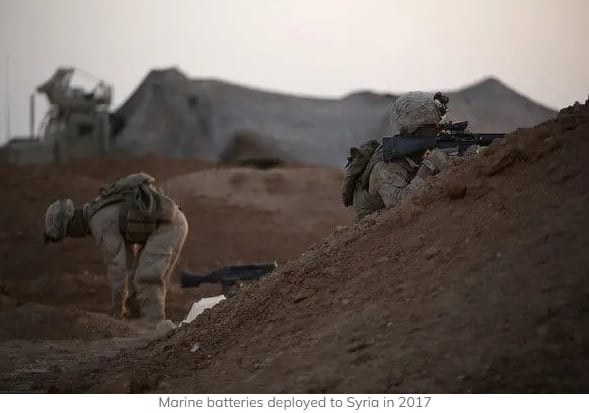 Day and night, they fired from the most modern guns - howitzers M777A2. Gun crews, as before, worked at arm's length from the barrel and fired by pulling a simple cord. The explosion was several times louder than a jet plane taking off and sent a shock wave that hit the crew like a blow to the chest. His ears rang, his bones trembled, his vision blurred, his eyeballs shrunk for a moment, and a wave ran through every neuron in his brain like a whiplash. "You feel it with your eyes, you feel it with your teeth ," said Carson Brown , a corporal from Idaho who pulled the trigger for hundreds of shots. "It's like taking a year off your life." Continuous fire was maintained by a small, top-secret group of the Army's Delta forces called Task Force 9. President Donald Trump has given the task force broad authority to use heavy firepower, and the task force has used it with wild enthusiasm, often breaking the rules and striking not only enemy positions but also mosques, schools, dams and power plants. Sometimes, according to the gunners, the task force ordered them to fire on the grid without aiming at any specific target, but simply throwing shells in the direction of Raqqa to keep the enemy in suspense. The demands of the 9th Task Force led to an intensity of artillery fire not seen in generations. During Operation Desert Storm in 1991, artillery crews fired an average of 70 rounds over the entire six-week campaign, said John Grenier , a historian at the US Army Field Artillery School. During the first months of the 2003 invasion of Iraq, aircrews fired an average of 260 rounds. In Syria, each gun of the "Alpha" battery fired more than 1,100 rounds in two months. Some of the guns of the Fox battery, which replaced the Alpha, fired about 10,000 rounds each. "It's shocking, it's crazy," Mr. Grenier said. 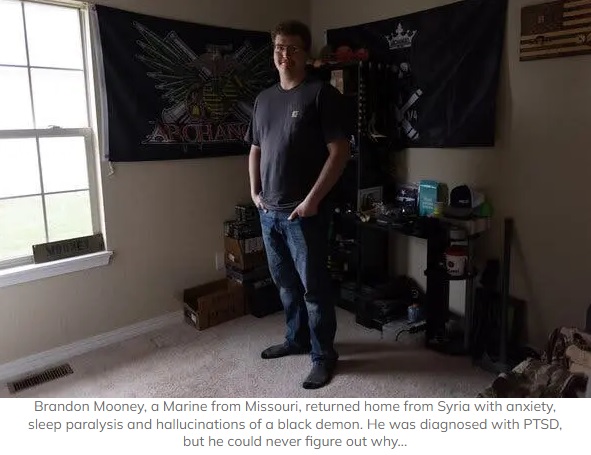 The Marines woke up hungover and staggered to their weapons like zombies. Their sense of taste was changing. Some felt nauseous. Crews became irritable, fights broke out. The symptoms were clear signs of a concussion, but also what anyone might experience after a series of grueling 20-hour days in the desert, sleeping in trenches and eating rations out of plastic bags. Medics came every day to check on the gunners, but never intervened. A 20-year-old Marine from Missouri named Brandon Mooney was servicing his pistol when he began to realize that he could no longer figure out how to put the parts back together. "It got to the point where you knew the shooting was affecting you, but what could you do? Reject the assignment?" - he said in one of the interviews. When he returned home, an examination showed that he was fine, but he was plagued by anxiety, sleep paralysis, and hallucinations of a black demon standing over his bed. After he left the Marines, he became depressed and suicidal. He turned to the veterans hospital for help. Although he never experienced anything particularly traumatic in Syria, his nightmares and anxiety have been diagnosed as post-traumatic stress disorder. "But from what?" - he asked in an interview. "I could never understand it." Misunderstood injuries In the spring of 2017, two months after returning home from Iraq, where he had fired thousands of rounds, Sergeant First Class Tyler Chatfield went missing in Kentucky. He was the senior soldier of Charlie Battery, 1st Battalion, 320th Field Artillery Regiment. The battery fired a staggering number of rounds at the Islamic State before returning to Fort Campbell, Cyprus, in February 2017, just as the Marines deployed. At Fort Campbell, the soldiers struggled to sleep, haunted by acute anxiety that sometimes turned into panic. All were checked for post-traumatic syndrome and brain injury. The tests did not show anything unusual. Iraq was Sergeant Chatfield's third rotation, and his wife knew coming home could be tough, but this time it was okay. He was relaxed, loving, interested. He coached the kids' baseball team and built a chicken coop in the backyard. One morning he was at the gym and his heart started pounding like a rabbit's. Cold sweat poured down his neck and he began to feel nauseous. He was sure he was having a heart attack. He was 26 years old. His wife took him to the hospital, but apart from a small inflammation, the cardiologists found nothing wrong. He returned home and a few days later had another attack. The doctor assumed that it could be anxiety and prescribed him a sedative - "Xanax". 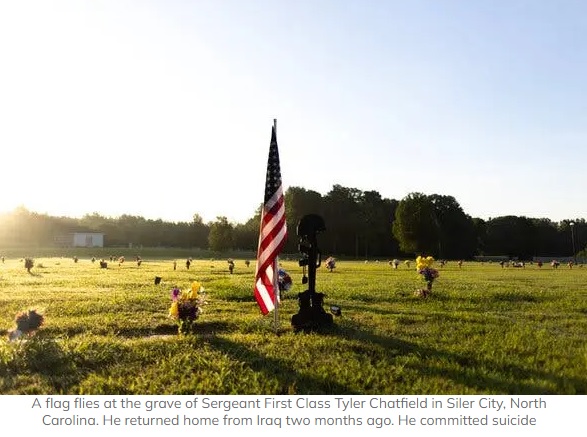 Traumatic brain injuries can have profound effects on parts of the body far away from the skull, as the damage can cause disruption of communication with other organs. Dozens of young veterans interviewed by The Times said they now have increased, irregular heartbeats and constant digestive problems. According to his wife, Sergeant Chatfield did not even think to tell the doctors about the explosions he experienced. And the doctors didn't ask. The next few days were uneventful for the sergeant. He took pills and rested. Roasted marshmallows in the backyard with the boys. And then he was gone. He was not in bed when his wife woke up on Thursday morning after the attack. He was not at work either. The army and the local police went in search of him. The wife was sure he would show up to coach his sons in the afternoon baseball game. But he was not there. By the end of the game, she felt so uneasy that she asked another soldier to walk her home. The soldier entered the house first and left a few minutes later, shaking his head. He found Sergeant Chatfield's body in the garage. The sergeant committed suicide. He left a brief farewell message, but said nothing to shed light on his decision. The Army conducted an investigation but found nothing that his wife, Janai Chatfield, said could explain it. "None of it made any sense ," she said in an interview. " I don't know why it happened. I don't know why it happened. And I don't think I ever will." 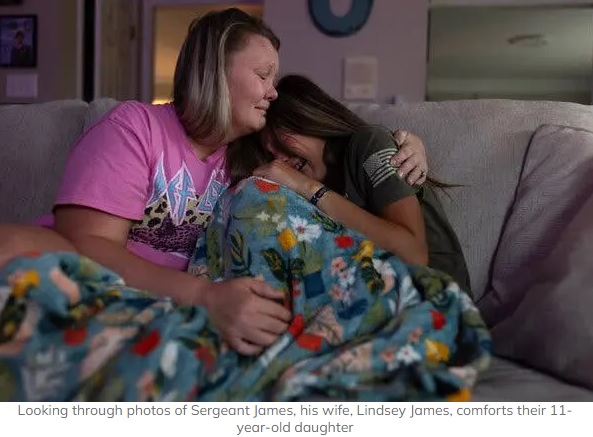 All four artillery batteries investigated by The Times had at least one case of suicide - a striking pattern, as death by suicide is rare even in high-risk groups. In some batteries there were several of them, and many servicemen said in interviews that they tried to commit suicide. Sergeant Chatfield's friend, Senior Sergeant Joshua James , went from a carefree young father to an alcoholic who suffered from anxiety and headaches. He seemed to get worse every year. In 2021, an MRI revealed an abnormality deep in his brain, but doctors said they didn't know what caused it or what could be done. In November 2022, he was traveling with his family when he had an argument with his wife. Without warning, he shot himself in the driveway of a fast food restaurant. "A man who went to serve never came back," Lindsay James , the sergeant's wife, said in an interview at her home in Tennessee. "He was a different person. He never understood what happened to him. I don't think the army did either." Damage at the nano-level Over the past decade, the Department of Defense has spent more than a billion dollars on brain injury research, but still knows very little about what might have happened to artillery shells. Almost all research has focused on large explosions from bombs and other enemy attacks, rather than blast waves from routine artillery fire. As these studies progressed and tried to determine the threshold at which an explosion causes brain damage, more and more data showed that this level was much lower than expected - so low that it was not much different from what the soldiers experienced , when they pulled the cord on the artillery gun. In 2016, when US troops in Iraq and Syria were subjected to repeated artillery fire, a research team did something similar with laboratory mice at the University of Missouri. In a series of tests, the team placed mice a few feet away from a piece of C4 explosives that was designed to detonate just above the official safety level set by the military. After the explosion, the mice were returned to their cages and began to run around, seemingly unaffected. "We were very disappointed - we didn't see anything abnormal," said Dr. Zezong Gu , who led the study. 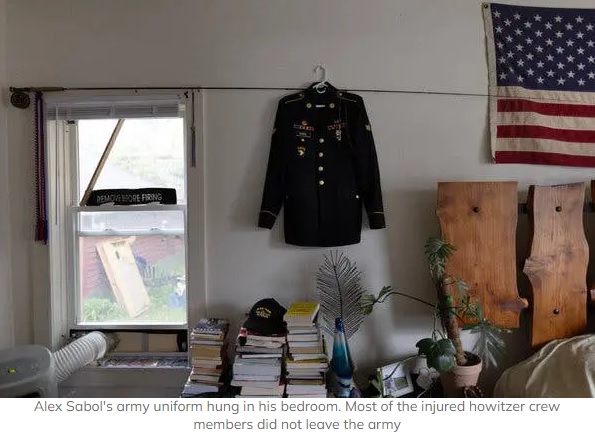 The picture changed over the next few days. The mice built nests instinctively, and the researchers used the quality of their nests as a criterion. Blown-up mice built only dilapidated nests, often leaving them unfinished. In subsequent experiments, the affected mice were guided through mazes. They made more wrong turns than healthy mice, and sometimes froze, refusing to go any further through the mazes at all. The team then dissected the animals' brains. At first they found almost no damage. "Everything looked good until we looked at the nanoscale ," says Dr. Gu . Under the electron microscope, the desolate neuronal landscape came into focus. Myelin sheaths, vital for insulating the brain's biological wiring, hung in flaps. In key parts of the brain that control emotion and motor functions, large numbers of mitochondria -- the tiny powerhouses that provide energy to every cell -- were dead. "It was impressive - the damage was very widespread, " said Dr. Gu. "And that's just from one explosion." Of course, the brains of mice and humans are very different. Dr. Scott Kota , a Navy captain and brain injury expert, said it was unclear whether the same damage would occur in the human brain. According to him, researchers cannot subject people to devastating explosions and then dissect them in the same way as mice. In addition, there are still no methods for detecting microscopic injuries in the living brain. "It's very difficult to study, " said Dr. Kota. "And unfortunately, at the moment, we can only do it post-mortem." Scared to death Artillery gun crews provide a rare and valuable chance to understand how explosions affect the brain. But it is not known whether anyone who could learn from them knows of the existence of this unique group of combat veterans. Most of the crew members have retired from the army and have moved to different parts of the country, where they continue to quietly struggle with headaches, depression and an inexplicable confusion for them. The two soldiers, working side by side on the same gun under the command of Sergeants James and Chatfield, were never able to find stability, even after years. Andrew Johnson , a tall, strong gunner who had stood directly behind the gun for thousands of rounds, came home and spoke with a noticeable delay, as if on a bad telephone line. He saw flashes of light that he could not explain. He became suspicious of his colleagues and remained isolated in his room. A year after returning home, he tried to overdose on sleeping pills. "I don't even remember what I was dealing with," Johnson said in an interview. "I didn't drink, I didn't smoke. I had a girlfriend. But I just couldn't function. I had a deep sense of loneliness." 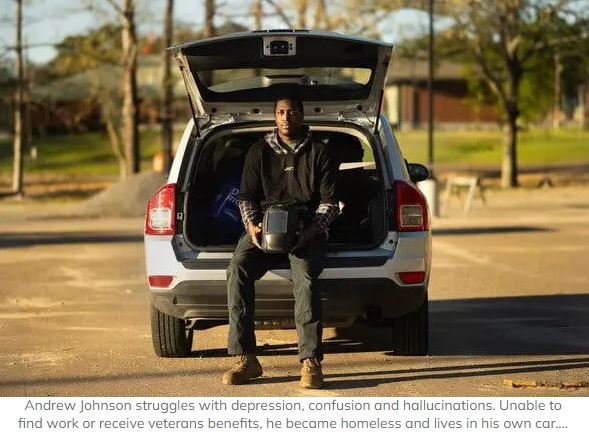 The army began treating him for depression and gave him pills for nightmares. He was transferred to a new unit, where nothing was known about the fact that he was injured in an explosion in Iraq. He developed a reputation for being unstable and was reprimanded for saying inappropriate things to other soldiers and pushing an orderly. Last year, the Army forced him to resign for misconduct. He took various jobs, but lost them. Twice he tried to enter the school, but failed. He sought help at a veterans hospital, but was turned away because his demobilization prevented him from receiving care there. Now he is homeless and sleeping in his car. Recently, he said, he tried to commit suicide again. Earlier this year, he started seeing things. The shadows cast by the street lamps seemed to crawl. First there were fleeting flickers of movement at the edge of his vision. Then came full blown hallucinations of creatures moving through the darkness. "Now they're very close, at arm's length, and very real," he said in a phone call from his car one night. "Honestly, I can see them right now and it scares me." Alex Sabol loaded shells next to Johnson in Iraq. He had many advantages that Johnson never had. He was honorably demobilized and received a monthly veteran's pension. His family pays for the services of a private psychotherapist. Despite this, it is not easy for him. 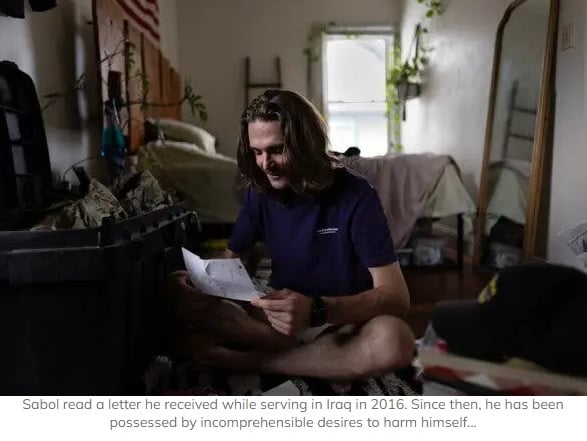 After serving in the army, he felt that his temper had become wild. In the army, he was diagnosed with anxiety, depression, attention deficit disorder and post-traumatic stress disorder. "My friends, my family, I don't think they understood why I couldn't help myself," he said in an interview. He is currently studying in college. He tries to eat well and do sports. On a spring morning, a pair of climbing boots hangs on the door of the light-filled cabin where he lives in the Appalachian mountains. But he has terrible mood swings. Last year he started beating himself up. In the fall, he found himself in tears in the kitchen, in a push-up position, hovering over a knife, not understanding why he had an irresistible urge to stick it in his heart. And this spring he tried to hang himself. His girlfriend saved him. She has since moved away from him. "I'm scared to death," he said in an interview in his hut. "I don't want to die. And I don't understand why I end up in these horrible places."
__________________ 💜🧿See Human | Be Human🧿💜 (War Section Hashtags) |
|
#132
●
11-05-2023, 08:33 PM
| ||||||||
 My Rank: MASTER GUNNERY SERGEANT Poster Rank:370 Join Date: Feb 2010 Posts: 3,202 Mentioned: 4 Post(s) Quoted: 553 Post(s)
| ||||||||
|
Re: Whiskey's Briefing Room III
A very good insight of his commitment & his overall understanding what's at stake.  Slava Ukraini ! |
|
#133
●
11-05-2023, 09:37 PM
| ||||||||
 My Rank: MASTER SERGEANT Poster Rank:500 Join Date: Dec 2014 Posts: 2,071 Mentioned: 1 Post(s) Quoted: 614 Post(s)
| ||||||||
|
Re: Whiskey's Briefing Room III
Wonder Mom: your comments really speak to me. My two older brothers served in Vietnam, and both came home screwed in the head beyond belief. One never held a job again and died several years ago. THe other earned a computer science Masters, and Medical School, and became a very rich doctor now retired. But totally fucked up in the head, to this day. He wisely became a radiologist who never ever had to speak to a patient in his entire professional practice for over 30 years. Ya, the middle east wars have done horrible things to an entire generation of our young people. And now, with Gaza, all those millions of people and soldiers will hate and distrust each other the rest of their lives. |
|
#134
●
11-05-2023, 09:57 PM
| ||||||||
 My Rank: FIRST SERGEANT Poster Rank:469 Join Date: Apr 2013 Posts: 2,290 Mentioned: 1 Post(s) Quoted: 572 Post(s)
| ||||||||
|
Re: Whiskey's Briefing Room III
This reminds me of Iraq in 2020 when Iran staged a revenge hit for Qassem Soleimani on the US base. The base was pounded by missiles but though no one died or was hit, most of the troops there suffered from debilitating injuries due to the shockwaves caused by the exploding ordnance.
|
|
#135
●
11-05-2023, 10:23 PM
| ||||||||
| My Rank: STAFF SERGEANT Poster Rank:919 Join Date: Apr 2010 Posts: 793 Mentioned: 1 Post(s) Quoted: 255 Post(s)
| ||||||||
|
Re: Whiskey's Briefing Room III
He wasn’t a doctor if he never spoke to a patient bro I don’t like when people say they’re doctors when they are not |
|
#137
●
11-06-2023, 05:10 AM
| ||||||||
 ✝Mudderator from Hell✝ Poster Rank:11 e-mail Join Date: Oct 2006 Posts: 95,411
Contributions: 817
Mentioned: 473 Post(s) Quoted: 10155 Post(s)
| ||||||||
|
Re: Whiskey's Briefing Room III
A radiologist is a medical doctor (MD) who specializes in diagnosing and treating conditions using imaging equipment. New Tool May Help Spot ‘Invisible’ Brain Damage. https://nyulangone.org/news/new-tool...llege-athletes I personally know a few combat vets that suffer from PTSD and they're on medication and function 50/50 depending on the day. One, non combat vet, but with a childhood trauma started seeing monks with hooded faces standing at his bed almost every night when he turned 33. He now is on meds, grew 90 pounds, and recently moved to a group facility where he has an own room and can get medical help 24/7 when he wants to. He once owned a house, had a regular job and gf and was real good in MMA. He often tells me he lives in a dark underground world that can't be explained properly. Recently he's doing much better and even travels to other cities with a friend and even in the process of getting his driver's license back all due to a new therapy incl. MDMA. https://neurosciencenews.com/ptsd-psychedelics-23614/ |
|
#138
●
11-06-2023, 07:12 PM
| ||||||||
| My Rank: MASTER GUNNERY SERGEANT Poster Rank:370 Join Date: Feb 2010 Posts: 3,202 Mentioned: 4 Post(s) Quoted: 553 Post(s)
| ||||||||
|
Re: Whiskey's Briefing Room III
Well, that's a creepy statement ! Also, who the fuck needed your approval. Not a doctor, lol, better to STFU when you have no idea what you're talking about. |
|
#139
●
11-06-2023, 08:00 PM
| ||||||||
| ☾ Administrator ☽ Poster Rank:76 ஜᎻᎬᎩᎾᏦᎪஜ Join Date: Dec 2011 Posts: 19,650
Contributions: 32
Mentioned: 180 Post(s) Quoted: 6920 Post(s)
| ||||||||
|
Re: Whiskey's Briefing Room III
Wondering when a good time would be to make a general "World War III" mega thread.  "US continues to ramp up it's military stocks & equipment on the Eastern Bank of the Euphrates river amid speculation of Iranian Militants planning to storm the Euphrates river in order to displace the SDF from it's positions."  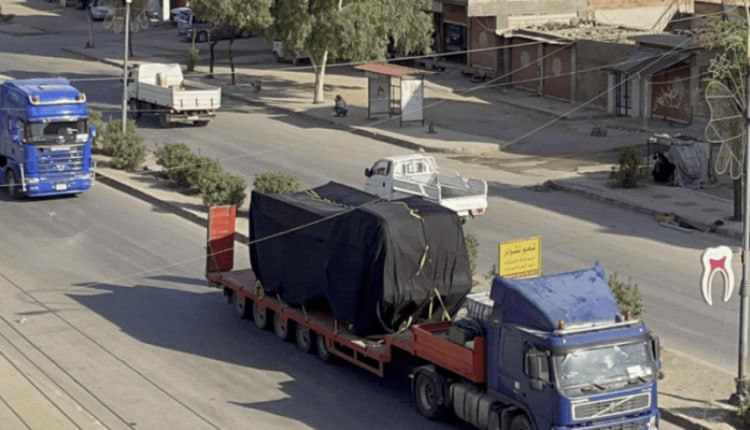 VIDEO: "US coalition troops on patrol in Al-Shheell on the Eastern bank of the Euphrates River, Syria."
__________________ 💜🧿See Human | Be Human🧿💜 (War Section Hashtags) |
|
#140
●
11-06-2023, 08:13 PM
| ||||||||
| ☾ Administrator ☽ Poster Rank:76 ஜᎻᎬᎩᎾᏦᎪஜ Join Date: Dec 2011 Posts: 19,650
Contributions: 32
Mentioned: 180 Post(s) Quoted: 6920 Post(s)
| ||||||||
|
Re: Whiskey's Briefing Room III
"Iran claimed that they have arrested 3 Mossad agents in the Iran-Afghanistan border. They will be transported to Tehran soon"  "Visuals from earlier showing Blinkin arriving at the Baghdad International Airport wearing a Bulletproof jacket." 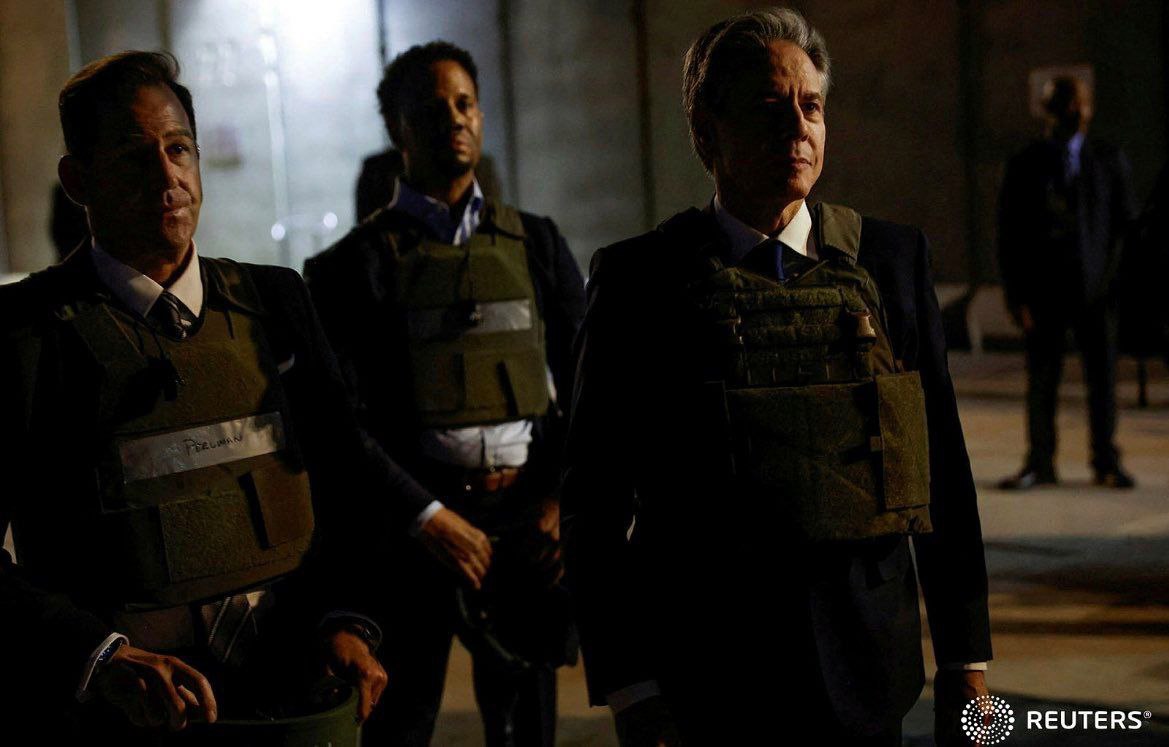 "Another picture showing Blinkin taking a Helicopter to go meet the Iraqi PM" 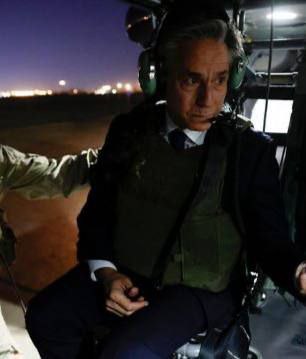 1. " US Secretary of State Blinkin spotted wearing a Bulletproof jacket as he arrived in Baghdad, Iraq." 2. "Visuals from Tahrir square in Baghdad as Sadr supporters continue to gather after Blinkin's visit."
__________________ 💜🧿See Human | Be Human🧿💜 (War Section Hashtags) |