Operation Eagle Claw (or Operation Evening Light or Operation Rice Bowl) was an American military operation ordered by U.S. President Jimmy Carter to attempt to end the Iran hostage crisis by rescuing 52 Americans held captive at the U.S. Embassy in Tehran, Iran on April 24, 1980. Its failure, and the humiliating public debacle that ensued, damaged American prestige worldwide and is believed by many, including Carter himself, to have played a major role in his defeat in the 1980 U.S. presidential election.
The plan called for a minimum of six helicopters; eight were sent in. Two of the aircraft couldn't navigate through a very fine sand cloud (a haboob) which forced one to crash land and the other to return to the aircraft carrier USS Nimitz (CVN-68). Six aircraft reached the initial rendezvous point, Desert One, but one of them had damaged its hydraulic systems. The spares were on one of the two aircraft that had aborted. From the early planning stages, it had been determined that if fewer than six operational helicopters were available, then the mission would be automatically aborted, even though only four were absolutely necessary for the operation. In a move still debated, the commanders on the scene requested to abort the mission; Carter gave his approval.
As the U.S. force prepared to leave Iran, one of the helicopters crashed into a C-130 Hercules transport aircraft containing fuel and a group of servicemen. The resulting fire destroyed the two aircraft involved and resulted in the remaining helicopters being left behind and the deaths of eight American servicemen. Operation Eagle Claw was one of Delta Force's first missions.
Fuel consumption calculations showed that the extra 90 minutes idling on the ground had made fuel critical for one of the EC-130s. When it became clear that only six helicopters would arrive at Desert One, Kyle had authorized the EC-130s to transfer 1,000 U.S. gallons from the bladders to their own main fuel tanks, but Republic 4 had already expended all of its bladder fuel refueling three of the helicopters and had none to transfer. To make it to the tanker refueling track without running out of fuel, it had to leave immediately, and was already loaded with part of the Delta team. In addition, RH-53 Bluebeard 4 needed additional fuel, requiring it be moved to the opposite side of the road.
To accomplish both actions, Sea Stallion Bluebeard 3 had to be moved from directly behind the EC-130. The aircraft couldn't be moved by ground taxi, and had to be moved by "air taxi" (flying a short distance at low speed and altitude). A U.S.A.F. CCT marshaller attempted to direct the maneuver from in front of the aircraft, but was blasted by desert sand churned up by the rotor. As the marshaller attempted to back away, Bluebeard 3's pilot perceived he was drifting backward (engulfed in a dust cloud, the pilot only had the CCT marshaller as a point of reference) and thus attempted to "correct" this situation by applying forward stick in order to maintain the same distance from the rearward moving marshaller. The RH-53 struck the EC-130's vertical stabilizer with its main rotor and crashed into the EC-130's wing root.
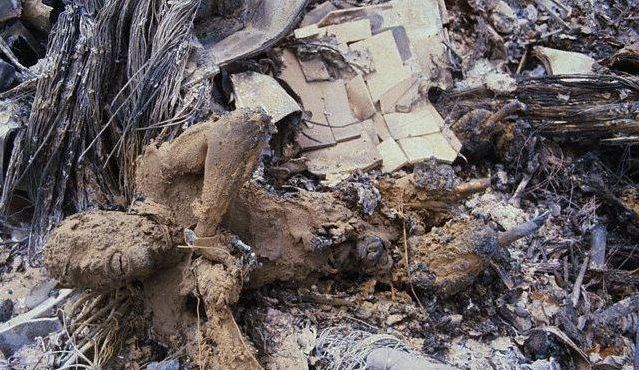
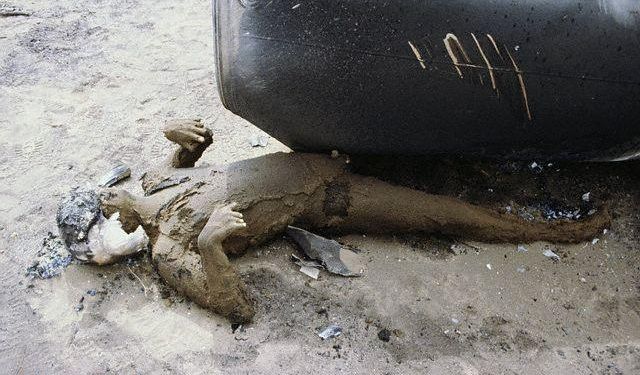
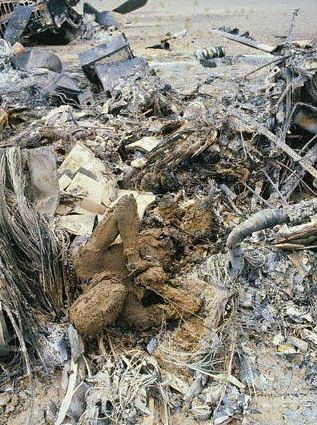
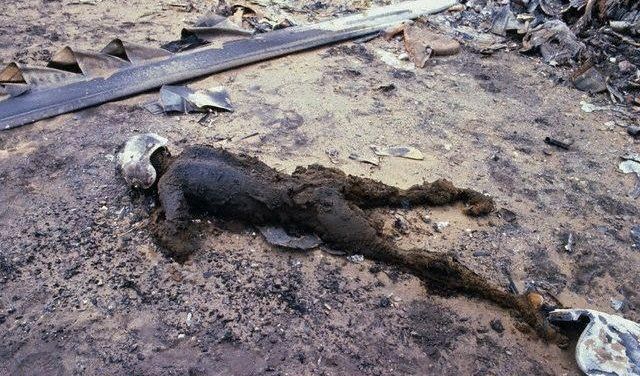
A-7Es aboard Coral Sea with special identification stripes.In the ensuing explosion and fire, eight servicemen died: five U.S.A.F. aircrew in the C-130, and three U.S.M.C. aircrew in the RH-53, with only the helicopter pilot and co-pilot (both badly burned) surviving. During the following frantic evacuation by the C-130s, the helicopter crews attempted to retrieve their classified mission documents and destroy the aircraft. The helicopter crews boarded the C-130s. Five RH-53 aircraft were left behind mostly intact, some damaged by shrapnel. The Iranians gained at least four of them.
The C-130s carried the remaining forces back to the intermediate airfield at Masirah Island, where two C-141 medical evacuation aircraft from the Night Two staging base at Wadi Abu Shihat, Egypt (referred to as Wadi Kena by the U.S. forces due to its location near Qena)
26°33′18″N 33°07′58″E picked up the injured personnel, helicopter crews, Rangers and Delta Force members, and returned to Wadi Kena. The injured were then transported to Ramstein Air Base in Germany. The Tehran CIA team left Iran, unaware of their compromised presence.
<object width="420" height="315"><param name="movie" value="http://www.youtube.com/v/dqzcLfihUN0?hl=it_IT&version=3&rel=0"></param><param name="allowFullScreen" value="true"></param><param name="allowscriptaccess" value="always"></param><embed src="http://www.youtube.com/v/dqzcLfihUN0?hl=it_IT&version=3&rel=0" type="application/x-shockwave-flash" width="420" height="315" allowscriptaccess="always" allowfullscreen="true"></embed></object>
<object width="420" height="315"><param name="movie" value="http://www.youtube.com/v/x4CitP34y6o?version=3&hl=it_IT&rel=0"></param><param name="allowFullScreen" value="true"></param><param name="allowscriptaccess" value="always"></param><embed src="http://www.youtube.com/v/x4CitP34y6o?version=3&hl=it_IT&rel=0" type="application/x-shockwave-flash" width="420" height="315" allowscriptaccess="always" allowfullscreen="true"></embed></object>