|
#1
●
06-08-2010, 04:34 AM
| ||||||||
 TROLLBEGONE!!!!! Poster Rank:20 female Join Date: Feb 2009 Posts: 59,620 Mentioned: 70 Post(s) Quoted: 10860 Post(s)
| ||||||||
|
WWII Museum at New Orleans
http://www.ddaymuseum.org/ Check out this website, and if you ever get down this way, be sure to check out the museum.  Returned to New Orleans in april 2007 Completed in December 1943, PT-305 saw action in the Mediterranean. One of the few PT boats to be returned to the United States at the end of the war, PT-305 eventually returns to new Orleans for inclusion in The National WWII Museum.  The Museum purchased its C-47 from a private owner in Hondo, Texas, with funds donated by Lulu and Paul Hilliard of Lafayette, Louisiana. The C-47 carried up to 6,000 pounds of cargo. It could easily handle an assembled jeep or a 37mm cannon. As the troop transport it carried 38 Marines, soldiers or sailors in full combat gear. As a medical airlift airplane it accommodated 14 stretchers and three nurses. Our C-47 “096” was present at major airborne missions including D-Day Normandy and Operations Market Garden and Varsity. The airplane was restored to its operable condition and made a voyage to Lafayette, then to the New Orleans Lakefront Airport. We took its wings off and prepared it to be driven to its permanent home at the Museum, where it was reassembled and suspended in the Louisiana Memorial Pavilion, where it remains today.  The Normandy invasion – June 6, 1944 – was one of the most-photographed events of the Second World War. In terms of the volume of motion picture footage and still photographs, few battles have received such extensive coverage. The invasion was filmed and photographed by official photographers from the US Army, US Navy and the US Coast Guard as well as hundreds of individuals who used their personal cameras to capture images of the most complex military operation in history. Snapshots of D-Day: Photographs of the Normandy Invasion is a special photographic exhibit featuring over 70 of the famous and not-so-famous photographs of the D-Day invasion. In addition for this special presentation of the exhibit the Museum has included a number of exciting artifacts seldom exhibited which complement the photographs. Snapshots of D-Day features images from the preparations for D-Day, combat before and after June 6 and the aftermath of the battle. Selected from American, British, Canadian and German sources, the photos show different sides of the struggle for Normandy. They capture the full range of human experiences of war: from training, to combat to R&R. From exhilaration, to fear and grief, Snapshots of D-Day shows the raw emotions stimulated by and expressed in armed conflict. In addition to official government photographs, Snapshots of D-Day also features images of and from individuals who participated in the invasion. In this section of the exhibit, you will see photos taken by combat photographer Reuben Weiner at places like St. Marcouf and La Fiére. You will also see photos of Franz Gockel, a German soldier who operated a machine gun during the early hours of the battle for Omaha Beach. There will also be images of William and Tony Hitztaler – brothers who experienced combat for the first time at Normandy. One survived and the other was the victim of an unspeakable atrocity. In addition, the exhibit features images of famous generals and field marshals who directed the battle. Photos of well-known leaders such as Eisenhower, Montgomery, Rommel, Roosevelt and Gavin hang alongside images of the countless unidentified soldiers they led. Capturing some of the most dramatic moments of the Normandy battle, Snapshots of D-Day provides an all new look at the invasion that changed the course of the war in Europe.  Sherman Tank 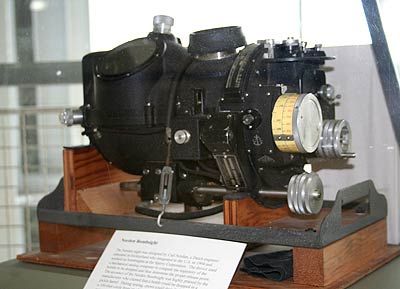 The Norden Bombsight was designed by Carl Norden, a Dutch engineer educated in Switzerland who emigrated to the U.S. in 1904 and worked on bombsights at the Sperry Corporation. Norden’s device used a mechanical analog computer to calculate the trajectory of a bomb and thus determined its proper release point. Its accuracy was highly praised by the manufacturer, who claimed one could drop a bomb into a pickle barrel with it. During testing, crews could hit targets within one hundred feet from an altitude of 20,000 feet. In practice, such accuracy was difficult to achieve under anti-aircraft fire and adverse weather conditions. Additionally, many bombardiers simply released their bombs when the lead aircraft released. Nevertheless, the Norden Bombsight played a critical role in the strategic bombing campaign of World War II and continued to be used through the Korean and Vietnam Wars. Gift in memory of John Kushner, supported in part by his friends and colleagues in the real estate business; The National WWII Museum Inc. check out the website for much much more. Get down to the museum and feel it! |
|
#2
●
06-08-2010, 04:59 AM
| ||||||||
 goinggoingGONE Poster Rank:32 I am a man yes I am and tell ya so Join Date: May 2009 Posts: 46,451 Mentioned: 65 Post(s) Quoted: 6610 Post(s)
| ||||||||
|
Re: WWII Museum at New Orleans
Looks really interesting and too bad never get to check it out. As new Orleans would be a place I would love to see. As well as this museum and rather intriguing to say the least. Good post.
|
|
#5
●
06-11-2010, 02:22 AM
| ||||||||
| So Fucking Banned Poster Rank:1455 Manley Man Join Date: Apr 2010 Posts: 400 Mentioned: 0 Post(s) Quoted: 71 Post(s)
| ||||||||
|
Re: WWII Museum at New Orleans
Hey PinkPanties, I'm on the Higgins team restoring the PT Boat. We have a long way to go. I'll post pics as the progression moves along.
|