|
#1
●
07-03-2013, 02:50 PM
| ||||||||
 My Rank: MASTER SERGEANT Poster Rank:424 Join Date: Jun 2011 Posts: 2,775
Contributions: 3
Mentioned: 13 Post(s) Quoted: 471 Post(s)
| ||||||||
|
Whales Flee from Military Sonar Leading to Mass Strandings, Research Shows
Studies are missing link in puzzle that has connected naval exercises to unusual mass strandings of whales and dolphins whales flee from the loud military sonar used by navies to hunt submarines, new research has proven for the first time. The studies provide a missing link in the puzzle that has connected naval exercises around the world to unusual mass strandings of whales and dolphins. Beaked whales, the most common casualty of the strandings, were shown to be highly sensitive to sonar. But the research also revealed unexpectedly that blue whales, the largest animals on Earth and whose population has plummeted by 95% in the last century, also abandoned feeding and swam rapidly away from sonar noise. The strong response observed in the beaked whales occurred at noise levels well below those allowed for US navy exercises. "This result has to be taken into consideration by regulators and those planning naval exercises," said Stacy DeRuiter, at the University of St Andrews in Scotland, who led one of the teams. "For whales and dolphins, listening is as important as seeing is for humans – they communicate, locate food, and navigate using sound," said Sarah Dolman, at charity Whale and Dolphin Conservation. "Noise pollution threatens vulnerable populations, driving them away from areas important to their survival, and at worst injuring or even causing the deaths of some whales and dolphins." Dolman said there were no accepted international standards regarding noise pollution and there was an urgent need to re-evaluate the environmental impacts of military activities. The US Navy part-funded the new studies but said the findings only showed behavioural responses to sonar, not actual harm. Nonetheless, Kenneth Hess, a US Navy spokesman, said permit conditions for naval exercises were reviewed annually and added: "We will evaluate the effectiveness of our marine mammal protective measures in light of new research findings." Unusual mass strandings, where multiple species of whale and dolphin beach at several locations at once, have soared since the introduction of military sonar in the 1950s and can be fatal. The strandings occur every year and major recent events saw up to 15 animals beached in the Canary Islands, the Bahamas and Greece. In May, the naval activity was found to be the most probable cause of the deaths of at least 26 short-beaked common dolphins in Falmouth Bay, Cornwall in June 2008. Beaked whales are the most common species affected by unusual mass strandings, perhaps because their shy nature makes them more easily scared by noises that they may interpret as killer whale sounds. Researchers used suction cups to attach digital devices to Cuvier's beaked whales off the coast of Southern California to measure the noise they were exposed to and their response. When a simulated military sonar signal was sounded at 200dB and between 3km and 10km away, the whales initially stopped feeding and swimming. They then swam rapidly away from the noise and some performed unusually deep and long dives. "The missing piece of the puzzle was how whales changed their behaviour and how that led to mass strandings," said DeRuiter. She added that they also stopped feeding for 6-7 hours, which is unusual. "If they miss out on food, they will be less healthy," she said, noting that where populations have been measured, numbers of Cuvier's beaked whales are declining. A second study, also off Southern California, estimated that a blue whale spooked by the sonar missed out on over a tonne of krill, about a day's worth of food. "Blue whales rely on large aggregations of dense krill to sustain their extreme body size, so they continuously dive and feed throughout the day when high-density prey patches are present," said Jeremy Goldbogen, at Cascadia Research, a non-profit US research organisation in Olympia, Washington. "Because of this, we suggest that sonar-induced disruption of feeding could have significant and previously undocumented impacts on individual baleen whale fitness and the health of their populations." A spokesman for the UK's Royal Navy said: "The Royal Navy already limits its use of sonar around whales. We are committed to taking all reasonable and practical measures to protect the environment and mitigate effects on marine mammals. This new research will be taken into account in the regular review of MoD active sonar mitigation procedures." http://www.guardian.co.uk/environmen...nar-strandings 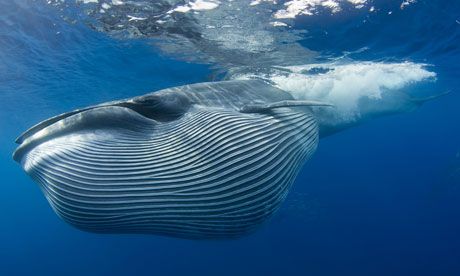 · |
|
#3
●
07-03-2013, 03:05 PM
| ||||||||
 ✝Mudderator from Hell✝ Poster Rank:10 e-mail Join Date: Oct 2006 Posts: 96,365
Contributions: 817
Mentioned: 476 Post(s) Quoted: 10316 Post(s)
| ||||||||
|
Re: Whales Flee from Military Sonar Leading to Mass Strandings, Research Shows
weird they studied it now as it's been at least 15 years they knew all this. http://www.nrdc.org/wildlife/marine/...tingwhales.asp |