|
#1
●
11-09-2026, 05:15 AM
|
 My Rank: FIRST SERGEANT Poster Rank:452 Join Date: Apr 2013 Posts: 2,532
Contributions: 2
2,532Posts 8,185Thanked 606Quoted 1Mentioned 2Contrib. |
|
A Walrus Calf Was Left for Dead. Then Came an Intern and a Biologist.
https://www.nytimes.com/2026/11/08/u...ka-rescue.html A Walrus Calf Was Left for Dead. Then Came an Intern and a Biologist. An injured five-month-old walrus was found huddled next to carcasses in remote Alaska after it became separated from its mother. Its rescue took days and lots of patience. The sun was glinting off the waves on a beach in Alaska when Violet Anniskett saw what she thought were four dead walruses on the sand. Then Anniskett, 19, stepped closer to the pile of blubber and saw one body, smaller than the rest. Its stomach was heaving. Suddenly, the walrus’s eyes opened. Anniskett gasped. “I was in shock,” she said. The calf’s mother was nowhere in sight. The 5-month-old baby walrus, a male, would later be named Annautaq, after Anniskett’s father, who, like her, is Inupiat, a member of a group of northern Indigenous people. Annautaq’s rescuers cared for him for four days near Point Lay in northern Alaska, near the Chukchi Sea. Annautaq eventually was transported to SeaWorld in Orlando, Florida, making him a rare success story of humans rescuing a baby walrus, without its mother, from a perilous fate. When Anniskett spotted the calf on Sept. 11, polar bear prints surrounded Annautaq and seagulls flew overhead, ready to perhaps eat chunks of his exposed flesh, she said. “He was so still, that’s why he was very smart,” Anniskett said. “I think that’s how the bears didn’t really go to him.” Anniskett called out to Anthony Fischbach, a wildlife biologist with the U.S. Geological Survey, whom she was shadowing during her internship. Annautaq rubbed his head on one of the carcasses as Anniskett and Fischbach devised a rescue plan. Annautaq, at 185 pounds, weighed at least as much as Fischbach, meaning that Anniskett and Fischbach could not simply lift him and his slippery body to safety. So, they gently touched Annautaq on his back to guide him away from the pile. Anniskett began making walrus sounds to ease his fears. Annautaq was found in an area where female walruses come to shore with their young every year, Fischbach said. The other three walruses could have been killed in a stampede, or by polar bears. Their causes of death were not immediately known, he said. Annautaq had likely never seen humans or touched grass after he was born around May. But he followed Anniskett and Fischbach. “It just felt like a connection,” Anniskett said. “Like he knew we weren’t going to hurt him. “I had to gain his trust as much as he had to gain mine,” she added. Anniskett and Fischbach eventually found shelter in an abandoned building. By this time, Fischbach had alerted the Alaska SeaLife Center that a walrus calf needed help. The center is the only permanent facility in the state that responds to injured marine mammals. Annautaq became only the 12th calf to be successfully rescued in the center’s 30-year history, said a spokesperson, Kaiti Grant. For Anniskett and Fischbach, their quest to keep Annautaq alive was just beginning. It would be about three days before veterinarians with the Alaska SeaLife Center would arrive. A storm was brewing, Fischbach said, making for extremely difficult flying conditions. Walrus calves like Annautaq survive purely on their mother’s milk. Lacking walrus formula, Anniskett and Fischbach fed Annautaq honey mixed with water. He became extremely playful, she said. For instance, when Fischbach began assembling his cot, Annautaq wanted it. Three times, Annautaq chased off Fischbach, who finally gave up. But Annautaq still was not happy. Fischbach unrolled a sleeping bag. He settled in and closed his eyes. But then he felt something on his shoulder. He opened his eyes and found Annautaq above him, shivering. The walrus climbed inside the sleeping bag, and he and Fischbach slept together that night. In the meantime, the Alaska SeaLife Center was trying multiple ways to find a flight. One company quoted $100,000 for the trip, which was beyond the center’s budget, said Jane Belovarac, a wildlife response curator with the organization. The center eventually chartered a plane. Belovarac and another veterinarian flew to northern Alaska with enough equipment for about a week in case a storm delayed their departure. “We brought a kennel to bring him back in, because you don’t want a walrus loose on the plane,” Belovarac said. Once at the center, veterinarians made sure Annautaq was hydrated. They had to figure out how to feed him, because he had never seen a baby bottle before. “Walruses are very gregarious animals,” Belovarac said. “They’re very tactile. You often see them like in herds, just piled on top of each other.” But Annautaq didn’t know who Belovarac and the veterinarians were. Were they other walruses? Something else? “So we would just sit there quietly with him and let him come to us,” she said. They worried he wouldn’t eat or drink from the bottle. By day four or five, though, Annautaq was drinking a specialized animal formula. By this time, the Alaska SeaLife Center needed to find a permanent home for him. There are only four facilities in the United States that can care for walruses, Belovarac said. Rescuers settled on sending Annautaq to SeaWorld, where they had also delivered another calf in 2024, a female named Uki. In Orlando, Annautaq and his magnificent whiskers stole hearts on social media as he played in a purple tunnel filled with ice. Now clocking in at about 252 pounds, Annautaq cuddled with staff members. He didn’t know it yet, but a surprise awaited him. On Wednesday, Annautaq lumbered across a concrete hallway and spotted a potential new friend: Uki. He heaved himself up to metal bars, where she waited on the other side. The two calves, miles from home, sniffed each other. They rubbed whiskers. “This is just the beginning,” SeaWorld captioned a video of the pair on social media. 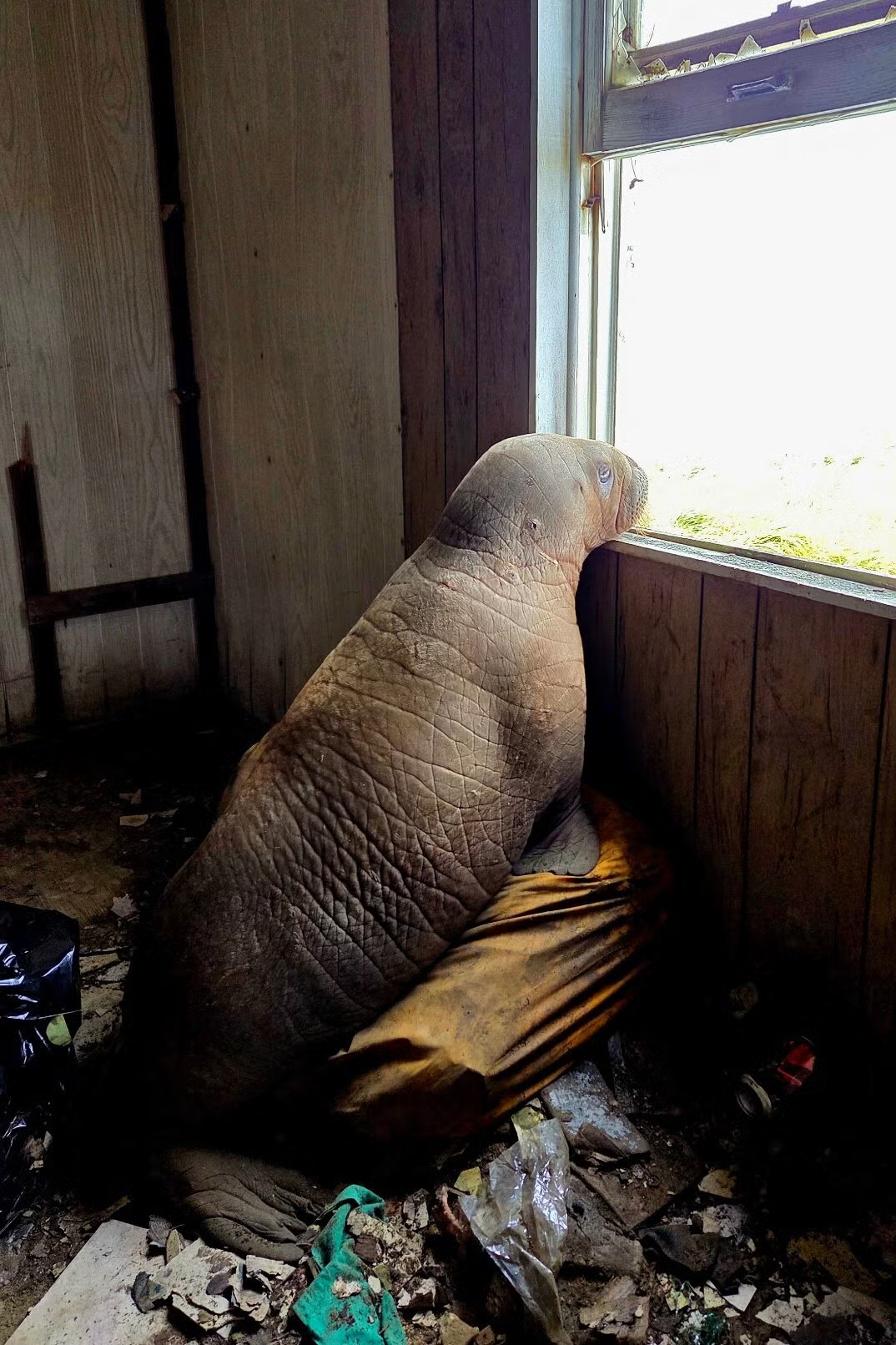 · 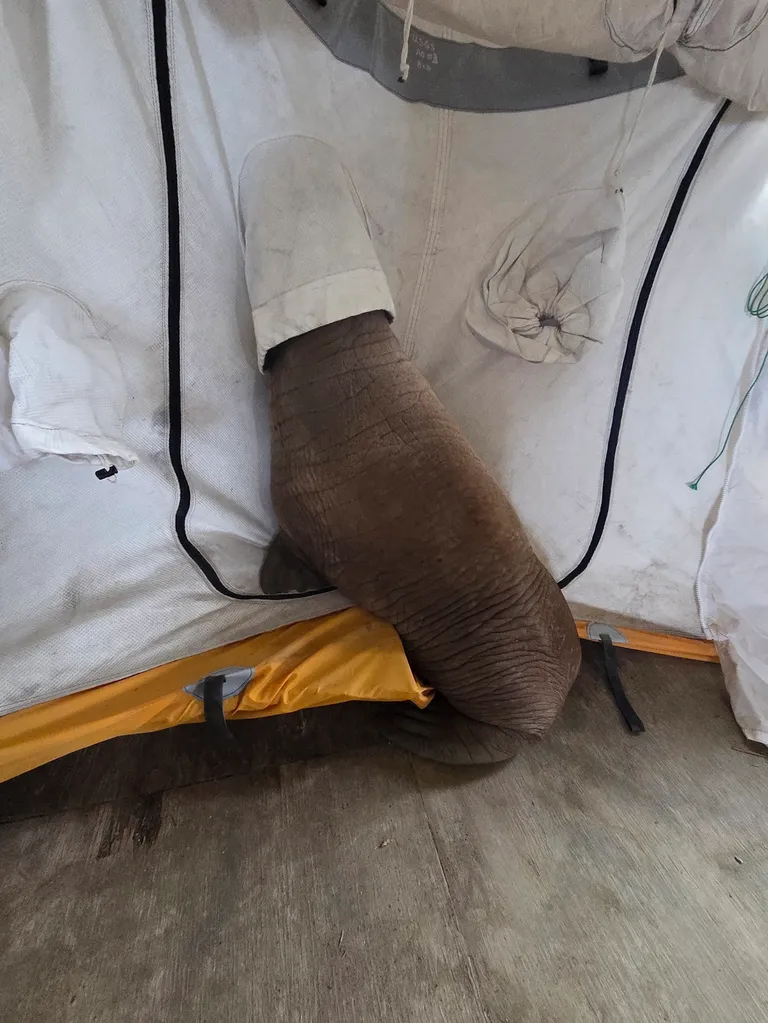 · 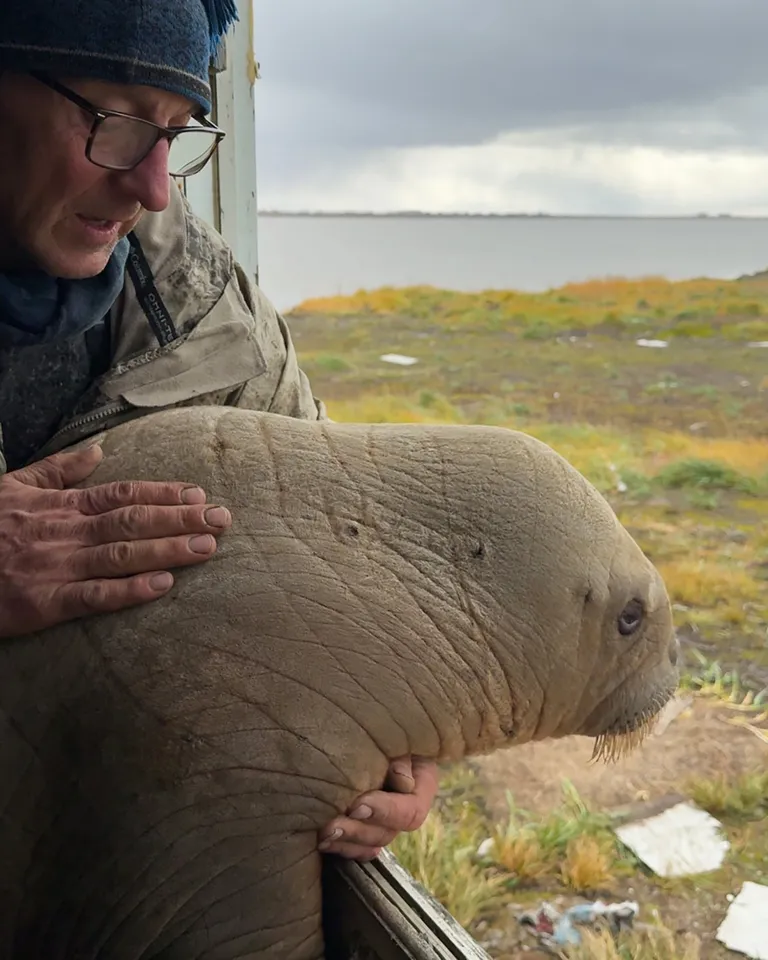 · 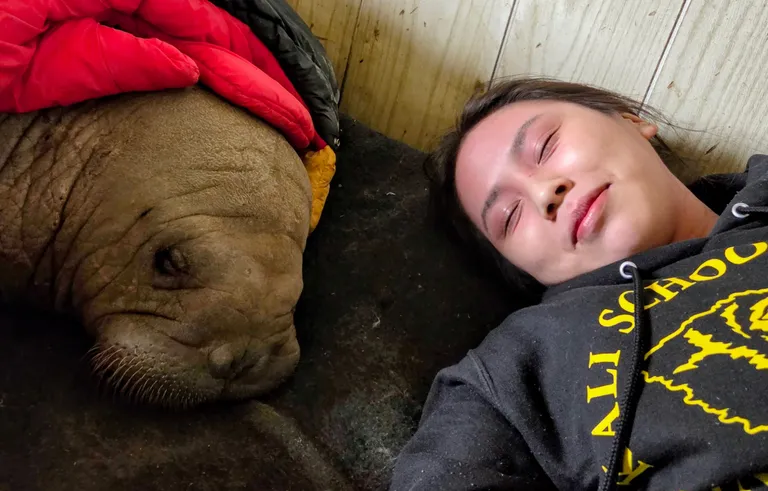 · |