|
#1
●
05-25-2010, 11:47 PM
| ||||||||
 My Rank: STAFF SERGEANT Poster Rank:726 male Join Date: Dec 2009 Posts: 1,139
Contributions: 18
Mentioned: 9 Post(s) Quoted: 300 Post(s)
| ||||||||
|
VY Canis Majoris
Hi all! My first post i hope you like it. From wiki VY Canis Majoris (VY CMa) is a red hypergiant star located in the constellation Canis Major. At between 1800 and 2100 solar radii (approx 2,505,600,000 to 2,923,200,000 km across or 1,556,534,837 to 1,816,267,995 miles), it is the largest known star and also one of the most luminous known. It is located about 1.5 kiloparsecs (4.6×10¹⁶ km) or about 4,900 light years away from Earth. Unlike most hypergiant stars, which occur in either binary or multiple star systems, VY CMa is a single star. It is categorized as a semiregular variable and has an estimated period of 2000 days. Nature of VY Canis Majoris The first known record of VY Canis Majoris is in the star catalogue of Jérôme Lalande, on March 7, 1801. The catalogue listed VY CMa as a 7th magnitude star. Further studies on its apparent magnitude during the 19th century showed that the star has been fading since 1850.[11] Since 1847, VY CMa has been known to be a red star.[11] During the 19th century, observers measured at least six discrete components to VY CMa, suggesting the possibility that it is a multiple star. These discrete components are now known to be bright areas in the surrounding nebula. Visual observations in 1957 and high-resolution imaging in 1998 showed that VY CMa does not have a companion star.[6][11] VY CMa is a high-luminosity M star with an effective temperature of about 3,000 K, placing it at the upper-right hand corner of the Hertzsprung–Russell diagram and suggesting that it is a highly evolved star. During its main sequence, it would have been an O star[10] with a mass of about 30 to 40 M☉. Measuring the distance Stellar distances can be calculated by measuring parallaxes as the Earth orbits around the Sun. However, VY CMa has a tiny parallax with a high margin of error, which makes it unreliable to calculate its distance using this method.[12] In 1976, Charles J. Lada and Mark J. Reid published the discovery of a bright-rimmed molecular cloud 15 minutes of arc east of VY CMa. At the edge of the cloud bordered by the bright rim, an abrupt decrease in the CO emission and an increase in brightness of the 12CO emission were observed, indicating possible destruction of molecular material and enhanced heating at the cloud-rim interface, respectively. Lada and Reid assumed the distance of the molecular cloud is approximately equal to that of the stars, which are members of open cluster NGC 2362, that ionize the rim. NGC 2362 has a distance of 1.5 ± 0.5 kiloparsecs as determined from its color-magnitude diagram.[10] VY CMa is projected onto the tip of the rim, suggesting its association with the molecular cloud. In addition to that, the velocity of the molecular cloud is very close to the velocity of the star. This further indicates the association of the star with the molecular cloud, and consequently with NGC 2362, which means VY CMa is also at a distance of 1.5 kpc. VY Canis Majoris is the largest known star. University of Minnesota professor Roberta M. Humphreys estimates the radius of VY CMa at 1,800 to 2,100 solar radii.[8] To illustrate, if Earth's Sun were replaced by VY Canis Majoris, its radius might extend beyond the orbit of Saturn (about 9 AU). Assuming the upper size limit of 2100 solar radii, light would take more than 2.7 hours to travel around the star's circumference, compared to 14.5 seconds for the Sun. It would take 7×10¹⁵ Earths to fill the volume of VY Canis Majoris. [13] If the Earth were to be represented by a sphere one centimeter in diameter, the Sun would be represented as a sphere with a diameter of 109 centimeters, at a distance of 117 meters. At these scales, VY Canis Majoris would have a diameter of approximately 2.3 kilometers, assuming the upper limit estimate of its radius. Size comparison of our Sun Compared to VY Canis Majoris (click on image below) 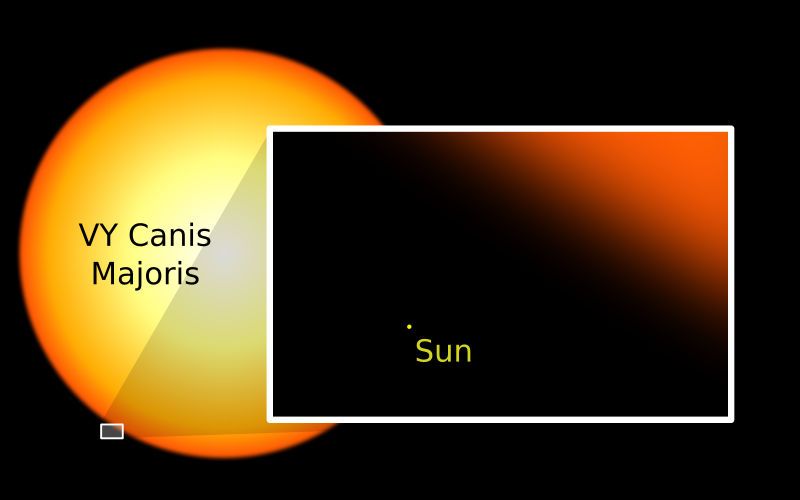 · |
|
#8
●
08-27-2010, 07:42 PM
| ||||||||
 ★ Legacy Member ★ Poster Rank:79 Male Join Date: Nov 2009 Posts: 19,417
Contributions: 1
Mentioned: 7 Post(s) Quoted: 717 Post(s)
| ||||||||
|
Re: VY Canis Majoris
This video is a fantastic scale guide to some the celestial bodies in our Galaxy working it's way up from our own moon right upto VY Canis Majoris. It really puts things in perspective regarding the enormity of this Red Hyper Giant. <iframe class="youtube-player" type="text/html" width="640" height="385" src="http://www.youtube.com/embed/HEheh1BH34Q" frameborder="0"></iframe> Cool post laal  |