1960: In the Nedelin disaster, over 100 Soviet rocket technicians and officials died when a switch was turned on that unintentionally ignited the rocket. The dead included Red Army Marshal Nedelin who was seated in a deck chair just 40 meters away overseeing launch preparations.
1960: Inejiro Asanuma, 61, the head of the Japanese Socialist Party, was stabbed to death with a wakizashi sword by extreme rightist Otoya Yamaguchi during a televised political rally. Yamaguchi was immediately arrested and later committed suicide.
1960: Alan Stacey, Formula One race driver died in a crash during the Belgian Grand Prix. Approaching a dangerous curve at high speed, a bird flew into his face causing him to lose control.
1961: Valentin Bondarenko, a Soviet cosmonaut trainee, died from shock after suffering third-degree burns over much of his body due to a flash fire in the pure oxygen environment of a training simulator.
1963: Thích Quảng Đức, a Vietnamese Buddhist monk, sat down in the middle of a busy intersection in Saigon, covered himself in gasoline, and lit himself on fire, burning himself to death.
1966: Worth Bingham, son of Barry Bingham, Sr., died when a surfboard, lying atop the back of his convertible, hit a parked car, swung around, and broke his neck.
1966: Skydiver Nick Piantanida died from the effects of uncontrolled decompression four months after an attempt to break the world record for the highest parachute jump. During his third attempt, his face mask came loose (or he possibly opened it by mistake), causing loss of air pressure and irreversible brain damage.
1967: Gus Grissom, Ed White, and Roger B. Chaffee, NASA astronauts, died when a flash fire began in their pure oxygen environment during a training exercise inside the unlaunched Apollo 1 spacecraft. The spacecraft's escape hatch could not be opened during the fire because it was designed to seal shut under pressure.
1967: Cosmonaut Vladimir Komarov became the first person to die during a space mission after the parachute of his capsule failed to deploy following re-entry.
1971: Jerome Irving Rodale, an American pioneer of organic farming, died of a heart attack while being interviewed on The Dick Cavett Show. The show was never broadcast.
1972: Leslie Harvey, guitarist of Stone the Crows, was electrocuted on stage by a live microphone.
1974: Basil Brown, a 48-year-old health food advocate from Croydon, drank himself to death with carrot juice.
1974: Christine Chubbuck, an American television news reporter, committed suicide during a live broadcast on July 15. At 9:38 am, 8 minutes into her talk show, on WXLT-TV in Sarasota, Florida, she drew out a revolver and shot herself in the head.
1974: Deborah Gail Stone, 18, an employee at Disneyland in Anaheim, California, was crushed to death between a moving wall and a stationary wall inside of the revolving America Sings attraction.
1975: Bandō Mitsugorō VIII, a Japanese kabuki actor, died of severe poisoning when he ate four fugu livers (also known as pufferfish). The liver is considered one of the most poisonous parts of the fish, but Mitsugorō claimed to be immune to the poison. The fugu chef felt he could not refuse Mitsugorō and lost his license as a result.
1975: Alex Mitchell, a 50-year-old from Norfolk, England, died laughing while watching The Goodies. A particular scene had made Mitchell uproar nonstop for twenty-five minutes, laughed a 'tremendous belly laugh', and died of heart failure.
1976: Keith Relf, former singer for British rhythm and blues band The Yardbirds, died while practicing his electric guitar. He was electrocuted because the amplifier was not properly grounded.
1977: Tom Pryce, a Formula One driver at the 1977 South African Grand Prix was killed when he was struck in the face by a track marshal's fire extinguisher. The marshal, Frederik Jansen van Vuuren, was running across the track to attend to Pryce's team-mate's burning car when he was struck, and killed instantly, by Pryce's car.
1978: Georgi Markov, a Bulgarian dissident, was assassinated in London with a specially modified umbrella that fired a metal pellet with a small cavity full of ricin into his calf.
1978: Janet Parker, a British medical photographer, died of smallpox in 1978, ten months after the disease was eradicated in the wild, when a researcher at the laboratory Parker worked at accidentally released some virus into the air of the building. She is believed to be the last smallpox fatality in history.
1978: Kurt Gödel, the Austrian/American logician and mathematician, died of starvation when his wife was hospitalized. Gödel suffered from extreme paranoia and refused to eat food prepared by anyone else. He was 65 pounds (approx. 30 kg) when he died. His death certificate reported that he died of "malnutrition and inanition caused by personality disturbance" in Princeton Hospital on January 14, 1978.
1979: Robert Williams, a worker at a Ford Motor Co. plant, was the first known human to be killed by a robot,[98] after the arm of a one-ton factory robot hit him in the head.
1979: John Bowen, a 20-year-old of Nashua, New Hampshire was attending a halftime show at a New York Jets football game at Shea Stadium on December 9, 1979. During an event which featured custom-made remote control flying machines, a 40-pound model plane shaped like a lawnmower accidentally dived into the stands, striking Bowen and another spectator and causing severe head injuries. While the other spectator survived, Bowen died in hospital four days later.
1980: James Frederick Polley, a 23-year-old from Raytown, Missouri, died while riding the Fire In The Hole ride in Branson, Missouri, at Silver Dollar City theme park. The train of cars he was riding in was mistakenly switched to enter the maintenance and storage area of the ride. The door to the maintenance area had a low-hanging bay door and his head got caught between the door and the train.
1981: David Allen Kirwan a 24-year-old, died after attempting to rescue a friend's dog from the 200°F (93°C) water in Celestine Pool, a hot spring at Yellowstone National Park on July 20, 1981. Kirwan suffered third-degree burns over 100% of his body and died the next morning at a Salt Lake City hospital. Kirwan is the only known case of someone dying after deliberately jumping into one of the park's hot springs.
1981: Boris Sagal, a film director, died while shooting the TV miniseries World War III when he walked into the tail rotor blade of a helicopter and was decapitated.
1981: Jeff Dailey, a 19-year-old gamer, became the first known person to die while playing video games. After achieving a score of 16,660 in the arcade game Berzerk, he succumbed to a massive heart attack. A year later, an 18-year-old gamer died after achieving high scores in the same game.
1981: Kenji Urada, a Japanese factory worker, was killed by a malfunctioning robot he was working on at a Kawasaki plant in Japan. The robot's arm pushed him into a grinding machine, killing him.
1981: Paul Gauci, a 41-year-old Maltese man, died after welding a butterfly bomb to a metal pipe and using it as a mallet, thinking it was a harmless can.
1982: Vic Morrow, actor, was decapitated by a helicopter blade during filming of Twilight Zone: The Movie. Two child actors, Myca Dinh Le (who was decapitated) and Renee Shin-Yi Chen (who was crushed), also died.
1982: David Grundman was killed near Lake Pleasant, Arizona while shooting at cacti with his shotgun. After firing several shots at a 26 ft (8m) tall Saguaro Cactus from extremely close range, a 4 ft limb of the cactus that was weakened by the gunfire detached and fell on him, crushing him.
1983: Four divers and a tender were killed on the Byford Dolphin semi-submersible, when a decompression chamber explosively decompressed from 9 atm to 1 atm in a fraction of a second. The diver nearest the chamber opening literally exploded just before his remains were ejected through a 24 in (60 cm) opening. The other divers' remains showed signs of boiled blood, unusually strong rigor mortis, large amounts of gas in the blood vessels, and scattered hemorrhages in the soft tissues.
1983: Sergei Chalibashvili, a professional diver, died after a diving accident during the 1983 Summer Universiade in Edmonton, Alberta, Canada. When he attempted a three-and-a-half reverse somersault in the tuck position from the ten meter platform, he smashed his head on the platform and was knocked unconscious. He died after being in a coma for a week.
1983: American author Tennessee Williams died when he choked on an eyedrop bottle cap in his room at the Hotel Elysee in New York. He would routinely place the cap in his mouth, lean back, and place his eyedrops in each eye.
1983: Jimmy Lee Gray, a man executed in Mississippi's gas chamber, died bashing his head against a metal pole behind the chair that he was strapped into. The poisonous gas had failed to kill him but left him in agony and gasping for eight minutes.
1984:Tommy Cooper, British comedian, died of a heart attack while performing during a live TV broadcast at Her Majesty's Theatre in London. Initially the audience, thinking it was part of the act, continued to laugh as he lay collapsed on the stage. He was then pulled from sight as attempts were made to revive him off stage.
1984: Jon-Erik Hexum, an American television actor, died after he shot himself in the head with a prop gun during a break in filming, playing Russian Roulette using a revolver loaded with a single blank cartridge.
1986: Hrand Arakelian, a Brink's armored truck guard, was crushed by several 25-pound boxes of quarters when the driver braked suddenly to avoid a car in Los Angeles, California.
1986: Over 1,700 were killed after a limnic eruption from Lake Nyos in Cameroon, released approximately 100 million cubic meters of carbon dioxide that quickly descended the lake and killed oxygen dependent life within 15-mile (25 kilometer) radius, including three villages. The same phenomenon is also blamed on the deaths of 37 near Lake Monoun in 1984.
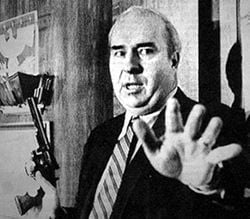
1987: Budd Dwyer, the State Treasurer of Pennsylvania, committed suicide during a televised press conference in Harrisburg, Pennsylvania. Facing a potential 55-year jail sentence for alleged involvement in a conspiracy, Dwyer shot himself in the mouth with a revolver.
1987: Franco Brun, a 22-year-old prisoner at Toronto East Detention Centre, in Toronto, Ontario, died after attempting to swallow and choking on a 6.35 cm. (2.5 inches) by 10 cm. (4 inches) by 1.27 centimetres (half an inch) Gideon's Bible.
1988: C.B. Lansing an Aloha Airlines Flight 243 flight attendant, was sucked out of an airliner when the bulkhead tore off in mid flight.