|
#1
●
10-01-2011, 04:26 PM
|
 My Rank: MAJOR Poster Rank:12 Join Date: Jun 2009 Posts: 93,062
Contributions: 239
93,062Posts 137,694Thanked 2,009Quoted 91Mentioned 239Contrib. |
|
Terrifying Prehistoric Sea Monsters
The modern ocean is a scary place, filled with barracuda, sharks, super-squids, and possibly Cthulhu. However, no matter what we find in the depths these days, none of them seem to come close to the giant terrors that roamed the seas in Earth’s past; giant sea-lizards, monster sharks and even “hypercarnivorous” whales. For most of these things, humans would barely qualify as a snack. Here are 10 of the scariest monsters to ever call the ocean home in prehistory. Megalodon 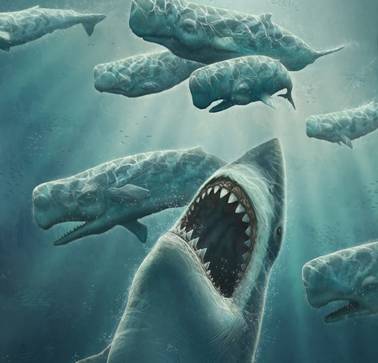 Megalodon is probably the best-known creature in the list; it’s hard to keep the idea of a shark the size of a school bus out of pop culture. Plus, science-minded entertainment sources like the Discovery Channel love creatures that could pass for a movie monster. Despite the popular idea that Megalodon coexisted with dinosaurs, they lived from 25 to 1.5 million years ago, meaning that at best they missed the last dinosaur by 40 million years. On the other hand, this meant they might have still been around for the first humans. Eek. Megalodons swam the warm oceans that were around until the last ice age in the early Pleistocene, which may have robbed them of their breeding grounds and food. Sometimes, it seems nature has our back. Liopleurodon 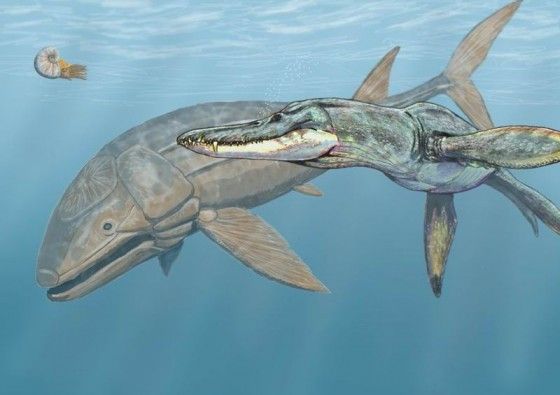 If Jurassic Park had an aquarium scene, and actually featured more animals from the Jurassic period, liopleurodon probably would have been in it. Although the actual length of these beasts is contested (some scientists have claimed lengths in excess of 50’), most agree that it was around 20 feet in length, with a full fifth of that being pointy-toothed head. When the mouth of the “smaller” estimate is still plenty large to eat you whole, I think that is perfectly huge enough. Scientists have tested the paddle design of these creatures on small swimming robots and found that although they would not have been incredibly fast, they were incredibly agile. They also would have been able to make short, fast burst attacks like crocodiles, which in no way makes them any less intimidating. Basilosaurus 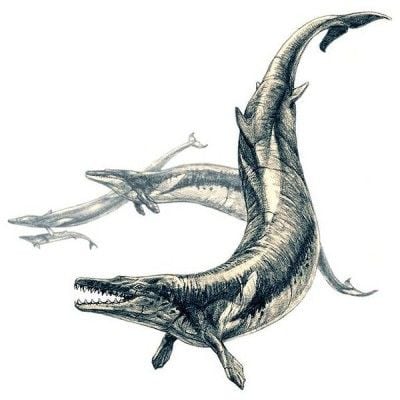 Despite the name and appearance, that is not a reptile, but actually a whale (and not even the most fearsome on the list!) Basilosaurs were predatory ancestors of modern whales, and could be 50 to 85 feet long! It is described as being the closest a whale has ever come to being a snake because of how long and sinuous it was. Imagine swimming in the ocean with an 80+ foot long alligator-snake-whale. Now imagine being afraid to even take a bath ever again. Physical evidence suggests that basilosaurus did not have the cognitive ability of modern whales, nor the ability to echolocate, and could only navigate in 2 dimensions (so no deep diving or breaching). So at least this monster whale was dumber than a bag of prehistoric hammers and could not chase you if you dove or scrambled out on dry land, probably forever. Jaekelopterus rhenaniae 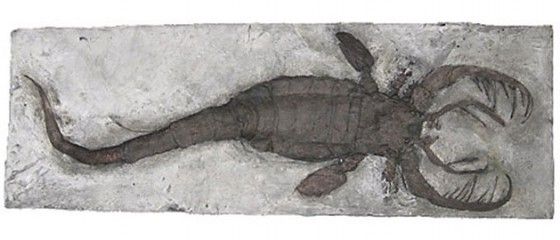 Nothing about the words “sea scorpion” are comforting to begin with, so this should not come off as too awful: this was one of the two largest arthropods to have ever lived, reaching a length of over 8 feet of armored, clawed horror. Most of us freak out at the thought of inch-long ants and foot wide spiders, so it’s easy to imagine screaming like a little girl if you ever stumbled across a living one of these. On the plus side, sea scorpions (Euripterids) have been extinct since before the dinosaurs, having been wiped out in the Permian Triassic extinction event (which killed 90% of all life on earth) and are only survived, to some degree, by horseshoe crabs, which are even less formidable than regular crabs. There is no evidence that any sea scorpions were actually venomous, but the structure of their tail is similar to a modern scorpion’s, so it might have been. Mauisaurus 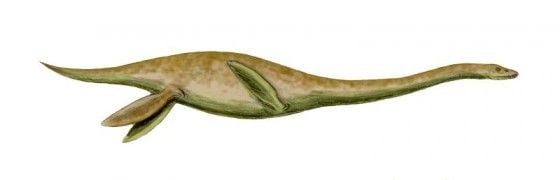 Mauisaurus was named after the Maori god Maui, who pulled the islands of New Zealand up from the sea floor with a fish hook, so already you know this thing is going to be enormous. The neck of Mauisaurus measured up to 49 feet long; the longest proportionate (and really, “actual”) neck of any living thing aside from some sauropod dinosaurs. Their overall length was about 66 feet, and that ridiculously long neck had plenty of vertebrae, implying that it was flexible. Imagine a snake strung through a sea turtle with no shell, and you have an approximate idea of what this thing looked like. It lived back in the Cretaceous era, meaning that creatures that jumped in the water avoid Velociraptors and Tyrannosaurs had to contend with these; the jury is out on which is worse. As far as science can tell, Mauisaurus was limited to the New Zealand area, showing that the area that would one day become Australia and its neighbors was always a land of terror. Dunkleosteus 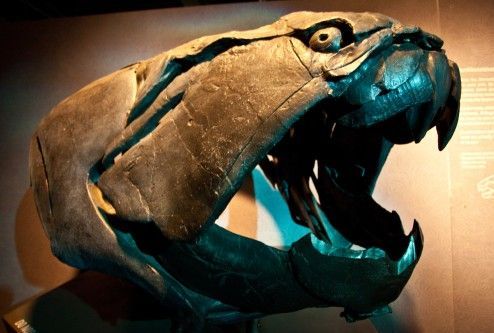 Dunkleosteus was a 30 foot long carnivorous tank. It was outlasted by sharks, but I am sure that is small consolation for the variety of creatures this beast ate. Instead of teeth, it had bony ridges, like a turtle. It has been calculated that they had a bite force of 8,000 pounds per square inch, putting it on par with crocodiles and T-Rex in terms of being history’s strongest biters. They also believe, based on the evidence in the skull regarding its musculature, that it could have opened its mouth in one fiftieth of a second, meaning it vacuumed food into its guillotine of a mouth. The plates that made up the “teeth” changed as the fish aged from a solid, rigid jaw to segments that allowed it to hold prey easier, and made it more effective in biting through the bony plate armor of other armored fish. In the arms race that was the prehistoric ocean, Dunleosteus was a predatory super tank. Kronosaurus 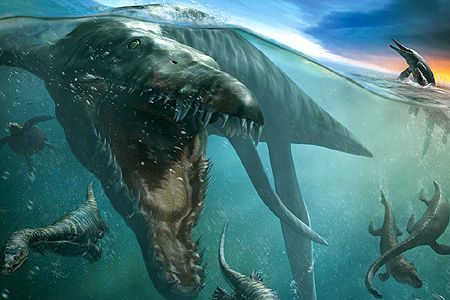 Kronosaurus is another short-necked pliosaur (like Liopleurodon up at number 9), and like Liopleurodon, its overall length has been contested. It was a “mere” 30 feet long and the longest teeth in its massive mouth were up to 11 inches long. This is why it was named after Cronus, the king of the old Greek Titans. Guess where it lived? If you guessed “Australia”, then you have been paying attention to life (and are correct). The head was up to 9 feet long. They could eat an entire modern man whole, and still have room left over for half of another. It has also been suggested that since their flippers are so similar in design to those of modern sea turtles, that they may have crawled out onto land to lay eggs. You can be sure no one was digging up these thing’s nests to get at the eggs. Helicoprion 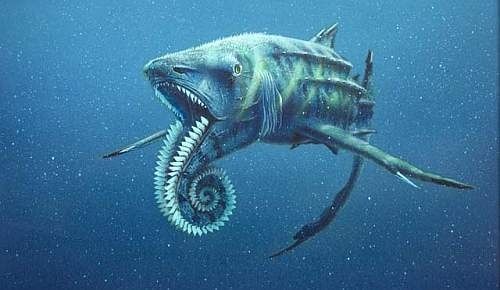 These sharks grew to be about 15 feet long, and had a lower jaw that was made of a “tooth whorl”. It looks like a cross between a circular saw and a shark, and when you mix apex predators with power tools, the world quakes in fear. Helicoprion’s teeth were serrated, implying that they were definitely carnivores, but there is some debate as to whether their teeth were in the front of the mouth, as shown in the picture, or if they were farther back, which would suggest a softer diet, like jellyfish. However it was arranged, it clearly worked; Helicoprion survived the Permian Triassic extinction, which means they may have been smart enough to create bomb shelters. Or maybe they just lived in the deep sea. Livyatan melvillei 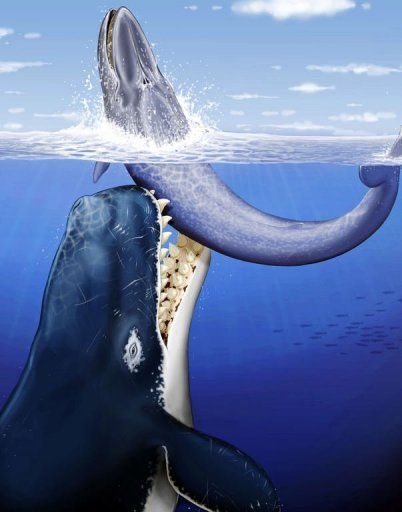 Remember me mentioning “hypercarnivorous” whales? Well here it is. Imagine a cross between an orca and a sperm whale. Livyatan melvillei was a whale that ate other whales. It had the largest teeth of any animal to ever use their teeth to eat (elephant tusks are bigger, but they just look impressive and help them smash things; they don’t eat with them) topping out at 1.18 feet. They lived in the same oceans and ate the same food as the Megalodon, so this whale actually had to compete with the largest predatory shark ever. Not to mention their head was 10 feet long and featured the same echo-locating equipment as modern toothed whales, making them much more effective in murky water. In case it was not obvious, this beast was named after the leviathan, a giant sea monster from the bible, and Herman Melville, who wrote Moby Dick. If the great white whale had Giant Stingray 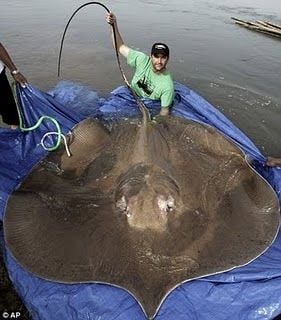 What grew 17 feet across, had a 10 inch poison spike in its tail and was strong enough to drag a boat filled with people? In this case, a prehistoric super-fish that is still lurking around in fresh and brackish waters from the Mekong river to northern Australia. Stingrays have been around since a few million years after the dinosaurs died out, and have proven to be a successful design, much like the sharks they descended from. |
|
#9
●
10-02-2011, 11:28 AM
|
| My Rank: LANCE CORPORAL Poster Rank:2782 Join Date: Apr 2010 Posts: 146 146Posts 103Thanked 10Quoted 0Mentioned 0Contrib. |
|
Re: Terrifying Prehistoric Sea Monsters
little sting-rays put up a decent fight when you hook em, could imagine what that big bastard would be like haha!
|
|
#10
●
10-02-2011, 11:57 PM
|
 ★ Legacy Member ★ Poster Rank:7 What we've got here is failure to communicate. Join Date: Aug 2009 Posts: 103,541
Contributions: 3
103,541Posts 83,563Thanked 43,400Quoted 112Mentioned 3Contrib. |
|
Re: Terrifying Prehistoric Sea Monsters
I have a Carcharodon Megaladon tooth, I tried to post it but my digi cam is dead, no batteries.  |