|
#1
●
07-20-2011, 03:52 PM
| ||||||||
 My Rank: MAJOR Poster Rank:12 Join Date: Jun 2009 Posts: 93,062
Contributions: 226
Mentioned: 91 Post(s) Quoted: 2009 Post(s)
| ||||||||
|
Telescope Discovers Pluto Has a Fourth Moon
NASA has announced that the Hubble Space Telescope has found a fourth moon circling the icy dwarf planet, Pluto, but it is just eight to 21 miles wide. Until astronomers decide upon a name, this moon will be called P4. Astronomers had been looking to see if Pluto had a ring, but instead they found the tiny object circling the dwarf planet that is 3 billion miles from Earth. Lost in space: Pluto's moons including the newly discovered P4 are shown in this graphic from NASA: 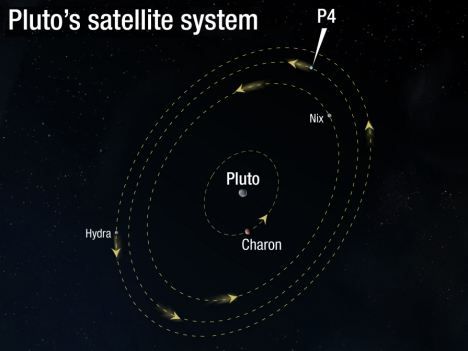 P4 is the smallest of Pluto's four moons, the U.S. space agency said in a statement. Pluto's largest moon, Charon, is 750 miles across, while its other moons, Nix and Hydra, are 56 and 70 miles in diameter respectively. Pluto itself is 1442 miles wide. For comparison, Earth's moon is 2158 miles wide. The space telescope was searching for rings around the planetary oddball at the edge of our solar system when it came across P4. Mark Showalter of the SETI Institute in Mountain View, California, who led this observing program with Hubble said: 'I find it remarkable that Hubble's cameras enabled us to see such a tiny object so clearly from a distance of more than 3 billion miles.' The observation by Hubble is part of ongoing work to support NASA's New Horizons mission, scheduled to have a close encounter with Pluto and its moons in 2015. Hubble's mapping of Pluto's surface and discovery of its satellites have been invaluable to planning for New Horizons' close encounter. Moon with a view: An artist's impression of the Pluto system from the surface of one of the outer moons. Pluto is the large disk at centre, while Charon, the largest moon, is to the right of Pluto: 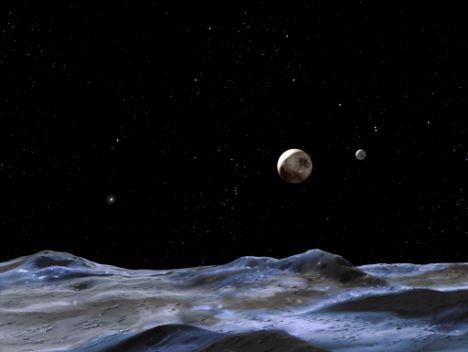 'This is a fantastic discovery,' said New Horizons’ principal investigator Alan Stern of the Southwest Research Institute in Boulder, Colo. 'Now that we know there's another moon in the Pluto system, we can plan close-up observations of it during our flyby. 'Pluto's satellite system is truly knocking our socks off with surprises — it's magnificently complex, and getting more crowded all the time. I can't wait till we get there to see what other surprises this planet and its moons have in store for us! P4 is located between the orbits of Nix and Hydra, both of which were discovered by Hubble in 2005. Charon was discovered in 1978 by the U.S. Naval Observatory. Pluto itself was only discovered in 1930, and from its discovery until 2006 was classified as a planet. Long view: The Hubble Space Telescope seen in a picture taken from the Space Shuttle has managed to image a moon just 20 miles wide orbiting Pluto: 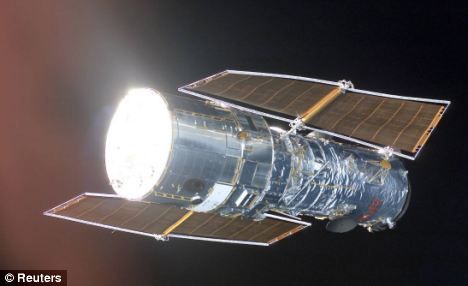 All four of Pluto's moons are believed to have formed when Pluto and another planet-sized body collided in the early history of our solar system. Earth's Moon may have formed the same way. P4 was first seen in a photo taken by Hubble on June 28 and was confirmed in subsequent Hubble pictures taken July 3 and July 18, NASA said. Lunar rocks returned to Earth from the Apollo missions led to the theory that our moon was the result of a similar collision between Earth and a Mars-sized body 4.4 billion years ago. Special delivery: Technicians at the kennedy Space Centre in Florida prepare the New Horizons space probe for its launch in 2006: 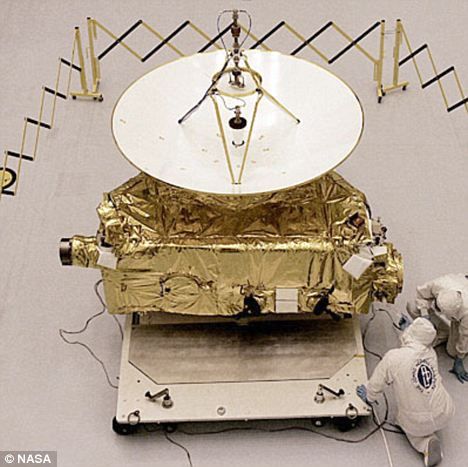 Scientists believe material blasted off Pluto's moons by micrometeoroid impacts may form rings around the dwarf planet, but the Hubble photographs have not detected any so far. 'This surprising observation is a powerful reminder of Hubble's ability as a general purpose astronomical observatory to make astounding, unintended discoveries,' said Jon Morse, astrophysics division director at NASA Headquarters in Washington. New Horizons will fly by Pluto in July 2015. Its instruments will carry out detailed mapping of the object's surface features, composition and atmosphere. The probe will go to about 10,000km from Pluto and about 27,000km from Charon, before pressing onwards to other objects in the Kuiper Belt, a region of space that contains many frozen leftovers from the birth of our Solar System. |
|
#2
●
07-20-2011, 04:21 PM
| ||||||||
 ✝Mudderator from Hell✝ Poster Rank:10 e-mail Join Date: Oct 2006 Posts: 96,583
Contributions: 817
Mentioned: 477 Post(s) Quoted: 10358 Post(s)
| ||||||||
|
Re: Telescope Discovers Pluto Has a Fourth Moon
that's where my auntie lives  |
|
#3
●
07-20-2011, 04:32 PM
| ||||||||
 ★Wizard Of Gore★ Poster Rank:2 Join Date: Aug 2009 Posts: 127,975
Contributions: 1
Mentioned: 460 Post(s) Quoted: 30201 Post(s)
| ||||||||
|
Re: Telescope Discovers Pluto Has a Fourth Moon
Just think, KH. In another 263 years, the card she sent you for Christmas in 1987 will get to you.  |
|
#5
●
07-21-2011, 01:03 PM
| ||||||||
 ★ Legacy Member ★ Poster Rank:4 Join Date: Mar 2009 Posts: 118,371 Mentioned: 465 Post(s) Quoted: 34616 Post(s)
| ||||||||
|
Re: Telescope Discovers Pluto Has a Fourth Moon
In August of 2006, the International Astronomical Union came up with a definition of the word “Planet”. According to this new definition, Pluto is no longer a planet. It is a “Dwarf Planet”. However, this has created controversy around the world among Astronomers. The IAU members gathered at the 2006 General Assembly agreed that a "planet" is defined as a celestial body that (a) is in orbit around the Sun, (b) has sufficient mass for its self-gravity to overcome rigid body forces so that it assumes a hydrostatic equilibrium (nearly round) shape, and (c) has cleared the neighbourhood around its orbit. A "dwarf planet" is a celestial body that (a) is in orbit around the Sun, (b) has sufficient mass for its self-gravity to overcome rigid body forces so that it assumes a hydrostatic equilibrium (nearly round) shape, (c) has not cleared the neighbourhood around its orbit, and (d) is not a satellite. The definition is flawed, relating to “cleared the neighborhood”. Every 228 years Pluto crosses inside of the orbit of Neptune, so technically speaking, it does not clear its neighborhood. But that also means that Neptune does not clear its own neighborhood. Mars and Jupiter don’t clear their neighborhoods as they “interfere” with the Asteroids, and the Earth actually orbits the Sun with thousands of Asteroids. So the Earth doesn’t clear its own neighborhood either. So if we use the definition set forth by the IAU, Pluto, Neptune, Jupiter, Mars, and the Earth, are NOT planets! Also, why aren’t “Dwarf Planets” known as planets? Dwarf Stars are still stars, and Dwarf Galaxies are still galaxies. These new definitions ONLY apply to objects in OUR Solar System, making the definition even more un-scientific. Along with the definition being both linguistically and scientifically flawed, so was the voting process. Although there are over 10,000 Astronomers in the IAU, only 237 of them voted and approved this definition. Therefore, there was NOT a majority consensus of what a planet is. Hundreds of Astronomers around the world (and this planetarium) have signed petitions to ignore the new definition and still refer to Pluto as the ninth planet in our Solar System.  Bastards Bastards
|
|
#8
●
07-23-2011, 12:05 AM
| ||||||||
 ★ Legacy Member ★ Poster Rank:388 male Join Date: Jan 2010 Posts: 3,081 Mentioned: 0 Post(s) Quoted: 147 Post(s)
| ||||||||
|
Re: Telescope Discovers Pluto Has a Fourth Moon
Kelly..I used to sit as a boy in my back garden with my best friend when i was ten and look up at the stars through the zip of our tent in the middle of the night...the sky in Ireland was really magical in the middle of january, crisp, cold, clear.. What the fuck our mas wer doing lettin us sleep out the back garden in the middle of winter il never know but god bless them Thanks for sharing!! |