|
#1
●
05-18-2013, 05:07 PM
|
 ★The Queen★ Poster Rank:68 Female Join Date: Jun 2011 Posts: 23,461
Contributions: 145
23,461Posts 28,287Thanked 3,083Quoted 95Mentioned 145Contrib. |
|
Tawny Crazy Ants Invading Homes in Southeastern US
Alien 'crazy ants' invading southern homes Invasive "crazy ants" are displacing fire ants in areas across the southeastern United States. 3 hr ago |By Matt Kwong of MSN News A new scourge of Tawny crazy ants from South America are invading homes across the southern US, annoying residents and threatening the local ecosystem. They move in dense mobs, they hide in crevices and they're quickly displacing fire ants as the new insect pest for homeowners in the southern United States. They're Tawny crazy ants, and, as their name suggests, they're driving people up the wall. Researchers with the University of Texas who have been tracking the populations now say the invasive insects originally from South America have spread so widely in the southern U.S. that they could eventually displace fire ants. That could come at a big environmental cost and throw the ecosystem out of whack, warned Ed LeBrun, a research associate with the Texas invasive species research program at the Brackenridge Field Laboratory in the College of Natural Sciences. If the foreign omnivorous insects formerly classified as Nylanderia fulva don't attack and kill other native species, their big appetites could end up starving off the competition. "Just the general reduction of arthropod abundance means the base of the terrestrial food chain has been suppressed, and that will cascade to all kinds of things," LeBrun said. "The suppression of herbivorous insects might, over the long term, change the character of the plant community as well." 'OPPORTUNISTIC NESTERS' The study by LeBrun and his colleagues was published in the latest edition of the peer review journal Biological Invasions. To give an idea of just how dense the Tawny crazy ant populations are compared to other species, LeBrun said that in his samples of an area, he found abundances were "about two orders of magnitude greater than all the other ants combined." That means 100 times. And then there's the annoyance factor. LeBrun describes the Tawny crazy ants, which are native to Argentina, southern Brazil and Paraguay, as "opportunistic nesters." Compared to relatively demure fire ants, the crazy ants aren't shy about inviting themselves into homes, he said. "Fire ants don't come into structures," he said. "So they make a mound in your yard, and as long as you don't step on that mound, you don't interact. These things, on the other hand, they come in and they cause a lot more aggravation generally." The ants also have a tendency to nest inside electrical circuits and have shorted out pumps and wells for rural land owners. Homeowners in some of the 21 counties in Texas and 20 counties in Florida that have reported infestations are so fed up, many would prefer to welcome back the fire ants. The ants have also been reported in Mississippi and Louisiana, mostly in wetter regions. LeBrun said the crazy ants were first discovered in America around 2002, when pest control operator Tom Raspberry was called to a Houston home to eradicate a population of the insects. "He treated it, but it did no good. Then he stopped and looked at the ant and realized it was something he'd never seen before," LeBrun said. HITCHING RIDES WITH HUMANS LeBrun noted that the Tawny crazy ants don't have a large wind dispersal, so their spread rate is typically limited locally. Once a local colony is established, it spreads only about 200 meters in a year. That means the ant populations are probably not spreading naturally on their own, but are likely hitching rides with unsuspecting humans. "They nest in small cavities on the ground, cardboard, potted plants, a piece of rotted wood, structures like RVs," LeBrun said. "So people travelling to areas that have these ants or taking things elsewhere need to be really vigilant in making sure there's no ants that are moving these things around." LeBrun said he and his colleagues still want to find out the extent of the Tawny crazy ants' ability to spread, as the impact they have on the local environment will depend on how dense their populations can get in a given area. On the positive side, unlike fire ants, the Tawny crazy ants don't sting. "They're a much larger annoyance, but that's a plus," LeBrun said. Photos - AP Mississippi Entomological Museum. 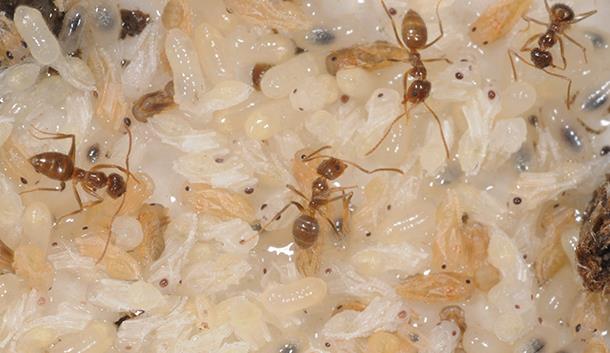 ·  · |