JavaScript and Cookies are required to view this site. Please enable both in your browser settings.
Spotless Sun: Blankest Year Of The Space Age

Spotless Sun: Blankest Year Of The Space Age 

Current Rating:

Unlimited Views No Ads No Algorithms Lifetime Account

Documenting Reality

Community Forum · Est. 2006

Join Now
Thread Tools
  #1  
04-24-2010, 11:03 PM
güttsfükk's Avatar
güttsfükk
Offline:
Super *********
Poster Rank:88
Join Date: Nov 2008
Posts: 17,426
 
Mentioned: 5 Post(s)
Quoted: 99 Post(s)
Activity Longevity
0/20 18/20
Today Posts
0/11 ssss17426
Spotless Sun: Blankest Year Of The Space Age

ScienceDaily (Oct. 7, 2008) — Astronomers who count sunspots have announced that 2008 is now the "blankest year" of the Space Age.

As of Sept. 27, 2008, the sun had been blank, i.e., had no visible sunspots, on 200 days of the year. To find a year with more blank suns, you have to go back to 1954, three years before the launch of Sputnik, when the sun was blank 241 times.

"Sunspot counts are at a 50-year low," says solar physicist David Hathaway of the NASA Marshall Space Flight Center. "We're experiencing a deep minimum of the solar cycle."

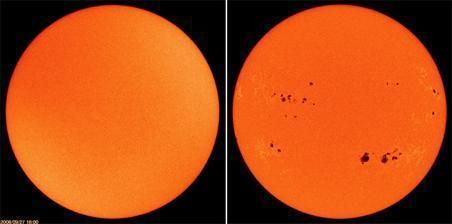
The image taken on Sept. 27, 2008 by the Solar and Heliospheric Observatory (SOHO) shows a solar disk completely unmarked by sunspots. For comparison, a SOHO image taken seven years earlier on Sept. 27, 2001, is peppered with colossal sunspots, all crackling with solar flares. The difference is the phase of the 11-year solar cycle. 2001 was a year of solar maximum, with lots of sunspots, solar flares and geomagnetic storms. 2008 is at the cycle's opposite extreme, solar minimum, a quiet time on the sun.

And it is a very quiet time. If solar activity continues as low as it has been, 2008 could rack up a whopping 290 spotless days by the end of December, making it a century-level year in terms of spotlessness.

Hathaway cautions that this development may sound more exciting than it actually is: "While the solar minimum of 2008 is shaping up to be the deepest of the Space Age, it is still unremarkable compared to the long and deep solar minima of the late 19th and early 20th centuries." Those earlier minima routinely racked up 200 to 300 spotless days per year.

Some solar physicists are welcoming the lull.

"This gives us a chance to study the sun without the complications of sunspots," says Dean Pesnell of the Goddard Space Flight Center. "Right now we have the best instrumentation in history looking at the sun. There is a whole fleet of spacecraft devoted to solar physics--SOHO, Hinode, ACE, STEREO and others. We're bound to learn new things during this long solar minimum."
As an example he offers helioseismology: "By monitoring the sun's vibrating surface, helioseismologists can probe the stellar interior in much the same way geologists use earthquakes to probe inside Earth. With sunspots out of the way, we gain a better view of the sun's subsurface winds and inner magnetic dynamo."

"There is also the matter of solar irradiance," adds Pesnell. "Researchers are now seeing the dimmest sun in their records. The change is small, just a fraction of a percent, but significant. Questions about effects on climate are natural if the sun continues to dim."

Pesnell is NASA's project scientist for the Solar Dynamics Observatory (SDO), a new spacecraft equipped to study both solar irradiance and helioseismic waves. Construction of SDO is complete, he says, and it has passed pre-launch vibration and thermal testing. "We are ready to launch! Solar minimum is a great time to go."

Coinciding with the string of blank suns is a 50-year record low in solar wind pressure, a recent discovery of the Ulysses spacecraft. The pressure drop began years before the current minimum, so it is unclear how the two phenomena are connected, if at all. This is another mystery for SDO and the others.

Who knew the blank sun could be so interesting?

Click image for larger version

Name:	081006184638-large.jpg
Views:	89
Size:	11.9 KB
ID:	157820
Left: A photo of the sun taken Sept. 27, 2008. The face of the sun is "blank," i.e., completely unmarked by spots. Right: The sun on Sept. 27, 2001. The sun's face is peppered with colossal sunspots, all crackling with solar flares.
Source : http://www.sciencedaily.com/releases...1006184638.htm
This User Says Thank You For This Post:
Flaka
▼ PROMO FROM DOCUMENTING REALITY
Struggle with technology? Our site is easy.
Join Now
Hidden for upgraded members.
  #2  
04-24-2010, 11:06 PM
güttsfükk's Avatar
güttsfükk
Offline:
Super *********
Poster Rank:88
Join Date: Nov 2008
Posts: 17,426
 
Mentioned: 5 Post(s)
Quoted: 99 Post(s)
Activity Longevity
0/20 18/20
Today Posts
0/11 ssss17426
Re: Spotless Sun: Blankest Year Of The Space Age

Sun Shows Signs Of Life: Long-Awaited Solar Cycle 24 Starting To Take Off

ScienceDaily (Nov. 12, 2008) — After two-plus years of few sunspots, even fewer solar flares, and a generally eerie calm, the sun is finally showing signs of life.

"I think solar minimum is behind us," says sunspot forecaster David Hathaway of the NASA Marshall Space Flight Center.

His statement is prompted by an October flurry of sunspots. "Last month we counted five sunspot groups," he says. That may not sound like much, but in a year with record-low numbers of sunspots and long stretches of utter spotlessness, five is significant. "This represents a real increase in solar activity."

Even more significant is the fact that four of the five sunspot groups belonged to Solar Cycle 24, the long-awaited next installment of the sun's 11-year solar cycle. "October was the first time we've seen sunspots from new Solar Cycle 24 outnumbering spots from old Solar Cycle 23. It's a good sign that the new cycle is taking off."

Old Solar Cycle 23 peaked in 2000 and has since decayed to low levels. Meanwhile, new Solar Cycle 24 has struggled to get started. 2008 is a year of overlap with both cycles weakly active at the same time. From January to September, the sun produced a total of 22 sunspot groups; 82% of them belonged to old Cycle 23. October added five more; but this time 80% belonged to Cycle 24. The tables have turned.

At first glance, old- and new-cycle sunspots look the same, but they are not. To tell the difference, solar physicists check two things: a sunspot's heliographic latitude and its magnetic polarity. (1) New-cycle sunspots always appear at high latitude, while old-cycle spots cluster around the sun's equator. (2) The magnetic polarity of new-cycle spots is reversed compared to old-cycle spots. Four of October's five sunspot groups satisfied these two criteria for membership in Solar Cycle 24.

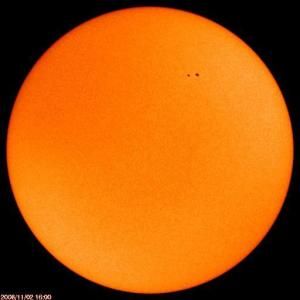
The biggest of the new-cycle spots emerged at the end of the month on Halloween. Numbered 1007, or "double-oh seven" for short, the sunspot had two dark cores each wider than Earth connected by active magnetic filaments thousands of kilometers long. Amateur astronomer Alan Friedman took this picture from his backyard observatory in Buffalo, New York:

On Nov. 3rd and again on Nov. 4th, double-oh seven unleashed a series of B-class solar flares. Although B-flares are considered minor, the explosions made themselves felt on Earth. X-rays bathed the dayside of our planet and sent waves of ionization rippling through the atmosphere over Europe. Hams monitoring VLF radio beacons noticed strange "fades" and "surges" caused by the sudden ionospheric disturbances.

Hathaway tamps down the excitement: "We're still years away from solar maximum and, in the meantime, the sun is going to have some more quiet stretches." Even with its flurry of sunspots, the October sun was mostly blank, with zero sunspots on 20 of the month's 31 days.

But it's a start. Stay tuned for solar activity.

Name:  081111230341.jpg
Views: 753
Size:  8.7 KB
New-cycle sunspot group 1007 emerges on Halloween and marches across the face of the sun over a four-day period in early November 2008.
Source : http://www.sciencedaily.com/releases...1111230341.htm
  #3  
04-24-2010, 11:13 PM
Psychonautical's Avatar
Psychonautical
Offline:
Server Supporter
Poster Rank:191
Male
Join Date: Feb 2010
Posts: 7,790
 
Mentioned: 1 Post(s)
Quoted: 230 Post(s)
Activity Longevity
0/20 17/20
Today Posts
0/11 sssss7790
Re: Spotless Sun: Blankest Year Of The Space Age

I'm color blind, so this is really not all that awesome. Info was interesting I wonder if the lack of activity will allow for better imaging of it.
  #4  
11-11-2011, 09:27 PM
vicksvaporub's Avatar
vicksvaporub
Offline:
My Rank: PRIVATE
Poster Rank:10350
Male
Join Date: Nov 2009
Posts: 13
 
Mentioned: 0 Post(s)
Quoted: 36 Post(s)
Activity Longevity
0/20 17/20
Today Posts
0/11 sssssss13
Re: Spotless Sun: Blankest Year Of The Space Age


Powered by vBulletin Copyright 2000-2010 Jelsoft Enterprises Limited.

Search Engine Friendly URLs by vBSEO