JavaScript and Cookies are required to view this site. Please enable both in your browser settings.
Dummy Spiders Spiders can end up with a lot of junk hanging in their webs with them, so they might as well put it to use. Some species will bundle up silk, old prey remains and detritus into clumps around the same size, shape and color as themselves, creating a row of “false” spiders they can hide amongst. This is useful to confuse flying predators such as dragonflies, robber flies or small birds who may attempt to swoop by and pluck a tasty spider from its web. Fake poop Celaenia excavata is not the only spider to imitate disguise itself as a wad of bird excrement, but it certainly sports the most convincing disguise. Not only is the spider’s body colored exactly like bird poo (complete with a seed-like spot!) but it sits atop a highly convincing “splatter” fashioned from its own silk. It’s the perfect disguise for a spider, since it’s highly unappetizing to spider-eating animals but looks enticingly tasty if you happen to be, say, a fly. Colonial super-webs Most spiders are aggressively solitary, treating even their own species as just an edible invader in their territory. A few species, however, are highly social and may build tremendous, complex web systems shared by thousands of individuals. One such spider is Eduador’s Theridion nigroannulatum – these spiders hang upside-down in large groups, dangling hundreds of silk strands to the ground. When a large insect brushes by these tripwires, dozens of spiders may drop down together and wrap it in silk. Hang-gliders Newly hatched or very small spiders can often travel thousands of miles by a process called “ballooning.” A special kind of silk called “gossamer” is produced that easily catches on the wind, and forms into a triangular parachute that may remain airborne for weeks at a time, even allowing spiders to colonize distant islands Handheld mini-webs The “ogre faced” or “net casting” spiders of order Deinopidae hang upside down from just a few strands of silk, holding an unusuall small, dense web between their front legs they use to physically reach out and scoop up passing insects. The silk of this special net isn’t sticky, but so fuzzy that it instantly entangles the hairs and joints of insects like velcro, allowing the spider to trap fairly large and powerful insects with only a small amount of silk. False advertising Many garden spiders construct webs with a distinct pattern of thick silk at the center, the purpose of which was long debated. We now know that this special silk is reflective to UV light, creating patterns similar to those used by flowers to attract their insect pollinators. Fatal attraction The bizarre “bolas spiders” or Mastophorea use their silk in a manner unlike any other arachnid group, secreting a dense, round glob of glue on the end of a single long “fishing line”…complete with lure. Each species of bolas spider emits a pheromone attractive to the males of a different moth species, who come looking for a lady-moth only to get whacked in the face by the spider’s goo-ball. Scuba tanks Argyroneta aquatica is one of the only true spiders that can be found completely underwater, earning it the name “diving bell spider.” Its hairy abdomen can trap a thin layer of air around its breathing pores, which it carries back and forth between the surface and its underwater web. The web is structured to trap a large pocket of air – just like a man-made diving bell – where the female raises her young and consumes her prey. Web Shooters Nearly all spiders produce silk from organs called spinnerets on the tip of the abdomen, and need to be able to touch something to wrap it up in webbing. Not so for the genus Scytodes, the “spitting” spiders, who have additional silk glands connected to their mouthparts. Slowly creeping up on unsuspecting insects, the spitting spider squirts twin streams of silk that are even laced with its own venom, waving its streams back and forth to lasso prey in a criss-crossed toxic net. " /> Dummy Spiders Spiders can end up with a lot of junk hanging in their webs with them, so they might as well put it to use. Some species will bundle up silk, old prey remains and detritus into clumps around the same size, shape and color as themselves, creating a row of “false” spiders they can hide amongst. This is useful to confuse flying predators such as dragonflies, robber flies or small birds who may attempt to swoop by and pluck a tasty spider from its web. Fake poop Celaenia excavata is not the only spider to imitate disguise itself as a wad of bird excrement, but it certainly sports the most convincing disguise. Not only is the spider’s body colored exactly like bird poo (complete with a seed-like spot!) but it sits atop a highly convincing “splatter” fashioned from its own silk. It’s the perfect disguise for a spider, since it’s highly unappetizing to spider-eating animals but looks enticingly tasty if you happen to be, say, a fly. Colonial super-webs Most spiders are aggressively solitary, treating even their own species as just an edible invader in their territory. A few species, however, are highly social and may build tremendous, complex web systems shared by thousands of individuals. One such spider is Eduador’s Theridion nigroannulatum – these spiders hang upside-down in large groups, dangling hundreds of silk strands to the ground. When a large insect brushes by these tripwires, dozens of spiders may drop down together and wrap it in silk. Hang-gliders Newly hatched or very small spiders can often travel thousands of miles by a process called “ballooning.” A special kind of silk called “gossamer” is produced that easily catches on the wind, and forms into a triangular parachute that may remain airborne for weeks at a time, even allowing spiders to colonize distant islands Handheld mini-webs The “ogre faced” or “net casting” spiders of order Deinopidae hang upside down from just a few strands of silk, holding an unusuall small, dense web between their front legs they use to physically reach out and scoop up passing insects. The silk of this special net isn’t sticky, but so fuzzy that it instantly entangles the hairs and joints of insects like velcro, allowing the spider to trap fairly large and powerful insects with only a small amount of silk. False advertising Many garden spiders construct webs with a distinct pattern of thick silk at the center, the purpose of which was long debated. We now know that this special silk is reflective to UV light, creating patterns similar to those used by flowers to attract their insect pollinators. Fatal attraction The bizarre “bolas spiders” or Mastophorea use their silk in a manner unlike any other arachnid group, secreting a dense, round glob of glue on the end of a single long “fishing line”…complete with lure. Each species of bolas spider emits a pheromone attractive to the males of a different moth species, who come looking for a lady-moth only to get whacked in the face by the spider’s goo-ball. Scuba tanks Argyroneta aquatica is one of the only true spiders that can be found completely underwater, earning it the name “diving bell spider.” Its hairy abdomen can trap a thin layer of air around its breathing pores, which it carries back and forth between the surface and its underwater web. The web is structured to trap a large pocket of air – just like a man-made diving bell – where the female raises her young and consumes her prey. Web Shooters Nearly all spiders produce silk from organs called spinnerets on the tip of the abdomen, and need to be able to touch something to wrap it up in webbing. Not so for the genus Scytodes, the “spitting” spiders, who have additional silk glands connected to their mouthparts. Slowly creeping up on unsuspecting insects, the spitting spider squirts twin streams of silk that are even laced with its own venom, waving its streams back and forth to lasso prey in a criss-crossed toxic net. " /> Spider Powers

Spider Powers 

Current Rating:

Unlimited Views No Ads No Algorithms Lifetime Account

Documenting Reality

Community Forum · Est. 2006

Join Now
Thread Tools
  #1  
09-29-2011, 04:14 PM
Faline's Avatar
Faline
Offline:
My Rank: MAJOR
Poster Rank:11
Join Date: Jun 2009
Posts: 93,130
Contributions: 226
 
Mentioned: 91 Post(s)
Quoted: 2009 Post(s)
Activity Longevity
0/20 18/20
Today Posts
0/11 ssss93130
Spider Powers

Spiders are among the most diverse, widespread and successful predators in the animal kingdom, due in part to the versatile powers at their disposal; their feet can scale any surface, their fangs pack corrosive venom and they secrete a highly adhesive substance more powerful than steel. You might think there isn’t much else a spider needs to survive, but many spiders exhibit even more unusual specialization.

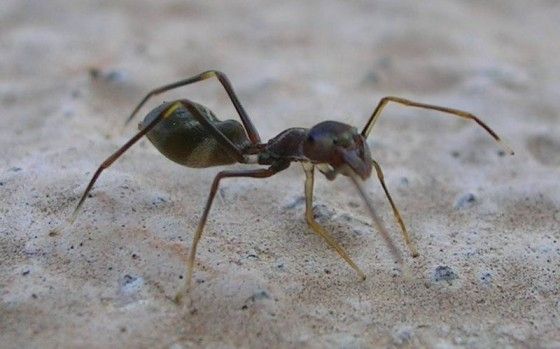
Ant Mimicry
Click image for larger version

Name:	Ant-Mimcry-560x349.jpg
Views:	148
Size:	44.1 KB
ID:	307486
Interestingly enough, there are hundreds of spider species – most of them jumping spiders – that closely resemble ants. Yes, that is a spider in the above image. Some of these arachnids use this disguise to hunt insects that are unafraid of ants, or protect themselves from predators that prefer to eat spiders. Others, of course, may prey upon the ants themselves, like wolves in sheep’s clothing.
<iframe width="480" height="360" src="http://www.youtube.com/embed/0fu4rkZ-Zi0" frameborder="0" allowfullscreen></iframe>


Dummy Spiders
Click image for larger version

Name:	Dummy-Spiders.jpg
Views:	171
Size:	23.3 KB
ID:	307487
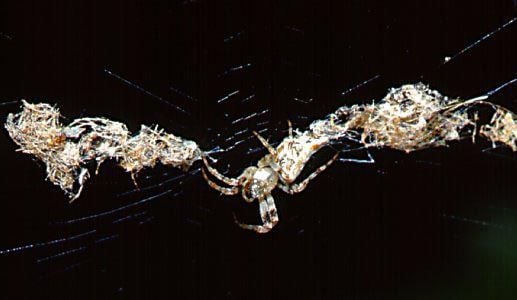
Spiders can end up with a lot of junk hanging in their webs with them, so they might as well put it to use. Some species will bundle up silk, old prey remains and detritus into clumps around the same size, shape and color as themselves, creating a row of “false” spiders they can hide amongst. This is useful to confuse flying predators such as dragonflies, robber flies or small birds who may attempt to swoop by and pluck a tasty spider from its web.

Fake poop
Click image for larger version

Name:	fake-poop-509x400.jpg
Views:	2416
Size:	53.3 KB
ID:	307488
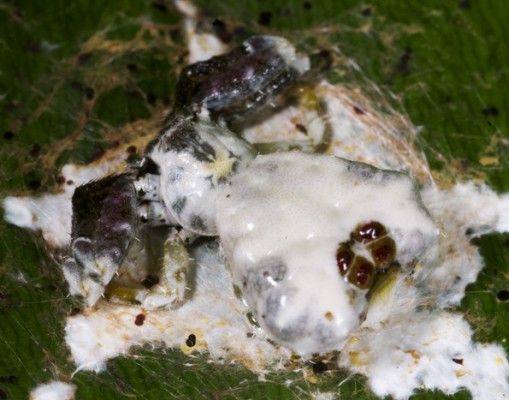
Celaenia excavata is not the only spider to imitate disguise itself as a wad of bird excrement, but it certainly sports the most convincing disguise. Not only is the spider’s body colored exactly like bird poo (complete with a seed-like spot!) but it sits atop a highly convincing “splatter” fashioned from its own silk. It’s the perfect disguise for a spider, since it’s highly unappetizing to spider-eating animals but looks enticingly tasty if you happen to be, say, a fly.

Colonial super-webs
Click image for larger version

Name:	super-webs-560x358.jpg
Views:	130
Size:	48.3 KB
ID:	307489
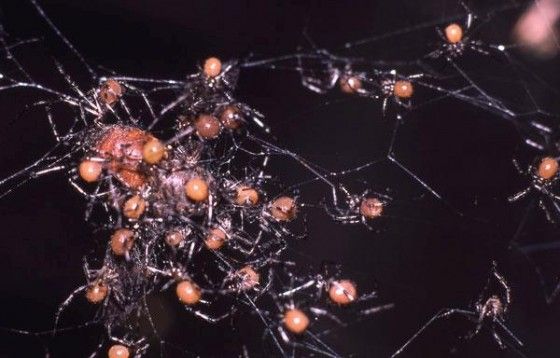
Most spiders are aggressively solitary, treating even their own species as just an edible invader in their territory. A few species, however, are highly social and may build tremendous, complex web systems shared by thousands of individuals. One such spider is Eduador’s Theridion nigroannulatum – these spiders hang upside-down in large groups, dangling hundreds of silk strands to the ground. When a large insect brushes by these tripwires, dozens of spiders may drop down together and wrap it in silk.

Hang-gliders
Click image for larger version

Name:	ballooning.jpg
Views:	277
Size:	15.4 KB
ID:	307490
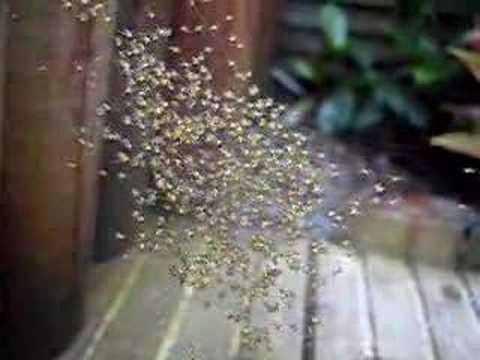
Newly hatched or very small spiders can often travel thousands of miles by a process called “ballooning.” A special kind of silk called “gossamer” is produced that easily catches on the wind, and forms into a triangular parachute that may remain airborne for weeks at a time, even allowing spiders to colonize distant islands

Handheld mini-webs
Click image for larger version

Name:	mini-webs-449x400.jpg
Views:	253
Size:	32.4 KB
ID:	307491
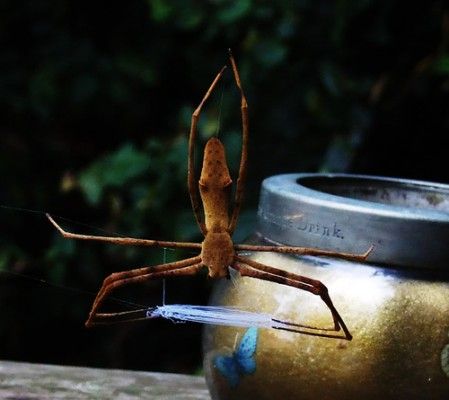
The “ogre faced” or “net casting” spiders of order Deinopidae hang upside down from just a few strands of silk, holding an unusuall small, dense web between their front legs they use to physically reach out and scoop up passing insects. The silk of this special net isn’t sticky, but so fuzzy that it instantly entangles the hairs and joints of insects like velcro, allowing the spider to trap fairly large and powerful insects with only a small amount of silk.
<iframe width="560" height="315" src="http://www.youtube.com/embed/tS8FwAouK8A" frameborder="0" allowfullscreen></iframe>

False advertising
Click image for larger version

Name:	false-advertising-560x373.jpg
Views:	142
Size:	62.3 KB
ID:	307492
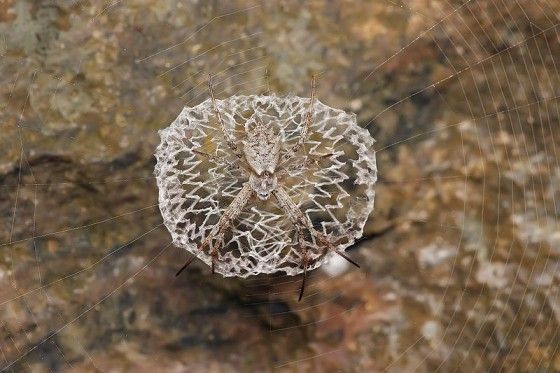
Many garden spiders construct webs with a distinct pattern of thick silk at the center, the purpose of which was long debated. We now know that this special silk is reflective to UV light, creating patterns similar to those used by flowers to attract their insect pollinators.

Fatal attraction
Click image for larger version

Name:	fatal-attraction.jpg
Views:	205
Size:	111.2 KB
ID:	307493
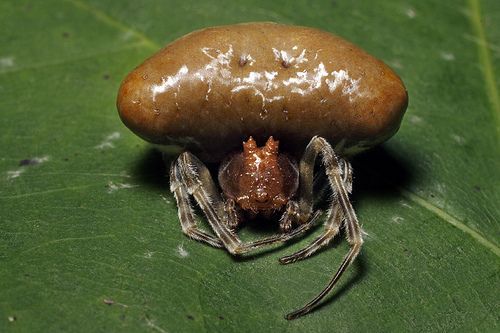
The bizarre “bolas spiders” or Mastophorea use their silk in a manner unlike any other arachnid group, secreting a dense, round glob of glue on the end of a single long “fishing line”…complete with lure. Each species of bolas spider emits a pheromone attractive to the males of a different moth species, who come looking for a lady-moth only to get whacked in the face by the spider’s goo-ball.
<iframe width="480" height="360" src="http://www.youtube.com/embed/2UfMJJAzvbI" frameborder="0" allowfullscreen></iframe>

Scuba tanks
Click image for larger version

Name:	scuba-tanks-533x400.jpg
Views:	249
Size:	50.9 KB
ID:	307494
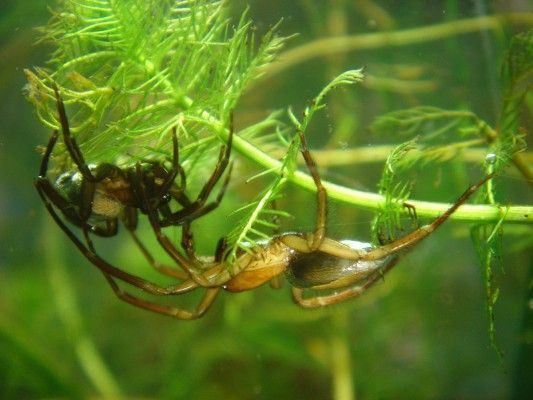
Argyroneta aquatica is one of the only true spiders that can be found completely underwater, earning it the name “diving bell spider.” Its hairy abdomen can trap a thin layer of air around its breathing pores, which it carries back and forth between the surface and its underwater web. The web is structured to trap a large pocket of air – just like a man-made diving bell – where the female raises her young and consumes her prey.
<iframe width="640" height="360" src="http://www.youtube.com/embed/JqyhhSzv4Hs" frameborder="0" allowfullscreen></iframe>
<iframe width="480" height="360" src="http://www.youtube.com/embed/GidrcvjoeKE" frameborder="0" allowfullscreen></iframe>


Web Shooters
Click image for larger version

Name:	web-shooters-560x377.jpg
Views:	230
Size:	62.6 KB
ID:	307495
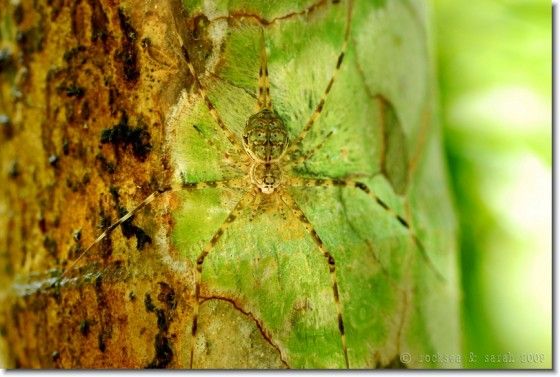
Nearly all spiders produce silk from organs called spinnerets on the tip of the abdomen, and need to be able to touch something to wrap it up in webbing. Not so for the genus Scytodes, the “spitting” spiders, who have additional silk glands connected to their mouthparts. Slowly creeping up on unsuspecting insects, the spitting spider squirts twin streams of silk that are even laced with its own venom, waving its streams back and forth to lasso prey in a criss-crossed toxic net.

<iframe width="480" height="360" src="http://www.youtube.com/embed/dqb30-YjYoY" frameborder="0" allowfullscreen></iframe>
<iframe width="480" height="360" src="http://www.youtube.com/embed/I0tvGhH6Fsk" frameborder="0" allowfullscreen></iframe>
5 Users Say Thank You For This Post:
Bastet, jovz999, redelefant, Stevee, tearsraven
▼ PROMO FROM DOCUMENTING REALITY
Your Easiest Financial Decision Today
Join Now
Hidden for upgraded members.
  #2  
09-29-2011, 04:52 PM
Kim's Avatar
Kim
Offline:
★ Legacy Member ★
Poster Rank:764
Female
Join Date: Dec 2008
Posts: 1,046
 
Mentioned: 5 Post(s)
Quoted: 11 Post(s)
Activity Longevity
0/20 18/20
Today Posts
0/11 sssss1046
Re: Spider Powers

All spiders have the power to make me run screaming like a little girl.
This User Says Thank You For This Post:
candymosh
  #3  
09-29-2011, 06:03 PM
dooshman's Avatar
dooshman
Offline:
*Born Retard*
Poster Rank:101
Dude
Join Date: Dec 2009
Posts: 16,041
 
Mentioned: 2 Post(s)
Quoted: 56 Post(s)
Activity Longevity
0/20 17/20
Today Posts
0/11 ssss16041
Re: Spider Powers

Spiders, when they initially bite into their prey, will inject it with digestive enzymes, similar to the type we have in our own stomachs. These enzymes breaks down the prey's insides, turning virtually everything into a protein-enriched soup. After an hour or more of leaving its prey idle, the spider will then return and proceed to "drink" its victims insides until he/she has had its fill and is ready to discard the dried-out remains.
This User Says Thank You For This Post:
juanmigual
  #4  
09-29-2011, 08:09 PM
collaredgirl65's Avatar
collaredgirl65
Offline:
Smartest Retard
Poster Rank:188
Female
Join Date: Feb 2010
Posts: 8,011
 
Mentioned: 1 Post(s)
Quoted: 34 Post(s)
Activity Longevity
0/20 17/20
Today Posts
0/11 sssss8011
Re: Spider Powers

For as creepy as I think spiders are, this was a very informative post.
  #5  
09-30-2011, 05:54 AM
redelefant's Avatar
redelefant
Offline:
My Rank: SERGEANT
Poster Rank:1134
m
Join Date: Mar 2010
Posts: 571
 
Mentioned: 0 Post(s)
Quoted: 38 Post(s)
Activity Longevity
0/20 17/20
Today Posts
0/11 ssssss571
Re: Spider Powers

  #6  
09-30-2011, 09:15 AM
Bastet's Avatar
Bastet
Offline:
My Rank: FIRST SERGEANT
Poster Rank:393
Join Date: Apr 2011
Posts: 3,054
 
Mentioned: 2 Post(s)
Quoted: 276 Post(s)
Activity Longevity
0/20 16/20
Today Posts
0/11 sssss3054
Re: Spider Powers

I'm obviously a rather eccentric person, since I love spiders and also can't help being amazed of how diverse and capable creatures they are. Great post
  #7  
09-30-2011, 12:12 PM
DelightfulEnglish's Avatar
My Rank: LANCE CORPORAL
Poster Rank:2613
Join Date: Aug 2011
Posts: 162
 
Mentioned: 0 Post(s)
Quoted: 60 Post(s)
Activity Longevity
0/20 15/20
Today Posts
0/11 ssssss162
Re: Spider Powers

Bootiful! My favourite animal. I have over 100, including 5 of the above.
This User Says Thank You For This Post:
Faline
  #8  
09-30-2011, 04:12 PM
Faline's Avatar
Faline
Offline:
My Rank: MAJOR
Poster Rank:11
Join Date: Jun 2009
Posts: 93,130
Contributions: 226
 
Mentioned: 91 Post(s)
Quoted: 2009 Post(s)
Activity Longevity
0/20 18/20
Today Posts
0/11 ssss93130
Re: Spider Powers

They scare the fucking shit out of me but amaze me at the same time
  #9  
10-01-2011, 02:26 PM
candymosh's Avatar
candymosh
Offline:
My Rank: MAJOR
Poster Rank:186
Join Date: Dec 2009
Posts: 8,081
 
Mentioned: 0 Post(s)
Quoted: 42 Post(s)
Activity Longevity
0/20 17/20
Today Posts
0/11 sssss8081
Re: Spider Powers

  #10  
10-01-2011, 11:00 PM
**butterflylove**'s Avatar
Australia Mate!
Poster Rank:339
I have a map of Tasmania
Join Date: Aug 2009
Posts: 3,720
 
Mentioned: 1 Post(s)
Quoted: 86 Post(s)
Activity Longevity
0/20 17/20
Today Posts
0/11 sssss3720
Re: Spider Powers

the "fake poo" disguise......must remember that idea


Powered by vBulletin Copyright 2000-2010 Jelsoft Enterprises Limited.

Search Engine Friendly URLs by vBSEO