|
#1
●
01-04-2013, 03:02 PM
| ||||||||
 My Rank: MASTER SERGEANT Poster Rank:424 Join Date: Jun 2011 Posts: 2,775
Contributions: 3
Mentioned: 13 Post(s) Quoted: 471 Post(s)
| ||||||||
|
Sex and the Century: Why the Art of the Enlightenment Was So Saucy
The forthcoming auction of an 18th-century sex manual reminds us that racy scenes were all the rage in the art of the period  Everyone was enjoying sex all the time in the 18th century, to judge by its art. The century of the American and French revolutions was also a time of open-minded, unstuffy attitudes to love and desire. News that a 1766 edition of a popular sex manual called Aristotle's Masterpiece is to be auctioned next week in Edinburgh is incitement enough for us to explore some Enlightenment erotica. The most important thing about Aristotle's Masterpiece, first published in the 1680s, was its advice that women needed to experience sexual pleasure as part of the reproductive process. This argument for equality in bed chimes with images of the boudoir as a female domain in Rococo art. William Hogarth's satirical depiction of an aristocratic bedroom from his series of paintings Marriage à la Mode shows a countess at her toilette surrounded by flunkeys (including a eunuch singing opera) while her lover suggests they meet later at a masked ball. Her bed is a pink curtained place of pleasure. What Hogarth laughs at, French Rococo artists indulge. Antoine Watteau's intimate painting of a woman naked in her bedroom is based on a sketch of one of his friends. But the most daring nude in 18th-century art is surely François Boucher's portrait of Marie-Louise O'Murphy lying on her stomach on a divan. Mademoiselle O'Murphy, daughter of an Irish emigre and mistress of Louis XV, shows the artist her buttocks in a self-consciously sexy pose. 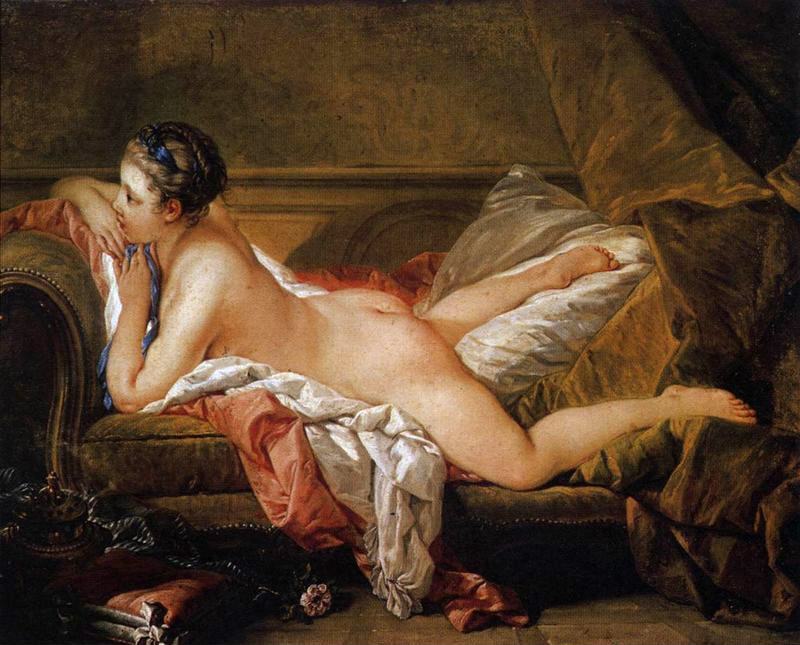 Not that love needed a velvet-draped boudoir. A clump of bushes would do, as Hogarth illustrates in his paintings Before and After. Country pleasures start with kisses and end in exhaustion.   It seems that sex could be found anywhere in an age that celebrated quick thrills. In the Regency cartoonist Thomas Rowlandson's picture The Exhibition Stare-Case, "connoisseurs" are examining the underwear of women who have fallen down the spiral staircase at the Royal Academy (today, the same staircase serves the Courtauld Gallery).  Rowlandson drew his saucy scene in the early 1800s, when louche attitudes still flourished, but by the Victorian age artists – at least in Britain – would be a lot more respectable, religious, and vague. The famous pre-Raphaelite painting The Awakening Conscience shows a mistress seeing the light about her sinful life. A century earlier, this trite painting would have seemed just as absurd and funny as it does today. 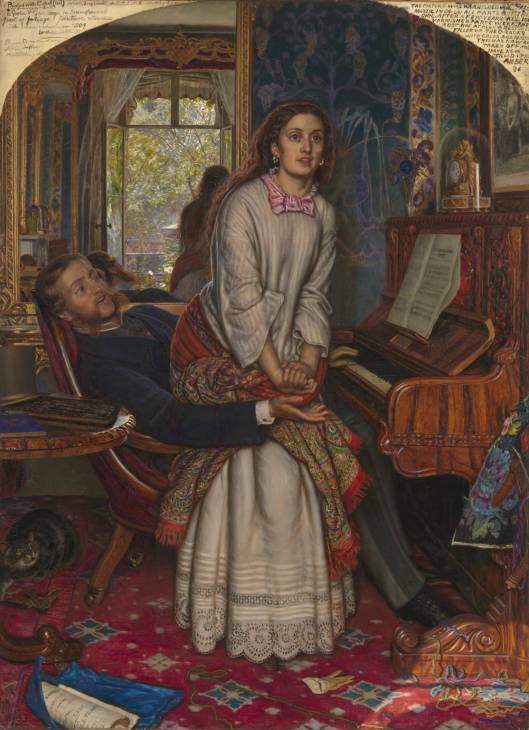 · |
|
#2
●
01-04-2013, 03:05 PM
| ||||||||
| My Rank: MASTER SERGEANT Poster Rank:424 Join Date: Jun 2011 Posts: 2,775
Contributions: 3
Mentioned: 13 Post(s) Quoted: 471 Post(s)
| ||||||||
|
Re: Sex and the Century: Why the Art of the Enlightenment Was So Saucy
Formerly banned sex manual to go under the hammer in Edinburgh An early manual on sex and pregnancy, which was banned from sale in the UK for more than 200 years will go under the hammer this month. Aristotle's Compleat Master-Piece first appeared around 1680. It sets out ideas on sexual relationships and how to conceive. It was banned in the mid-18th century and remained a forbidden text until the prohibition was lifted in the 1960s. An edition printed in the 1760s is expected to fetch up to £400 when it goes on sale at Edinburgh auction house Lyon and Turnbull. Cathy Marsden, a book specialist at the auctioneers, said: "It was very popular. It was probably the most printed text of its kind and it went through a lot of editions. It's fascinating reading. It tells an amazing story about the changing perspectives on sex." The book is thought to have served as a reference guide for amateur midwives and young married couples. It includes dire warnings about the possible consequences of extramarital sex. "There's nothing in it that would really be considered dirty in our society now. It's funny more than anything," Marsden said. "There are various things which warn parents about what could happen to their children if they sinned whilst conceiving them, perhaps by having sex outside marriage. It would say that your baby would be born all hairy or it would suggest that conjoined twins were the result of the parents' sins. "There are also interesting bits about the 17th century notion that it was considered beneficial for a woman to enjoy sexual intercourse in order to conceive. It suggests that both men and women should enjoy sex. "That's interesting because much later on, when they realised that a woman didn't have to climax in order to conceive, the idea of a woman enjoying sex was considered far less important." The book was attributed to Aristotle but there is little, if any, of his work in the text. Nothing is known of the actual author of the piece. Marsden said: "We don't really know why it was attributed to Aristotle but one possibility is that they were just trying to make it sound better or more worthy than it might have been." She added that the book ban probably occurred around the middle of the 18th century, a time when various legal cases saw several books deemed too rude to be allowed for sale. It remained banned in the UK until 1961, although it could be legally obtained in countries such as New Zealand throughout the Victorian era. Marsden said the pictures in the book are thought to be one of the main reasons it became a forbidden text. "To our eyes they're not graphic at all," she said. "There's one image of a baby in a womb and the woman's torso has been 'cut open' to show the baby. "There are other images of hairy children or children with their mouths where their navels are. They are very strange images." But the banned book continued to thrive in a vibrant black market. "It was very popular whilst it was banned. You could certainly buy it under the counter," said Marsden. Simon Vickers, also a book specialist at Lyon and Turnbull, said: "Drawing from the works of Nicholas Culpeper and Albertus Magnus, with a good dose of old wives' tale, there were more editions of this work published in the 18th century than any other medical text. However, Aristotle's Compleat Master-Piece slowly began to be considered highly distasteful and even downright lewd and was banned in Britain until 1961." A cutting from 1930s newspaper advice column is said to have included a question from a reader asking where a copy of the book could be obtained. Apparently contradicting itself, the reply stated: "You may not buy a copy of Aristotle's Complete Master-Piece. You may expect to pay three-and-sixpence." The edition being auctioned at Lyon & Turnbull is thought to have been published around 1766. It will go under the hammer in Edinburgh on 16 January. |
|
#3
●
01-07-2013, 06:17 AM
| ||||||||
 USER REQUESTED BAN Poster Rank:241 Join Date: Apr 2012 Posts: 5,989
Contributions: 1
Mentioned: 9 Post(s) Quoted: 779 Post(s)
| ||||||||
|
Re: Sex and the Century: Why the Art of the Enlightenment Was So Saucy
i'd love to read this book because attitudes towards sex have changed a lot and i bet the language was quirky too.
|
|
#4
●
01-16-2013, 03:12 PM
| ||||||||
 My Rank: PRIVATE FIRST CLASS Poster Rank:4859 Join Date: Jul 2009 Posts: 56 Mentioned: 0 Post(s) Quoted: 2 Post(s)
| ||||||||
|
Re: Sex and the Century: Why the Art of the Enlightenment Was So Saucy
Meh. They probably figured their married lifes went down south and nothing in this really worked out properly. Based on our divorce rate right now the generation succeeding us might either take actions of similar amplitude or abandon marriage alltogether. When they do either ones they need myths. We simply live with myths the best. We need scientists to give us dogmata, buddhists to soothe our angst of dying, lobbies to tell others our rights are at the foremost and institutions to encourage us its allright to take these rights, despite whatever former norms we are clashing with. To make it short, myths and overthrowing them are part of the game. I even think there is no concept of 'process' in humanism. We just piss about in it to our liking and inevadably throw ourselfs back to square one every now and then. Sure it does keep us moving though and movement brings sight.  · |