|
#1
●
11-02-2011, 09:54 AM
| ||||||||
 My Rank: MAJOR Poster Rank:12 Join Date: Jun 2009 Posts: 93,128
Contributions: 226
Mentioned: 91 Post(s) Quoted: 2009 Post(s)
| ||||||||
|
Scariest Freshwater Animals
Piranha Notorious for their sharp teeth and voracious appetities, piranha inhabit several of the major river basins in South America. These omnivorous fish are known for their taste for meat, although attacks on human beings are quite rare, despite breathless accounts from early explorers. In an historic visit to Brazil, Theodore Roosevelt famously saw a group of piranhas shredding pieces of a cow carcass in seconds. His dramatic account would color popular imagination for years, even though it was based on a manipulated spectacle, in which fishermen blocked off a group of the fish and starved them beforehand. Stil, piranha are important scavengers and predators in their native rivers, and they often resort to cannibalism if food gets scarce. It's true that local fishermen occasionally have scars from close encounters with them. It's unknown how many species of piranha exist, with estimates ranging from 30 to 60. 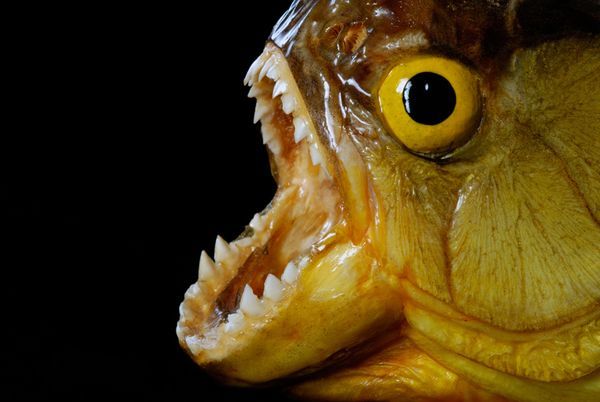 http://en.wikipedia.org/wiki/Piranha Electric Eel Elekra the electric eel (Electrophorus electricus) demonstrates her shocking power at Ford Motor Company's "Cycle of Production" exhibit at the 1939 New York World's Fair. Despite their name, electric eels are actually a type of knifefish and are more closely related to catfish than they are to true eels. These unusual fish inhabit waterways in the Amazon and Orinoco basins of South America, where they hunt prey and defend themselves by producing powerful burts of electricity. Electric eels gulp air from the surface in order to breathe. Thanks to specialized internal organs, they can produce pluses of elecricity greater than 500 volts, with a current greater than one amp. That's enough to kill an adult human being. Electric eels mostly hunt invertebrates, though adults also consume fish and small mammals. They only attack human beings if they are disturbed. They tend to live in murky, stagnate waters. Scientists have long been fascinated by the species, and have probed its impressive electrical abilities. 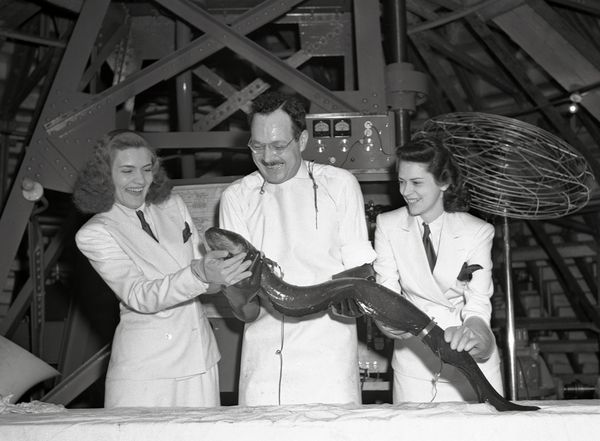 http://en.wikipedia.org/wiki/Electric_eel Goliath Bird-eater Spider The second largest spider in the world, the goliath bird-eater (Theraphosa leblondi) is related to tarantulas. It received its fearsome name after Victorian explorers witnessed one feasting on a hummingbird. The big spiders inhabit marshy land in the rain forests of nothern South America, where they can grow to a leg span of up to 12 inches (30 cm) and can weigh more than six ounces (170 grams). As in many other spiders, females may eat the males after mating. Partially as a result, males have a lifespan of three to six years, while femaies have a lifespan of 15 to 25 years. Despite their name, birds are not the main prey of the goliath bird-eater. They prefer to eat insects and other invertebrates, although they will occasionally eat small vertebrates. The big spiders are not generally considered dangerous to human beings, although they can bite if disturbed, leaving a wound about as painful as a wasp sting. They can also release hairs that irritate the skin. 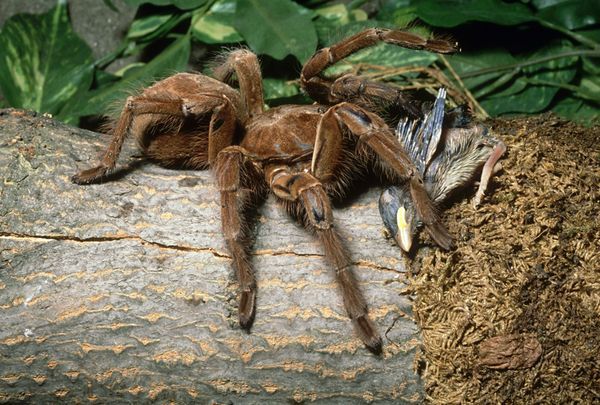 http://en.wikipedia.org/wiki/Goliath_birdeater Tiger Fish Widely distributed across much of Africa, tiger fish are fierce predators with large, razor-sharp teeth. They often hunt in packs and occasionally take large animals. Attacks on human beings are rare but not unheard of. The two largest species are the goliath tiger fish (Hydrocynus goliath) and the Hydrocyon vittatus, which is commonly called the tiger fish. Both are prized as game fish. The goliath tiger fish, which can reach sizes up to 110 pounds (50 kg), is found in the Congo River and Lake Tanganyika. H. vittatus can weigh up to 33 pounds (15 kg) and is found in the Zambezi River system. 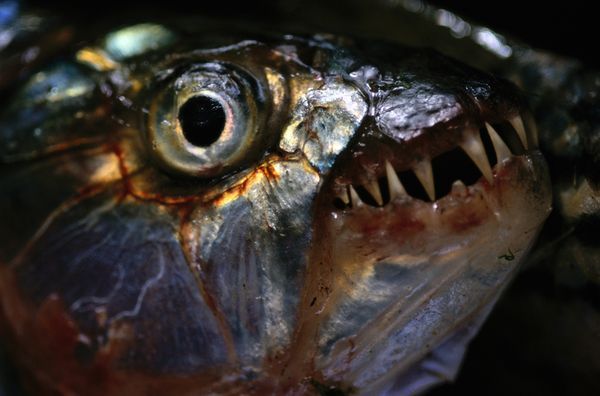 http://en.wikipedia.org/wiki/Tigerfish Nile Crocodile A year-old Nile crocodile attempts to snap up a frog in the St. Lucia Estuary in South Africa (from the National Geographic book Visions of Earth). Also known asthe common crocodile, these large reptiles are distributed across much of Africa, and they have earned their reputation as among the most ferocious, deadly animals on the planet. Male crocs typically measure from 11.5 to 16 feet long (3.5 to 5 meters), but they have been known to exceed 18 ft (5.5 m) in length. Individual crocodiles attack anything the same size or smaller than them. They are occasionally known to hunt in packs, in which they can take down animals as large as hippos and rhinos. Nile crocodiles occasionaly prey on human beings, with estimates ranging from several hundred to several thousand deaths a year. The ancient Egyptians feared and reveared Nile crocodiles, and worked them into their mystic religions. In modern times, the big animals were heavily hunted for their leather, although recent protections have helped stabilize the population at an estimated 250,000 to 500,000. 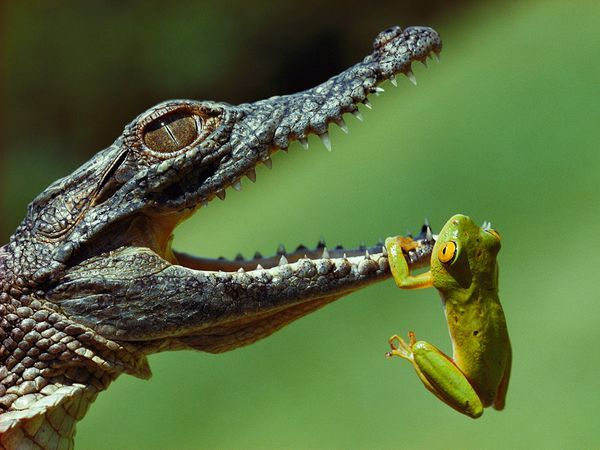 http://en.wikipedia.org/wiki/Nile_crocodile Snakehead Snakeheads are often feared in the West, where populations of the aggressive fish have occasionally taken root as invasive species. After a fisherman found a Northern snakehead (Channa argus) in a pond in Maryland, it caused a media sensation. Biologists warned that the large freshwater fish could readily become established in North America, where it could wreak havoc on native ecosystems. The voracious top-level predators can reach a length of three feet (1 meter). They prey on invertebrates, frogs and smaller fish, though they are known to attack anything moving when they are breeding. Snakeheads can breathe air and can survive out of water for up to four days. They can survive much longer periods of drought by burrowing into the mud. Several species of the fish are native to much of Asia, where they are commonly caught and are prized for the dinner table. They are also frequently kept as aquarium fish, and are noted for their aggressive behavior. 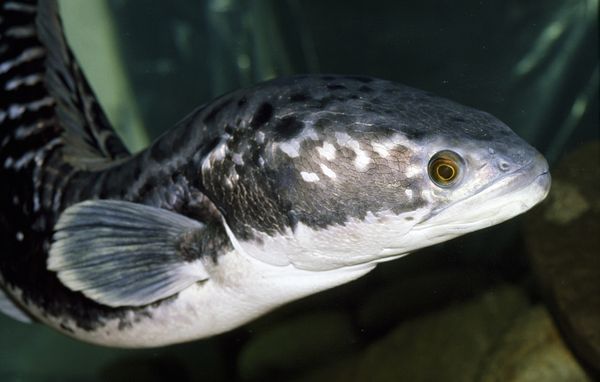 http://en.wikipedia.org/wiki/Snakehead_(fish) Mata Mata A mata mata (Chelus fimbriatus) is a freshwater turtle that inhabits the Amazon and Orinoco basins in South America. The bizarre turtles are entirely aquatic, although they prefer shallow, stagnant water, where they can easily reach their head out of water to breathe. The mata mata can grow quite large, up to 33 pounds (15 kg). They feed on invertebrates and fish and aren't dangerous to people, despite their primoridal appearance. The mata mata is fairly senstive to water quality, both in captivity and in the wild, so they can be harmed by pollutants. 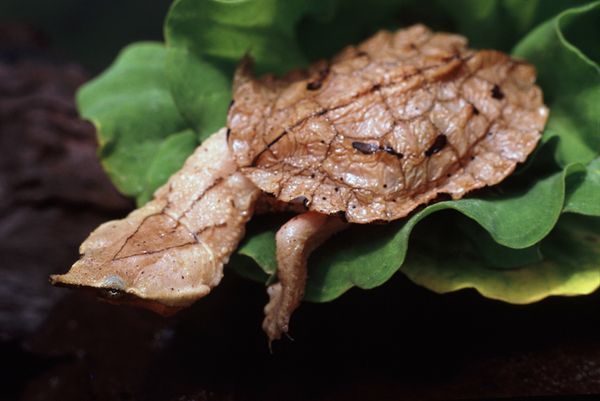 http://en.wikipedia.org/wiki/Matamata Giant Catfish Divers with model European catfish in the Great Lake at Ostersund in north Sweden. Large catfish live in many rivers throughout the world, where they are important scavengers. The largest on record is the Mekong giant catfish, which has reached recorded sizes up to 10.5 feet (3.2m) and 660 pounds (300 kg). Once distributed across several countries in Southeast Asia, the Mekong giant catfish is now critically endangered, thanks to habitat disruption. Not much is known about the world's biggest freshwater fish, although conservation efforts are underway. Big catfish are rarely considered dangerous to people. The Mekong species can live to be more than 60 years old. 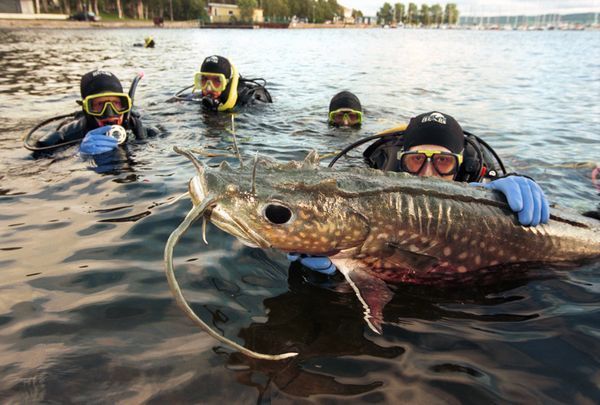 http://en.wikipedia.org/wiki/Mekong_giant_catfish Diving Bell Spider The diving bell spider (Argyroneta aquatica) is the only known spider in the world that lives entirely underwater. Like other arachnids, it must breathe air, but it provides its own supply by forming a bubble, which it holds by hairs on its legs and abdomen. The spiders must occasionally return to the surface to replenish their air supply, although some gas exchange happens across the surface of their bubbles, so they don't have to come up very often. The diving bell spider is found in northern and central Europe and parts of northern Asia. Unusual for spiders, the males are bigger than the females, perhaps because the males are more active hunters. The spiders can inflict a painful bite that is often accompanied by feverish symptoms. Those who are afraid of spiders may be disturbed to know they may not be safe from them, even in the water. 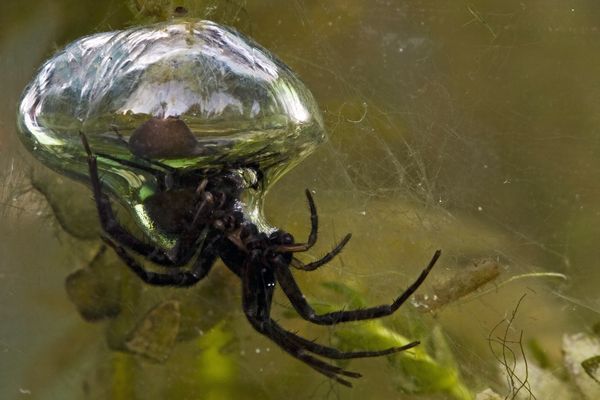 http://en.wikipedia.org/wiki/Diving_bell_spider Anaconda Animal handlers hold a 19-foot anaconda at the Zoological Gardens. Among the world's largest snakes, anacondas live in rivers and wetlands of South America. The word anaconda is thought to come from the Tamil word anaikolra, which means elephant killer, alluding to the reptile's fearsome reputation. Anacondas feed on fish, birds, reptiles and small mammals, though they have been known to take the occasional domestic animal. The big snakes can be dangerous to people, though reports of deliberate predation are very rare. Like other boas, anacondas are non-venomous, and they often kill their prey by contsricting it. Like other snakes, they swallow their prey whole.  http://en.wikipedia.org/wiki/Anaconda Giant Freshwater Stingray As National Geographic previously reported, freshwater stingrays are known to inhabit rivers in Southeast Asia and northern Australia, where they can reach enormous proportions, measuring up to 16.5 feet (5 meters) long and up to 1,320 pounds (600 kilograms). However, very little is known about these creatures, including how many are left, and if they ever enter saltwater. Freshwater stingrays are hard to see, because they often bury themselves in river sediments. They hunt for clams and crabs by detecting their electric impulses. There are reports of the big animals overturning boats, though they rarely attack people. Even so, the stingrays can pack a powerful punch; they have a barb at the base of their tale that contains deadly poison and a stinger as long as 15 inches (38 cm). Many scientists fear that freshwater stingrays are threatened by habitat loss and pollution. 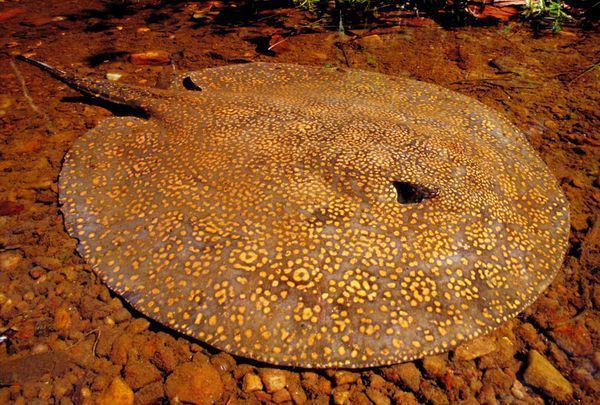 Vampire Fish Fanged vampire fish, or payara (Hydrolycus scomberoides), are offered at market in Pevas, Peru on the Amazon River. This fearsome, little known fish is prized for its meat in the Amazon and Orinoco basins. Vampire fish prey primarily on smaller fish, especially piranhas, which they impale with their long, sharp fangs. The intimidating teeth can grow up to six inches long. 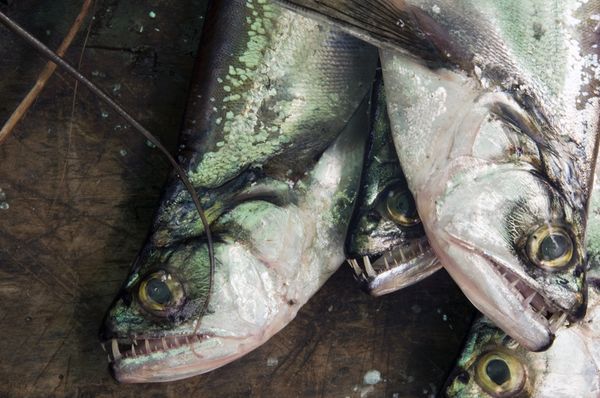 http:/en.wikipedia.org/wiki/Candiru Candiru Perhaps the most feared freshwater species of all, candiru are parasitic catfish in the family Trichomycteridae. These small, narrow fish normally feed on the gills of larger fish in the Amazon. However, over the past few centuries there have been reports of these creatures lodging in the urethras of men and women. Some native peoples along the Amazon have described means of preventing such a disturbing infection, which is said to be hard to remedy, even with surgery. Protection measures are said to include tough clothing, tying off extremities with ligatures and avoiding urination around rivers. It was long believed that urine attracted the candiru, although a recent study showed that the animals displayed no interest in it. There are very few documented cases of candiru attacks on human beings, and a much discussed incident from 1997 has been met with considerable skepticism. Further, with an average width of a quarter of an inch and average length of three inches, the fish are a little large to enter a urethra. Still, the prospect remains frightening enough to keep many out of tropcial waters, even far away from the candiru's range. 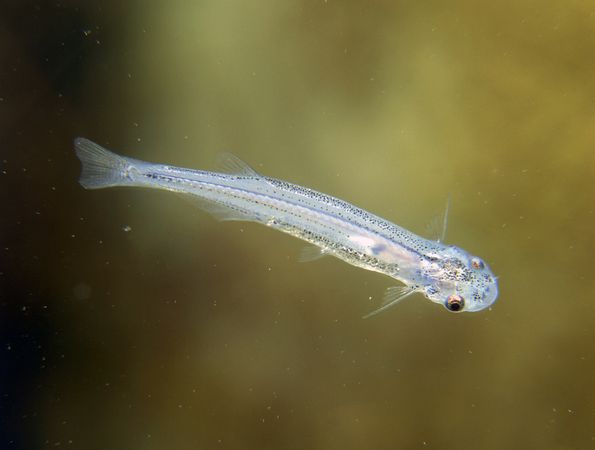 http://en.wikipedia.org/wiki/Candiru |
|
#4
●
11-02-2011, 12:46 PM
| ||||||||
 allergic to socialism Poster Rank:162 as if you retards know the difference between male or female. Join Date: Jul 2009 Posts: 9,557 Mentioned: 1 Post(s) Quoted: 325 Post(s)
| ||||||||
|
Re: Scariest Freshwater Animals
the candiru - urethra fact is a myth.
|
|
#9
●
11-11-2011, 09:56 PM
| ||||||||
| So Fucking Banned Poster Rank:81 Join Date: Oct 2011 Posts: 18,665
Contributions: 2
Mentioned: 1 Post(s) Quoted: 10 Post(s)
| ||||||||
|
Re: Scariest Freshwater Animals
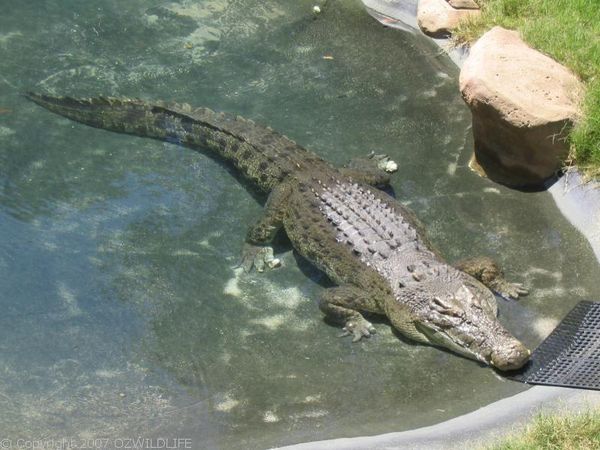 Holey The biggest saltwater crocodile (they live in freshwater, by the way) that I've ever seen. That picture does not do him (I think it was male) justice. I'd say just a touch under 5 metres long, and just straight up huge. When we first saw it, it took a moment to realise that it was real and not just one of those big-ass statues they put out the front for kids to get photos with. |
|
#10
●
11-11-2011, 09:57 PM
| ||||||||
| So Fucking Banned Poster Rank:81 Join Date: Oct 2011 Posts: 18,665
Contributions: 2
Mentioned: 1 Post(s) Quoted: 10 Post(s)
| ||||||||
|
Re: Scariest Freshwater Animals
Found a better picture.  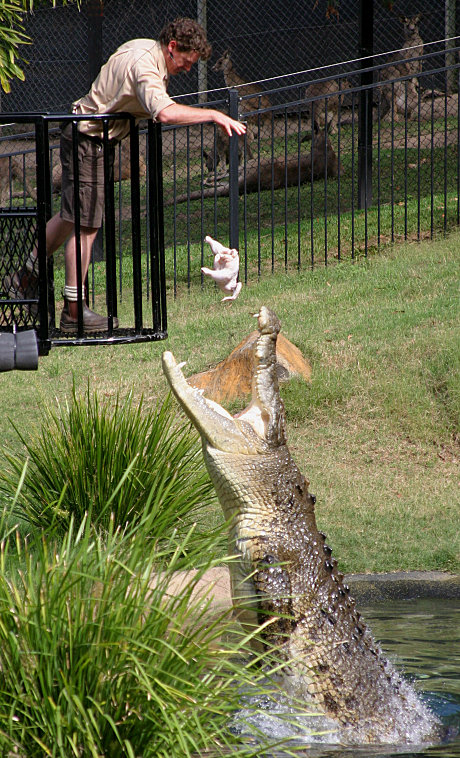 |