|
#1
●
02-28-2013, 02:56 PM
| ||||||||
 My Rank: MASTER SERGEANT Poster Rank:416 Join Date: Jun 2011 Posts: 2,775
Contributions: 3
Mentioned: 13 Post(s) Quoted: 471 Post(s)
| ||||||||
|
Rosalind Franklin - the Woman Science Forgot
Through a tragic twist of events, and no small measure of sexism, the name Rosalind Franklin has all but submerged beneath the waves of history. Yet she had a hand in perhaps the most important scientific achievement of the 20th century - the discovery of the structure of DNA, an event which was pronounced on this day 60 years ago. Fellow scientists Francis Crick and James Watson secured their stars in the scientific firmament when they were awarded the 1962 Nobel prize for this landmark discovery. By this time Franklin had died of ovarian cancer aged 37, after having had her work "lifted" by colleagues and then been deliberately shut out of her chosen field of research. This is her story. Franklin was born in London's Notting Hill in 1920. Possessed of a logical and incisive mind, she decided while still a teenager that she wanted to become a scientist. Needless to say this was a much frowned upon career choice for a woman at the time. Franklin had a battle on her hands right from the off. After she passed the entrance exams for Cambridge University, her father announced that he was not going to pay her fees. Although relatively wealthy, he disapproved of university education for women. However with the backing of her aunt and her mother, her father finally relented. Franklin took to science naturally. She graduated in 1941 and then went on to research the properties of coal - an important wartime question - for her PhD, completing her studies in 1945. After this she embarked upon research using the technique that was to prove so vital to the elucidation of DNA - X-ray crystallography. If you've ever wondered how scientific diagrams of molecules are created, given that individual atoms are far too small to be seen, X-ray crystallography is often the answer. Focussing a beam of X-rays onto a crystalline solid causes the beam to diffract into many different directions. By measuring the angles of these beams a scientist can build up a picture of the positions of the atoms in the substance. It's a technique that's very mathematically difficult. It's been likened to having a set of snooker balls arranged in a mystery shape, then having broken them using the cue, using the balls' final resting positions to calculate their original positions. No mean feat. In 1951 Franklin went to London to start work as a research associate at King's College with a scientist called Maurice Wilkins and a PhD student called Raymond Gosling who had already begun using X-ray crystallography on DNA. And here an aside. Although Watson and Crick are often credited with discovering DNA, this is not the case - it was in fact discovered by Swiss chemist Friedrich Miescher, who isolated what he termed "nuclein" from white blood cells in the 1860s. Watson and Crick received their accolade for, specifically, determining DNA's structure. Miescher hadn't been on the hunt for DNA - indeed no-one at the time had any inkling that it even existed - rather he had been trying to extract the protein components of the cells. He realised he'd stumbled upon something rather different by the substance's high phosphorus content. But no-one else seemed to think that his discovery was very interesting and "nuclein" was all but ignored for many years. The substance under investigation by Franklin, Wilkins and Gosling - and separately at Cambridge by Watson and Crick - was regarded by most within the scientific community as rather unprepossessing. Few suspected it could be responsible for transmission of hereditary traits. And there was good reason behind this. Although the exact structure of DNA was unknown, what was known was that it was made up on just four types of subunit, known as nucleotides. These are guanine, adenine, thymine and cytosine - the now famous G, A, T and C that form the genetic "language." But at the time it was asked how such a simple type of substance could have such an important biological role, especially in comparison with proteins - seen as the most likely contenders for containing genetic information - which have 20 different types of subunit with all sorts of different and interesting properties. Even old Miescher had been focusing on proteins as the subject of his research. But back to Franklin. She made some significant advances in X-ray techniques, focussing the rays into finer beams and making use of finer DNA fibres than before, all of which culminated in a diffraction image that has been nicknamed Photo 51. The great communist scientist JD Bernal called it "amongst the most beautiful X-ray photographs of any substance ever taken." The image provided essential information on the structure of DNA. The pattern of the diffracted X-rays showed that DNA consisted of a double helix with two strands running in opposite directions, and that these "backbone" strands, containing phosphorus, were on the outside of the molecule. It also indicated its physical dimensions. However, here is where history turned against Franklin. On January 30 1953 Watson travelled to King's College to visit Wilkins to suggest that they should collaborate. There was an argument, and Franklin became angry when Watson suggested she did not know how to interpret her findings. Later, without Franklin's knowledge or permission, Wilkins shared the all-important Photo 51 with their Cambridge competitors. Wilkins and Franklin had never got on. Watson and Crick then pulled ahead in the race and began building a physical model of DNA - there are famous pictures of the pair showing them posing beside it. Franklin, however, shied away from model-building. She felt that more evidence should be gathered first. According to Watson's autobiography The Double Helix, the Cambridge pair felt so confident that their model was correct that on February 28 1953 Crick announced that they had "found the secret of life." However it wasn't until later that they finally completed their double helical model, before finally publishing their discovery in the prestigious scientific journal Nature on April 25 that year. Watson and Crick invited Wilkins to be named as co-author of their paper, but Wilkins turned them down because he hadn't been involved in building the model. The Nature article contained a footnote acknowledging "having been stimulated by a general knowledge of" Franklin's and Wilkins's work. By this time Franklin had decided to transfer to Birkbeck University. Not only was her relationship with Wilkins seriously strained, King's College was not a welcoming environment for women. The male staff would eat in what has been described as a "large, comfortable, rather clubby dining room," whereas the women would eat in the students' hall. The head of King's let Franklin leave on the condition that she would not work on DNA. He also insisted that her work was property of the college, and she relinquished Photo 51 to Wilkins. Franklin returned to her studies of coal and later conducted pioneering work on viruses such as polio, publishing 17 papers in five years. She experienced the first symptoms of cancer while on a work trip to the US in 1956 and underwent chemotherapy, but she continued her research right up until her death in 1958. For Watson and Crick meanwhile, their model remained theoretical for a number of years, and it wasn't until the early '60s that it was finally proven. Watson, Crick - and Wilkins - won the 1962 Nobel prize for physiology or medicine for their genetic work. Franklin was not nominated because the rules forbid posthumous nominations. Crick eventually admitted: "I'm afraid we always used to adopt - let's say, a patronising attitude towards her." Watson however seems to have made obnoxious views something of a speciality, declaring in 2003: "People say it would be terrible if we made all girls pretty [using genetics]. I think it would be great," and in 2007 that he was "inherently gloomy about the prospect of Africa [because] all our social policies are based on the fact that their intelligence is the same as ours - whereas all the testing says not really." More recently Franklin's contribution to the discovery of DNA has begun to be acknowledged. In 1997 Birkbeck opened its Rosalind Franklin Laboratory, and in 2000 King's College London opened the Franklin-Wilkins Building. Yet it remains the names of Watson and Crick that are indelibly associated with the molecule of life. How society regarded Franklin is reflected in her death certificate. It read: "A research scientist, spinster, daughter of Ellis Arthur Franklin, a banker." 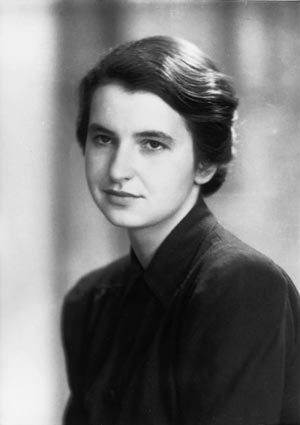 · |
|
#2
●
03-07-2013, 02:37 AM
| ||||||||
 puelling pueman Poster Rank:171 m Join Date: Apr 2010 Posts: 8,913 Mentioned: 21 Post(s) Quoted: 2948 Post(s)
| ||||||||
|
Re: Rosalind Franklin - the Woman Science Forgot
pioneering work on polio vaccines?? so she gave us AIDS and DNA....awesome!!
|
|
#4
●
03-20-2013, 07:54 PM
| ||||||||
 Born in the USA Poster Rank:123 100% female Join Date: Jul 2012 Posts: 12,876
Contributions: 1
Mentioned: 81 Post(s) Quoted: 1799 Post(s)
| ||||||||
|
Re: Rosalind Franklin - the Woman Science Forgot
Yet another example of the good ole boys club taking credit from a would-be star due to femininity. Obviously, she was brilliant.
|