JavaScript and Cookies are required to view this site. Please enable both in your browser settings.
Researchers Detail How A Distant Black Hole Devoured A Star (24/8/2011)
Documenting Reality True Crime Related Chat & Research Interesting People, Places, Things, Animals Researchers Detail How A Distant Black Hole Devoured A Star (24/8/2011)

Researchers Detail How A Distant Black Hole Devoured A Star (24/8/2011) 

Current Rating:

Unlimited Views No Ads No Algorithms Lifetime Account

Documenting Reality

Community Forum · Est. 2006

Join Now
Thread Tools
  #1  
08-25-2011, 06:11 PM
güttsfükk's Avatar
güttsfükk
Offline:
Super *********
Poster Rank:88
Join Date: Nov 2008
Posts: 17,426
 
Mentioned: 5 Post(s)
Quoted: 99 Post(s)
Activity Longevity
0/20 18/20
Today Posts
0/11 ssss17426
Researchers Detail How A Distant Black Hole Devoured A Star (24/8/2011)

Originally Posted by ~Z~
Hey I found this Nasa report, I thought it would be pertinent for the Interest section.... I just don't know how to embed that video! So if you can post it, it would be cool!
Cheers!
~Z~


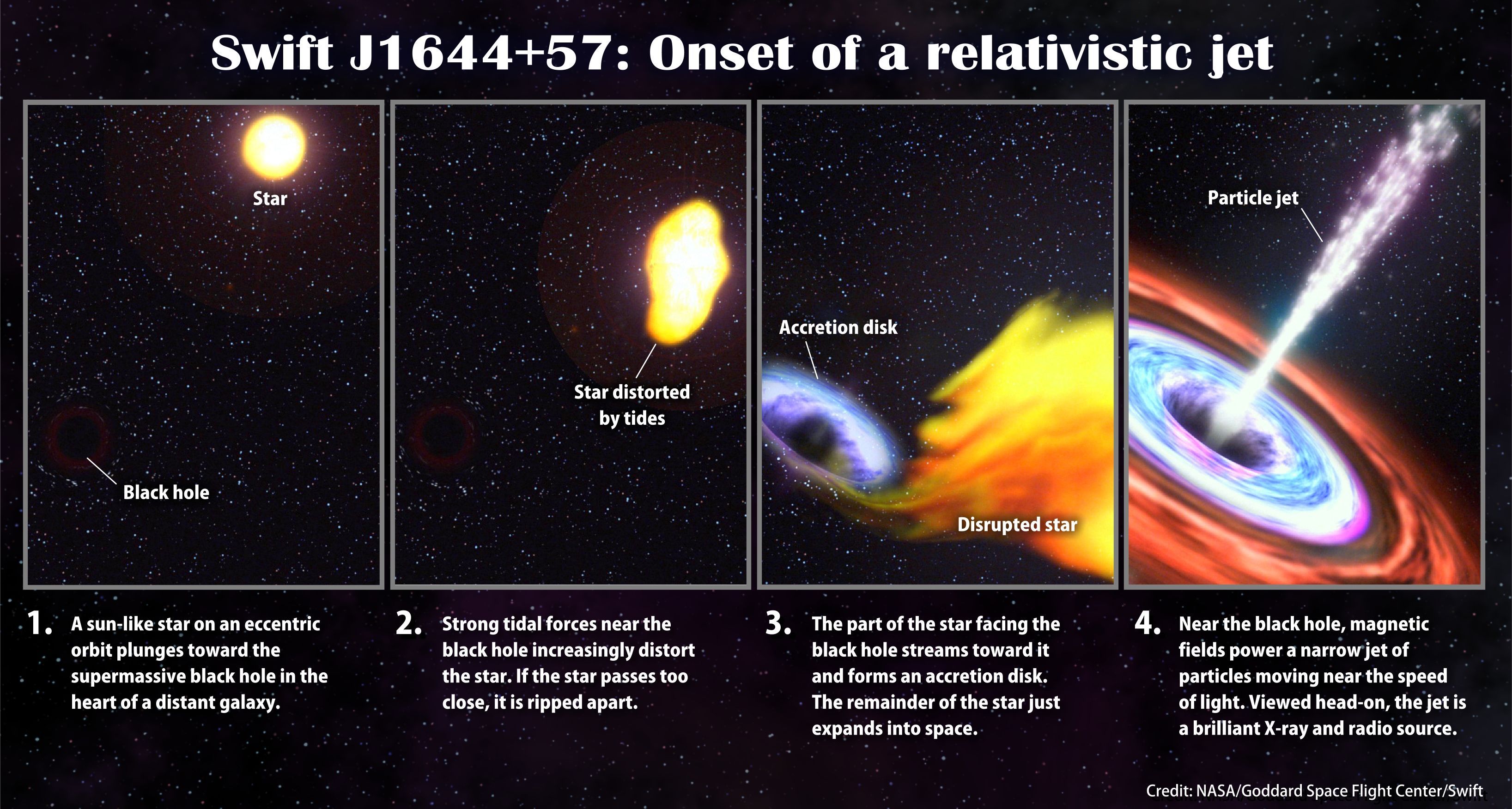
WASHINGTON -- Two studies appearing in the Aug. 25 issue of the journal Nature provide new insights into a cosmic accident that has been streaming X-rays toward Earth since late March. NASA's Swift satellite first alerted astronomers to intense and unusual high-energy flares from the new source in the constellation Draco.

"Incredibly, this source is still producing X-rays and may remain bright enough for Swift to observe into next year," said David Burrows, professor of astronomy at Penn State University and lead scientist for the mission's X-Ray Telescope instrument. "It behaves unlike anything we've seen before."

Astronomers soon realized the source, known as Swift J1644+57, was the result of a truly extraordinary event -- the awakening of a distant galaxy's dormant black hole as it shredded and consumed a star. The galaxy is so far away, it took the light from the event approximately 3.9 billion years to reach Earth.

Burrows' study included NASA scientists. It highlights the X- and gamma-ray observations from Swift and other detectors, including the Japan-led Monitor of All-sky X-ray Image (MAXI) instrument aboard the International Space Station.

The second study was led by Ashley Zauderer, a post-doctoral fellow at the Harvard-Smithsonian Center for Astrophysics in Cambridge, Mass. It examines the unprecedented outburst through observations from numerous ground-based radio observatories, including the National Radio Astronomy Observatory's Expanded Very Large Array (EVLA) near Socorro, N.M.

Most galaxies, including our own, possess a central supersized black hole weighing millions of times the sun's mass. According to the new studies, the black hole in the galaxy hosting Swift J1644+57 may be twice the mass of the four-million-solar-mass black hole in the center of the Milky Way galaxy. As a star falls toward a black hole, it is ripped apart by intense tides. The gas is corralled into a disk that swirls around the black hole and becomes rapidly heated to temperatures of millions of degrees.

The innermost gas in the disk spirals toward the black hole, where rapid motion and magnetism create dual, oppositely directed "funnels" through which some particles may escape. Jets driving matter at velocities greater than 90 percent the speed of light form along the black hole's spin axis. In the case of Swift J1644+57, one of these jets happened to point straight at Earth.

"The radio emission occurs when the outgoing jet slams into the interstellar environment," Zauderer explained. "By contrast, the X-rays arise much closer to the black hole, likely near the base of the jet."

Theoretical studies of tidally disrupted stars suggested they would appear as flares at optical and ultraviolet energies. The brightness and energy of a black hole's jet is greatly enhanced when viewed head-on. The phenomenon, called relativistic beaming, explains why Swift J1644+57 was seen at X-ray energies and appeared so strikingly luminous.

When first detected March 28, the flares were initially assumed to signal a gamma-ray burst, one of the nearly daily short blasts of high-energy radiation often associated with the death of a massive star and the birth of a black hole in the distant universe. But as the emission continued to brighten and flare, astronomers realized that the most plausible explanation was the tidal disruption of a sun-like star seen as beamed emission.

By March 30, EVLA observations by Zauderer's team showed a brightening radio source centered on a faint galaxy near Swift's position for the X-ray flares. These data provided the first conclusive evidence that the galaxy, the radio source and the Swift event were linked.

"Our observations show that the radio-emitting region is still expanding at more than half the speed of light," said Edo Berger, an associate professor of astrophysics at Harvard and a coauthor of the radio paper. "By tracking this expansion backward in time, we can confirm that the outflow formed at the same time as the Swift X-ray source."

Swift, launched in November 2004, is managed by NASA's Goddard Space Flight Center in Greenbelt, Md. It is operated in collaboration with Penn State, the Los Alamos National Laboratory in N.M. and Orbital Sciences Corp., in Dulles, Va., with international collaborators in the U.K., Italy, Germany and Japan. MAXI is operated by the Japan Aerospace Exploration Agency as an external experiment attached to the Kibo module of the space station.


Source : http://www.nasa.gov/mission_pages/sw...ured-star.html
581968main_4-panel_graphic.jpg
3.41 MB ·254 views
Click here to remove ›
2.07 MB ·139 views DownloadMember
2 Users Say Thank You For This Post:
SwanSong, ~Z~
▼ PROMO FROM DOCUMENTING REALITY
Cheaper than the doctor visit tomorrow
Join Now
Hidden for upgraded members.
  #2  
08-25-2011, 08:27 PM
Wolf's Avatar
Wolf
Offline:
on the outside looking in
Poster Rank:328
male
Join Date: Jun 2011
Posts: 3,896
 
Mentioned: 1 Post(s)
Quoted: 39 Post(s)
Activity Longevity
0/20 16/20
Today Posts
0/11 sssss3896
Re: Researchers Detail How A Distant Black Hole Devoured A Star (24/8/2011)

That was interesting, good post
  #3  
08-25-2011, 11:09 PM
DollHead's Avatar
DollHead
Offline:
My Rank: STAFF SERGEANT
Poster Rank:841
Female
Join Date: Apr 2010
Posts: 911
 
Mentioned: 0 Post(s)
Quoted: 4 Post(s)
Activity Longevity
0/20 17/20
Today Posts
0/11 ssssss911
Re: Researchers Detail How A Distant Black Hole Devoured A Star (24/8/2011)


For the first time, a black hole has been caught in the act of tearing apart and swallowing a star that got too close.

Scientists, who until now had witnessed only the aftermath of such events, say the observation is shedding light on "relativistic jets," bursts of matter that shoot out at nearly the speed of light.

At the centers of virtually all large galaxies are supermassive black holes. These monsters, which are millions to billions of times the mass of the sun, can rip apart passers-by, gravitationally pulling at stars in gigantic versions of how our moon tugs on Earth's oceans to generate tides.

Evidence for this destruction may come in the form of a bright flare of ultraviolet, gamma and X-rays, a flare that can theoretically last for years as the star is gradually consumed. Although scientists have observed the aftermath of such "tidal disruption" events several times, they had never seen the onset of one.

"Now we've seen the start of this event for the first time," study co-author David Burrows, an astrophysicist at Pennsylvania State University, told Space.com.

The Swift satellite observed a string of extremely bright bursts of gamma rays from outside our galaxy that began March 25 and lasted about two days. Scientists have detected gamma ray bursts in the past, but this pattern of light was completely different.

"It was nothing like we expected for a gamma-ray burst," said Ashley Zauderer, an astronomer at the Harvard-Smithsonian Center for Astrophysics who co-authored a different study on the event.

Additional observations by several radio telescopes suggested the flare occurred in the center of a galaxy, and that the source of this radiation was expanding at 99.5 percent the speed of light. This suggested the flare came from a relativistic jet released after a black hole ripped apart a star, which scientists named Swift J1644+57.

Based on the wavelengths of light emitted by the flare and the way it evolved over time, the scientists concluded that it originated from matter falling or accreting onto a black hole about 1 million times the mass of the sun, comparable to the supermassive black hole at the heart of the Milky Way.

In the past, scientists had missed the fact that relativistic jets could form as black holes ripped apart stars. This helps explain why the flare had X-rays 10,000 times brighter than predicted for a tidal disruption event: Basically, relativistic jets are focused bursts of energy.

"It's not surprising that such an event would cause jets, but it was just never discussed in past publications," Burrows said.

Future research could reveal more outbursts of this kind. Knowing how often these occur will help scientists figure out just how many galaxies harbor supermassive black holes, what the properties of these monsters are, the density of stars in galactic cores, and how these jets form.

"There are a lot more surprises in space for us to discover, especially as we continue to make huge strides in the technical capabilities of our instruments," Zauderer said.

The scientists detailed their findings in two papers in the Aug. 25 issue of the journal Nature.
6 Users Say Thank You For This Post:
Flaka, gatagato, mrm1109, shoottokill, Sybil, Wolf
  #4  
08-25-2011, 11:20 PM
Flaka's Avatar
Flaka
Offline:
~Una dama~
Poster Rank:39
Join Date: Oct 2009
Posts: 38,287
 
Mentioned: 53 Post(s)
Quoted: 2764 Post(s)
Activity Longevity
0/20 17/20
Today Posts
0/11 ssss38287
Re: Researchers Detail How A Distant Black Hole Devoured A Star (24/8/2011)

Amazing!!! Thanks
  #5  
08-26-2011, 07:37 AM
kellyhound's Avatar
kellyhound
Online
✝Mudderator from Hell✝
Poster Rank:10
e-mail
Join Date: Oct 2006
Posts: 95,095
Contributions: 817
 
Mentioned: 472 Post(s)
Quoted: 10104 Post(s)
Activity Longevity
18/20 20/20
Today Posts
7/11 ssss95095
Re: Researchers Detail How A Distant Black Hole Devoured A Star (24/8/2011)

cool
  #6  
08-26-2011, 12:58 PM
lilbuzzkill's Avatar
lilbuzzkill
Offline:
My Rank: LANCE CORPORAL
Poster Rank:2565
female
Join Date: Mar 2010
Posts: 167
 
Mentioned: 0 Post(s)
Quoted: 0 Post(s)
Activity Longevity
0/20 17/20
Today Posts
0/11 ssssss167
Re: Researchers Detail How A Distant Black Hole Devoured A Star (24/8/2011)

That is so cool!
  #7  
08-28-2011, 02:17 AM
shoottokill's Avatar
shoottokill
Offline:
My Rank: SERGEANT MAJOR
Poster Rank:272
roneluv
Join Date: Sep 2009
Posts: 4,775
 
Mentioned: 5 Post(s)
Quoted: 674 Post(s)
Activity Longevity
0/20 17/20
Today Posts
0/11 sssss4775
Re: Researchers Detail How A Distant Black Hole Devoured A Star (24/8/2011)

the universe at work. some badass shit right here, imagine some of these murderers going into a black hole. wouldn't that be a sight to see closeup. not possible of course, still wishful thinking
This User Says Thank You For This Post:
ewnasssty
  #8  
08-28-2011, 07:16 AM
MrCorpse's Avatar
MrCorpse
Offline:
*DR's nice guy*
Poster Rank:78
Male
Join Date: Oct 2009
Posts: 19,438
 
Mentioned: 89 Post(s)
Quoted: 7144 Post(s)
Activity Longevity
0/20 17/20
Today Posts
0/11 ssss19438
Re: Researchers Detail How A Distant Black Hole Devoured A Star (24/8/2011)

Funny thing is I was watching a porno last night that had the same title
Documenting Reality True Crime Related Chat & Research Interesting People, Places, Things, Animals Researchers Detail How A Distant Black Hole Devoured A Star (24/8/2011)


Powered by vBulletin Copyright 2000-2010 Jelsoft Enterprises Limited.

Search Engine Friendly URLs by vBSEO