JavaScript and Cookies are required to view this site. Please enable both in your browser settings.
Pyramid-shaped Mountain on Ceres

Pyramid-shaped Mountain on Ceres 

Current Rating:

Unlimited Views No Ads No Algorithms Lifetime Account

Documenting Reality

Community Forum · Est. 2006

Join Now
Thread Tools
  #1  
06-24-2015, 10:27 AM
gatagato's Avatar
gatagato
Offline:
★ ********* ★
Poster Rank:247
Male
Join Date: Jul 2009
Posts: 5,565
Contributions: 368
 
Mentioned: 66 Post(s)
Quoted: 932 Post(s)
Activity Longevity
0/20 18/20
Today Posts
0/11 sssss5565
Pyramid-shaped Mountain on Ceres

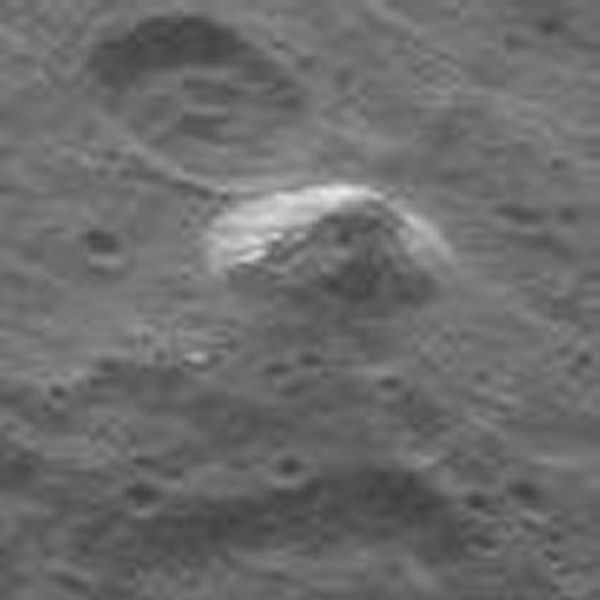
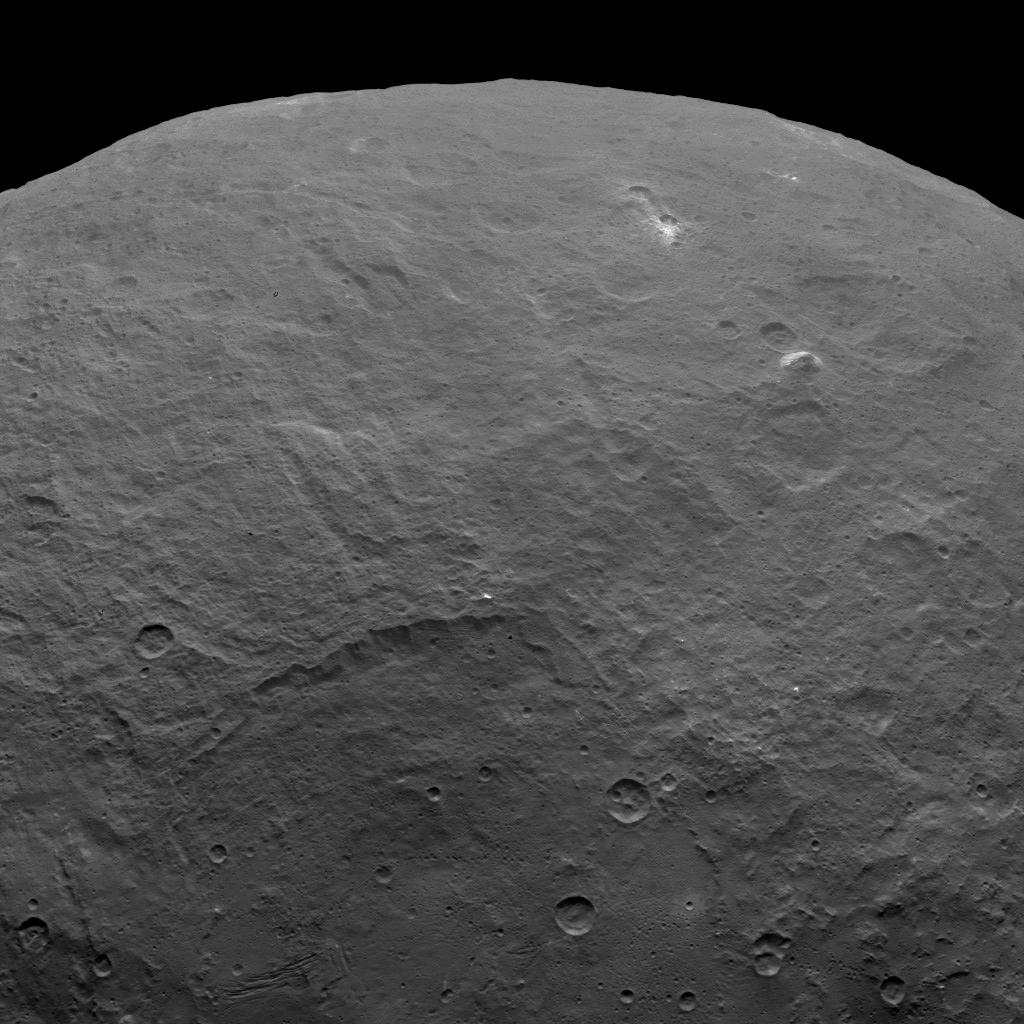
The pyramid-shaped mountain of Ceres is a large unnamed mountain on the dwarf planet Ceres. The mountain is unusual for its size and location on an otherwise relatively flat surface.

Discovery and description
The feature was first photographed by the Dawn spacecraft on 6 June 2015, with a wide-angle photo released 17 June 2015. The mountain is estimated to be about 5 km (16,000 ft; 3.1 mi) high;] and approximately 14.5 km (48,000 ft; 9.0 mi) wide at the base.

Hypotheses and speculations
The mountain has only been known to the general public as of June 17, 2015 and initial speculation has ranged widely. The tech website Cnet.com called the feature "an odd pyramid-shaped peak." NBC News's website commented on pictures of the mountain, noting Ceres' "intriguing features, including a steep-sided mountain that rises about 3 miles (5 kilometers) from the dwarf planet's heavily cratered surface and has been nicknamed the "pyramid." In contrast to the NBC report, the Washington Post referred to "a pyramid-shaped peak that towers three miles high over an otherwise fairly flat surface."

Size comparisons
The mountain is similar in base-to-peak height to Mons Huygens, the tallest lunar mountain, and Mons Hadley visited by Apollo 15. However, the relative size of the Moon, Earth, and the dwarf planet Ceres are a consideration.

Mount Everest rises to 8.8 km (29,000 ft) altitude above sea level but is only 4.6 km (15,000 ft) (base-to-peak). Africa's Mount Kilimanjaro is about 5.9 km (19,000 ft) altitude above sea level to the Uhuru Peak summit; also 4.6 km base-to-peak. Hawaii's Mauna Kea is about 9.3 km (31,000 ft) base-to-peak, but only 4.2 km (14,000 ft) of it is above sea level. Alaska's Mt. McKinley, also known as Denali, has a base-to-peak of 5.5 km (18,000 ft). Mont Blanc in the Alps is 4.8 km (16,000 ft) in altitude above sea level,[14] Mount Fuji (富士山), which overlooks Tokyo, Japan is about 3.8 km (12,000 ft) altitude.
http://photojournal.jpl.nasa.gov/catalog/PIA19574
PIA19574: Dawn Survey Orbit Image 6

 Target Name:  Ceres
 Is a satellite of:  Dwarf Planet
 Mission:  Dawn 
 Spacecraft:  Dawn
 Instrument:  Framing Camera 
 Product Size:  1024 x 1024 pixels (w x h) 
 Produced By:  JPL 
 Full-Res TIFF:  PIA19574.tif (1.05 MB)
 Full-Res JPEG:  PIA19574.jpg (136.3 kB)
Click image for larger version

Name:	PIA19574.jpg
Views:	401
Size:	133.1 KB
ID:	629747
Click image for larger version

Name:	PIA19574-Ceres-DwarfPlanet-Dawn-2ndMappingOrbit-image6-20150606-crop104.jpg
Views:	544
Size:	19.6 KB
ID:	629748

Original Caption Released with Image:
Among the fascinating features on dwarf planet Ceres is an intriguing pyramid-shaped mountain protruding from a relatively smooth area. Scientists estimate that this structure rises about 3 miles (5 kilometers) above the surface. NASA's Dawn spacecraft took this image from an altitude of 2,700 miles (4,400 kilometers). The image, with a resolution of 1,400 feet (410 meters) per pixel, was taken on June 6, 2015.

Dawn's mission is managed by JPL for NASA's Science Mission Directorate in Washington. Dawn is a project of the directorate's Discovery Program, managed by NASA's Marshall Space Flight Center in Huntsville, Alabama. UCLA is responsible for overall Dawn mission science. Orbital ATK, Inc., in Dulles, Virginia, designed and built the spacecraft. The German Aerospace Center, the Max Planck Institute for Solar System Research, the Italian Space Agency and the Italian National Astrophysical Institute are international partners on the mission team. For a complete list of acknowledgments, see http://dawn.jpl.nasa.gov/mission.

For more information about the Dawn mission, visit http://dawn.jpl.nasa.gov.


http://dawn.jpl.nasa.gov/
http://www.theweathernetwork.com/new...t-cloud/52920/
http://www.nbcnews.com/science/space...-spots-n379931
6 Users Say Thank You For This Post:
blaze915, commondenom, el_topo, hal0mega, myss)(phit, T2
▼ PROMO FROM DOCUMENTING REALITY
Not what you expected? Here You know.
Join Now
Hidden for upgraded members.
  #2  
08-09-2015, 09:10 PM
el_topo's Avatar
el_topo
Offline:
So Fucking Banned
Poster Rank:265
MAN
Join Date: Jul 2010
Posts: 5,143
 
Mentioned: 20 Post(s)
Quoted: 2832 Post(s)
Activity Longevity
0/20 16/20
Today Posts
0/11 sssss5143
Re: Pyramid-shaped Mountain on Ceres

Looks more like a hill than a pyramid, which has 4 flat sides and a square base.
This User Says Thank You For This Post:
Arkoquisa
  #3  
08-10-2015, 03:12 PM
commondenom's Avatar
commondenom
Offline:
puelling pueman
Poster Rank:171
m
Join Date: Apr 2010
Posts: 8,913
 
Mentioned: 21 Post(s)
Quoted: 2948 Post(s)
Activity Longevity
0/20 17/20
Today Posts
0/11 sssss8913
Re: Pyramid-shaped Mountain on Ceres

love the totally irregular shape of the horizon/edge of the ball


Powered by vBulletin Copyright 2000-2010 Jelsoft Enterprises Limited.

Search Engine Friendly URLs by vBSEO