|
Poland Once Sent the U.S. a Birthday Card.
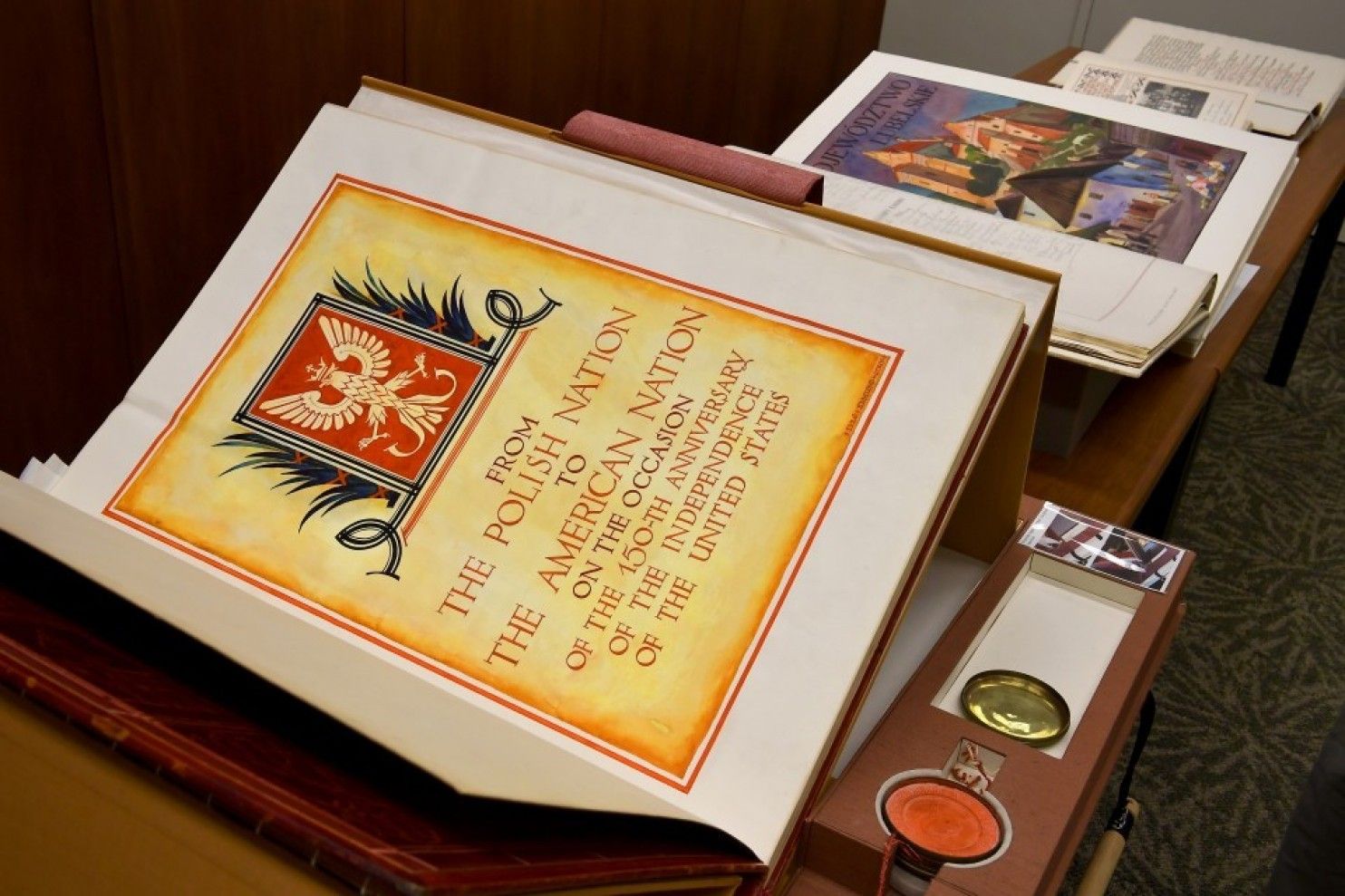
Poland once sent the U.S. a birthday card. With 5 million signatures.  On Oct. 14, 1926, a distinguished citizen of Poland named Leopold Kotnowski came to the White House with a greeting card for the United States’ 150th birthday.
It was a little late — the Sesquicentennial’s Fourth of July was months in the past — but it had taken a while to gather the signatures: 5.5 million of them.
Plus, there was the elegant, gilded artwork, the photographs, the poems, the pressed flowers, the salutes from the cycling clubs, skating clubs, banks, schoolchildren, medical and rowing societies, lute singers, journalists and the army.
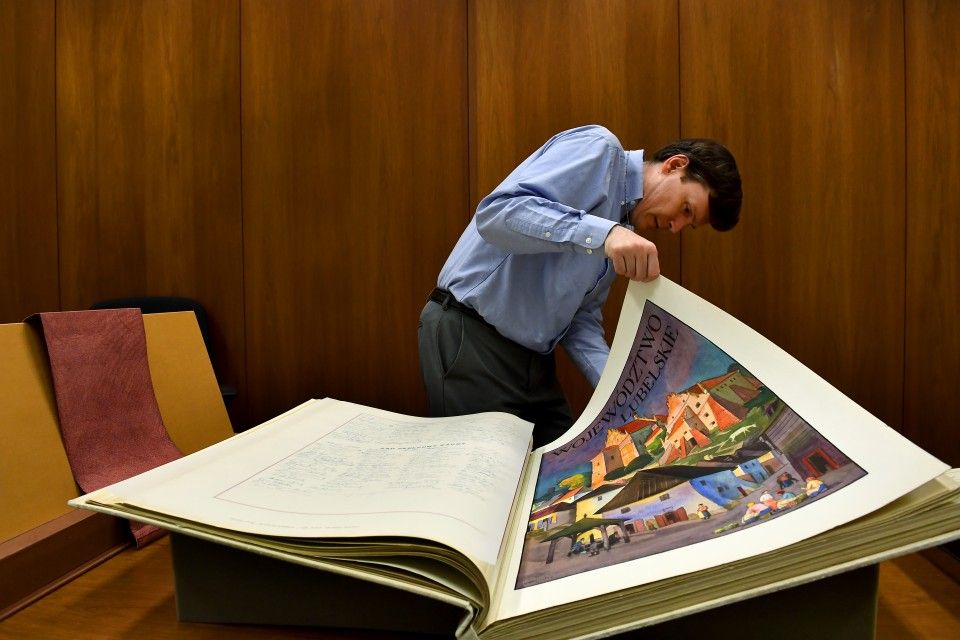
The good wishes came on 30,000 pages, in 111 bound volumes compiled by the people of Poland, newly independent following World War I, who wanted to express their affection for the United States.
The Library of Congress, which has had the volumes since 1926, announced Thursday that, in cooperation with the Polish Library of Washington and the Polish Embassy, all the books have now been digitized and are available online.
“It’s essentially a gigantic birthday card, signed by … almost a sixth of the population of Poland in 1926,” Sahr *Conway-Lanz, a manuscript historian at the library, said there last week. 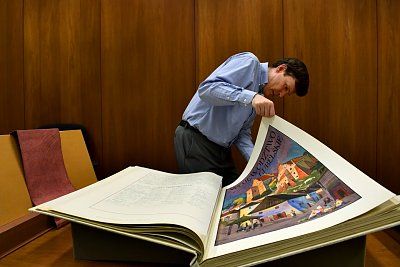 With recent polls showing the increasingly poor image of the United States overseas, “the Polish Declarations of Admiration and Friendship” serve as a reminder of better times.
The Poles thanked the United States for the good example it set, for its role in World War I, and for saving Poland’s children from famine and disease at the war’s end.
Kotnowski, in his Pince-nez glasses and Van **** beard, posed for photographs with President Calvin Coolidge, holding the first volume, outside the White House.
The dour Coolidge smiled.
“Noble Americans,” the Poles wrote, “your national holiday is sacred not for you alone. It finds a warm reverberation over the whole world.”
“We, the people of Poland, send to you, citizens of the great American union, fraternal greetings [and] . . . our deepest admiration . . . for the institutions which have been created by you.
“In them, Liberty, Equality and Justice have found their highest expression and have become the guiding stars for all modern democracies.”
“With eternal gratitude in our hearts,” the Poles declared, “we . . . desire . . . to wish your country and your nation all possible prosperity. . . . Long live the United States of America!”
At the end of World War I, Poland had just emerged from more than a century of domination under its powerful neighbors Russia, Germany and Austria-Hungary, *Conway-Lanz said.
Poland’s modern independence day is Nov. 11, 1918 — “Armistice Day,” which ended the war, he said.
Among President Woodrow Wilson’s famous Fourteen Points, which suggested a framework for postwar peace, point 13 called for an independent Poland.
But the war had also left Poland, and much of Europe, in a state of famine and destitution.
The United States responded with the American Relief Administration, headed by future president Herbert Hoover.
“During and after World War I, Hoover directed the largest relief operation ever mounted in Europe,” saving millions from starvation, according to the Hoover Institution at Stanford University.
Train loads of food were shipped to Poland in 1919, the institution says. And half a billion meals were given to country’s hungry in the years after the war.
The Poles did not forget.
Seven years later, still bracketed by unstable neighbors Germany and the Soviet Union — who would soon pounce again — Poland was eager to celebrate the American Sesquicentennial.
It was a heartfelt gesture. “Poles have always been crazy about America,” said library reference specialist Regina Frackowiak.
It was also a wise “example of cultural diplomacy,” Conway-Lanz said.
A committee to mark “4 Lipca,” the Fourth of July, was formed, and Kotnowski, president of the Poland’s American-Polish Chamber of Commerce and Industry, was appointed to head it.
The committee quickly came up with the idea for the declarations.
The dedication was composed by writer and patriot Zdzislaw Debicki. Special blank pages were printed up and circulated throughout the country, to be signed and mailed back. They were bound into the books later, Frackowiak said.
The project took off.
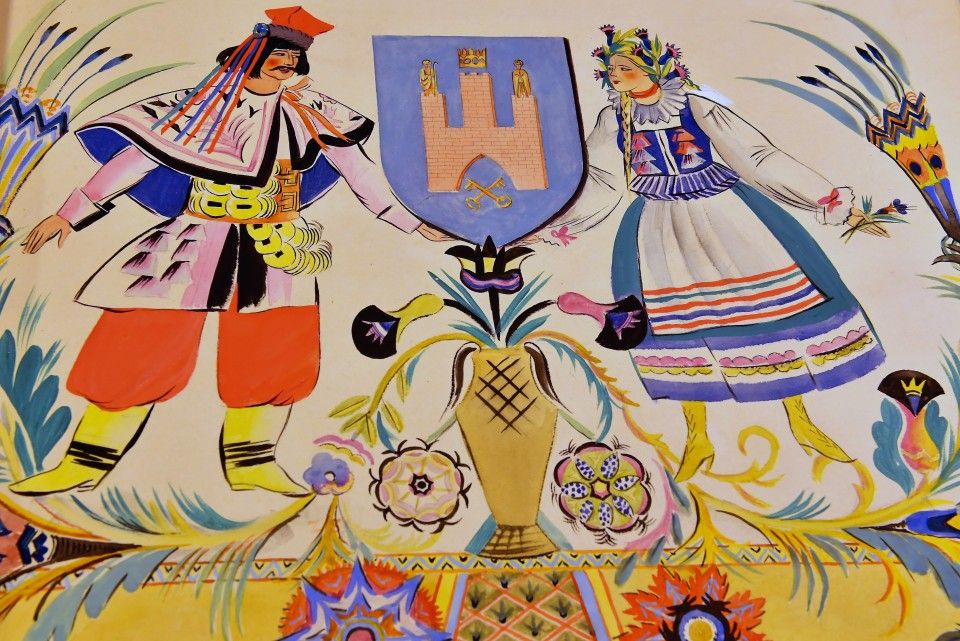
Famous Polish artists contributed exquisite images. 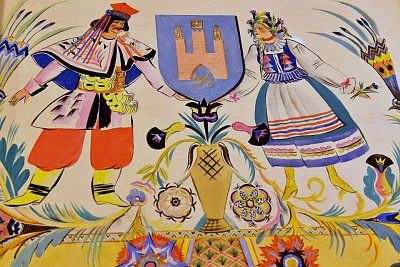 Ludomir Slendzinski used gold paint in his image of two women — one in red, the other in blue — flanking the Bialystok district coat of arms.
Warsaw’s Association of Physicians included a drawing of the majestic King Sigismund’s Column, which was later destroyed by the Nazis during World War II.
And Warsaw’s Lute Singing Club included music and lyrics from the prominent Polish composer and teacher Zygmunt Noskowski: “For you my brothers, for you brothers, I sing and play, I sing and play.”
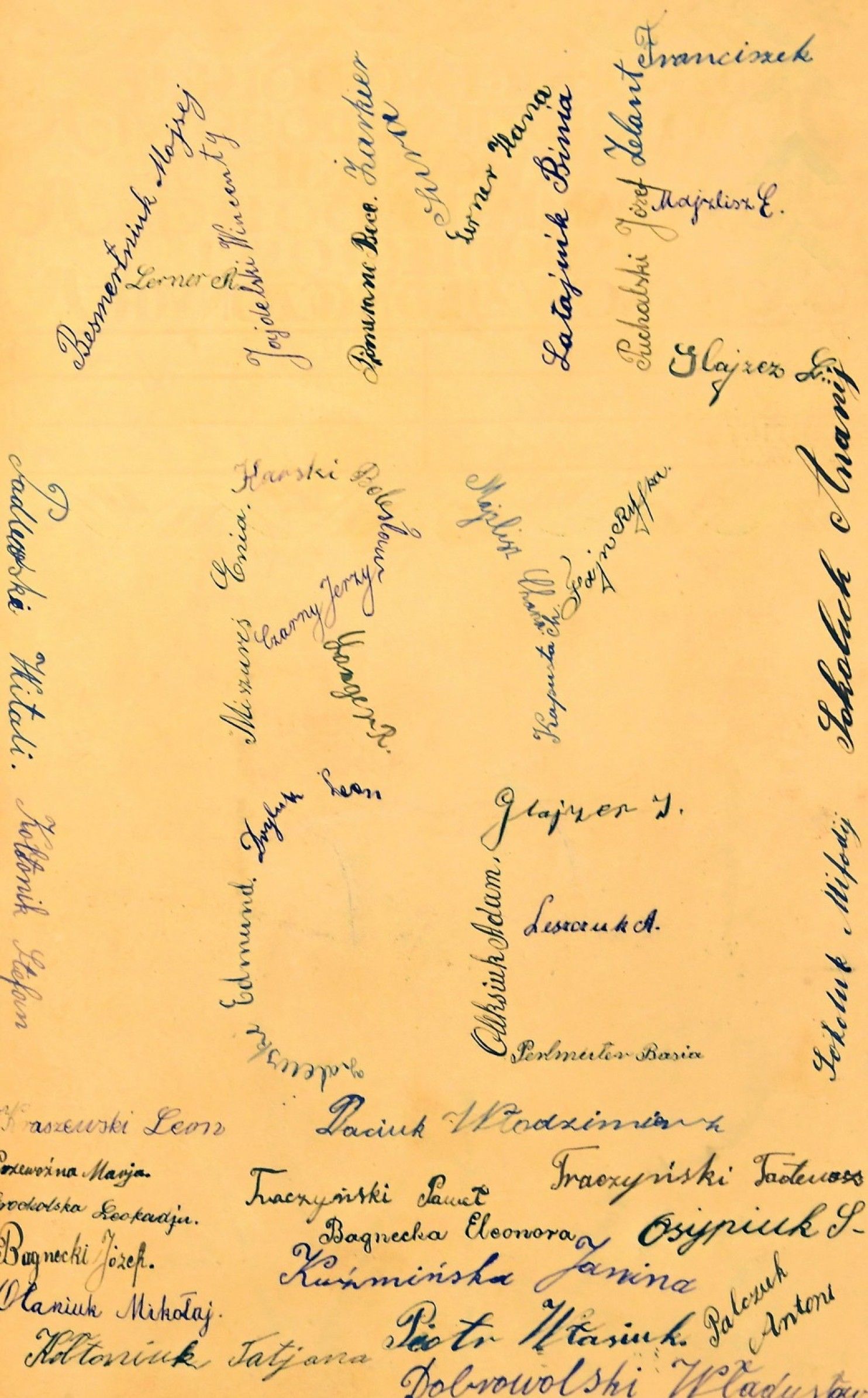
Then there are the signatures. Some were dashed off by top officials. Many others are in the meticulous handwriting of schoolchildren. 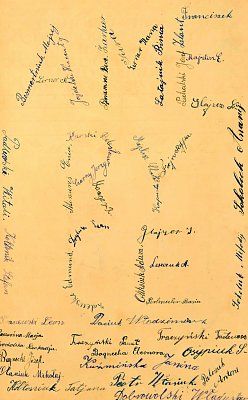 Students from the public school in Wielki Klincz, in northern Poland, sent pressed flowers and a school picture — the girls with ribbons in their hair, the boys with buzz cuts — along with their signatures.
Anna Malinowska, Gertruda Rekonska, Franciszek Gostkowski and 28 other children wrote their names in black ink.
Such signatures provide, in a way, a “demographic snapshot of Poland in 1926,” Conway-Lanz said.
Many of the names are likely those of the almost 6 million Polish citizens, including 3 million Jews, killed during World War II, the library said.
Another school in northern Poland sent students’ signatures along with a drawing in pencil.
It seems to depict a destitute-looking family pausing for a meal under a tree. Children reach for food that a woman is preparing. There’s a ruined, smoldering building in the background.
The caption reads: “Bóg zesłał nam pomoc z Ameryki”
God has sent us help from America! Source ... |