JavaScript and Cookies are required to view this site. Please enable both in your browser settings.
Video 2: The Harvard Monolithic Bee undergoing pop-up 3D assembly. Video 3: A demonstration of pop-up assembly of an icosahedron (20 sided polygon). The device is fabricated flat but assumes a nearly spherical shape, potentially useful for omnidirectional sensing. Photo 1: The Harvard Monolithic Bee (or "Mobee") pops up within an assembly scaffold, which performs more than 20 origami assembly folds. Photos courtesy of Pratheev Sreetharan. Photo 2: A close-up view of part of a pop-up microrobot, showing the device's transmission. Each flat section comprises up to 18 layers of material. Photo courtesy of Pratheev Sreetharan. Photo 3: A small portion of the CAD design for the Harvard Monolithic Bee illustrates the complexity of folds and joints necessary for its assembly. Using the old, manual process, every one of those parts would have to be cut, folded, assembled, and glued by hand. The bottom image illustrates the 18 layers of laser-cut materials that create the pop-up structure. Images courtesy of Pratheev Sreetharan." /> Video 2: The Harvard Monolithic Bee undergoing pop-up 3D assembly. Video 3: A demonstration of pop-up assembly of an icosahedron (20 sided polygon). The device is fabricated flat but assumes a nearly spherical shape, potentially useful for omnidirectional sensing. Photo 1: The Harvard Monolithic Bee (or "Mobee") pops up within an assembly scaffold, which performs more than 20 origami assembly folds. Photos courtesy of Pratheev Sreetharan. Photo 2: A close-up view of part of a pop-up microrobot, showing the device's transmission. Each flat section comprises up to 18 layers of material. Photo courtesy of Pratheev Sreetharan. Photo 3: A small portion of the CAD design for the Harvard Monolithic Bee illustrates the complexity of folds and joints necessary for its assembly. Using the old, manual process, every one of those parts would have to be cut, folded, assembled, and glued by hand. The bottom image illustrates the 18 layers of laser-cut materials that create the pop-up structure. Images courtesy of Pratheev Sreetharan." /> New Mass-production Technique, Robotic Insects Spring to Life
Documenting Reality True Crime Related Chat & Research Interesting People, Places, Things, Animals New Mass-production Technique, Robotic Insects Spring to Life

New Mass-production Technique, Robotic Insects Spring to Life 

Current Rating:

Unlimited Views No Ads No Algorithms Lifetime Account

Documenting Reality

Community Forum · Est. 2006

Join Now
Thread Tools
  #1  
02-17-2012, 04:10 AM
GODREKR's Avatar
GODREKR
Offline:
✖ The Antique Christ ✖
Poster Rank:105
Gonzo Punk
Join Date: Jan 2009
Posts: 15,488
Contributions: 58
 
Mentioned: 23 Post(s)
Quoted: 2046 Post(s)
Activity Longevity
0/20 18/20
Today Posts
0/11 ssss15488
New Mass-production Technique, Robotic Insects Spring to Life

Production method inspired by children's pop-up books enables rapid fabrication of tiny, complex devices. Read full article at the Harvard website HERE.

Video 1: The Harvard Monolithic Bee is a millimeter-scale flapping wing robotic insect produced using Printed Circuit MEMS (PC-MEMS) techniques. This video describes the manufacturing process, including pop-up book inspired assembly. This work was funded by the NSF, the Wyss Institute, and the ASEE.
<iframe width="853" height="480" src="http://www.youtube.com/embed/VxSs1kGZQqc" frameborder="0" allowfullscreen></iframe>

Video 2: The Harvard Monolithic Bee undergoing pop-up 3D assembly.
<iframe width="853" height="480" src="http://www.youtube.com/embed/PqUOOf-1SSU" frameborder="0" allowfullscreen></iframe>

Video 3: A demonstration of pop-up assembly of an icosahedron (20 sided polygon). The device is fabricated flat but assumes a nearly spherical shape, potentially useful for omnidirectional sensing.
<iframe width="640" height="480" src="http://www.youtube.com/embed/cUu9lQV0XBE" frameborder="0" allowfullscreen></iframe>


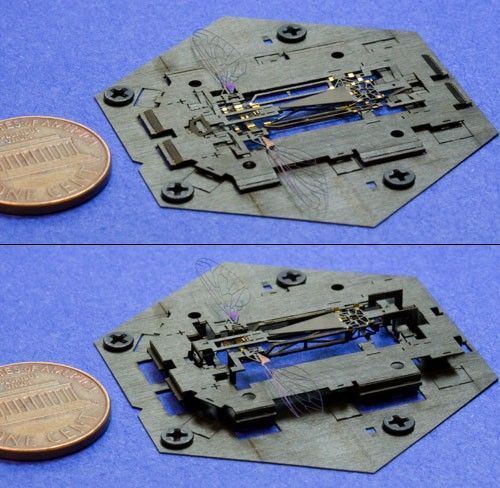
Photo 1: The Harvard Monolithic Bee (or "Mobee") pops up within an assembly scaffold, which performs more than 20 origami assembly folds. Photos courtesy of Pratheev Sreetharan.

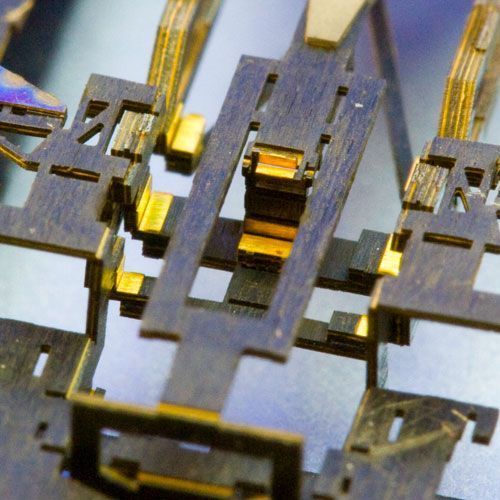
Photo 2: A close-up view of part of a pop-up microrobot, showing the device's transmission. Each flat section comprises up to 18 layers of material. Photo courtesy of Pratheev Sreetharan.

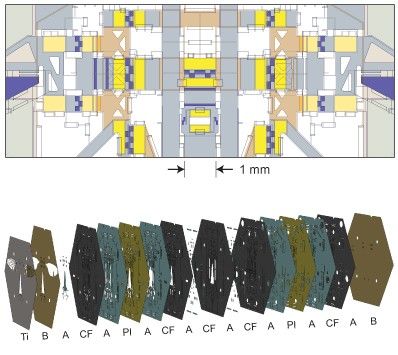
Photo 3: A small portion of the CAD design for the Harvard Monolithic Bee illustrates the complexity of folds and joints necessary for its assembly. Using the old, manual process, every one of those parts would have to be cut, folded, assembled, and glued by hand. The bottom image illustrates the 18 layers of laser-cut materials that create the pop-up structure. Images courtesy of Pratheev Sreetharan.
image_large.jpg
80.7 KB ·2156 views
imageCAM5U8AU.jpg
63.3 KB ·120 views
image_large2.jpg
43.5 KB ·222 views
▼ PROMO FROM DOCUMENTING REALITY
Want a better bang for your buck?
Join Now
Hidden for upgraded members.
  #2  
02-17-2012, 04:12 AM
GODREKR's Avatar
GODREKR
Offline:
✖ The Antique Christ ✖
Poster Rank:105
Gonzo Punk
Join Date: Jan 2009
Posts: 15,488
Contributions: 58
 
Mentioned: 23 Post(s)
Quoted: 2046 Post(s)
Activity Longevity
0/20 18/20
Today Posts
0/11 ssss15488
Re: New Mass-production Technique, Robotic Insects Spring to Life

<iframe width="853" height="480" src="http://www.youtube.com/embed/GgR-mH6X5VU" frameborder="0" allowfullscreen></iframe>

A prototype of "RoboBee", a project funded by the National Science Foundation to build a fully-functional, insect-sized robotic bee capable of autonomous flight. This video shows a series of early, uncontrolled takeoff tests proving that the vehicle can generate enough lift to overcome its own weight; however no stability control is implemented.

The Harvard Microrobotics Lab is part of the Harvard School of Engineering and Applied Sciences and the Wyss Institute for Biologically Inspired Engineering. For more information, see the following websites:

micro.seas.harvard.edu
seas.harvard.edu
wyss.harvard.edu
  #3  
02-17-2012, 05:06 AM
Blewvane's Avatar
Blewvane
Offline:
Benevolent dictator
Poster Rank:57
Arse fucker
Join Date: May 2009
Posts: 25,643
 
Mentioned: 17 Post(s)
Quoted: 1450 Post(s)
Activity Longevity
0/20 18/20
Today Posts
0/11 ssss25643
Re: New Mass-production Technique, Robotic Insects Spring to Life

...........needs missiles.
  #4  
02-17-2012, 06:59 PM
GODREKR's Avatar
GODREKR
Offline:
✖ The Antique Christ ✖
Poster Rank:105
Gonzo Punk
Join Date: Jan 2009
Posts: 15,488
Contributions: 58
 
Mentioned: 23 Post(s)
Quoted: 2046 Post(s)
Activity Longevity
0/20 18/20
Today Posts
0/11 ssss15488
Re: New Mass-production Technique, Robotic Insects Spring to Life

I'm surprised you didn't say it needed a beer holder too.
  #5  
02-18-2012, 06:52 AM
Blewvane's Avatar
Blewvane
Offline:
Benevolent dictator
Poster Rank:57
Arse fucker
Join Date: May 2009
Posts: 25,643
 
Mentioned: 17 Post(s)
Quoted: 1450 Post(s)
Activity Longevity
0/20 18/20
Today Posts
0/11 ssss25643
Re: New Mass-production Technique, Robotic Insects Spring to Life

...........an ashtray would be usefull.
Documenting Reality True Crime Related Chat & Research Interesting People, Places, Things, Animals New Mass-production Technique, Robotic Insects Spring to Life


Powered by vBulletin Copyright 2000-2010 Jelsoft Enterprises Limited.

Search Engine Friendly URLs by vBSEO