JavaScript and Cookies are required to view this site. Please enable both in your browser settings.
National Geographic: Best Astronomy Pictures of 2012

National Geographic: Best Astronomy Pictures of 2012 

Current Rating:

Unlimited Views No Ads No Algorithms Lifetime Account

Documenting Reality

Community Forum · Est. 2006

Join Now
Thread Tools
  #1  
09-28-2012, 01:48 PM
Kanda444's Avatar
Kanda444
Offline:
You holdin....?
Poster Rank:21
Join Date: May 2010
Posts: 58,107
Contributions: 23
 
Mentioned: 263 Post(s)
Quoted: 25273 Post(s)
Activity Longevity
0/20 17/20
Today Posts
0/11 ssss58107
National Geographic: Best Astronomy Pictures of 2012

National Geographic: Best Astronomy Pictures of 2012

Enjoy!!


Whirlpool Galaxy
Photograph courtesy Martin Pugh, APOY/Royal Observatory

This penetrating look at the Whirlpool Galaxy won Australia's Martin Pugh top prize in the 2012 Astronomy Photographer of the Year competition.

The contest, run by the U.K.'s Royal Observatory Greenwich, drew nearly 850 entries this year from around the world.

Here, a spiral arm of the Whirlpool Galaxy grazes the light of a smaller companion galaxy that's slowly being torn apart by its neighbor's gravity.

The galaxies—some 20 million light-years away—are too faint and distant for the human eye to register their hues. But this long photographic exposure allows us to appreciate their colorful nature, said Marek Kukula, the Royal Observatory's public astronomer and a contest judge. Young stars appear blue, he explained, and hydrogen gas in the spiral arms varies from pink to reddish.

Pugh's picture impressed judges with its depth, clarity, and color.

"It's not just the detail in the spiral arms that's remarkable," said judge Will Gater. "Look closely and you'll see many, very distant galaxies in the background too."

The winning pictures in the competition's four categories are on view at the Royal Observatory through February 2013.

—Luna Shyr


Aurora Over Norway
Photograph courtesy Arild Heitmann, APOY/Royal Observatory

In Norway's Nordland Fylke, the aurora borealis lights up a midwinter sky.

The colorful phenomenon, also known as the northern lights, occurs when gusts of solar wind hit the Earth's magnetic field.

Fast-moving electrons collide with oxygen and nitrogen in the Earth's upper atmosphere, unleashing light whose color depends on the type of gas. Oxygen emits red or greenish-yellow light—nitrogen usually appears blue.

Photographer Arild Heitmann, a runner-up in the Earth and Space picture category, said, "This shot captures for me the intense feeling of standing deep in the mountains, far away from light pollution, and watching the finest light show on the planet."


Star Fields
Photograph courtesy Tunç Tezel, APOY/Royal Observatory

One August evening, photographer Tunç Tezel trekked to Uludag National Park near his hometown of Bursa, Turkey. He intended to watch the moon and evening planets, then take in the Perseids meteor shower.

He came away with this image of the Milky Way's vast star fields hanging over a valley of human-made light.

"We live in a spiral arm of the Milky Way, so when we gaze through the thickness of our galaxy, we see it as a band of dense star fields encircling the sky," said Kukula, the Royal Observatory's public astronomer.

"The galaxy's central region contains a vast bulge of ancient stars, so when we look in this direction, the Milky Way band appears to swell and thicken."


Witch's Broom
Photograph courtesy Robert Franke, APOY/Royal Observatory

This image of a supernova remnant called the Witch's Broom received high commendation in the Deep Space category.

Taken by American Robert Franke, it shows scattering debris from a Milky Way star that exploded several thousand years ago. These cosmic filaments are part of the Veil Nebula, one of the largest supernova remnants in the sky. It lies some 1,400 light-years away in the constellation Cygnus.

Franke noted that narrowband filters greatly increased the detail in his image while giving a reasonable representation of the nebula's color.


Milky Way Reflections
Photograph courtesy Luc Perrot, APOY/Royal Observatory

It took two years of waiting before conditions were right for Luc Perrot to create this image of Piton de l'Eau, a volcanic crater lake on Réunion Island (map), a part of France.

He needed clear, cloudless skies; stable atmospheric conditions; and an absence of wind to keep the surface of the lake mirror-smooth.

The Milky Way arches over the lake, making the site seem even more otherworldly.

At center in the distance stands Piton des Neiges, Réunion's highest peak at more than 10,000 feet (3,000 meters).

This picture was highly commended in the Earth and Space category.
0


Venus Transit
Photograph courtesy Paul Haese, APOY/Royal Observatory

One of the biggest astronomical events of 2012 occurred in June, when Venus passed directly between the Earth and sun, inspiring photographers around the world. The transit phenomenon won't happen again until 2117.

Here, Venus appears like a dark speck against the blotched face of the sun.

"I remember this particular morning quite well," said Paul Haese, an Australian whose photograph was highly commended in the Our Solar System category.

"I went out to observe the sun and saw this massive prominence. I just had to image it."

A solar prominence is a large projection from the sun's surface. Each one can loop hundreds of thousands of miles into space. Haese's photo captures the barefaced sun, streaked and spotted with filaments, sunspots, and prominences.


Spaghetti Nebula
Photograph courtesy Rogelio Bernal Andreo, APOY/Royal Observatory

Between the constellations of Auriga and Taurus lies Simeis 147, a vast supernova remnant nicknamed the Spaghetti Nebula.

It consists of debris from a star that exploded around 40,000 years ago. As the wreckage spreads apart, it collides with dust and gas between stars, creating the spaghetti strands we see here.

Kukula called this a "true color" image in which "the photographer is trying to be faithful to the wavelengths of light being emitted." Hydrogen gas gives out red light, which can be brought out through a long telescope exposure, then digitally processed and enhanced.

Said photographer Rogelio Bernal Andreo, a runner-up in the Deep Space category: "Most images I've seen of [Simeis 147] deprive us from viewing the many other things happening around it. My goal was producing an image that documents not only the main object but also what's around it."


Eyes to the Heavens
Photograph courtesy Laurent Laveder, APOY/Royal Observatory

This nightscape featuring the conjunction of Venus and Jupiter took top prize in the People and Space category.

Though millions of miles apart, the two planets make photogenic partners above a beach in northwestern France. Venus appears brighter because of its proximity to Earth and the sun. And although Jupiter is much bigger, it appears smaller than Venus because it was roughly ten times farther away that evening.

"Both planets are very bright because they're covered in clouds, which reflect sunlight," Kukula noted. "They're not exactly like clouds on Earth, but similar."

French photographer Laurent Laveder appears in the bottom corner of the picture.

"I took my place in the corner of the frame to complete the diagonal formed by me, the two planets, and the Pleiades and Taurus in the upper left," he said. The surreal glow on the beach? A red flashlight on his head created it.


Desert Sky
Photograph courtesy Thomas Sullivan, APOY/Royal Observatory

Thirteen-year-old Thomas Sullivan produced this vision of ancient land and sky in California—and was highly commended in the category of Young Astronomy Photographer.

Accompanied by his father, Sullivan captured a gnarled bristlecone pine—more than 4,000 years old—tilting in alignment with the central bulge of the Milky Way galaxy.

"My dad, sister, and I drove a thousand miles [1,600 kilometers] to take cool astronomy photos," said Sullivan, who titled this one "Origins of Life on Earth."

Contest judge Marek Kukula noted that astrophotographers sometimes shine a light toward the end of a long exposure. That lets them bring out the foreground without affecting how the sky looks.

In this case, Sullivan's father happened to be nearby, preparing to take a picture with his own camera. His flashlight provided the finishing effect.

Seven Sisters
Photograph courtesy Jacob von Chorus, APOY/Royal Observatory

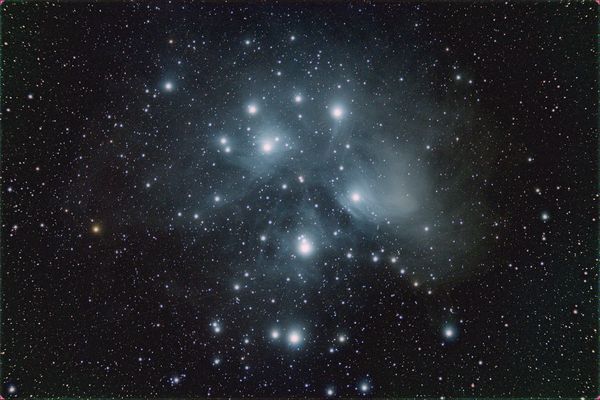
Twinkle, twinkle, little stars: The bright lights of the Pleiades, often called the Seven Sisters, dazzle in this closeup taken by 15-year-old Jacob von Chorus of Canada, who took top honors in the category of Young Astronomy Photography.

"It was taken near dusk, with only two frames and an hour of exposure," said the teenager. "The image was a test to see what would happen with such a long exposure."

This shot reveals many of the hot, young stars that make up the Pleiades cluster, beyond the brightest ones that are normally visible to the naked eye during winter in the Northern Hemisphere.

Swirling wisps of a bluish gas cloud, which the cluster is passing through, are also visible in the picture.
best-astro-photographs-space-pictures-2012-pleiades_59490_600x450.jpg
50.3 KB ·301 views
4 Users Say Thank You For This Post:
Arsedestroyer, ernyzaz, rabenson, wickedminds1
▼ PROMO FROM DOCUMENTING REALITY
Not everything online is real. We are
Join Now
Hidden for upgraded members.
  #2  
09-28-2012, 01:54 PM
Kanda444's Avatar
Kanda444
Offline:
You holdin....?
Poster Rank:21
Join Date: May 2010
Posts: 58,107
Contributions: 23
 
Mentioned: 263 Post(s)
Quoted: 25273 Post(s)
Activity Longevity
0/20 17/20
Today Posts
0/11 ssss58107
Re: National Geographic: Best Astronomy Pictures of 2012

National Geographic Pictures: Best Amateur Astronomy Images Announced


Diamond in the Rough
Image courtesy Igor Chekalin via ESO

The Orion Nebula comes alive with color in 1 of 20 recently announced winning shots in the European Southern Observatory's Hidden Treasures 2010 astrophotography contest.

The competition called for the public to troll through terabytes of raw image data collected by ESO's professional observatories and process it into something artistic and scientifically valuable.

Ten people submitted the 20 highest ranked shots, which were chosen based on "the quality of the data processing, the originality of the image, and the overall aesthetic feel," according to an ESO statement.

The Orion Nebula, a huge cloud of gas and dust that's actively forming stars, is one of the most studied and photographed celestial objects. Russian amateur astronomer Igor Chekalin decided to process this image to emphasize the relatively cool dust, which reflects starlight, rather than the hot hydrogen gas, which emits its own light. (See a high-resolution Hubble picture of Orion.)

Chekalin first identified a series of grayscale images archived from ESO's 2.2-meter telescope in La Silla, Chile. Then he painstakingly stitched together and digitally processed the images to pull out structural details in the nebula.

"Normally our team of professional image processors searches this archive and identifies data sets that could be interesting for the public," said ESO public outreach officer Oana Sandu. "This time, however, we decided to give astronomy and photography enthusiasts the opportunity to try their skills and show the world what they can do."

—Andrew Fazekas


Neon Crown
Image courtesy Sergey Stepanenko via ESO

A kaleidoscope of neon swirls decorates the nebula known as NGC 6729 in another winning picture from the ESO contest, processed by Ukrainian armchair astronomer Sergey Stepanenko. The raw data came from a now decommissioned spectrograph used by the Very Large Telescope in Chile.

Hidden deep in the constellation Corona Australis ("southern crown"), this star incubator glows because its gases are being charged by powerful radiation from the newborn stars inside. Even though NGC 6729 lies just 424 light-years from Earth—making it one of the nearest star-forming regions in the Milky Way galaxy—the nebula remains one of the least studied.

Astronomers can bring out certain structural details in a nebula by using a set of special narrow-band filters on telescope cameras. But in a given image, the filters highlight some structures while masking others—which can pose problems when trying to reassemble a true likeness of the ghostly celestial object.

"The NGC 6729 nebula is based on a very original data set, containing only narrow-band filter images, which are challenging to work with," ESO's Sandu said. "While the data processing was simpler than for the Orion image, assembling data obtained only through these filters is not simple. But Sergey did a great job."


Cratered Crescent
Image courtesy Andy Strappazzon via ESO

Although ESO collected almost a hundred entries during the Hidden Treasures contest, this winning picture of a crescent moon was the only submission featuring a solar system body.

The bane of most professional astronomers, the moon is often avoided because its bright glare blocks out views of more distant—and thus fainter—objects.

Andy Strappazzon from Belgium used raw data from a wide-field imager attached to the 2.2-meter telescope in Chile to assemble the complex and detailed mosaic of the cratered surface of Earth's only natural satellite. (See the first high-resolution pictures of the moon from NASA's Lunar Reconnaissance Orbiter.)

"We appreciated he looked for images of the moon, which are uncommon in our archive and which are very often overlooked," ESO's Sandu said.


Loops of Light
Image courtesy Joseph DePasquale via ESO

A mushrooming cloud of hydrogen gas—lighted up by dozens of young stars huddled near the cloud's center—spreads into interstellar space in this prize-winning picture of the nebula NGC 3582. The raw data came from the 2.2-meter La Silla telescope.

Like the contest's other cosmic artisans, Joe DePasquale of the United States had his work cut out dealing with optical distortions and digital blemishes scattered throughout the original data sets. Many raw images taken by even the largest telescopes contain such artifacts, which are caused by the instruments and so don't reflect the true natures of the featured objects.

Certain photo-processing techniques are required to correct the raw data, including using some reference and calibration images acquired before or after the desired image is snapped.

"These steps are delicate, as applying the wrong correction will result in an image that will have a very uneven background, stripes, lines, and other incorrect—and ugly—results," Sandu said


Goblin Grin
Image courtesy Manuel Mejias via ESO

Looking like a ghoulish Halloween mask in this winning photo, the so-called N44 superbubble shines in vibrant color thanks to Manuel Mejas from Argentina, who processed raw data from the Very Large Telescope to create the scene.

The superbubble is a nebula complex 160,000 light-years away in the Large Magellanic Cloud, a satellite galaxy of the Milky Way. The bubble itself measures about 325 light-years across. Astronomers suspect the bubble was carved by fast stellar winds blown by a central cluster of stars. Additional star formation is thought to be triggered by the expanding gas shells of superbubbles such as this one.


Star Nest
Image courtesy Josh Barrington via ESO

Josh Barrington of the United States managed to render a hauntingly beautiful, prize-winning view of a distant cousin of the Orion Nebula, the star-forming nebula NGC 2467. Like a cosmic nest of stellar chicks, this cloud of dust and gas hides a cluster of newborn stars from direct view.

Barrington found the raw data—of an object 13,000 light-years from Earth—among images captured by a wide-field camera attached to the 2.2-meter La Silla telescope.

"The participants certainly exceed all our expectations," Sandu said. "This was not a competition for the faint-hearted, and entrants had to prove both knowledge of data processing and an artistic eye. We were pleasantly surprised to see so many talented people and, what's more, to discover that many of them learned to achieve such great results along the way."
7 Users Say Thank You For This Post:
Arsedestroyer, chefbob09, Darkest Angel, kankpace, rabenson, Sharon, thenamesdick
  #3  
09-28-2012, 03:42 PM
Sharon's Avatar
Sharon
Offline:
♚ Legacy Gold Member ♚
Poster Rank:34
Female
Join Date: Nov 2008
Posts: 43,403
Contributions: 204
 
Mentioned: 95 Post(s)
Quoted: 2281 Post(s)
Activity Longevity
0/20 18/20
Today Posts
0/11 ssss43403
Re: National Geographic: Best Astronomy Pictures of 2012

Wow, what an amazing set of images! Simply OUT OF THIS WORLD
This User Says Thank You For This Post:
Kanda444
  #4  
09-28-2012, 03:45 PM
Sharon's Avatar
Sharon
Offline:
♚ Legacy Gold Member ♚
Poster Rank:34
Female
Join Date: Nov 2008
Posts: 43,403
Contributions: 204
 
Mentioned: 95 Post(s)
Quoted: 2281 Post(s)
Activity Longevity
0/20 18/20
Today Posts
0/11 ssss43403
Re: National Geographic: Best Astronomy Pictures of 2012

Aurora Over Norway is my favourite Being wrapped up all warm and cosy just watching it in the flesh would be an amazing, romantic experience. Plenty North Face clothing required!
2 Users Say Thank You For This Post:
Kanda444, WhiteWidow00
  #5  
09-28-2012, 03:56 PM
Kanda444's Avatar
Kanda444
Offline:
You holdin....?
Poster Rank:21
Join Date: May 2010
Posts: 58,107
Contributions: 23
 
Mentioned: 263 Post(s)
Quoted: 25273 Post(s)
Activity Longevity
0/20 17/20
Today Posts
0/11 ssss58107
Re: National Geographic: Best Astronomy Pictures of 2012

Aurora Over Norway is my favourite Being wrapped up all warm and cosy just watching it in the flesh would be an amazing, romantic experience. Plenty North Face clothing required!
that would be AMAZING!!! i've seen them a few times out here but not since i was a kid and no where near that stunning!!! they were super lame by comparison, actually.
This User Says Thank You For This Post:
Sharon
  #6  
09-28-2012, 06:19 PM
ernyzaz's Avatar
ernyzaz
Offline:
My Rank: CORPORAL
Poster Rank:1621
Join Date: May 2010
Posts: 340
 
Mentioned: 0 Post(s)
Quoted: 0 Post(s)
Activity Longevity
0/20 17/20
Today Posts
0/11 ssssss340
Re: National Geographic: Best Astronomy Pictures of 2012

wow amazing, star fields is my fav. Good job posting this man
This User Says Thank You For This Post:
Kanda444
  #7  
09-28-2012, 08:44 PM
Darkest Angel's Avatar
Darkest Angel
Offline:
Born in the USA
Poster Rank:123
100% female
Join Date: Jul 2012
Posts: 12,876
Contributions: 1
 
Mentioned: 81 Post(s)
Quoted: 1799 Post(s)
Activity Longevity
0/20 14/20
Today Posts
0/11 ssss12876
Re: National Geographic: Best Astronomy Pictures of 2012

absolutely fantabulous!!
This User Says Thank You For This Post:
Kanda444
  #8  
09-29-2012, 12:36 PM
Sharon's Avatar
Sharon
Offline:
♚ Legacy Gold Member ♚
Poster Rank:34
Female
Join Date: Nov 2008
Posts: 43,403
Contributions: 204
 
Mentioned: 95 Post(s)
Quoted: 2281 Post(s)
Activity Longevity
0/20 18/20
Today Posts
0/11 ssss43403
Re: National Geographic: Best Astronomy Pictures of 2012

i've seen them a few times out here but not since i was a kid and no where near that stunning!!! they were super lame by comparison, actually.
Wow!! You're very lucky to have seen even lame ones

The coolest thing I've seen was the solar eclipse. I worked in a hospital at the time and we used patients' x-rays to safely look at it. We weren't daft enough to pay for the silly glasses!


Powered by vBulletin Copyright 2000-2010 Jelsoft Enterprises Limited.

Search Engine Friendly URLs by vBSEO